Social marketing communications Dr Stephen Dann
Introduction To be able to evaluate the effectiveness of social marketing communications first you need to understand what element of the social marketing framework the communication is addressing plus what stage of the behaviour change process is being targeted Also of importance is the extent to which the communication clearly shows that the campaign has adopted a “client” rather than organisation centred approach
Overview Marketing and social marketing  Behavioural change model Targeting communication strategies within the social marketing framework Common styles of message Freedom from Fear  Case Study
Definitions 1985 - Marketing : the process of planning and executing the conception, pricing, promotion and distribution of ideas, goods and services to create exchanges that satisfy individual and organisational needs. 2004  - Marketing:  an organizational function and a set of processes for creating, communicating and delivering value to customers and for managing customer relationships in ways that benefit the organization and its stakeholders.  (AMA 2004).
Social Marketing Social marketing : the adaptation of commercial marketing technologies to create programs designed to influence the voluntary behaviour of target audiences to improve their personal welfare and that of the society of which they are a part.
Framework of managerial marketing Client centred Research and evidence driven Aims to achieve mutually beneficial exchanges Adapts to external environments Implemented through the “marketing mix”
Framework of social marketing Social marketing uses and modifies managerial marketing Client focussed in the design of campaigns Social marketing’s “bottom line” is  voluntary  behavioural change Socially beneficial outcomes are subjective
Some characteristics of social marketing Level and extent of public scrutiny Extravagant expectations Targeted at non existent or negative demand Target unresponsive audiences Focus on sensitive issues Behaviours often have invisible, delayed or non guaranteed benefits
Social marketing and behaviour change
Behaviour change model Targets adopt the alternative behaviour long term as their “normal” behaviour Maintenance Targets trial the alternate behaviour Action Targets determine what they need to know or do to change their behaviour  Preparation Targets become aware of the issue and start to consider it in light of their lives Contemplation Potential targets are unaware of issue Pre contemplation Characteristics Stage
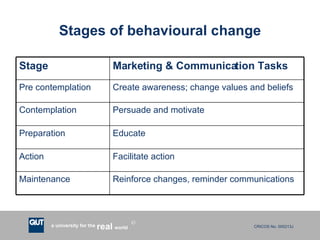
Stages of behavioural change Reinforce changes, reminder communications Maintenance Facilitate action Action Educate  Preparation Persuade and motivate Contemplation Create awareness; change values and beliefs Pre contemplation Marketing & Communication Tasks Stage
Marketing mix The marketing mix is the basic framework that marketers use to manage the marketing effort The marketing mix is sometimes called the 4 Ps and consists of the following elements product,  price,  place,  promotion
Marketing mix: Product The bundle of benefits that the organisation is offering to the public From a social marketing perspective – what are you “selling” to the market? What aspect of the product needs to be communicated?
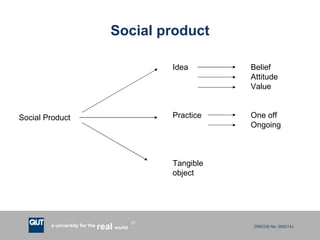
Social product Social Product Idea Practice Tangible  object Belief Attitude Value One off Ongoing
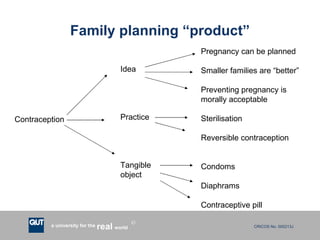
Family planning “product” Contraception Idea Practice Tangible  object Pregnancy can be planned Smaller families are “better” Preventing pregnancy is morally acceptable Sterilisation  Reversible contraception Condoms Diaphrams Contraceptive pill
Communication implications What aspect of the social product needs to be communicated? Are you trying to communicate a change in values, put forward an alternative lifestyle are you more focussed on portraying the relative benefits of one familiar activity over another?
Marketing mix: Price What someone gives up to own a product or use a service Price involves more than just money Social price - sum of all perceived costs that a person gives up to benefit from a campaign Costs include monetary costs for tangible goods and services plus time, effort, convenience, fear, loss of enjoyment, physical discomfort
Communications implications Social marketing communications often focus on making it easier to change a behaviour and thereby reduce the social price Example:  Exercise  30 minutes a day in one session or 3 x 10 minutes walk up stairs or get off the bus a stop earlier etc Social price barriers are related to competition
Competition Behaviours and associated benefits of the competing behaviour Behaviours that are habits Organisations and individuals that promote a counter behaviour
Competition: Example Behaviour objective: drink 8 glasses of water per day Competing behaviour: drinking coffee Competing messages/messengers: Coffee Club, Starbucks Social marketing message: have a glass of mineral water when meeting friends for “coffee”, have a glass of water with coffee, communicate negative effects of caffeine
Place Place refers to how your product gets from you to your client base Place can refer to retail outlets or service points Main communication task with relation to place is informing targets about where they can get access to services and information
Promotion Promotion refers to all the different communication methods that you use to contact, inform or influence your target market Promotions mix advertising publicity personal selling public relations sales promotions and any other communication method
Common approaches to social marketing communication Information based assumes that targets do not know about the issue or are missing key facts focus is on “educating” the market Emotion based focus on positive or negative emotions assumes the targets know the facts but need motivation in starting or maintaining behaviour
Negative emotion appeals Fear and threat appeals are common in social marketing Effectiveness of the appeal will depend on the extent to which the target identifies with the issue and believes that it can happen to them Engendering “fear” or negative emotions without providing a solution negates the value of the stimulation of the fear appeal Other negative emotions are also used in this context including guilt, remorse, embarrassment  Negative emotions are common in road safety advertising
Freedom From Fear Case Western Australia campaign against domestic violence
Approach Most anti domestic violence campaigns focus on either law reform or educating police and the judiciary with respect to domestic violence issues Public campaigns tend to focus on the victims and getting them to leave the abusive environment or seek help Freedom from Fear targeted the male perpetrators of domestic violence
Research: Getting the message right Research objectives Examine awareness, knowledge, attitudes, perceptions, and behaviours of men in general with respect to domestic violence Understand perpetrators beliefs and attitudes and hence assess whether reaching and impacting the primary target market was viable via mass media Assess the effectiveness of 5 potential message themes for a community education program: criminal sanctions, community interventions, social disapproval, consequences and “help is available”
Reactions to potential messages Criminal sanctions – not seen as credible or a significant deterrent Community interventions – idea of reporting incidences was seen as inconsistent with social norms (ie dobbing in a mate) Social disapproval – favourable reaction with most Consequences – damage to partner not an influencing factor for perpetrators, lacked credibility; damage to children powerful motivator Help is available – endorsed by both men in general and perpetrators
Campaign messages Domestic violence adversely impacts on the lives of children Help is available Victims are not to blame Violence against partners is not acceptable Reinforces the link between the use of emotion to increase arousal and attention while offering a clear solution
Communication media Men’s Helpline (staffed by male counsellors) Self help materials and publications Promotional material such as posters and beer mats distributed through sporting clubs, pubs, hotels, TABs, workplaces Television, radio, press and outdoor advertising
Adverts
Summary Social marketing is derived from managerial marketing and therefore uses commercial marketing tools and frameworks The ultimate aim of social marketing is to change behaviour Social marketing communications use traditional marketing communication methods and include the full range of marketing mix and promotional mix elements

Social marketing communications

  • 1.
  • 2.
    Introduction To beable to evaluate the effectiveness of social marketing communications first you need to understand what element of the social marketing framework the communication is addressing plus what stage of the behaviour change process is being targeted Also of importance is the extent to which the communication clearly shows that the campaign has adopted a “client” rather than organisation centred approach
  • 3.
    Overview Marketing andsocial marketing Behavioural change model Targeting communication strategies within the social marketing framework Common styles of message Freedom from Fear Case Study
  • 4.
    Definitions 1985 -Marketing : the process of planning and executing the conception, pricing, promotion and distribution of ideas, goods and services to create exchanges that satisfy individual and organisational needs. 2004 - Marketing: an organizational function and a set of processes for creating, communicating and delivering value to customers and for managing customer relationships in ways that benefit the organization and its stakeholders. (AMA 2004).
  • 5.
    Social Marketing Socialmarketing : the adaptation of commercial marketing technologies to create programs designed to influence the voluntary behaviour of target audiences to improve their personal welfare and that of the society of which they are a part.
  • 6.
    Framework of managerialmarketing Client centred Research and evidence driven Aims to achieve mutually beneficial exchanges Adapts to external environments Implemented through the “marketing mix”
  • 7.
    Framework of socialmarketing Social marketing uses and modifies managerial marketing Client focussed in the design of campaigns Social marketing’s “bottom line” is voluntary behavioural change Socially beneficial outcomes are subjective
  • 8.
    Some characteristics ofsocial marketing Level and extent of public scrutiny Extravagant expectations Targeted at non existent or negative demand Target unresponsive audiences Focus on sensitive issues Behaviours often have invisible, delayed or non guaranteed benefits
  • 9.
    Social marketing andbehaviour change
  • 10.
    Behaviour change modelTargets adopt the alternative behaviour long term as their “normal” behaviour Maintenance Targets trial the alternate behaviour Action Targets determine what they need to know or do to change their behaviour Preparation Targets become aware of the issue and start to consider it in light of their lives Contemplation Potential targets are unaware of issue Pre contemplation Characteristics Stage
  • 11.
    Stages of behaviouralchange Reinforce changes, reminder communications Maintenance Facilitate action Action Educate Preparation Persuade and motivate Contemplation Create awareness; change values and beliefs Pre contemplation Marketing & Communication Tasks Stage
  • 12.
    Marketing mix Themarketing mix is the basic framework that marketers use to manage the marketing effort The marketing mix is sometimes called the 4 Ps and consists of the following elements product, price, place, promotion
  • 13.
    Marketing mix: ProductThe bundle of benefits that the organisation is offering to the public From a social marketing perspective – what are you “selling” to the market? What aspect of the product needs to be communicated?
  • 14.
    Social product SocialProduct Idea Practice Tangible object Belief Attitude Value One off Ongoing
  • 15.
    Family planning “product”Contraception Idea Practice Tangible object Pregnancy can be planned Smaller families are “better” Preventing pregnancy is morally acceptable Sterilisation Reversible contraception Condoms Diaphrams Contraceptive pill
  • 16.
    Communication implications Whataspect of the social product needs to be communicated? Are you trying to communicate a change in values, put forward an alternative lifestyle are you more focussed on portraying the relative benefits of one familiar activity over another?
  • 17.
    Marketing mix: PriceWhat someone gives up to own a product or use a service Price involves more than just money Social price - sum of all perceived costs that a person gives up to benefit from a campaign Costs include monetary costs for tangible goods and services plus time, effort, convenience, fear, loss of enjoyment, physical discomfort
  • 18.
    Communications implications Socialmarketing communications often focus on making it easier to change a behaviour and thereby reduce the social price Example: Exercise 30 minutes a day in one session or 3 x 10 minutes walk up stairs or get off the bus a stop earlier etc Social price barriers are related to competition
  • 19.
    Competition Behaviours andassociated benefits of the competing behaviour Behaviours that are habits Organisations and individuals that promote a counter behaviour
  • 20.
    Competition: Example Behaviourobjective: drink 8 glasses of water per day Competing behaviour: drinking coffee Competing messages/messengers: Coffee Club, Starbucks Social marketing message: have a glass of mineral water when meeting friends for “coffee”, have a glass of water with coffee, communicate negative effects of caffeine
  • 21.
    Place Place refersto how your product gets from you to your client base Place can refer to retail outlets or service points Main communication task with relation to place is informing targets about where they can get access to services and information
  • 22.
    Promotion Promotion refersto all the different communication methods that you use to contact, inform or influence your target market Promotions mix advertising publicity personal selling public relations sales promotions and any other communication method
  • 23.
    Common approaches tosocial marketing communication Information based assumes that targets do not know about the issue or are missing key facts focus is on “educating” the market Emotion based focus on positive or negative emotions assumes the targets know the facts but need motivation in starting or maintaining behaviour
  • 24.
    Negative emotion appealsFear and threat appeals are common in social marketing Effectiveness of the appeal will depend on the extent to which the target identifies with the issue and believes that it can happen to them Engendering “fear” or negative emotions without providing a solution negates the value of the stimulation of the fear appeal Other negative emotions are also used in this context including guilt, remorse, embarrassment Negative emotions are common in road safety advertising
  • 25.
    Freedom From FearCase Western Australia campaign against domestic violence
  • 26.
    Approach Most antidomestic violence campaigns focus on either law reform or educating police and the judiciary with respect to domestic violence issues Public campaigns tend to focus on the victims and getting them to leave the abusive environment or seek help Freedom from Fear targeted the male perpetrators of domestic violence
  • 27.
    Research: Getting themessage right Research objectives Examine awareness, knowledge, attitudes, perceptions, and behaviours of men in general with respect to domestic violence Understand perpetrators beliefs and attitudes and hence assess whether reaching and impacting the primary target market was viable via mass media Assess the effectiveness of 5 potential message themes for a community education program: criminal sanctions, community interventions, social disapproval, consequences and “help is available”
  • 28.
    Reactions to potentialmessages Criminal sanctions – not seen as credible or a significant deterrent Community interventions – idea of reporting incidences was seen as inconsistent with social norms (ie dobbing in a mate) Social disapproval – favourable reaction with most Consequences – damage to partner not an influencing factor for perpetrators, lacked credibility; damage to children powerful motivator Help is available – endorsed by both men in general and perpetrators
  • 29.
    Campaign messages Domesticviolence adversely impacts on the lives of children Help is available Victims are not to blame Violence against partners is not acceptable Reinforces the link between the use of emotion to increase arousal and attention while offering a clear solution
  • 30.
    Communication media Men’sHelpline (staffed by male counsellors) Self help materials and publications Promotional material such as posters and beer mats distributed through sporting clubs, pubs, hotels, TABs, workplaces Television, radio, press and outdoor advertising
  • 31.
  • 32.
    Summary Social marketingis derived from managerial marketing and therefore uses commercial marketing tools and frameworks The ultimate aim of social marketing is to change behaviour Social marketing communications use traditional marketing communication methods and include the full range of marketing mix and promotional mix elements