





David De Roure
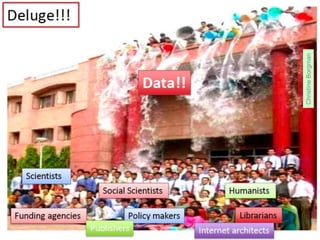
Christine Borgman
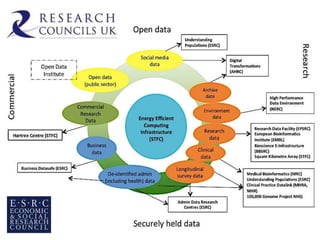
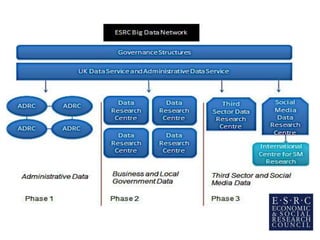
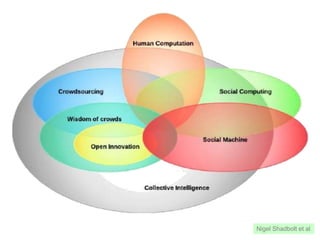
Nigel Shadbolt et al
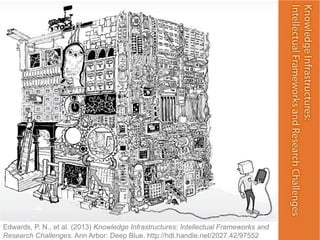
Edwards, P. N., et al. (2013) Knowledge Infrastructures: Intellectual Frameworks and
Research Challenges. Ann Arbor: Deep Blue. http://hdl.handle.net/2027.42/97552
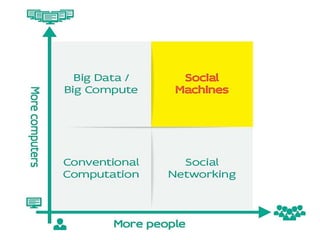
The Order of Social Machines
Real life is and must be full of all kinds of social
constraint – the very processes from which society
arises. Computers can help if we use them to
create abstract social machines on the Web:
processes in which the people do the creative work
and the machine does the administration... The
stage is set for an evolutionary growth of new
social engines. The ability to create new forms of
social process would be given to the world at large,
and development would be rapid.
Berners-Lee, Weaving the Web, 1999 (pp. 172–175)
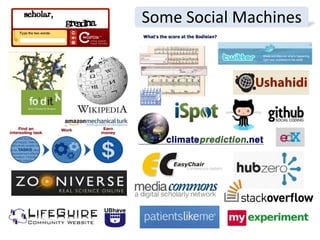
Some Social Machines
SOCIAM: The Theory and Practice
of Social Machines http://www.sociam.org/
EPSRC Programme Grant (June 2012 - May 2017)
• Southampton Shadbolt, Hall,
Berners-Lee, Moreau (ECS)

• Edinburgh Robertson, Buneman (CS)
• Oxford De Roure (e-Research)
http://gow.epsrc.ac.uk/NGBOViewGrant.aspx?GrantRef=EP/J017728/1

• Research into pioneering methods of supporting
purposeful human interaction onBehaviour Wide Web, of
the World is socially
the kind exemplified by phenomena such as Wikipedia and
constituted, not
Galaxy Zoo.
programmed in
• These collaborations are empowering, as communities
identify and solve their own problems, harnessing their
commitment, local knowledge and embedded skills,
without having to rely on remote experts or governments.
• The ambition is to enable us to build social machines that
solve the routine tasks of daily life as well as the
emergencies… to develop the theory and practice so that
we can create the next generation of decentralised, data
intensive, social machines. We are interested in design
• Understanding the attributes of the current generation of
successful social machines will help us build the next.
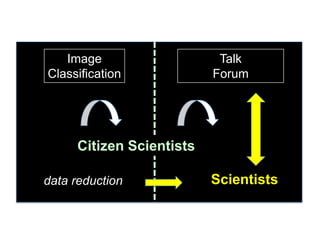
www.zooniverse.org
Image
Classification

Talk
Forum

Citizen Scientists
data reduction

Scientists
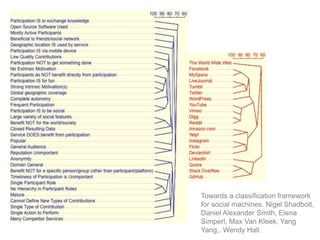
Towards a classification framework
for social machines. Nigel Shadbolt,
Daniel Alexander Smith, Elena
Simperl, Max Van Kleek, Yang
Yang,. Wendy Hall.
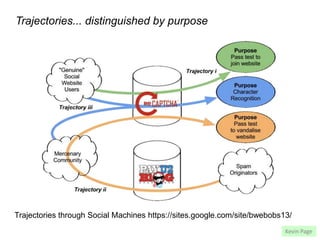
Trajectories... distinguished by purpose

Trajectories through Social Machines https://sites.google.com/site/bwebobs13/
Kevin Page
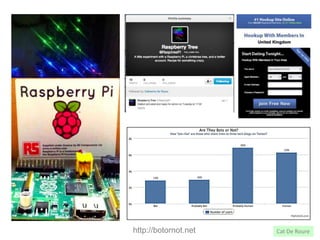
http://botornot.net

Cat De Roure
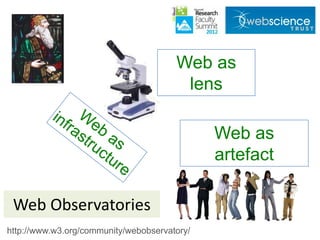
Web as
lens

Web as
artefact
Web Observatories
http://www.w3.org/community/webobservatory/
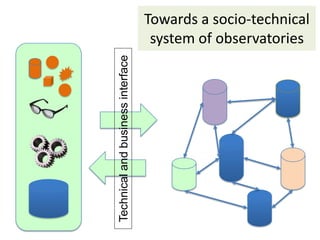
Technical and business interface

Towards a socio-technical
system of observatories
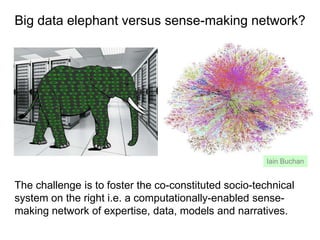
Big data elephant versus sense-making network?

Iain Buchan

The challenge is to foster the co-constituted socio-technical
system on the right i.e. a computationally-enabled sensemaking network of expertise, data, models and narratives.
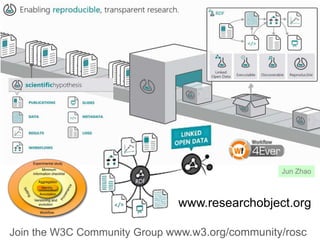
Jun Zhao

www.researchobject.org
Join the W3C Community Group www.w3.org/community/rosc
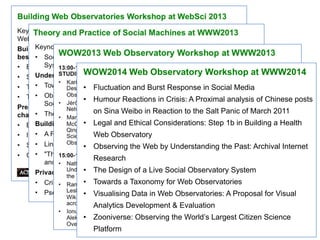
WOW2014 Web Observatory Workshop at WWW2014
• Fluctuation and Burst Response in Social Media
• Humour Reactions in Crisis: A Proximal analysis of Chinese posts

on Sina Weibo in Reaction to the Salt Panic of March 2011
• Legal and Ethical Considerations: Step 1b in Building a Health
Web Observatory
• Observing the Web by Understanding the Past: Archival Internet
Research

• The Design of a Live Social Observatory System
• Towards a Taxonomy for Web Observatories
• Visualising Data in Web Observatories: A Proposal for Visual
Analytics Development & Evaluation
• Zooniverse: Observing the World’s Largest Citizen Science
Platform
In Conclusion
1. The future is Big Data and Big Social… and with
increasing automation and machine-to-machine

2. The Theory, Practice, Design and Construction of
Social Machines are emerging areas of study
3. Try thinking about your projects in terms of an
ecosystem of interacting Social Machines instead
of layers of computer systems and users
4. There are growing Social Machines and Web
Observatory communities (join the Web
Observatory Community Group!)
david.deroure@oerc.ox.ac.uk
www.oerc.ox.ac.uk/people/dder
@dder
SOCIAM: The Theory and Practice of Social Machines is funded by the UK Engineering and
Physical Sciences Research Council (EPSRC) under grant number EPJ017728/1 and
comprises the Universities of Southampton, Oxford and Edinburgh. See sociam.org
SmartSociety: Hybrid and Diversity-Aware Collective Adaptive Systems: When People
Meet Machines to Build a Smarter Society funded by 7th Framework Programme FP7-ICT2011-9 Grant Agreement 600854. See www.smart-society-project.eu

Social Machines IIIT

  • 1.
  • 5.
  • 7.
  • 8.
    Edwards, P. N.,et al. (2013) Knowledge Infrastructures: Intellectual Frameworks and Research Challenges. Ann Arbor: Deep Blue. http://hdl.handle.net/2027.42/97552
  • 9.
    The Order ofSocial Machines Real life is and must be full of all kinds of social constraint – the very processes from which society arises. Computers can help if we use them to create abstract social machines on the Web: processes in which the people do the creative work and the machine does the administration... The stage is set for an evolutionary growth of new social engines. The ability to create new forms of social process would be given to the world at large, and development would be rapid. Berners-Lee, Weaving the Web, 1999 (pp. 172–175)
  • 10.
  • 11.
    SOCIAM: The Theoryand Practice of Social Machines http://www.sociam.org/ EPSRC Programme Grant (June 2012 - May 2017) • Southampton Shadbolt, Hall, Berners-Lee, Moreau (ECS) • Edinburgh Robertson, Buneman (CS) • Oxford De Roure (e-Research)
  • 12.
    http://gow.epsrc.ac.uk/NGBOViewGrant.aspx?GrantRef=EP/J017728/1 • Research intopioneering methods of supporting purposeful human interaction onBehaviour Wide Web, of the World is socially the kind exemplified by phenomena such as Wikipedia and constituted, not Galaxy Zoo. programmed in • These collaborations are empowering, as communities identify and solve their own problems, harnessing their commitment, local knowledge and embedded skills, without having to rely on remote experts or governments. • The ambition is to enable us to build social machines that solve the routine tasks of daily life as well as the emergencies… to develop the theory and practice so that we can create the next generation of decentralised, data intensive, social machines. We are interested in design • Understanding the attributes of the current generation of successful social machines will help us build the next.
  • 13.
  • 15.
  • 16.
    Towards a classificationframework for social machines. Nigel Shadbolt, Daniel Alexander Smith, Elena Simperl, Max Van Kleek, Yang Yang,. Wendy Hall.
  • 17.
    Trajectories... distinguished bypurpose Trajectories through Social Machines https://sites.google.com/site/bwebobs13/ Kevin Page
  • 18.
  • 19.
    Web as lens Web as artefact WebObservatories http://www.w3.org/community/webobservatory/
  • 20.
    Technical and businessinterface Towards a socio-technical system of observatories
  • 21.
    Big data elephantversus sense-making network? Iain Buchan The challenge is to foster the co-constituted socio-technical system on the right i.e. a computationally-enabled sensemaking network of expertise, data, models and narratives.
  • 22.
    Jun Zhao www.researchobject.org Join theW3C Community Group www.w3.org/community/rosc
  • 23.
    WOW2014 Web ObservatoryWorkshop at WWW2014 • Fluctuation and Burst Response in Social Media • Humour Reactions in Crisis: A Proximal analysis of Chinese posts on Sina Weibo in Reaction to the Salt Panic of March 2011 • Legal and Ethical Considerations: Step 1b in Building a Health Web Observatory • Observing the Web by Understanding the Past: Archival Internet Research • The Design of a Live Social Observatory System • Towards a Taxonomy for Web Observatories • Visualising Data in Web Observatories: A Proposal for Visual Analytics Development & Evaluation • Zooniverse: Observing the World’s Largest Citizen Science Platform
  • 25.
    In Conclusion 1. Thefuture is Big Data and Big Social… and with increasing automation and machine-to-machine 2. The Theory, Practice, Design and Construction of Social Machines are emerging areas of study 3. Try thinking about your projects in terms of an ecosystem of interacting Social Machines instead of layers of computer systems and users 4. There are growing Social Machines and Web Observatory communities (join the Web Observatory Community Group!)
  • 26.
    david.deroure@oerc.ox.ac.uk www.oerc.ox.ac.uk/people/dder @dder SOCIAM: The Theoryand Practice of Social Machines is funded by the UK Engineering and Physical Sciences Research Council (EPSRC) under grant number EPJ017728/1 and comprises the Universities of Southampton, Oxford and Edinburgh. See sociam.org SmartSociety: Hybrid and Diversity-Aware Collective Adaptive Systems: When People Meet Machines to Build a Smarter Society funded by 7th Framework Programme FP7-ICT2011-9 Grant Agreement 600854. See www.smart-society-project.eu