David De Roure
 @dder


Intersection, Scale, and
Social Machines:
Scholarship in the digital world
DIRECTOR, UNIVERSITY OF OXFORD E-RESEARCH CENTRE
Today we are witnessing several shifts in scholarly practice,
in and across multiple disciplines, as researchers embrace
digital techniques to tackle established research questions in
new ways and new questions afforded by digital and
digitized collections, approaches, and technologies.
Pervasive adoption of technology, coupled with the co-
creation of new social processes, has created a new and
complex space for scholarship where citizens both generate
and analyze data as they interact at the intersection of the
physical and digital.
Drawing on a background in distributed computing, and
adopting the lens of Social Machines, this talk discusses
current activity in digital scholarship, framing it in its
interdisciplinary settings.
data-intensive

social processes

social machines
The Big Picture(s)

Challenging Assumptions
ChristineBorgman
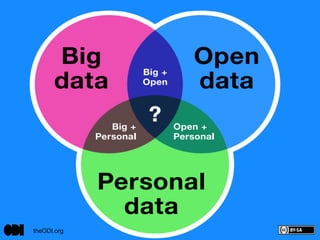
New Forms of Data
▶ Internet data, derived from social
media and other online interactions
(including data gathered by
connected people and devices, eg
mobile devices, wearable
technology, Internet of Things)
▶ Tracking data, monitoring the
movement of people and objects
(including GPS/geolocation data,
traffic and other transport sensor
data, CCTV images etc)
▶ Satellite and aerial imagery (eg
Google Earth, Landsat, infrared,
radar mapping etc) http://www.oecd.org/sti/sci-tech/new-data-for-
understanding-the-human-condition.htm
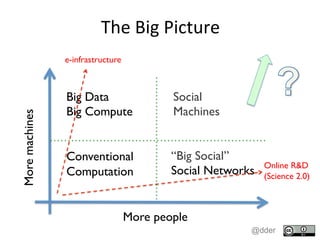
The	
  Big	
  Picture	
  
More people
Moremachines
Big Data
Big Compute
Conventional
Computation
“Big Social”
Social Networks
e-infrastructure
Online R&D
(Science 2.0)
Social
Machines
@dder
theODI.org
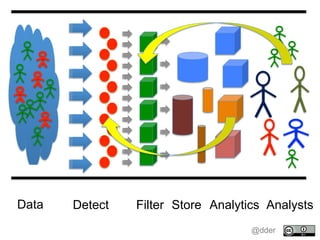
Data Detect Store AnalyticsFilter Analysts
@dder
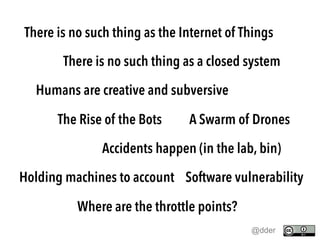
There is no such thing as the Internet of Things
There is no such thing as a closed system
Humans are creative and subversive
The Rise of the Bots A Swarm of Drones
Accidents happen (in the lab, bin)
Holding machines to account Software vulnerability
Where are the throttle points?
@dder
F i r s t
New Research Questions
▶ Social media data offers
the possibility of studying
social processes as they
unfold at the level of
populations, as an
alternative to traditional
surveys or interviews.
▶ The data from social media
is described as "qualitative
data on a quantitative
scale" and requires
innovative analysis
techniques.
Social media
data and real
time
analytics
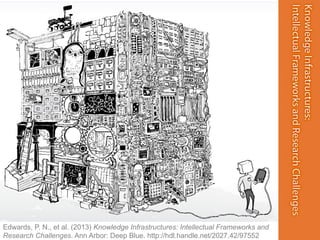
Edwards, P. N., et al. (2013) Knowledge Infrastructures: Intellectual Frameworks and
Research Challenges. Ann Arbor: Deep Blue. http://hdl.handle.net/2027.42/97552
Social Machines

Empowered Citizens
Social	
  Machines	
  Defini6on	
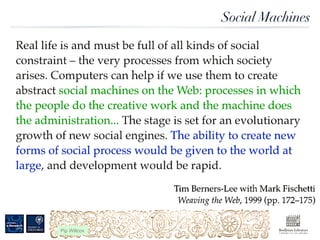
  TBL	
  
Pip Willcox
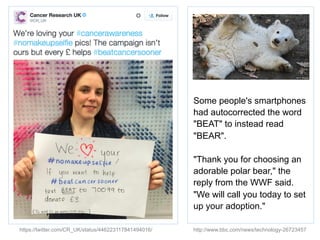
https://twitter.com/CR_UK/status/446223117841494016/
Some people's smartphones
had autocorrected the word
"BEAT" to instead read
"BEAR".
"Thank you for choosing an
adorable polar bear," the
reply from the WWF said.
"We will call you today to set
up your adoption."
http://www.bbc.com/news/technology-26723457
SOCIAM: The Theory and Practice of Social Machines is funded by the UK Engineering and Physical Sciences Research Council
(EPSRC) under grant number EPJ017728/1 and comprises the Universities of Southampton, Oxford and Edinburgh. See sociam.org
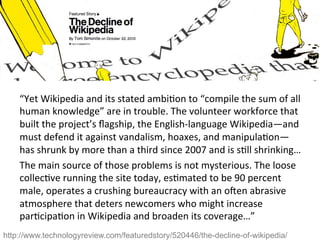
“Yet	
  Wikipedia	
  and	
  its	
  stated	
  ambi6on	
  to	
  “compile	
  the	
  sum	
  of	
  all	
  
human	
  knowledge”	
  are	
  in	
  trouble.	
  The	
  volunteer	
  workforce	
  that	
  
built	
  the	
  project’s	
  flagship,	
  the	
  English-­‐language	
  Wikipedia—and	
  
must	
  defend	
  it	
  against	
  vandalism,	
  hoaxes,	
  and	
  manipula6on—
has	
  shrunk	
  by	
  more	
  than	
  a	
  third	
  since	
  2007	
  and	
  is	
  s6ll	
  shrinking…	
  	
  
The	
  main	
  source	
  of	
  those	
  problems	
  is	
  not	
  mysterious.	
  The	
  loose	
  
collec6ve	
  running	
  the	
  site	
  today,	
  es6mated	
  to	
  be	
  90	
  percent	
  
male,	
  operates	
  a	
  crushing	
  bureaucracy	
  with	
  an	
  oSen	
  abrasive	
  
atmosphere	
  that	
  deters	
  newcomers	
  who	
  might	
  increase	
  
par6cipa6on	
  in	
  Wikipedia	
  and	
  broaden	
  its	
  coverage…”	
  
	
  http://www.technologyreview.com/featuredstory/520446/the-decline-of-wikipedia/
Scientists
Talk
Forum
Image
Classification
data reduction
Citizen Scientists
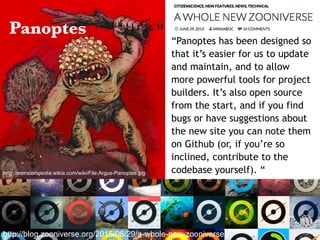
“Panoptes has been designed so
that it’s easier for us to update
and maintain, and to allow
more powerful tools for project
builders. It’s also open source
from the start, and if you find
bugs or have suggestions about
the new site you can note them
on Github (or, if you’re so
inclined, contribute to the
codebase yourself). “
"	
  
http://blog.zooniverse.org/2015/06/29/a-whole-new-zooniverse/
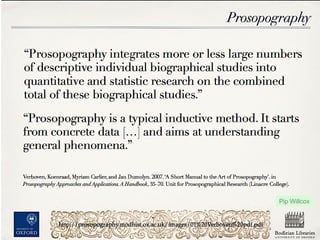
http://monsterspedia.wikia.com/wiki/File:Argus-Panoptes.jpg
Panoptes
Musical Social Machines

Social Machines of Scholarship
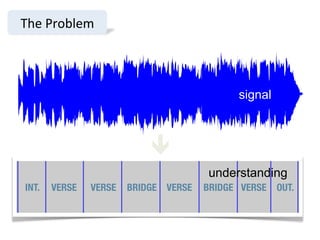
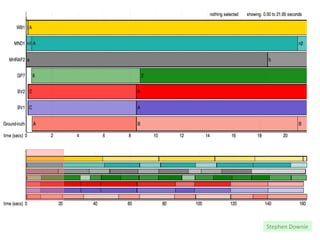
INT. VERSE VERSE VERSE VERSEBRIDGEBRIDGE OUT.
ê
The	
  Problem	
  
signal
understanding
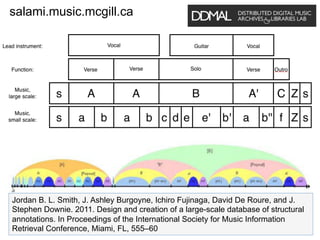
salami.music.mcgill.ca
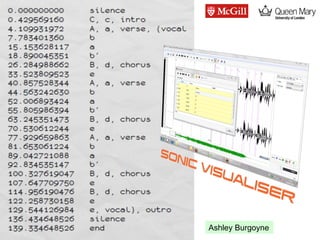
Jordan B. L. Smith, J. Ashley Burgoyne, Ichiro Fujinaga, David De Roure, and J.
Stephen Downie. 2011. Design and creation of a large-scale database of structural
annotations. In Proceedings of the International Society for Music Information
Retrieval Conference, Miami, FL, 555–60
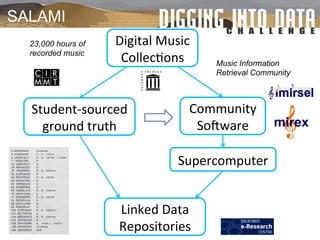
Digital	
  Music	
  
Collec6ons	
  
Student-­‐sourced	
  
ground	
  truth	
  
Community	
  
SoSware	
  
Linked	
  Data	
  
Repositories	
  
Supercomputer	
  
23,000 hours of
recorded music
Music Information
Retrieval Community
SALAMI
Ashley Burgoyne
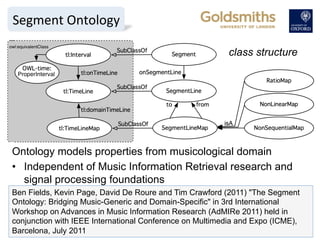
class structure
Ontology models properties from musicological domain
•  Independent of Music Information Retrieval research and
signal processing foundations
•  Maintains an accurate and complete description of
relationships that link them
Segment	
  Ontology	
  
Ben Fields, Kevin Page, David De Roure and Tim Crawford (2011) "The Segment
Ontology: Bridging Music-Generic and Domain-Specific" in 3rd International
Workshop on Advances in Music Information Research (AdMIRe 2011) held in
conjunction with IEEE International Conference on Multimedia and Expo (ICME),
Barcelona, July 2011
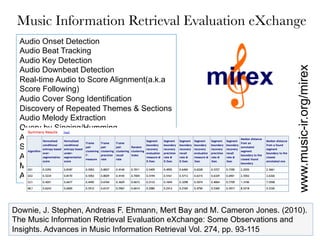
www.music-ir.org/mirex
Music Information Retrieval Evaluation eXchange
Audio Onset Detection
Audio Beat Tracking
Audio Key Detection
Audio Downbeat Detection
Real-time Audio to Score Alignment(a.k.a
Score Following)
Audio Cover Song Identification
Discovery of Repeated Themes & Sections
Audio Melody Extraction
Query by Singing/Humming
Audio Chord Estimation
Singing Voice Separation
Audio Fingerprinting
Music/Speech Classification/Detection
Audio Offset Detection
Downie, J. Stephen, Andreas F. Ehmann, Mert Bay and M. Cameron Jones. (2010).
The Music Information Retrieval Evaluation eXchange: Some Observations and
Insights. Advances in Music Information Retrieval Vol. 274, pp. 93-115
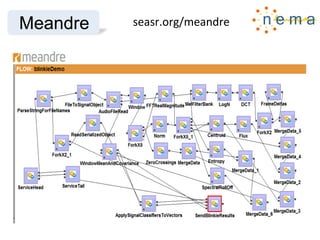
seasr.org/meandre	
  Meandre	
  
Stephen	
  Downie	
  
http://chordify.net/
Studying Social Machines

Scholarship of Social Machines
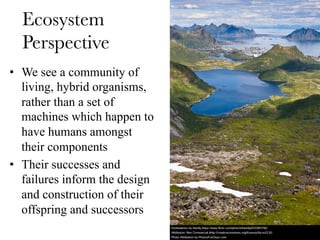
Ecosystem
Perspective
•  We see a community of
living, hybrid organisms,
rather than a set of
machines which happen to
have humans amongst
their components
•  Their successes and
failures inform the design
and construction of their
offspring and successors
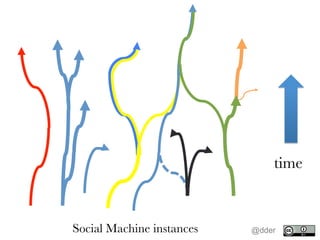
time
Social Machine instances
 @dder
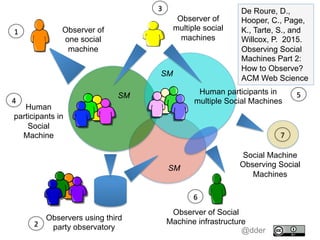
Observer of
one social
machine
Observers using third
party observatory
Observer of
multiple social
machines
Human
participants in
Social
Machine
Human participants in
multiple Social Machines
Observer of Social
Machine infrastructure
1	
  
4	
  
2	
  
3	
  
5	
  
6	
  
SM
SM
SM
Social Machine
Observing Social
Machines
7	
  
@dder
De Roure, D.,
Hooper, C., Page,
K., Tarte, S., and
Willcox, P. 2015.
Observing Social
Machines Part 2:
How to Observe?
ACM Web Science
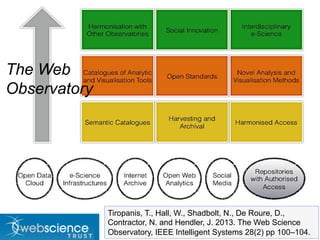
The Web
Observatory
Tiropanis, T., Hall, W., Shadbolt, N., De Roure, D.,
Contractor, N. and Hendler, J. 2013. The Web Science
Observatory, IEEE Intelligent Systems 28(2) pp 100–104.
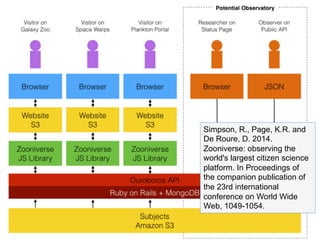
Simpson, R., Page, K.R. and
De Roure, D. 2014.
Zooniverse: observing the
world's largest citizen science
platform. In Proceedings of
the companion publication of
the 23rd international
conference on World Wide
Web, 1049-1054.
By Ségolène Tarte, David De Roure
and Pip Willcox
Working out the Plot
The Role of Stories in
Social Machines
Tarte, S.M., De Roure, D. and Willcox, P. 2014. Working out the Plot: the Role of
Stories in Social Machines. SOCM2014: The Theory and Practice of Social
Machines, Seoul, Korea, International World Wide Web Conferences pp. 909–914
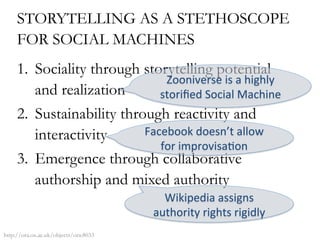
STORYTELLING AS A STETHOSCOPE
FOR SOCIAL MACHINES
1.  Sociality through storytelling potential
and realization
2.  Sustainability through reactivity and
interactivity
3.  Emergence through collaborative
authorship and mixed authority
Zooniverse	
  is	
  a	
  highly	
  
storified	
  Social	
  Machine	
  
Facebook	
  doesn’t	
  allow	
  
for	
  improvisa6on	
  
Wikipedia	
  assigns	
  
authority	
  rights	
  rigidly	
  
http://ora.ox.ac.uk/objects/ora:8033
Pip Willcox
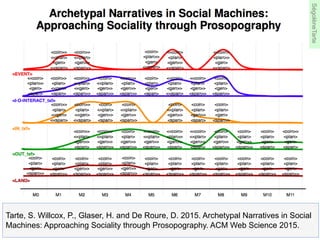
Tarte, S. Willcox, P., Glaser, H. and De Roure, D. 2015. Archetypal Narratives in Social
Machines: Approaching Sociality through Prosopography. ACM Web Science 2015.
SégolèneTarte
Automation

Dystopias
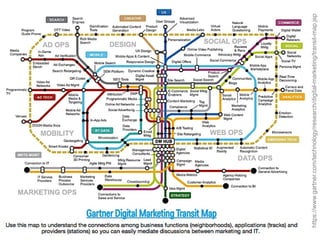
https://www.gartner.com/technology/research/digital-marketing/transit-map.jsp
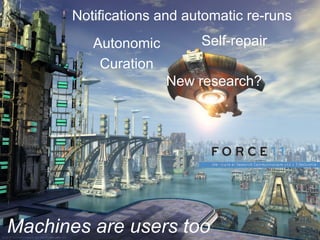
Notifications and automatic re-runs
Machines are users too
Autonomic
Curation
Self-repair
New research?
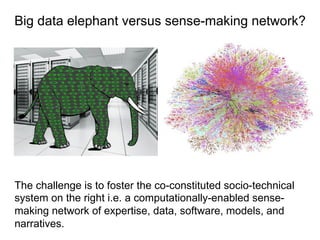
The challenge is to foster the co-constituted socio-technical system
on the right i.e. a computationally-enabled sense-making network of
expertise, data, software, models, and narratives.

Big data elephant versus sense-making network?
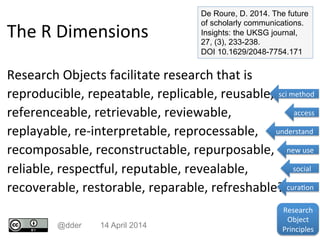
The	
  R	
  Dimensions	
  
Research	
  Objects	
  facilitate	
  research	
  that	
  is	
  
reproducible,	
  repeatable,	
  replicable,	
  reusable,	
  
referenceable,	
  retrievable,	
  reviewable,	
  
replayable,	
  re-­‐interpretable,	
  reprocessable,	
  
recomposable,	
  reconstructable,	
  repurposable,	
  
reliable,	
  respec`ul,	
  reputable,	
  revealable,	
  
recoverable,	
  restorable,	
  reparable,	
  refreshable?”	
  
@dder 14 April 2014
sci	
  method	
  
access	
  
understand	
  
new	
  use	
  
social	
  
cura6on	
  
Research	
  
Object	
  
Principles	
  
De Roure, D. 2014. The future
of scholarly communications.
Insights: the UKSG journal,
27, (3), 233-238.
DOI 10.1629/2048-7754.171
Closing thoughts

Reflections
Principles of Robotics
1.  Robots are multi-use tools. Robots should not be designed solely
or primarily to kill or harm humans, except in the interests of
national security.
2.  Humans, not robots, are responsible agents. Robots should be
designed; operated as far as is practicable to comply with existing
laws & fundamental rights & freedoms, including privacy.
3.  Robots are products. They should be designed using processes
which assure their safety and security.
4.  Robots are manufactured artefacts. They should not be designed
in a deceptive way to exploit vulnerable users; instead their
machine nature should be transparent.
5.  The person with legal responsibility for a robot should be
attributed.
https://www.epsrc.ac.uk/research/ourportfolio/themes/engineering/activities/principlesofrobotics/
AlanWinfield
Principles of Robotics Social Machines?
1.  Social Machines are multi-use tools. Social Machines should not
be designed solely or primarily to kill or harm humans, except in
the interests of national security.
2.  Humans, not Social Machines, are responsible agents. Social
Machines should be designed; operated as far as is practicable to
comply with existing laws & fundamental rights & freedoms,
including privacy.
3.  Social Machines are products. They should be designed using
processes which assure their safety and security.
4.  Social Machines are manufactured artefacts. They should not be
designed in a deceptive way to exploit vulnerable users; instead
their machine nature should be transparent.
5.  The person with legal responsibility for a Social Machine should
be attributed.
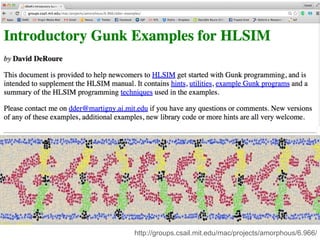
http://groups.csail.mit.edu/mac/projects/amorphous/6.966/
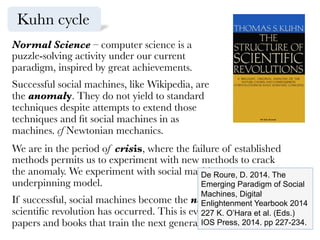
Normal Science – computer science is a
puzzle-solving activity under our current
paradigm, inspired by great achievements. 
Kuhn cycle
We are in the period of crisis, where the failure of established
methods permits us to experiment with new methods to crack the
anomaly. We experiment with social machines as an underpinning
model.
If successful, social machines become the new paradigm and
scientific revolution has occurred. This is evidenced by the papers and
books that train the next generation. 
De Roure, D. 2014. The
Emerging Paradigm of Social
Machines, Digital
Enlightenment Yearbook 2014
227 K. O’Hara et al. (Eds.)
IOS Press, 2014. pp 227-234.
Successful social machines, like Wikipedia,
are the anomaly. They do not yield to
standard techniques despite attempts to
extend those techniques and fit social
machines in as machines. cf Newtonian
mechanics.
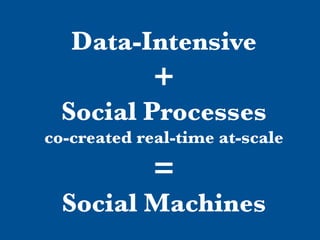
Data-Intensive
+
Social Processes
co-created real-time at-scale
=
Social Machines
PipWillcox
david.deroure@oerc.ox.ac.uk
@dder
Thanks to Stephen Downie, Ich Fujinaga, Chris Lintott,
Grant Miller, Kevin Page, Ségolène Tarte, Pip Willcox,
Project SOCIAM and Project MAC.
http://www.slideshare.net/davidderoure/scholarship-in-the-digital-world
Supported by SOCIAM: The Theory and Practice of Social Machines, funded by the UK Engineering and Physical
Sciences Research Council (EPSRC), under grant number EP/J017728/1, also FAST EP/L019981/1, and Smart
Society: Hybrid and Diversity-Aware Collective Adaptive Systems: When People Meet Machines to Build a Smarter
Society, funded under the European Commission FP7-ICT FET Proactive Initiative: Fundamentals of Collective
Adaptive Systems (FOCAS), Project Reference 600854.
www.oerc.ox.ac.uk	

david.deroure@oerc.ox.ac.uk	

@dder

Scholarship in the Digital World

  • 1.
    David De Roure @dder Intersection, Scale, and Social Machines: Scholarship in the digital world DIRECTOR, UNIVERSITY OF OXFORD E-RESEARCH CENTRE
  • 2.
    Today we arewitnessing several shifts in scholarly practice, in and across multiple disciplines, as researchers embrace digital techniques to tackle established research questions in new ways and new questions afforded by digital and digitized collections, approaches, and technologies. Pervasive adoption of technology, coupled with the co- creation of new social processes, has created a new and complex space for scholarship where citizens both generate and analyze data as they interact at the intersection of the physical and digital. Drawing on a background in distributed computing, and adopting the lens of Social Machines, this talk discusses current activity in digital scholarship, framing it in its interdisciplinary settings. data-intensive social processes social machines
  • 3.
  • 4.
  • 5.
    New Forms ofData ▶ Internet data, derived from social media and other online interactions (including data gathered by connected people and devices, eg mobile devices, wearable technology, Internet of Things) ▶ Tracking data, monitoring the movement of people and objects (including GPS/geolocation data, traffic and other transport sensor data, CCTV images etc) ▶ Satellite and aerial imagery (eg Google Earth, Landsat, infrared, radar mapping etc) http://www.oecd.org/sti/sci-tech/new-data-for- understanding-the-human-condition.htm
  • 6.
    The  Big  Picture   More people Moremachines Big Data Big Compute Conventional Computation “Big Social” Social Networks e-infrastructure Online R&D (Science 2.0) Social Machines @dder
  • 7.
  • 8.
    Data Detect StoreAnalyticsFilter Analysts @dder
  • 9.
    There is nosuch thing as the Internet of Things There is no such thing as a closed system Humans are creative and subversive The Rise of the Bots A Swarm of Drones Accidents happen (in the lab, bin) Holding machines to account Software vulnerability Where are the throttle points? @dder
  • 10.
    F i rs t
  • 11.
    New Research Questions ▶ Socialmedia data offers the possibility of studying social processes as they unfold at the level of populations, as an alternative to traditional surveys or interviews. ▶ The data from social media is described as "qualitative data on a quantitative scale" and requires innovative analysis techniques. Social media data and real time analytics
  • 12.
    Edwards, P. N.,et al. (2013) Knowledge Infrastructures: Intellectual Frameworks and Research Challenges. Ann Arbor: Deep Blue. http://hdl.handle.net/2027.42/97552
  • 13.
  • 14.
    Social  Machines  Defini6on  TBL   Pip Willcox
  • 15.
    https://twitter.com/CR_UK/status/446223117841494016/ Some people's smartphones hadautocorrected the word "BEAT" to instead read "BEAR". "Thank you for choosing an adorable polar bear," the reply from the WWF said. "We will call you today to set up your adoption." http://www.bbc.com/news/technology-26723457
  • 17.
    SOCIAM: The Theoryand Practice of Social Machines is funded by the UK Engineering and Physical Sciences Research Council (EPSRC) under grant number EPJ017728/1 and comprises the Universities of Southampton, Oxford and Edinburgh. See sociam.org
  • 18.
    “Yet  Wikipedia  and  its  stated  ambi6on  to  “compile  the  sum  of  all   human  knowledge”  are  in  trouble.  The  volunteer  workforce  that   built  the  project’s  flagship,  the  English-­‐language  Wikipedia—and   must  defend  it  against  vandalism,  hoaxes,  and  manipula6on— has  shrunk  by  more  than  a  third  since  2007  and  is  s6ll  shrinking…     The  main  source  of  those  problems  is  not  mysterious.  The  loose   collec6ve  running  the  site  today,  es6mated  to  be  90  percent   male,  operates  a  crushing  bureaucracy  with  an  oSen  abrasive   atmosphere  that  deters  newcomers  who  might  increase   par6cipa6on  in  Wikipedia  and  broaden  its  coverage…”    http://www.technologyreview.com/featuredstory/520446/the-decline-of-wikipedia/
  • 20.
  • 21.
    “Panoptes has beendesigned so that it’s easier for us to update and maintain, and to allow more powerful tools for project builders. It’s also open source from the start, and if you find bugs or have suggestions about the new site you can note them on Github (or, if you’re so inclined, contribute to the codebase yourself). “ "   http://blog.zooniverse.org/2015/06/29/a-whole-new-zooniverse/ http://monsterspedia.wikia.com/wiki/File:Argus-Panoptes.jpg Panoptes
  • 22.
    Musical Social Machines SocialMachines of Scholarship
  • 23.
    INT. VERSE VERSEVERSE VERSEBRIDGEBRIDGE OUT. ê The  Problem   signal understanding
  • 24.
    salami.music.mcgill.ca Jordan B. L.Smith, J. Ashley Burgoyne, Ichiro Fujinaga, David De Roure, and J. Stephen Downie. 2011. Design and creation of a large-scale database of structural annotations. In Proceedings of the International Society for Music Information Retrieval Conference, Miami, FL, 555–60
  • 25.
    Digital  Music   Collec6ons   Student-­‐sourced   ground  truth   Community   SoSware   Linked  Data   Repositories   Supercomputer   23,000 hours of recorded music Music Information Retrieval Community SALAMI
  • 26.
  • 27.
    class structure Ontology modelsproperties from musicological domain •  Independent of Music Information Retrieval research and signal processing foundations •  Maintains an accurate and complete description of relationships that link them Segment  Ontology   Ben Fields, Kevin Page, David De Roure and Tim Crawford (2011) "The Segment Ontology: Bridging Music-Generic and Domain-Specific" in 3rd International Workshop on Advances in Music Information Research (AdMIRe 2011) held in conjunction with IEEE International Conference on Multimedia and Expo (ICME), Barcelona, July 2011
  • 28.
    www.music-ir.org/mirex Music Information RetrievalEvaluation eXchange Audio Onset Detection Audio Beat Tracking Audio Key Detection Audio Downbeat Detection Real-time Audio to Score Alignment(a.k.a Score Following) Audio Cover Song Identification Discovery of Repeated Themes & Sections Audio Melody Extraction Query by Singing/Humming Audio Chord Estimation Singing Voice Separation Audio Fingerprinting Music/Speech Classification/Detection Audio Offset Detection Downie, J. Stephen, Andreas F. Ehmann, Mert Bay and M. Cameron Jones. (2010). The Music Information Retrieval Evaluation eXchange: Some Observations and Insights. Advances in Music Information Retrieval Vol. 274, pp. 93-115
  • 29.
  • 30.
  • 31.
  • 32.
  • 33.
    Ecosystem Perspective •  We seea community of living, hybrid organisms, rather than a set of machines which happen to have humans amongst their components •  Their successes and failures inform the design and construction of their offspring and successors
  • 34.
  • 35.
    Observer of one social machine Observersusing third party observatory Observer of multiple social machines Human participants in Social Machine Human participants in multiple Social Machines Observer of Social Machine infrastructure 1   4   2   3   5   6   SM SM SM Social Machine Observing Social Machines 7   @dder De Roure, D., Hooper, C., Page, K., Tarte, S., and Willcox, P. 2015. Observing Social Machines Part 2: How to Observe? ACM Web Science
  • 36.
    The Web Observatory Tiropanis, T.,Hall, W., Shadbolt, N., De Roure, D., Contractor, N. and Hendler, J. 2013. The Web Science Observatory, IEEE Intelligent Systems 28(2) pp 100–104.
  • 37.
    Simpson, R., Page,K.R. and De Roure, D. 2014. Zooniverse: observing the world's largest citizen science platform. In Proceedings of the companion publication of the 23rd international conference on World Wide Web, 1049-1054.
  • 38.
    By Ségolène Tarte,David De Roure and Pip Willcox Working out the Plot The Role of Stories in Social Machines Tarte, S.M., De Roure, D. and Willcox, P. 2014. Working out the Plot: the Role of Stories in Social Machines. SOCM2014: The Theory and Practice of Social Machines, Seoul, Korea, International World Wide Web Conferences pp. 909–914
  • 39.
    STORYTELLING AS ASTETHOSCOPE FOR SOCIAL MACHINES 1.  Sociality through storytelling potential and realization 2.  Sustainability through reactivity and interactivity 3.  Emergence through collaborative authorship and mixed authority Zooniverse  is  a  highly   storified  Social  Machine   Facebook  doesn’t  allow   for  improvisa6on   Wikipedia  assigns   authority  rights  rigidly   http://ora.ox.ac.uk/objects/ora:8033
  • 40.
  • 41.
    Tarte, S. Willcox,P., Glaser, H. and De Roure, D. 2015. Archetypal Narratives in Social Machines: Approaching Sociality through Prosopography. ACM Web Science 2015. SégolèneTarte
  • 42.
  • 43.
  • 44.
    Notifications and automaticre-runs Machines are users too Autonomic Curation Self-repair New research?
  • 45.
    The challenge isto foster the co-constituted socio-technical system on the right i.e. a computationally-enabled sense-making network of expertise, data, software, models, and narratives. Big data elephant versus sense-making network?
  • 46.
    The  R  Dimensions   Research  Objects  facilitate  research  that  is   reproducible,  repeatable,  replicable,  reusable,   referenceable,  retrievable,  reviewable,   replayable,  re-­‐interpretable,  reprocessable,   recomposable,  reconstructable,  repurposable,   reliable,  respec`ul,  reputable,  revealable,   recoverable,  restorable,  reparable,  refreshable?”   @dder 14 April 2014 sci  method   access   understand   new  use   social   cura6on   Research   Object   Principles   De Roure, D. 2014. The future of scholarly communications. Insights: the UKSG journal, 27, (3), 233-238. DOI 10.1629/2048-7754.171
  • 47.
  • 48.
    Principles of Robotics 1. Robots are multi-use tools. Robots should not be designed solely or primarily to kill or harm humans, except in the interests of national security. 2.  Humans, not robots, are responsible agents. Robots should be designed; operated as far as is practicable to comply with existing laws & fundamental rights & freedoms, including privacy. 3.  Robots are products. They should be designed using processes which assure their safety and security. 4.  Robots are manufactured artefacts. They should not be designed in a deceptive way to exploit vulnerable users; instead their machine nature should be transparent. 5.  The person with legal responsibility for a robot should be attributed. https://www.epsrc.ac.uk/research/ourportfolio/themes/engineering/activities/principlesofrobotics/ AlanWinfield
  • 49.
    Principles of RoboticsSocial Machines? 1.  Social Machines are multi-use tools. Social Machines should not be designed solely or primarily to kill or harm humans, except in the interests of national security. 2.  Humans, not Social Machines, are responsible agents. Social Machines should be designed; operated as far as is practicable to comply with existing laws & fundamental rights & freedoms, including privacy. 3.  Social Machines are products. They should be designed using processes which assure their safety and security. 4.  Social Machines are manufactured artefacts. They should not be designed in a deceptive way to exploit vulnerable users; instead their machine nature should be transparent. 5.  The person with legal responsibility for a Social Machine should be attributed.
  • 51.
  • 52.
    Normal Science –computer science is a puzzle-solving activity under our current paradigm, inspired by great achievements. Kuhn cycle We are in the period of crisis, where the failure of established methods permits us to experiment with new methods to crack the anomaly. We experiment with social machines as an underpinning model. If successful, social machines become the new paradigm and scientific revolution has occurred. This is evidenced by the papers and books that train the next generation. De Roure, D. 2014. The Emerging Paradigm of Social Machines, Digital Enlightenment Yearbook 2014 227 K. O’Hara et al. (Eds.) IOS Press, 2014. pp 227-234. Successful social machines, like Wikipedia, are the anomaly. They do not yield to standard techniques despite attempts to extend those techniques and fit social machines in as machines. cf Newtonian mechanics.
  • 53.
  • 54.
  • 55.
    david.deroure@oerc.ox.ac.uk @dder Thanks to StephenDownie, Ich Fujinaga, Chris Lintott, Grant Miller, Kevin Page, Ségolène Tarte, Pip Willcox, Project SOCIAM and Project MAC. http://www.slideshare.net/davidderoure/scholarship-in-the-digital-world Supported by SOCIAM: The Theory and Practice of Social Machines, funded by the UK Engineering and Physical Sciences Research Council (EPSRC), under grant number EP/J017728/1, also FAST EP/L019981/1, and Smart Society: Hybrid and Diversity-Aware Collective Adaptive Systems: When People Meet Machines to Build a Smarter Society, funded under the European Commission FP7-ICT FET Proactive Initiative: Fundamentals of Collective Adaptive Systems (FOCAS), Project Reference 600854.
  • 56.