What are SocialRelationships?
These are the connections, interactions, and associations that
individuals form with others in society..
They are built on patterns of communication, mutual expectations, and
shared roles, and can range from close personal bonds (like family and
friendships) to broader social ties (like classmates, colleagues, or
community members).
These are the bonds between individuals that influence behavior,
emotions, and social interaction within different contexts of life.
3.
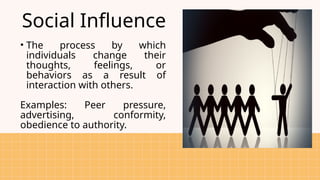
Social Influence
• Theprocess by which
individuals change their
thoughts, feelings, or
behaviors as a result of
interaction with others.
Examples: Peer pressure,
advertising, conformity,
obedience to authority.
4.
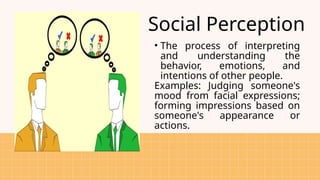
Social Perception
• Theprocess of interpreting
and understanding the
behavior, emotions, and
intentions of other people.
Examples: Judging someone's
mood from facial expressions;
forming impressions based on
someone's appearance or
actions.
5.
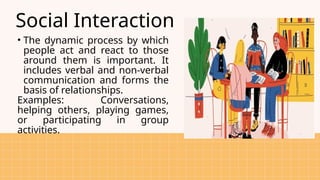
Social Interaction
• Thedynamic process by which
people act and react to those
around them is important. It
includes verbal and non-verbal
communication and forms the
basis of relationships.
Examples: Conversations,
helping others, playing games,
or participating in group
activities.
6.
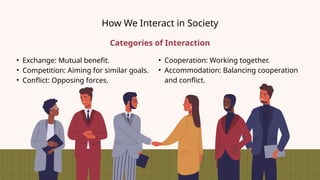
How We Interactin Society
Categories of Interaction
• Exchange: Mutual benefit.
• Competition: Aiming for similar goals.
• Conflict: Opposing forces.
• Cooperation: Working together.
• Accommodation: Balancing cooperation
and conflict.
7.
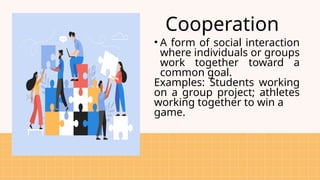
Cooperation
• A formof social interaction
where individuals or groups
work together toward a
common goal.
Examples: Students working
on a group project; athletes
working together to win a
game.
8.
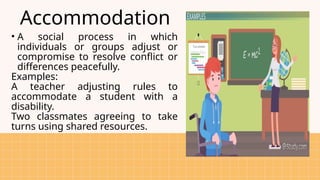
Accommodation
• A socialprocess in which
individuals or groups adjust or
compromise to resolve conflict or
differences peacefully.
Examples:
A teacher adjusting rules to
accommodate a student with a
disability.
Two classmates agreeing to take
turns using shared resources.
9.
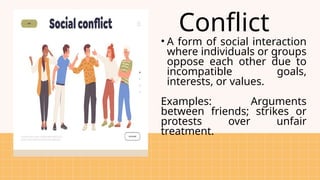
Conflict
• A formof social interaction
where individuals or groups
oppose each other due to
incompatible goals,
interests, or values.
Examples: Arguments
between friends; strikes or
protests over unfair
treatment.
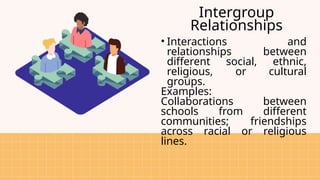
Intergroup
Relationships
• Interactions and
relationshipsbetween
different social, ethnic,
religious, or cultural
groups.
Examples:
Collaborations between
schools from different
communities; friendships
across racial or religious
lines.
13.
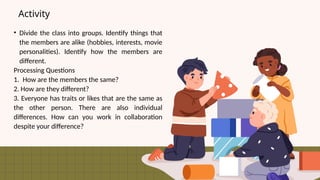
• Divide theclass into groups. Identify things that
the members are alike (hobbies, interests, movie
personalities). Identify how the members are
different.
Processing Questions
1. How are the members the same?
2. How are they different?
3. Everyone has traits or likes that are the same as
the other person. There are also individual
differences. How can you work in collaboration
despite your difference?
Activity
14.
Plaque of Appreciation
•Make a plaque of appreciation
out of recycled materials to a
person or group of persons who
are significant in your life.
Carefully craft the words that
you will place on the plaque.
Performance Task