School Community and
teaching
Group Assignment
Sara Amjad 2018-2334
Nimra Muzaffar 2018-2342
Ayesha Saeed. 2018-2325
Mishal Basit 2018-2345
Awais Alam. 2018-2328
Understanding of social
interaction and socialization
in educational context.
Meaning of social interaction and socialization
● Social interaction and socialization:
A social interaction is an exchange between two or more individuals and is a building block of
society. Social interaction can be studied between groups of two (dyads), three (triads) or larger
social groups. By interacting with one another, people design rules, institutions and systems within
which they seek to live.
● Importance:
The role of socialization is to acquaint individuals with the norms of a given social group or
society. It prepares individuals to participate in a group by illustrating the expectations of
that group. Socialization is very important for children, who begin the process at home with
family, and continue it at school.
Social interaction and socialization in education
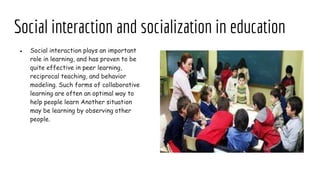
● Social interaction plays an important
role in learning, and has proven to be
quite effective in peer learning,
reciprocal teaching, and behavior
modeling. Such forms of collaborative
learning are often an optimal way to
help people learn Another situation
may be learning by observing other
people.
Classroom interaction
● Classroom interaction, classroom behaviour Describes the form and content of behaviour or
social interaction in the classroom. In particular, research on gender, class, and 'race' in
education has examined the relationship between teacher and students in the classroom.
● One of our students stated: “Social interaction is important in the classroom because it gets
students to communication with each other.Teachers must become lifelong learners who
continue to develop and hone their craft by observing students, working with other teachers,
and reflecting on their own teaching.
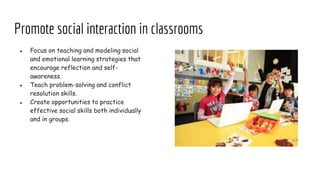
Promote social interaction in classrooms
● Focus on teaching and modeling social
and emotional learning strategies that
encourage reflection and self-
awareness.
● Teach problem-solving and conflict
resolution skills.
● Create opportunities to practice
effective social skills both individually
and in groups.
Functions of teacher’s role
● The teacher's role as a socializing agent is to help the child deal with postions of authority, to
cooperate with others, to cope with problems, and to achieve competence. Effective teacher
are warm, enthusiastic, and generous with praise, and have high status.
● The teacher's leadership style, management style, and expectations affect how the student
learns. Teachers' expectations of children often influence their interactions with them and,
consequently, the children's performance. Teachers need to be aware of their responces to
gender, to children from diverse cultural groups, to children from various social classes and
religions, and to those at risk for negative developmental outcomes because of poverty,
substance abuse or violence in the family.
Level of Social Interaction
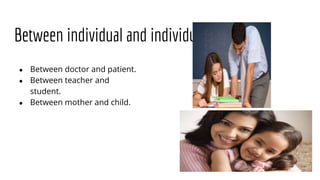
● Between individual and individual
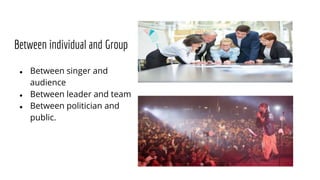
● Between individual and group
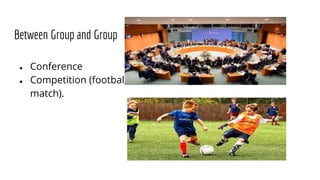
● Between group and group
● Between individual and culture.
Between individual and individual
● Between doctor and patient.
● Between teacher and
student.
● Between mother and child.
Between individual and Group
● Between singer and
audience
● Between leader and team
● Between politician and
public.
Between Group and Group
● Conference
● Competition (football
match).
Between individual and culture
• Norms customs values tradition
Types of Social Interaction
● Exchange
● Competition
● Conflict
● Cooperation
● Accommodation
Exchange
● Individuals, group,
societies interact in an
effort to receive a
reward for their
actions.
ExchangeTheory
• People are motivated by self
interest
• Rewarded behavior tends to be
repeated.
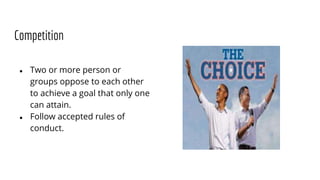
Competition
● Two or more person or
groups oppose to each other
to achieve a goal that only one
can attain.
● Follow accepted rules of
conduct.
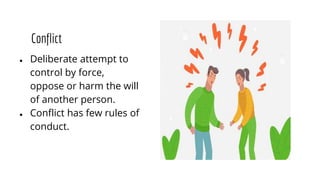
Conflict
● Deliberate attempt to
control by force,
oppose or harm the will
of another person.
● Conflict has few rules of
conduct.
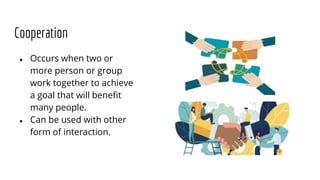
Cooperation
● Occurs when two or
more person or group
work together to achieve
a goal that will benefit
many people.
● Can be used with other
form of interaction.
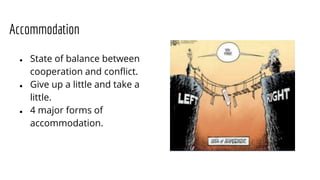
Accommodation
● State of balance between
cooperation and conflict.
● Give up a little and take a
little.
● 4 major forms of
accommodation.
4 Types of Accommodation
Elements of Social
Interaction
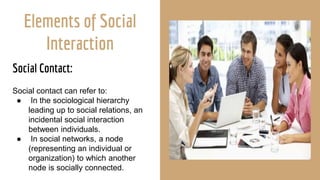
Social Contact:
Social contact can refer to:
● In the sociological hierarchy
leading up to social relations, an
incidental social interaction
between individuals.
● In social networks, a node
(representing an individual or
organization) to which another
node is socially connected.
Why is Social Contact Important?
Social contact helps us to cope with stress and major life
changes like a divorce, redundancy and moving house. And
knowing that we are valued by others is an important
psychological factor in helping us to forget the negative
aspects of our lives, and thinking more positively about our
environment.
How to Build a Social Network:
A social network comprises a group of friends and
acquaintances that share similar interests, careers or both.
Building a social network online can also mean gaining an
audience that will in turn benefit your career or your political
clout. Building an effective social network will mean that you
will always have contacts to help you with your personal or
career endeavors.
Communication
“Communication can be used to
produce social interaction.”
In their daily course of living, human
being develop and maintain bonds,
intimacy, relations and associations.
Communication Functions:
There are four communication Functions.
● Regulation or Control
● Social Interaction
● Motivation
● Information
Social Attitude and Values:
Social Values:
“Social values refers to human or moral values or principles that are
essentially desirable for the well being of an individual, a group or a
society.”
Important Social Values:
● Truth and Honesty. • Justice and Kindness
● Generosity. • Tolerance
● Patriotism. • Co-operation
● Respect for senior or elders. • Excellence
Social Attitude:
“Attitude of individual or groups with respect to social objects or
phenomenon such as persons, races, institutions or traits.”
Attitudes are the response that is a result of our values. Values decide what
we think as for right, wrong, good, or unjust. Attitudes are our likes and dislike
of things, people, and objects. Values are more or less permanent in nature.
Attitudes are changeable with favorable experiences.
School Community and Teaching