Social Innovation
Prof Ute Stephan
Aston University
SEFORIS Research Consortium
u.stephan@aston.ac.uk
Nottingham, 15 April 2015
Social innovation
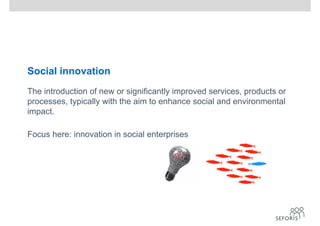
The introduction of new or significantly improved services, products or
processes, typically with the aim to enhance social and environmental
impact.
Focus here: innovation in social enterprises
Why innovation? What triggered this reserach ...
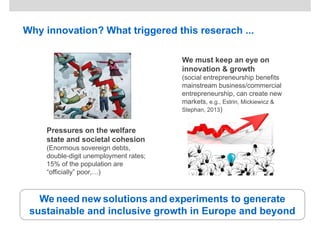
Pressures on the welfare
state and societal cohesion
(Enormous sovereign debts,
double-digit unemployment rates;
15% of the population are
“officially” poor,…)
We must keep an eye on
innovation & growth
(social entrepreneurship benefits
mainstream business/commercial
entrepreneurship, can create new
markets, e.g., Estrin, Mickiewicz &
Stephan, 2013)
We need new solutions and experiments to generate
sustainable and inclusive growth in Europe and beyond
Informed by evidence …
• from two ambitious international research projects 2008-2017
Rich, cross-country comparable panel dataset documenting the behaviors
of over 500 social enterprises in 5 countries at two moments in time,
currently extending to 9 countries including Russia and China.
• ‘what-works’ evidence review on how to drive social change funded
by NBS
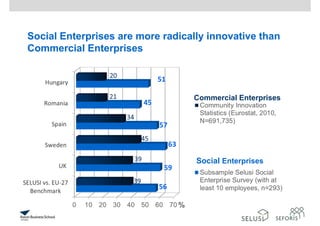
Social Enterprises are more radically innovative than
Commercial Enterprises
Social Enterprises
Commercial Enterprises
%
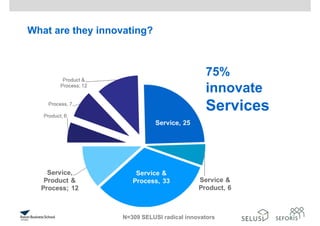
What are they innovating?
N=309 SELUSI radical innovators
75%
innovate
Services
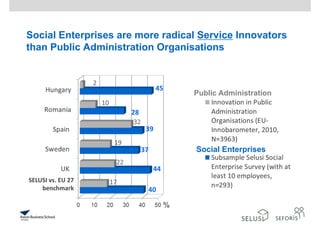
Social Enterprises are more radical Service Innovators
than Public Administration Organisations
Social Enterprises
Public Administration
SELUSI vs. EU 27 
benchmark
%
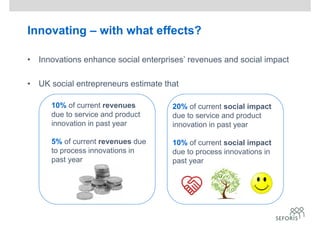
Innovating – with what effects?
• Innovations enhance social enterprises’ revenues and social impact
• UK social entrepreneurs estimate that
10% of current revenues
due to service and product
innovation in past year
5% of current revenues due
to process innovations in
past year
20% of current social impact
due to service and product
innovation in past year
10% of current social impact
due to process innovations in
past year
Key drivers (and barriers)
to innovation in social enterprises
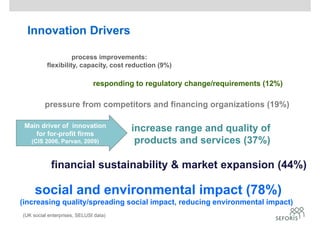
Innovation Drivers
social and environmental impact (78%)
(increasing quality/spreading social impact, reducing environmental impact)
increase range and quality of
products and services (37%)
financial sustainability & market expansion (44%)
pressure from competitors and financing organizations (19%)
process improvements:
flexibility, capacity, cost reduction (9%)
responding to regulatory change/requirements (12%)
Main driver of innovation
for for-profit firms
(CIS 2006, Parvan, 2009)
(UK social enterprises, SELUSI data)
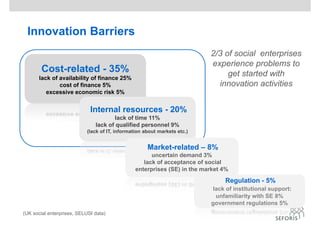
Innovation Barriers
2/3 of social enterprises
experience problems to
get started with
innovation activities
Cost-related - 35%
lack of availability of finance 25%
cost of finance 5%
excessive economic risk 5%
Internal resources - 20%
lack of time 11%
lack of qualified personnel 9%
(lack of IT, information about markets etc.)
Market-related – 8%
uncertain demand 3%
lack of acceptance of social
enterprises (SE) in the market 4%
Regulation - 5%
lack of institutional support:
unfamiliarity with SE 8%
government regulations 5%
(UK social enterprises, SELUSI data)
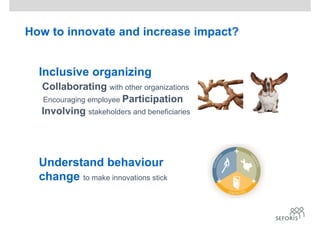
How to innovate and increase impact?
Inclusive organizing
Collaborating with other organizations
Encouraging employee Participation
Involving stakeholders and beneficiaries
Understand behaviour
change to make innovations stick
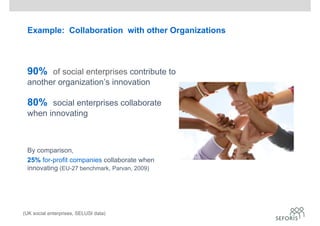
Example: Collaboration with other Organizations
90% of social enterprises contribute to
another organization’s innovation
80% social enterprises collaborate
when innovating
By comparison,
25% for-profit companies collaborate when
innovating (EU-27 benchmark, Parvan, 2009)
(UK social enterprises, SELUSI data)
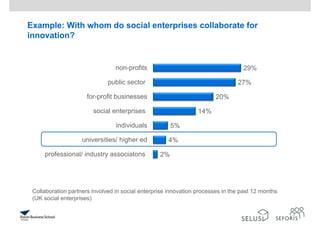
Example: With whom do social enterprises collaborate for
innovation?
Collaboration partners involved in social enterprise innovation processes in the past 12 months
(UK social enterprises)
29%
27%
20%
14%
5%
4%
2%
non-profits
public sector
for-profit businesses
social enterprises
individuals
universities/ higher ed
professional/ industry associatons
Understand ‘behaviour change’ to make
innovations stick
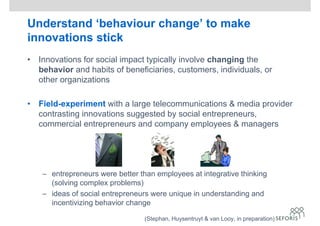
• Innovations for social impact typically involve changing the
behavior and habits of beneficiaries, customers, individuals, or
other organizations
• Field-experiment with a large telecommunications & media provider
contrasting innovations suggested by social entrepreneurs,
commercial entrepreneurs and company employees & managers
– entrepreneurs were better than employees at integrative thinking
(solving complex problems)
– ideas of social entrepreneurs were unique in understanding and
incentivizing behavior change
(Stephan, Huysentruyt & van Looy, in preparation)
So how to change behaviour …?
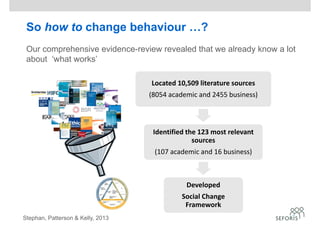
Our comprehensive evidence-review revealed that we already know a lot
about ‘what works’
Located 10,509 literature sources  
(8054 academic and 2455 business)
Located 10,509 literature sources  
(8054 academic and 2455 business)
Identified the 123 most relevant 
sources
(107 academic and 16 business) 
Identified the 123 most relevant 
sources
(107 academic and 16 business) 
Developed
Social Change 
Framework 
Developed
Social Change 
Framework 
Stephan, Patterson & Kelly, 2013
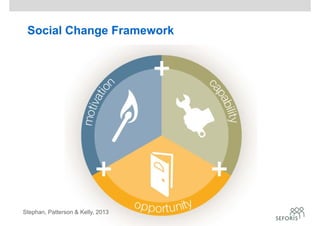
Social Change Framework
Motivation Capability Opportunity
Stephan, Patterson & Kelly, 2013
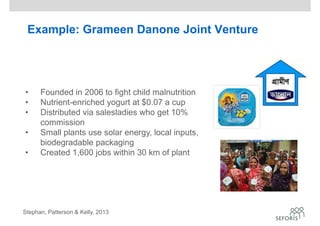
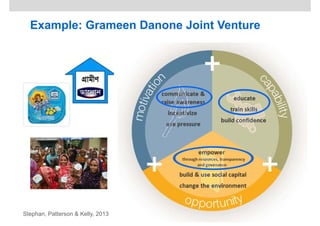
Example: Grameen Danone Joint Venture
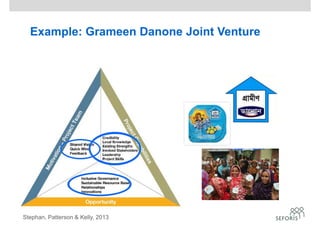
• Founded in 2006 to fight child malnutrition
• Nutrient-enriched yogurt at $0.07 a cup
• Distributed via salesladies who get 10%
commission
• Small plants use solar energy, local inputs,
biodegradable packaging
• Created 1,600 jobs within 30 km of plant
Stephan, Patterson & Kelly, 2013
Example: Grameen Danone Joint Venture
Stephan, Patterson & Kelly, 2013
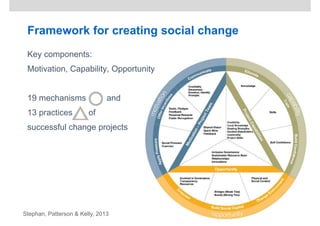
Key components:
Motivation, Capability, Opportunity
19 mechanisms and
13 practices of
successful change projects
Framework for creating social change
Stephan, Patterson & Kelly, 2013
Example: Grameen Danone Joint Venture
Personal Reflection:
Higher Education and
Social Innovation
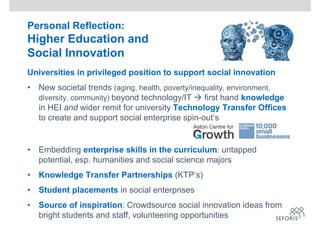
Universities in privileged position to support social innovation
• New societal trends (aging, health, poverty/inequality, environment,
diversity, community) beyond technology/IT  first hand knowledge
in HEI and wider remit for university Technology Transfer Offices
to create and support social enterprise spin-out’s
• Embedding enterprise skills in the curriculum: untapped
potential, esp. humanities and social science majors
• Knowledge Transfer Partnerships (KTP’s)
• Student placements in social enterprises
• Source of inspiration: Crowdsource social innovation ideas from
bright students and staff, volunteering opportunities
THANK YOU - Questions?
Prof Ute Stephan
Aston Business School
Birmingham, UK
U.Stephan@aston.ac.uk
EU-funded Social Enterprise Projects
www.selusi.eu
www.seforis.eu
Social Change Project
(Social Change/Impact Wheel, Stephan, Patterson & Kelly, 2013)
http://nbs.net/knowledge/stakeholder/social-change/executive-report/

Social Innovation

  • 1.
    Social Innovation Prof UteStephan Aston University SEFORIS Research Consortium u.stephan@aston.ac.uk Nottingham, 15 April 2015
  • 2.
    Social innovation The introductionof new or significantly improved services, products or processes, typically with the aim to enhance social and environmental impact. Focus here: innovation in social enterprises
  • 3.
    Why innovation? Whattriggered this reserach ... Pressures on the welfare state and societal cohesion (Enormous sovereign debts, double-digit unemployment rates; 15% of the population are “officially” poor,…) We must keep an eye on innovation & growth (social entrepreneurship benefits mainstream business/commercial entrepreneurship, can create new markets, e.g., Estrin, Mickiewicz & Stephan, 2013) We need new solutions and experiments to generate sustainable and inclusive growth in Europe and beyond
  • 5.
    Informed by evidence… • from two ambitious international research projects 2008-2017 Rich, cross-country comparable panel dataset documenting the behaviors of over 500 social enterprises in 5 countries at two moments in time, currently extending to 9 countries including Russia and China. • ‘what-works’ evidence review on how to drive social change funded by NBS
  • 6.
    Social Enterprises aremore radically innovative than Commercial Enterprises Social Enterprises Commercial Enterprises %
  • 7.
    What are theyinnovating? N=309 SELUSI radical innovators 75% innovate Services
  • 8.
    Social Enterprises aremore radical Service Innovators than Public Administration Organisations Social Enterprises Public Administration SELUSI vs. EU 27  benchmark %
  • 9.
    Innovating – withwhat effects? • Innovations enhance social enterprises’ revenues and social impact • UK social entrepreneurs estimate that 10% of current revenues due to service and product innovation in past year 5% of current revenues due to process innovations in past year 20% of current social impact due to service and product innovation in past year 10% of current social impact due to process innovations in past year
  • 10.
    Key drivers (andbarriers) to innovation in social enterprises
  • 11.
    Innovation Drivers social andenvironmental impact (78%) (increasing quality/spreading social impact, reducing environmental impact) increase range and quality of products and services (37%) financial sustainability & market expansion (44%) pressure from competitors and financing organizations (19%) process improvements: flexibility, capacity, cost reduction (9%) responding to regulatory change/requirements (12%) Main driver of innovation for for-profit firms (CIS 2006, Parvan, 2009) (UK social enterprises, SELUSI data)
  • 12.
    Innovation Barriers 2/3 ofsocial enterprises experience problems to get started with innovation activities Cost-related - 35% lack of availability of finance 25% cost of finance 5% excessive economic risk 5% Internal resources - 20% lack of time 11% lack of qualified personnel 9% (lack of IT, information about markets etc.) Market-related – 8% uncertain demand 3% lack of acceptance of social enterprises (SE) in the market 4% Regulation - 5% lack of institutional support: unfamiliarity with SE 8% government regulations 5% (UK social enterprises, SELUSI data)
  • 13.
    How to innovateand increase impact?
  • 14.
    How to innovateand increase impact? Inclusive organizing Collaborating with other organizations Encouraging employee Participation Involving stakeholders and beneficiaries Understand behaviour change to make innovations stick
  • 15.
    Example: Collaboration withother Organizations 90% of social enterprises contribute to another organization’s innovation 80% social enterprises collaborate when innovating By comparison, 25% for-profit companies collaborate when innovating (EU-27 benchmark, Parvan, 2009) (UK social enterprises, SELUSI data)
  • 16.
    Example: With whomdo social enterprises collaborate for innovation? Collaboration partners involved in social enterprise innovation processes in the past 12 months (UK social enterprises) 29% 27% 20% 14% 5% 4% 2% non-profits public sector for-profit businesses social enterprises individuals universities/ higher ed professional/ industry associatons
  • 17.
    Understand ‘behaviour change’to make innovations stick • Innovations for social impact typically involve changing the behavior and habits of beneficiaries, customers, individuals, or other organizations • Field-experiment with a large telecommunications & media provider contrasting innovations suggested by social entrepreneurs, commercial entrepreneurs and company employees & managers – entrepreneurs were better than employees at integrative thinking (solving complex problems) – ideas of social entrepreneurs were unique in understanding and incentivizing behavior change (Stephan, Huysentruyt & van Looy, in preparation)
  • 18.
    So how tochange behaviour …? Our comprehensive evidence-review revealed that we already know a lot about ‘what works’ Located 10,509 literature sources   (8054 academic and 2455 business) Located 10,509 literature sources   (8054 academic and 2455 business) Identified the 123 most relevant  sources (107 academic and 16 business)  Identified the 123 most relevant  sources (107 academic and 16 business)  Developed Social Change  Framework  Developed Social Change  Framework  Stephan, Patterson & Kelly, 2013
  • 19.
    Social Change Framework MotivationCapability Opportunity Stephan, Patterson & Kelly, 2013
  • 20.
    Example: Grameen DanoneJoint Venture • Founded in 2006 to fight child malnutrition • Nutrient-enriched yogurt at $0.07 a cup • Distributed via salesladies who get 10% commission • Small plants use solar energy, local inputs, biodegradable packaging • Created 1,600 jobs within 30 km of plant Stephan, Patterson & Kelly, 2013
  • 21.
    Example: Grameen DanoneJoint Venture Stephan, Patterson & Kelly, 2013
  • 22.
    Key components: Motivation, Capability,Opportunity 19 mechanisms and 13 practices of successful change projects Framework for creating social change Stephan, Patterson & Kelly, 2013
  • 23.
    Stephan, Patterson &Kelly, 2013 Example: Grameen Danone Joint Venture
  • 24.
    Personal Reflection: Higher Educationand Social Innovation Universities in privileged position to support social innovation • New societal trends (aging, health, poverty/inequality, environment, diversity, community) beyond technology/IT  first hand knowledge in HEI and wider remit for university Technology Transfer Offices to create and support social enterprise spin-out’s • Embedding enterprise skills in the curriculum: untapped potential, esp. humanities and social science majors • Knowledge Transfer Partnerships (KTP’s) • Student placements in social enterprises • Source of inspiration: Crowdsource social innovation ideas from bright students and staff, volunteering opportunities
  • 25.
    THANK YOU -Questions? Prof Ute Stephan Aston Business School Birmingham, UK U.Stephan@aston.ac.uk EU-funded Social Enterprise Projects www.selusi.eu www.seforis.eu Social Change Project (Social Change/Impact Wheel, Stephan, Patterson & Kelly, 2013) http://nbs.net/knowledge/stakeholder/social-change/executive-report/