SOCIAL GEOGRAPHY
PAUL C. ESGUERRA
Geography
Geography is the study of places and the relationships
between people and their environments. Geographers explore
both the physical properties of Earth’s surface and the human
societies spread across it. They also examine how human
culture interacts with the natural environment and the way that
locations and places can have an impact on people. Geography
seeks to understand where things are found, why they are
there, and how they develop and change over time.
Two Types of Geography:
1. Physical Geography: The study
of where any why natural forces
occur as they do (climates,
landforms, types of vegetation,
etc)
2. Human Geography: Study of
where and why human activities
are located where they are
(religions, cities, businesses,
governments, etc)
Human Geography has a theme
of 2 interrelated but converse
themes - Globalization and
Local Diversity
THE FIVE THEMES OF GEOGRAPHY:
Location
Place
Human-Environment Interaction
Movement
Regions
Space: Distribution of Features
◦Space refers to the physical gap or interval
between two objects.
◦Geographers think about the arrangement of
people and activities in an attempt to try to
understand why they are in such a distribution
(the arrangement of a feature in space)
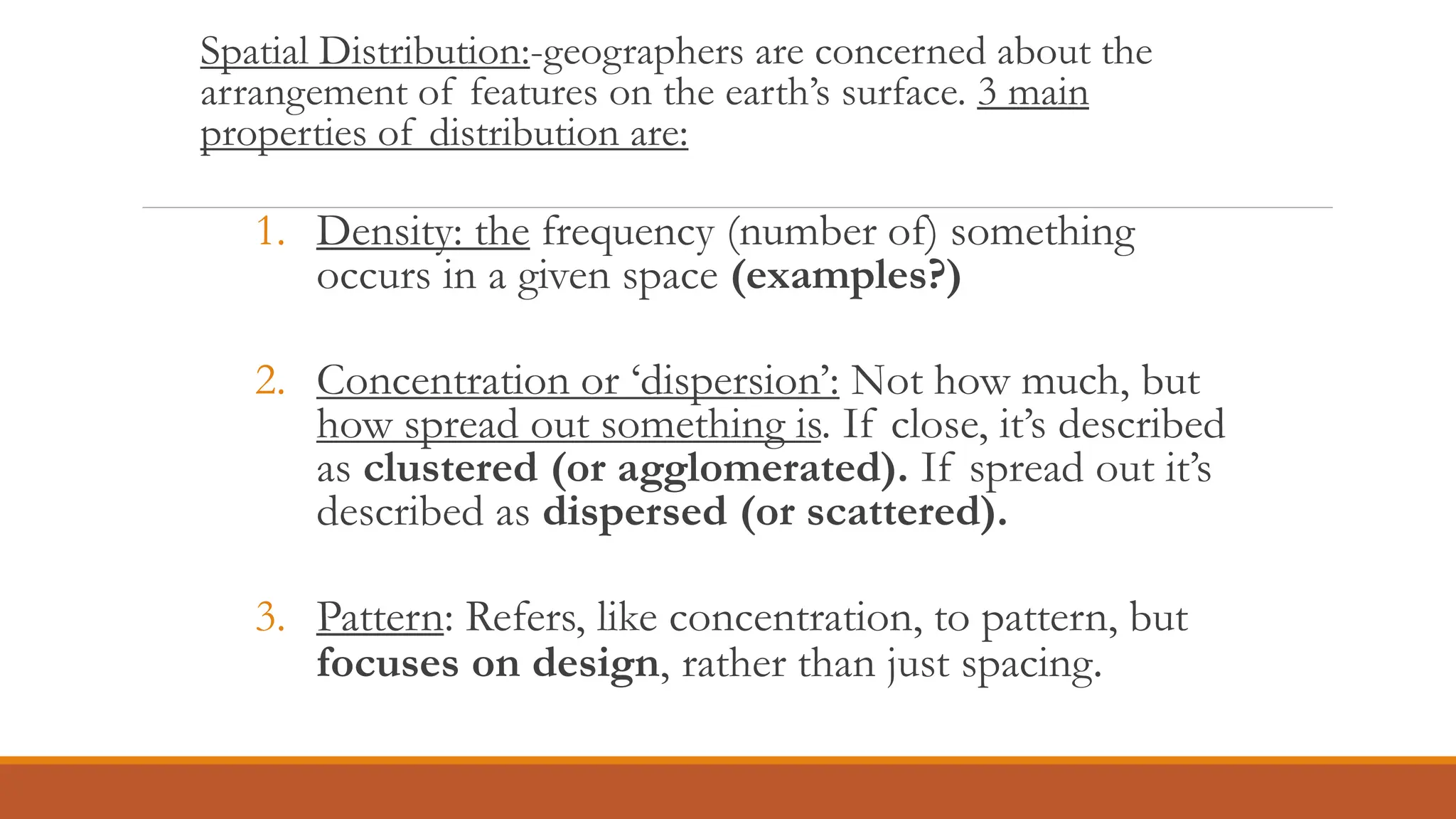
Spatial Distribution:-geographers are concerned about the
arrangement of features on the earth’s surface. 3 main
properties of distribution are:
1. Density: the frequency (number of) something
occurs in a given space (examples?)
2. Concentration or ‘dispersion’: Not how much, but
how spread out something is. If close, it’s described
as clustered (or agglomerated). If spread out it’s
described as dispersed (or scattered).
3. Pattern: Refers, like concentration, to pattern, but
focuses on design, rather than just spacing.
Density-In A we see 6 houses on 1 acre of land. And in B we see 12 houses per
acre
Concentration-in A we see the houses dispersed and in B we see them clustered.
Pattern-in A the houses are in a single linear arrangement, in B the arrangement is
irregular.
PLACE
What is it like there, what kind of place is it?
Human
Characteristics
◦ What are the main languages,
customs, and beliefs.
◦ How many people live, work, and
visit a place.
Physical
Characteristics
◦ Landforms (mountains, rivers,
etc.), climate, vegetation, wildlife,
soil, etc.
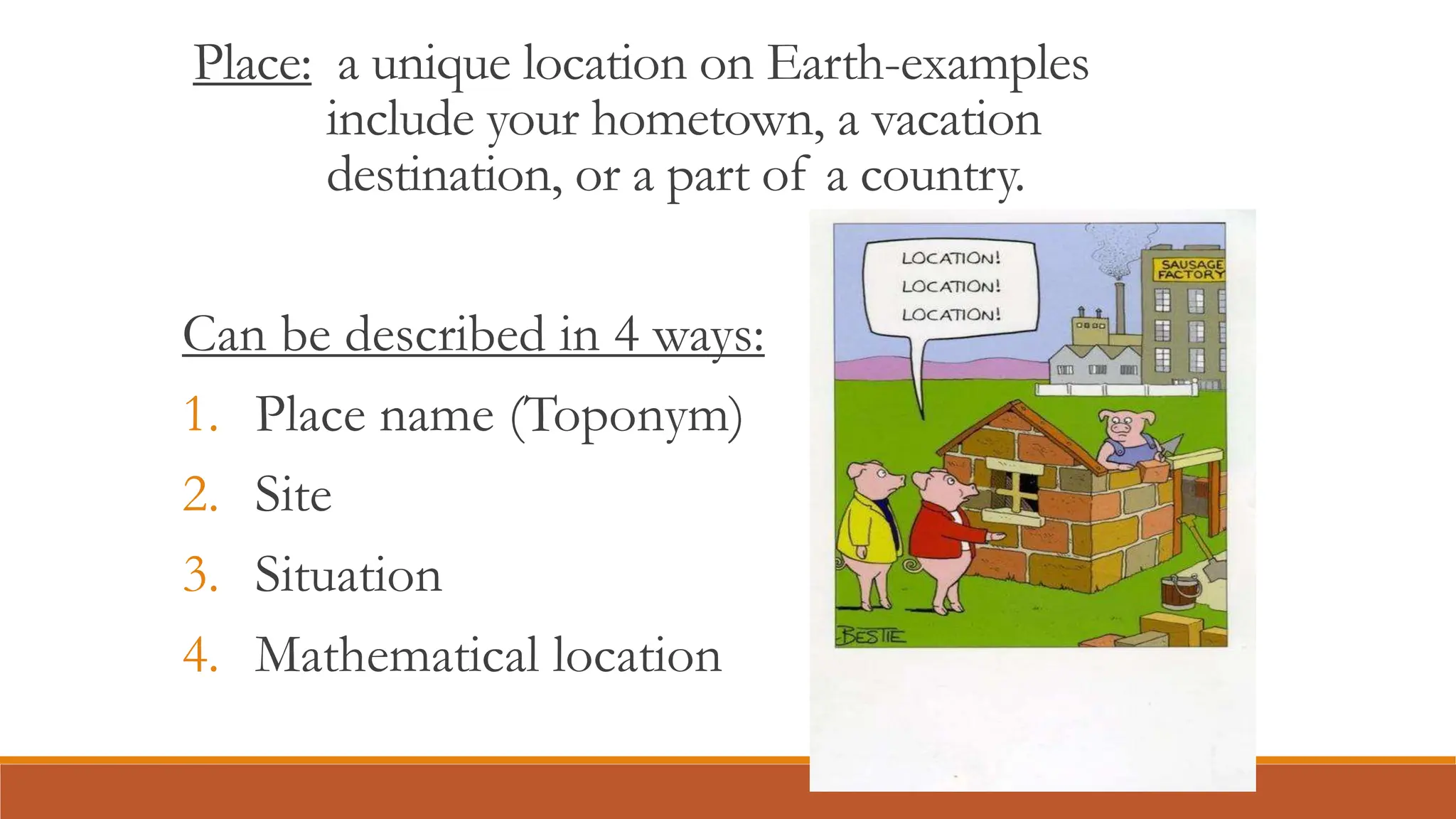
Place: a unique location on Earth-examples
include your hometown, a vacation
destination, or a part of a country.
Can be described in 4 ways:
1. Place name (Toponym)
2. Site
3. Situation
4. Mathematical location
Toponym: name given to a
place on Earth. Can be
named after a person, a
religion, resources, or
features of physical
environment
Toponymy is the scientific
study of place-names, along
with their origins and
meanings, based on
etymological, historical, and
geographical information
H. Frank Carey High School
Bolivia – Simon Bolivar
Colombia – Christopher Columbus
America – Amerigo Vespucci
Philippines – King Philip II of Spain
Washington, D.C. – George Washington
Georgia (US) – King George of England
Baltimore – Lord Baltimore
Vietnam – Ho Chi Minh City- (Self
Explanatory)
St. Petersburg
Petrograd
Leningrad
St. Petersburg
Reflects political changes…
Changed to Petrograd in 1914 because Russians thought St.
Petersburg sounded too German. Renamed Leningrad in 1924, 3
days after Lenin’s death. Renamed St. Petersburg in 1991 after the
collapse of the Soviet Union.
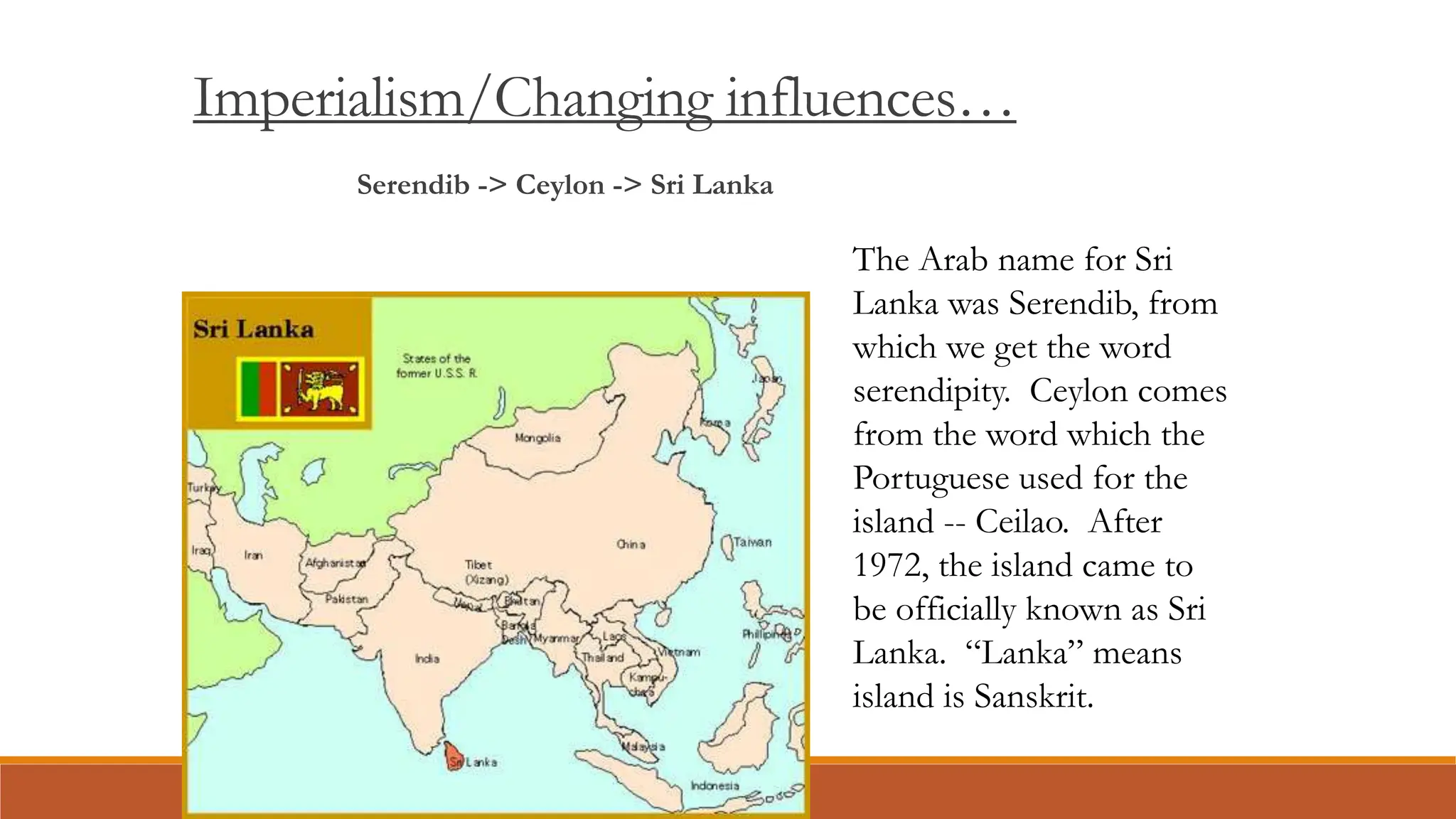
Imperialism/Changing influences…
Serendib -> Ceylon -> Sri Lanka
The Arab name for Sri
Lanka was Serendib, from
which we get the word
serendipity. Ceylon comes
from the word which the
Portuguese used for the
island -- Ceilao. After
1972, the island came to
be officially known as Sri
Lanka. “Lanka” means
island is Sanskrit.
HUMAN-ENVIRONMENT INTERACTION
How humans and the environment have affected each other.
◦ We depend on it.
◦ People depend on the River for water and transportation.
◦ We modify it.
◦ People modify our environment by
heating and cooling buildings for comfort.
◦ We adapt to it.
◦ We adapt to the environment by wearing
clothing suitable for summer (shorts) and
winter (coats), rain and shine.
MOVEMENT
Movement is how people, goods, and ideas are moved from place to
place.
◦ Human Movement
◦ Trucks, Trains, Planes
◦ Information Movement
◦ Phones, computer (email), mail
◦ Idea Movement
◦ How do fads move from place to place?
TV, Radio, Magazines
REGIONS
Regions are areas that share some
common characteristics.
◦Formal Regions
◦ Regions defined by governmental or administrative
boundaries (States, Countries, Cities)
◦ Regions defined by similar characteristics (Corn Belt,
Rocky Mountain region, Chinatown).
◦Functional Regions
◦ Regions defined by a function (newspaper service
area, cell phone coverage area).
What is Social Geography?
Social geography is concerned with the ways in which social
relations, social identities, and social inequalities are
produced, their spatial variation, and the role of space in
constructing them. It places particular emphasis on the
welfare issues which affect people’s lives, and aims to
expose the forms of power which lead to social and spatial
inequality and oppression” (Pain et al, 2001: 1)
More definitions
The identification of different regions of the earth’s surface
according to associations of social phenomena related to the total
environment (Watson, 1957: 482)
the study of the patterns and processes (required) in understanding
socially defined populations in a spatial setting (Pahl, 1965: 81)
the study of the areal (spatial) patterns and functional relations of
social groups in the context of their social environment; the internal
structure and external relations of the nodes of social activity, and
the articulation of various channels of social communication
(Buttimer, 1968: 144)
the analysis of the social patterns and processes arising from the
distribution of, and access to, scarce resources and... an
examination of the societal causes of, and suggested solutions
to, social and environmental problems (Eyles, 1974: 65)
The understanding of ‘the patterns which arise from’ the use
social groups make of space as they see it, and of the processes
involved in making and changing such patterns (Jones, 1975: 7)
(it) stressed structure relations in the analysis of social
problems...
Social geography involves going beyond
personal experiences and opinions to understand
broader social issues, patterns and possibilities.
Focus on space and socio-spatial. Space is not
just passive, but fundamental to social
relationships and hierarchies e.g. a lecture
theatre, a prison.
Scope Of Social Geography
Social Geography is primarily concerned with the ways in
which social relations, identities and inequalities are
created.
How these social creations vary over space and the role of
space in their construction is the principle distinction
between sociology and social geography.
Social Interaction and relations
•According to PANOPIO,1997, Social interaction refers to
the mutual inter stimulation and response between two or
more persons and groups through symbols, language,
gestures and expression of ideas.
• Social interaction is the foundation of society. Without
interaction there would be no group life.
Social interaction has different form of
interaction:
1. Between individual to individual
2. Between Individual to Groups
3. Between groups to groups
4. Between individual and culture
Types of Social Groups
1. Primary Group (Families, Play groups)
2. Secondary Group (industrial workers, Faculty Staff)
3. According Self-identification(LGBTQIA+)
4. According to purpose
5. According to geographic location
Community and Society
• The Primary difference between a community and Society is
that a community is limited to a specific geographic location,
but a society can be made up of people who live in different
places. Another difference is that a society is made up of direct
and indirect social connections between people, but a
community is made up of individuals who are more closely
connected. For example, people who live in town represent a
community, whereas everyone who lives in the state the town is
located in makes up a society. Several communities can be
located within a society but each society is separate from
another.
Societies often include more diversity, with
people from different backgrounds, social
classes and races. People in communities most
often share similar characteristics.
Concept of Social Space
• A social space is physical or virtual space such as a social
center, online social media, or other gathering place where
people gather and interact.
• Some social spaces such as town squares or parks are public
places and others such as pubs, websites or shopping malls are
private places.
• Henri emphasized that in human society all “Space is social:
It involves assigning more or less appropriated places to social
relations.
Socio-cultural Region
Socio cultural regions helps us to understand the soul of
the place. The well we know the socio cultural regions, it is
easier to understand the people, agriculture, traditions
seasons, and buying selling periods
We can also plot them. For Example Cooking Medium
.Some Socio Cultural regions are mustard oil users and
some may be ground nut oil users. We can also map hard
and soft water. A social planner have many maps. These
maps helps us to know about the particular region.
Social structure
Social structure, in sociology, the distinctive, stable
arrangement of institutions whereby human beings in
a society interact and live together. Social structure is
often treated together with the concept of social
change, which deals with the forces that change the
social structure and the organization of society.
Social structure refers to regularities in social
life, its application is inconsistent. For example,
the term is sometimes wrongly applied when
other concepts such as custom, tradition, role,
or norm would be more accurate.
Studies of social structure attempt to explain such matters
as integration and trends in inequality. In the study of these
phenomena, sociologists analyze organizations, social
categories (such as age groups), or rates (such as of crime or
birth).
SOCIAL PROCESSES
Social processes are the ways in which individuals and groups
interact, adjust and readjust and establish relationships and pattern
of behaviour which are again modified through social interactions.
The concept of social process refers to some of the general and
recurrent forms that social interaction may take. The interaction or
mutual activity is the essence of social life. Interaction between
individuals and groups occurs in the form of social process. A social
process refers to forms of social interaction that occur again and
again.
Meaning of Social Interaction
• Man is a social animal. It is difficult for him to live in
isolation. They always live in groups. As members of these
groups they act in a certain manner. Their behaviour is
mutually affected. This interaction or mutual activity is the
essence of social life. Social life is not possible without
interactions.
• Social interactions are reciprocal relationships which not
only influence the interacting individuals but also the
quality of relationships. According to Gillin and Gillin, “By
social interaction we refer to social relations of all sorts in
functions – dynamic social relations of all kinds – whether
such relations exist between individual and individual,
between group and group and group and individual, as
the case may be”.
Meaning of Social Interaction
• Eldredge and Merrill say, “Social interaction is
thus the general process whereby two or more
persons are in meaningful contact-as a result of
which their behaviour is modified, however,
slightly”. The mere placing of individuals in
physical proximity, although it usually results in
at least a medium of interaction, does not weld
them into a social unit or group.
• When the interacting individuals or groups
influence the behaviour of each other it is called
social interaction. People in action with one another
means interaction of some kind. But not every kind of
action is social.
• When people and their attitudes are involved the
process become social. Social interaction may then
be defined as that dynamic interplay of forces in
which contact between persons and groups result in
a modification of the attitudes and behaviour of the
participants.
• The two basic condition of social interaction
are (i) social contact and (ii) communication. In
the words of Gillin and Gillin, “social contact is
the first phase of interaction”. Social contacts
are always established through the medium of
someone causes sense organ.
Meaning of Social Process
Social processes refer to forms of social interaction that occur
repeatedly. By social processes we mean those ways in which
individuals and groups interact and establish social relationships.
There are various of forms of social interaction such as cooperation,
conflict, competition and accommodation etc.
According to Maclver, “Social process is the manner in
which the relations of the members of a group, once
brought together, acquire a distinctive character” As
Ginsberg says, “Social processes mean the various modes of
interaction between individuals or groups including
cooperation and conflict, social differentiation and
integration, development, arrest and decay”. According to
Horton and Hunt, “The term social process refers to the
repetitive form of behaviour which is commonly found in
social life”.
Elements of Social Geography – Ethnicity, tribe, dialect,
language, Caste and Religion – Concept of Social Well –
being.
RACES- The race is a group of people with more or less
permanent distinguishing characteristics. There are skin
colour and hair colour to which persons concerned attach
certain interpretations. Objectives and scientific
classification are the division of mankind in to racial groups
should be done on the basis of measurable physical features
and qualities inherited from a common ancestor.
The important features on the basis of
which the races are identified and classified
include skin colour, stature, shape of head,
face, nose, eye, type of hair, and blood
group. Human races are classified in to six
broad groups.
Ethnicity
Ethnicity is a concept referring to a shared culture and a way
of life. This can be reflected in language, religion, material
culture such as clothing and cuisine, and cultural products
such as music and art. Ethnicity is often a major source of
social cohesion and social conflict. The world is home to
thousands of different ethnic groups, from the Han Chinese
(the largest ethnic group in the world) to the smallest
indigenous groups, some of which include only a few dozen
people. Almost all of these groups possess a shared history,
language, religion, and culture, which provide group
members with a common identity.
Tribal Religions
Tribal Religions Tribal religions are the special forms
of ethnic religion. The tribal people are generally in
the Neolithic stage of social development. Tribal
people are strikingly different and diverse in their
culture, social and economic life. They cherish their
own distinct and have maintained a close relationship
to the land and natural environment
Most of them live according to their traditions and are
engaged in food gathering, hunting, fishing, primitive
agriculture etc, there are about 300 million indigenous
people worldwide, constituting about four percent of the
total population of the world living in more than sixty
countries. Sometimes the tribal people are being termed as
the fourth world. The first – second and third world believed
that “the land belongs to the people” whereas the fourth
world believes that “the people belongs to the land”.
Tribal Distribution in world. Some major tribal group of the
world particularly who are living and struggling
1. Equatorial Forest region: Pigmy, Semang, Sakai, Boro,
Papuan, etc.
2. Grasslands: Masai, Kyrghizs, etc.
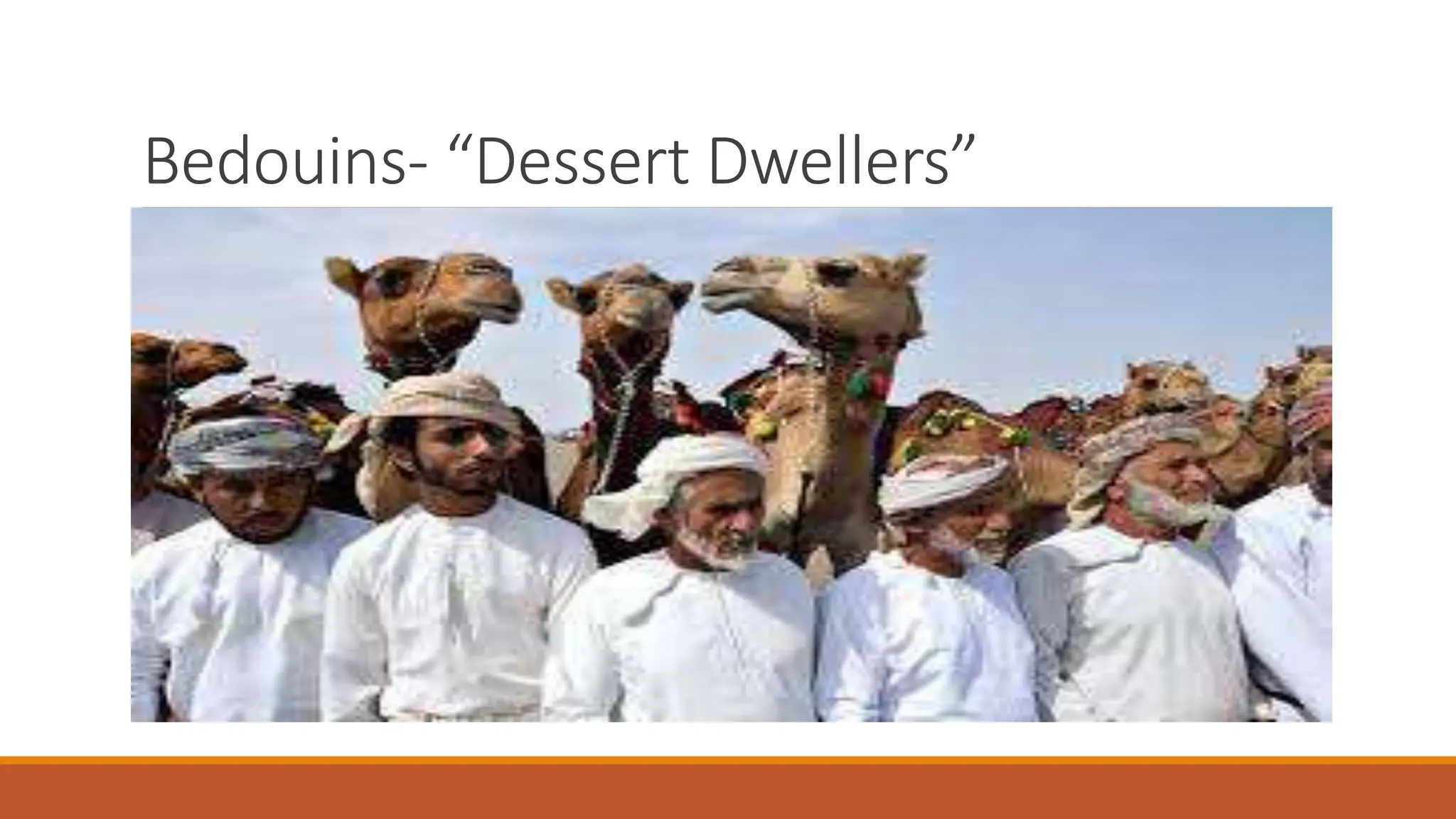
3. Tropical deserts: Bedowin, Bushman, Aborigines etc.
4. Mountainous region: Bhotia, gujjar, Naga etc.
5. Monsoon regions: Gonds, Santhals, Todas, Bhils, etc.
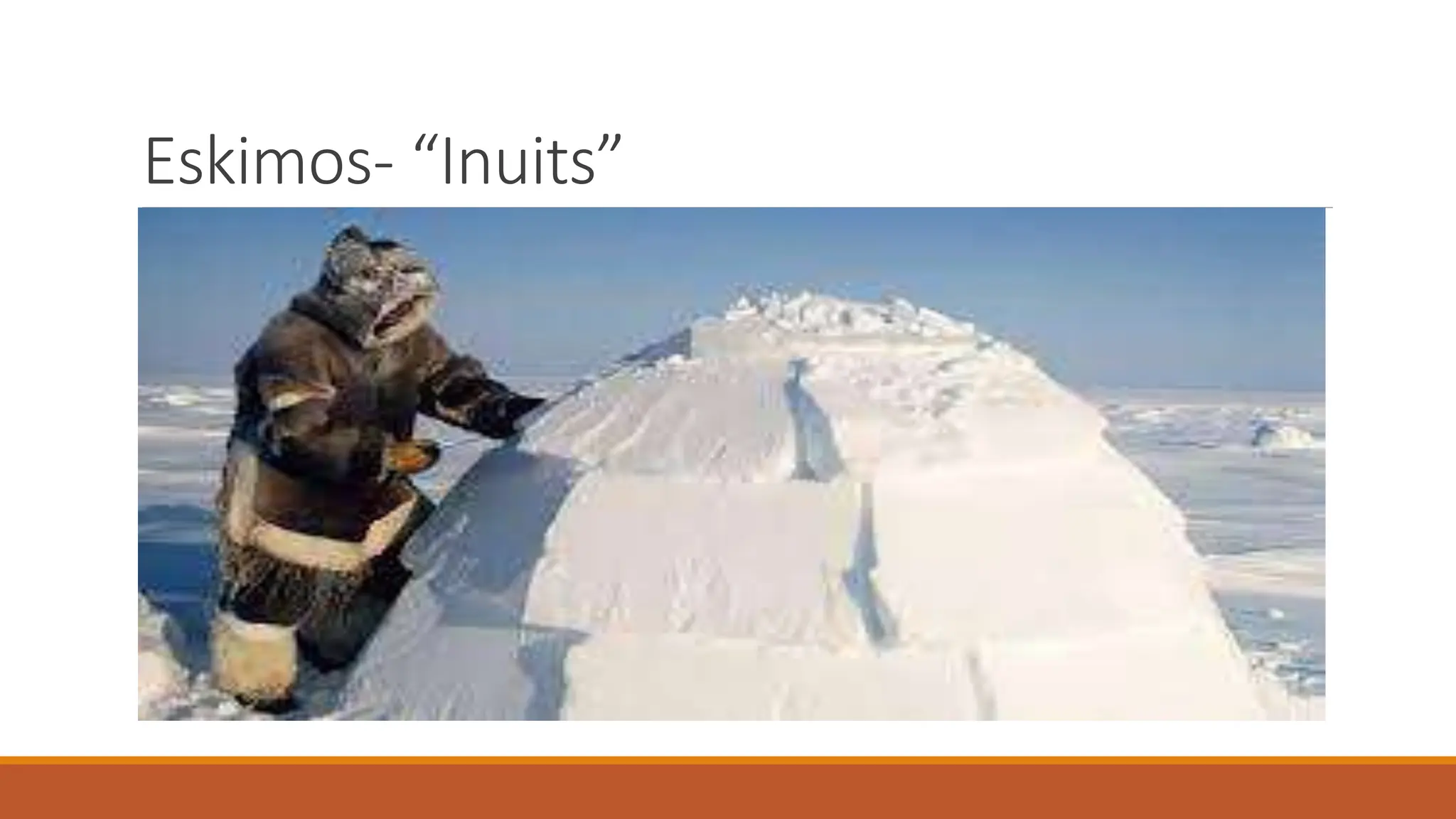
6. Arctic cold regions: Eskimo, Lapp, Alute, Chukchi etc.
Pigmies- “Small People”
Masai- 'high jumping dance'
Bedouins- “Dessert Dwellers”
Eskimos- “Inuits”
Language
Language is an identification mark for different cultures.
Because language is essential to communication, it strongly
influences the sort of political, social and economic we create.
As a result, economic and religious system frequently follows
patterns of language distribution and political borders quite
often parallel linguistic boundaries. In modern times linguistic
diffusion has been facilitated by trade, tourism, media and
international organizations. It has helped in the development of
the linguistic pluralism. The greatest linguistic diversity is
attributed to heterogeneous societies.
Religion
Religion is not a vague fear or unknown powers not the
child of terror, but rather a relation of all the members of a
community to a power that has the good of the community
at heart and protects its law and moral order. Religion
produces a distinct attitude towards life which affects the
further development of the society. Indeed most cultural
situations show the mutual interaction between religion
and socio-economic and politico-cultural factors.
Concept of Social Well-Being
The concept of social well being is given by
David M,Smith Social well being and the quality
of life seems to be synonymous, but this is not
so. Quality of Life implies a rather personalized
concept.whereas reference to aggregates of
people defined by area of residence more
appropriatedly addresses the welfare of some
social group.
The research conducted by Bradburn and Caplovitz in 1965 and by
Bradburn in 1969 on happiness has indicated possibilities for the analysis
of levels of psychological well-being or self-esteem through survey
methods. Stagner in 1970 proposed a set of psychological urban indicators
that would focus on the frequency and intensity of
satisfaction/Dissatisfaction with aspects of urban life perceived as
important by the inhabitants of the city. Indeed the use of Massive
surveys designed to find out what the people themselves think of the
quality of life and the themselves think of the quality of life and the
criteria or conditions impinging on it may be the only way to avoid
introducing the biased values of the academicians and government
officials concerned professionally with social indicator.
Social Geography in the 1960
During the 1960s and early 1970s, the focus of social geography was on
mapping and statistically analysing social inequalities.
Quantitative revolution: geographer analyse social patterns, and geography wastrying
to brand itself as a science.
Behavioural approaches: human behaviour could be scientifically measured and
analysed to discern commonalities and patterns. Human behaviour can be predicted.
Work adopted a positivist approach to social research. Social science attemptsto
provide general rules.
Geography of social problems’
Urbanization: cities preceding at a dramatic pace, multi-cultural,
multi-class. Social issues emerged.
Many books and papers published on the ‘geography of social
problems’,often in an urban context, e.g. a focus on crime,
health, housing, poverty, segregation by class, race.
Social geography as applied social science – if we show how
social inequalities vary over space, then these inequalities can be
addressed by policy makers and service providers. Can help
governments tackle problems.
1970s: Social Geography and Social Justice
Social geography undergoes a transformation. It was a response to a period of
heightened political and social tension emerging out of new movements.
Rise of ‘new social movements’:
- Civil rights
- Feminism
- Gay and lesbian rights
- Disability rights
- Anti-racism
- Post-colonial struggles
- Environmentalism
Marginalised communities articulate their voices. Concepts speak back to powerand
hierarchies.
Who defines “social problems”?
- Greater recognition that social problems are
historically, politically and culturally specific;
generalization across societies becomes more
problematic
- Greater emphasis on providing alternative
explanations and conceptions of social issues,
attentive to everyday lived experience.
- Methodological shifts – from quantitative
methods to qualitative methods (interviews,
focus groups, ethnography, action research).
1980s and 90s: Social Geography
and the ‘Cultural Turn’
- 1980s: cultural turn merges social geography with more
explicitly cultural interpretations.
- Influence of feminism, post-structuralism, post- colonial critiques.
- Rethink geographical foundations.
o What does it mean to be modern? Developed? Value of
knowledge? Production of hierarchies? What does it mean to
be human?
o Beyond empirical geography  philosophical.
- Borders between cultural and social geography become
(andremain) blurry.
- Establishment of Social and Cultural Geography
Social and Cultural Geography [2000-]
“The role of space, place and culture in relation to social issues, cultural politics, aspects of daily
life, cultural commodities, identity and community, and historical legacies” (Gleeson et al, 2000:
6)
Overlap between disciplines.
2000s: Return of ‘the Social’?
Social Geography: its own field? Rethink social geography as distinct
Social Geography, 2005-
Journal focused on continental Europe and Anglo-American Social
Geography.
- Readers, dictionaries and summaries try to delineate the sub-
field of Social Geography
- “Social” relations are a concern of geographers in other sub-
fields (political geography, cultural geography, economic geography,
etc.): justice and injustice, identity, politics, equality
Social Geographers Today
Need to be able to locate disciplinary debates in relation to
different theoretical and political perspectives.
Need to recognize the historical and geographical specificity of
taken-for-granted concepts such as ‘society’ and ‘the social’.
Certain concepts have a history. They are fluid concepts: change
with place, space, time etc.
Need to develop our ‘geographical imaginations’ in light of debates
around:
- Post-humanism (challenge human understanding of the world)

SOCIAL GEOGRAPHY basic concepts and principles

  • 1.
  • 2.
    Geography Geography is thestudy of places and the relationships between people and their environments. Geographers explore both the physical properties of Earth’s surface and the human societies spread across it. They also examine how human culture interacts with the natural environment and the way that locations and places can have an impact on people. Geography seeks to understand where things are found, why they are there, and how they develop and change over time.
  • 3.
    Two Types ofGeography: 1. Physical Geography: The study of where any why natural forces occur as they do (climates, landforms, types of vegetation, etc) 2. Human Geography: Study of where and why human activities are located where they are (religions, cities, businesses, governments, etc) Human Geography has a theme of 2 interrelated but converse themes - Globalization and Local Diversity
  • 4.
    THE FIVE THEMESOF GEOGRAPHY: Location Place Human-Environment Interaction Movement Regions
  • 5.
    Space: Distribution ofFeatures ◦Space refers to the physical gap or interval between two objects. ◦Geographers think about the arrangement of people and activities in an attempt to try to understand why they are in such a distribution (the arrangement of a feature in space)
  • 7.
    Spatial Distribution:-geographers areconcerned about the arrangement of features on the earth’s surface. 3 main properties of distribution are: 1. Density: the frequency (number of) something occurs in a given space (examples?) 2. Concentration or ‘dispersion’: Not how much, but how spread out something is. If close, it’s described as clustered (or agglomerated). If spread out it’s described as dispersed (or scattered). 3. Pattern: Refers, like concentration, to pattern, but focuses on design, rather than just spacing.
  • 8.
    Density-In A wesee 6 houses on 1 acre of land. And in B we see 12 houses per acre Concentration-in A we see the houses dispersed and in B we see them clustered. Pattern-in A the houses are in a single linear arrangement, in B the arrangement is irregular.
  • 9.
    PLACE What is itlike there, what kind of place is it? Human Characteristics ◦ What are the main languages, customs, and beliefs. ◦ How many people live, work, and visit a place. Physical Characteristics ◦ Landforms (mountains, rivers, etc.), climate, vegetation, wildlife, soil, etc.
  • 10.
    Place: a uniquelocation on Earth-examples include your hometown, a vacation destination, or a part of a country. Can be described in 4 ways: 1. Place name (Toponym) 2. Site 3. Situation 4. Mathematical location
  • 11.
    Toponym: name givento a place on Earth. Can be named after a person, a religion, resources, or features of physical environment Toponymy is the scientific study of place-names, along with their origins and meanings, based on etymological, historical, and geographical information H. Frank Carey High School
  • 12.
    Bolivia – SimonBolivar Colombia – Christopher Columbus America – Amerigo Vespucci Philippines – King Philip II of Spain Washington, D.C. – George Washington Georgia (US) – King George of England Baltimore – Lord Baltimore Vietnam – Ho Chi Minh City- (Self Explanatory)
  • 13.
    St. Petersburg Petrograd Leningrad St. Petersburg Reflectspolitical changes… Changed to Petrograd in 1914 because Russians thought St. Petersburg sounded too German. Renamed Leningrad in 1924, 3 days after Lenin’s death. Renamed St. Petersburg in 1991 after the collapse of the Soviet Union.
  • 14.
    Imperialism/Changing influences… Serendib ->Ceylon -> Sri Lanka The Arab name for Sri Lanka was Serendib, from which we get the word serendipity. Ceylon comes from the word which the Portuguese used for the island -- Ceilao. After 1972, the island came to be officially known as Sri Lanka. “Lanka” means island is Sanskrit.
  • 15.
    HUMAN-ENVIRONMENT INTERACTION How humansand the environment have affected each other. ◦ We depend on it. ◦ People depend on the River for water and transportation. ◦ We modify it. ◦ People modify our environment by heating and cooling buildings for comfort. ◦ We adapt to it. ◦ We adapt to the environment by wearing clothing suitable for summer (shorts) and winter (coats), rain and shine.
  • 16.
    MOVEMENT Movement is howpeople, goods, and ideas are moved from place to place. ◦ Human Movement ◦ Trucks, Trains, Planes ◦ Information Movement ◦ Phones, computer (email), mail ◦ Idea Movement ◦ How do fads move from place to place? TV, Radio, Magazines
  • 17.
    REGIONS Regions are areasthat share some common characteristics. ◦Formal Regions ◦ Regions defined by governmental or administrative boundaries (States, Countries, Cities) ◦ Regions defined by similar characteristics (Corn Belt, Rocky Mountain region, Chinatown). ◦Functional Regions ◦ Regions defined by a function (newspaper service area, cell phone coverage area).
  • 18.
    What is SocialGeography? Social geography is concerned with the ways in which social relations, social identities, and social inequalities are produced, their spatial variation, and the role of space in constructing them. It places particular emphasis on the welfare issues which affect people’s lives, and aims to expose the forms of power which lead to social and spatial inequality and oppression” (Pain et al, 2001: 1)
  • 20.
    More definitions The identificationof different regions of the earth’s surface according to associations of social phenomena related to the total environment (Watson, 1957: 482) the study of the patterns and processes (required) in understanding socially defined populations in a spatial setting (Pahl, 1965: 81) the study of the areal (spatial) patterns and functional relations of social groups in the context of their social environment; the internal structure and external relations of the nodes of social activity, and the articulation of various channels of social communication (Buttimer, 1968: 144)
  • 21.
    the analysis ofthe social patterns and processes arising from the distribution of, and access to, scarce resources and... an examination of the societal causes of, and suggested solutions to, social and environmental problems (Eyles, 1974: 65) The understanding of ‘the patterns which arise from’ the use social groups make of space as they see it, and of the processes involved in making and changing such patterns (Jones, 1975: 7) (it) stressed structure relations in the analysis of social problems...
  • 22.
    Social geography involvesgoing beyond personal experiences and opinions to understand broader social issues, patterns and possibilities.
  • 23.
    Focus on spaceand socio-spatial. Space is not just passive, but fundamental to social relationships and hierarchies e.g. a lecture theatre, a prison.
  • 25.
    Scope Of SocialGeography Social Geography is primarily concerned with the ways in which social relations, identities and inequalities are created. How these social creations vary over space and the role of space in their construction is the principle distinction between sociology and social geography.
  • 26.
    Social Interaction andrelations •According to PANOPIO,1997, Social interaction refers to the mutual inter stimulation and response between two or more persons and groups through symbols, language, gestures and expression of ideas. • Social interaction is the foundation of society. Without interaction there would be no group life.
  • 27.
    Social interaction hasdifferent form of interaction: 1. Between individual to individual 2. Between Individual to Groups 3. Between groups to groups 4. Between individual and culture
  • 28.
    Types of SocialGroups 1. Primary Group (Families, Play groups) 2. Secondary Group (industrial workers, Faculty Staff) 3. According Self-identification(LGBTQIA+) 4. According to purpose 5. According to geographic location
  • 29.
    Community and Society •The Primary difference between a community and Society is that a community is limited to a specific geographic location, but a society can be made up of people who live in different places. Another difference is that a society is made up of direct and indirect social connections between people, but a community is made up of individuals who are more closely connected. For example, people who live in town represent a community, whereas everyone who lives in the state the town is located in makes up a society. Several communities can be located within a society but each society is separate from another.
  • 30.
    Societies often includemore diversity, with people from different backgrounds, social classes and races. People in communities most often share similar characteristics.
  • 31.
    Concept of SocialSpace • A social space is physical or virtual space such as a social center, online social media, or other gathering place where people gather and interact. • Some social spaces such as town squares or parks are public places and others such as pubs, websites or shopping malls are private places. • Henri emphasized that in human society all “Space is social: It involves assigning more or less appropriated places to social relations.
  • 32.
    Socio-cultural Region Socio culturalregions helps us to understand the soul of the place. The well we know the socio cultural regions, it is easier to understand the people, agriculture, traditions seasons, and buying selling periods We can also plot them. For Example Cooking Medium .Some Socio Cultural regions are mustard oil users and some may be ground nut oil users. We can also map hard and soft water. A social planner have many maps. These maps helps us to know about the particular region.
  • 35.
    Social structure Social structure,in sociology, the distinctive, stable arrangement of institutions whereby human beings in a society interact and live together. Social structure is often treated together with the concept of social change, which deals with the forces that change the social structure and the organization of society.
  • 36.
    Social structure refersto regularities in social life, its application is inconsistent. For example, the term is sometimes wrongly applied when other concepts such as custom, tradition, role, or norm would be more accurate.
  • 37.
    Studies of socialstructure attempt to explain such matters as integration and trends in inequality. In the study of these phenomena, sociologists analyze organizations, social categories (such as age groups), or rates (such as of crime or birth).
  • 38.
    SOCIAL PROCESSES Social processesare the ways in which individuals and groups interact, adjust and readjust and establish relationships and pattern of behaviour which are again modified through social interactions. The concept of social process refers to some of the general and recurrent forms that social interaction may take. The interaction or mutual activity is the essence of social life. Interaction between individuals and groups occurs in the form of social process. A social process refers to forms of social interaction that occur again and again.
  • 39.
    Meaning of SocialInteraction • Man is a social animal. It is difficult for him to live in isolation. They always live in groups. As members of these groups they act in a certain manner. Their behaviour is mutually affected. This interaction or mutual activity is the essence of social life. Social life is not possible without interactions.
  • 40.
    • Social interactionsare reciprocal relationships which not only influence the interacting individuals but also the quality of relationships. According to Gillin and Gillin, “By social interaction we refer to social relations of all sorts in functions – dynamic social relations of all kinds – whether such relations exist between individual and individual, between group and group and group and individual, as the case may be”.
  • 41.
    Meaning of SocialInteraction • Eldredge and Merrill say, “Social interaction is thus the general process whereby two or more persons are in meaningful contact-as a result of which their behaviour is modified, however, slightly”. The mere placing of individuals in physical proximity, although it usually results in at least a medium of interaction, does not weld them into a social unit or group.
  • 42.
    • When theinteracting individuals or groups influence the behaviour of each other it is called social interaction. People in action with one another means interaction of some kind. But not every kind of action is social.
  • 43.
    • When peopleand their attitudes are involved the process become social. Social interaction may then be defined as that dynamic interplay of forces in which contact between persons and groups result in a modification of the attitudes and behaviour of the participants.
  • 44.
    • The twobasic condition of social interaction are (i) social contact and (ii) communication. In the words of Gillin and Gillin, “social contact is the first phase of interaction”. Social contacts are always established through the medium of someone causes sense organ.
  • 45.
    Meaning of SocialProcess Social processes refer to forms of social interaction that occur repeatedly. By social processes we mean those ways in which individuals and groups interact and establish social relationships. There are various of forms of social interaction such as cooperation, conflict, competition and accommodation etc.
  • 46.
    According to Maclver,“Social process is the manner in which the relations of the members of a group, once brought together, acquire a distinctive character” As Ginsberg says, “Social processes mean the various modes of interaction between individuals or groups including cooperation and conflict, social differentiation and integration, development, arrest and decay”. According to Horton and Hunt, “The term social process refers to the repetitive form of behaviour which is commonly found in social life”.
  • 47.
    Elements of SocialGeography – Ethnicity, tribe, dialect, language, Caste and Religion – Concept of Social Well – being. RACES- The race is a group of people with more or less permanent distinguishing characteristics. There are skin colour and hair colour to which persons concerned attach certain interpretations. Objectives and scientific classification are the division of mankind in to racial groups should be done on the basis of measurable physical features and qualities inherited from a common ancestor.
  • 48.
    The important featureson the basis of which the races are identified and classified include skin colour, stature, shape of head, face, nose, eye, type of hair, and blood group. Human races are classified in to six broad groups.
  • 49.
    Ethnicity Ethnicity is aconcept referring to a shared culture and a way of life. This can be reflected in language, religion, material culture such as clothing and cuisine, and cultural products such as music and art. Ethnicity is often a major source of social cohesion and social conflict. The world is home to thousands of different ethnic groups, from the Han Chinese (the largest ethnic group in the world) to the smallest indigenous groups, some of which include only a few dozen people. Almost all of these groups possess a shared history, language, religion, and culture, which provide group members with a common identity.
  • 50.
    Tribal Religions Tribal ReligionsTribal religions are the special forms of ethnic religion. The tribal people are generally in the Neolithic stage of social development. Tribal people are strikingly different and diverse in their culture, social and economic life. They cherish their own distinct and have maintained a close relationship to the land and natural environment
  • 51.
    Most of themlive according to their traditions and are engaged in food gathering, hunting, fishing, primitive agriculture etc, there are about 300 million indigenous people worldwide, constituting about four percent of the total population of the world living in more than sixty countries. Sometimes the tribal people are being termed as the fourth world. The first – second and third world believed that “the land belongs to the people” whereas the fourth world believes that “the people belongs to the land”.
  • 52.
    Tribal Distribution inworld. Some major tribal group of the world particularly who are living and struggling 1. Equatorial Forest region: Pigmy, Semang, Sakai, Boro, Papuan, etc. 2. Grasslands: Masai, Kyrghizs, etc. 3. Tropical deserts: Bedowin, Bushman, Aborigines etc. 4. Mountainous region: Bhotia, gujjar, Naga etc. 5. Monsoon regions: Gonds, Santhals, Todas, Bhils, etc. 6. Arctic cold regions: Eskimo, Lapp, Alute, Chukchi etc.
  • 53.
  • 54.
  • 55.
  • 56.
  • 57.
    Language Language is anidentification mark for different cultures. Because language is essential to communication, it strongly influences the sort of political, social and economic we create. As a result, economic and religious system frequently follows patterns of language distribution and political borders quite often parallel linguistic boundaries. In modern times linguistic diffusion has been facilitated by trade, tourism, media and international organizations. It has helped in the development of the linguistic pluralism. The greatest linguistic diversity is attributed to heterogeneous societies.
  • 58.
    Religion Religion is nota vague fear or unknown powers not the child of terror, but rather a relation of all the members of a community to a power that has the good of the community at heart and protects its law and moral order. Religion produces a distinct attitude towards life which affects the further development of the society. Indeed most cultural situations show the mutual interaction between religion and socio-economic and politico-cultural factors.
  • 59.
    Concept of SocialWell-Being The concept of social well being is given by David M,Smith Social well being and the quality of life seems to be synonymous, but this is not so. Quality of Life implies a rather personalized concept.whereas reference to aggregates of people defined by area of residence more appropriatedly addresses the welfare of some social group.
  • 60.
    The research conductedby Bradburn and Caplovitz in 1965 and by Bradburn in 1969 on happiness has indicated possibilities for the analysis of levels of psychological well-being or self-esteem through survey methods. Stagner in 1970 proposed a set of psychological urban indicators that would focus on the frequency and intensity of satisfaction/Dissatisfaction with aspects of urban life perceived as important by the inhabitants of the city. Indeed the use of Massive surveys designed to find out what the people themselves think of the quality of life and the themselves think of the quality of life and the criteria or conditions impinging on it may be the only way to avoid introducing the biased values of the academicians and government officials concerned professionally with social indicator.
  • 61.
    Social Geography inthe 1960 During the 1960s and early 1970s, the focus of social geography was on mapping and statistically analysing social inequalities. Quantitative revolution: geographer analyse social patterns, and geography wastrying to brand itself as a science. Behavioural approaches: human behaviour could be scientifically measured and analysed to discern commonalities and patterns. Human behaviour can be predicted. Work adopted a positivist approach to social research. Social science attemptsto provide general rules.
  • 62.
    Geography of socialproblems’ Urbanization: cities preceding at a dramatic pace, multi-cultural, multi-class. Social issues emerged. Many books and papers published on the ‘geography of social problems’,often in an urban context, e.g. a focus on crime, health, housing, poverty, segregation by class, race. Social geography as applied social science – if we show how social inequalities vary over space, then these inequalities can be addressed by policy makers and service providers. Can help governments tackle problems.
  • 63.
    1970s: Social Geographyand Social Justice Social geography undergoes a transformation. It was a response to a period of heightened political and social tension emerging out of new movements. Rise of ‘new social movements’: - Civil rights - Feminism - Gay and lesbian rights - Disability rights - Anti-racism - Post-colonial struggles - Environmentalism Marginalised communities articulate their voices. Concepts speak back to powerand hierarchies.
  • 64.
    Who defines “socialproblems”? - Greater recognition that social problems are historically, politically and culturally specific; generalization across societies becomes more problematic - Greater emphasis on providing alternative explanations and conceptions of social issues, attentive to everyday lived experience. - Methodological shifts – from quantitative methods to qualitative methods (interviews, focus groups, ethnography, action research).
  • 65.
    1980s and 90s:Social Geography and the ‘Cultural Turn’ - 1980s: cultural turn merges social geography with more explicitly cultural interpretations. - Influence of feminism, post-structuralism, post- colonial critiques. - Rethink geographical foundations. o What does it mean to be modern? Developed? Value of knowledge? Production of hierarchies? What does it mean to be human? o Beyond empirical geography  philosophical. - Borders between cultural and social geography become (andremain) blurry. - Establishment of Social and Cultural Geography
  • 66.
    Social and CulturalGeography [2000-] “The role of space, place and culture in relation to social issues, cultural politics, aspects of daily life, cultural commodities, identity and community, and historical legacies” (Gleeson et al, 2000: 6) Overlap between disciplines. 2000s: Return of ‘the Social’? Social Geography: its own field? Rethink social geography as distinct
  • 67.
    Social Geography, 2005- Journalfocused on continental Europe and Anglo-American Social Geography. - Readers, dictionaries and summaries try to delineate the sub- field of Social Geography - “Social” relations are a concern of geographers in other sub- fields (political geography, cultural geography, economic geography, etc.): justice and injustice, identity, politics, equality
  • 68.
    Social Geographers Today Needto be able to locate disciplinary debates in relation to different theoretical and political perspectives. Need to recognize the historical and geographical specificity of taken-for-granted concepts such as ‘society’ and ‘the social’. Certain concepts have a history. They are fluid concepts: change with place, space, time etc. Need to develop our ‘geographical imaginations’ in light of debates around: - Post-humanism (challenge human understanding of the world)