SOCIAL ENTREPRENEURSHIP
MANAGEMENT: Risk
Management
DrAnisAmiraAbRahman2015
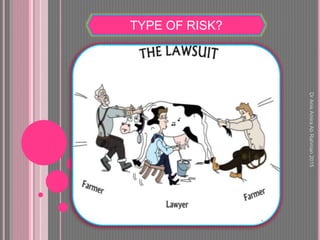
TYPE OF RISK?
DrAnisAmiraAbRahman2015
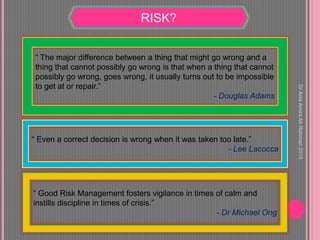
RISK?
“ The major difference between a thing that might go wrong and a
thing that cannot possibly go wrong is that when a thing that cannot
possibly go wrong, goes wrong, it usually turns out to be impossible
to get at or repair.”
- Douglas Adams
“ Even a correct decision is wrong when it was taken too late.”
- Lee Lacocca
“ Good Risk Management fosters vigilance in times of calm and
instills discipline in times of crisis.”
- Dr Michael Ong
DrAnisAmiraAbRahman2015
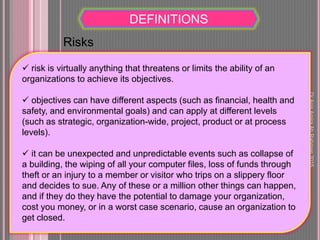
DEFINITIONS
Risks
 risk is virtually anything that threatens or limits the ability of an
organizations to achieve its objectives.
 objectives can have different aspects (such as financial, health and
safety, and environmental goals) and can apply at different levels
(such as strategic, organization-wide, project, product or at process
levels).
 it can be unexpected and unpredictable events such as collapse of
a building, the wiping of all your computer files, loss of funds through
theft or an injury to a member or visitor who trips on a slippery floor
and decides to sue. Any of these or a million other things can happen,
and if they do they have the potential to damage your organization,
cost you money, or in a worst case scenario, cause an organization to
get closed.
DrAnisAmiraAbRahman2015
DEFINITIONS
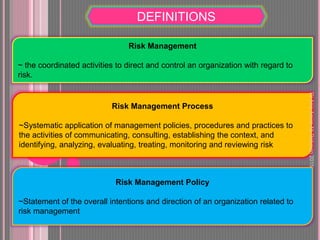
Risk Management
~ the coordinated activities to direct and control an organization with regard to
risk.
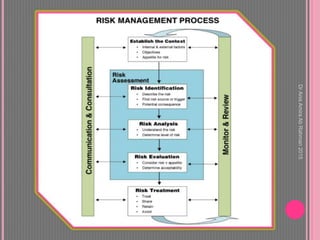
Risk Management Process
~Systematic application of management policies, procedures and practices to
the activities of communicating, consulting, establishing the context, and
identifying, analyzing, evaluating, treating, monitoring and reviewing risk
Risk Management Policy
~Statement of the overall intentions and direction of an organization related to
risk management
DrAnisAmiraAbRahman2015
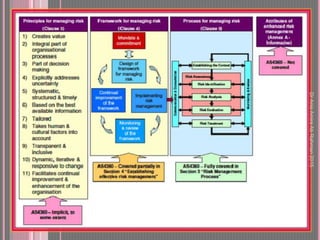
Why do we need to manage risk?
Risk Management is required for an organization in order to :
 Increase the likelihood of achieving objectives
 Encourage proactive management
 Be aware of the need to identify and treat risk throughout the
organization
 Improve the identification of opportunities and threats
 Comply with relevant legal and regulatory requirements and
international norms
 Improve mandatory and voluntary reporting
 Improve governance
 Improve stakeholder confidence and trust
DrAnisAmiraAbRahman2015
Why do we need to manage risk?
 Establish a reliable basis for decision making and planning
 Improve controls
 Effectively allocate and use resources for risk treatments
 Improve operational effectiveness and efficiently
 Enhance health and safety performance, as well as
environmental protection
 Improve loss prevention and incident management
 Minimize losses
 Improve organizational learning, and
 Improve organizational resilience
DrAnisAmiraAbRahman2015
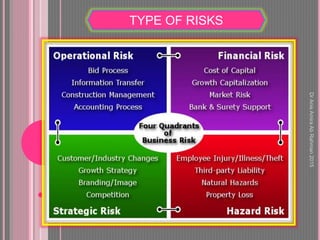
TYPE OF RISKS
DrAnisAmiraAbRahman2015
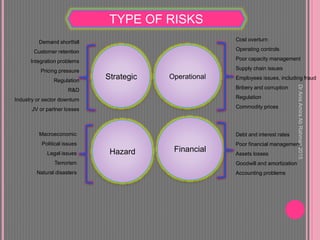
TYPE OF RISKS
Strategic
FinancialHazard
Operational
Demand shortfall
Customer retention
Integration problems
Pricing pressure
Regulation
R&D
Industry or sector downturn
JV or partner losses
Cost overturn
Operating controls
Poor capacity management
Supply chain issues
Employees issues, including fraud
Bribery and corruption
Regulation
Commodity prices
Macroeconomic
Political issues
Legal issues
Terrorism
Natural disasters
Debt and interest rates
Poor financial management
Assets losses
Goodwill and amortization
Accounting problems
DrAnisAmiraAbRahman2015
RISKS ASSESSMENT
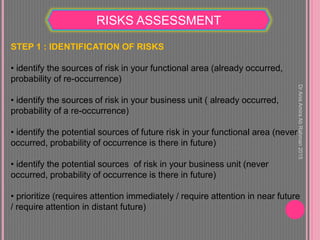
STEP 1 : IDENTIFICATION OF RISKS
• identify the sources of risk in your functional area (already occurred,
probability of re-occurrence)
• identify the sources of risk in your business unit ( already occurred,
probability of a re-occurrence)
• identify the potential sources of future risk in your functional area (never
occurred, probability of occurrence is there in future)
• identify the potential sources of risk in your business unit (never
occurred, probability of occurrence is there in future)
• prioritize (requires attention immediately / require attention in near future
/ require attention in distant future)
DrAnisAmiraAbRahman2015
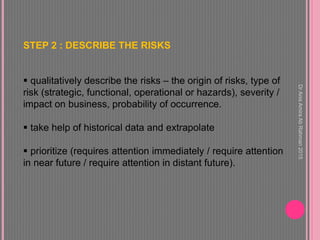
STEP 2 : DESCRIBE THE RISKS
 qualitatively describe the risks – the origin of risks, type of
risk (strategic, functional, operational or hazards), severity /
impact on business, probability of occurrence.
 take help of historical data and extrapolate
 prioritize (requires attention immediately / require attention
in near future / require attention in distant future).
DrAnisAmiraAbRahman2015
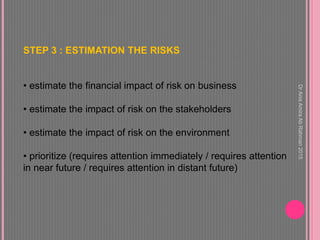
STEP 3 : ESTIMATION THE RISKS
• estimate the financial impact of risk on business
• estimate the impact of risk on the stakeholders
• estimate the impact of risk on the environment
• prioritize (requires attention immediately / requires attention
in near future / requires attention in distant future)
DrAnisAmiraAbRahman2015
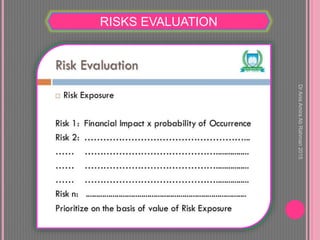
RISKS EVALUATION
DrAnisAmiraAbRahman2015
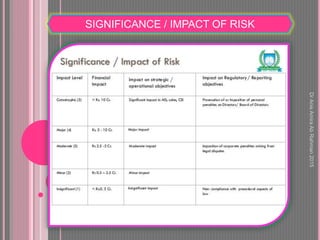
SIGNIFICANCE / IMPACT OF RISK
DrAnisAmiraAbRahman2015
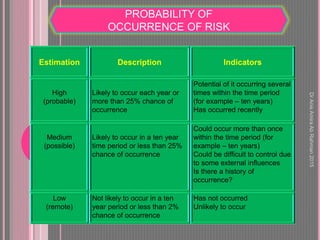
PROBABILITY OF
OCCURRENCE OF RISK
Estimation Description Indicators
High
(probable)
Likely to occur each year or
more than 25% chance of
occurrence
Potential of it occurring several
times within the time period
(for example – ten years)
Has occurred recently
Medium
(possible)
Likely to occur in a ten year
time period or less than 25%
chance of occurrence
Could occur more than once
within the time period (for
example – ten years)
Could be difficult to control due
to some external influences
Is there a history of
occurrence?
Low
(remote)
Not likely to occur in a ten
year period or less than 2%
chance of occurrence
Has not occurred
Unlikely to occur
DrAnisAmiraAbRahman2015
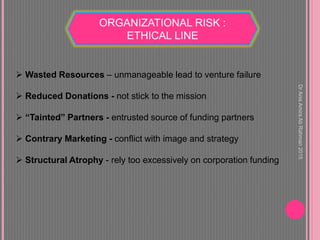
ORGANIZATIONAL RISK :
ETHICAL LINE
 Wasted Resources – unmanageable lead to venture failure
 Reduced Donations - not stick to the mission
 “Tainted” Partners - entrusted source of funding partners
 Contrary Marketing - conflict with image and strategy
 Structural Atrophy - rely too excessively on corporation funding
DrAnisAmiraAbRahman2015
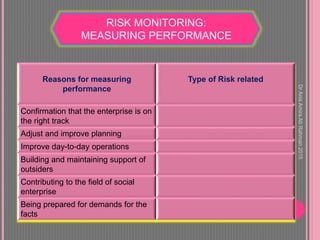
RISK MONITORING:
MEASURING PERFORMANCE
Reasons for measuring
performance
Type of Risk related
Confirmation that the enterprise is on
the right track
Adjust and improve planning
Improve day-to-day operations
Building and maintaining support of
outsiders
Contributing to the field of social
enterprise
Being prepared for demands for the
facts
DrAnisAmiraAbRahman2015
REFERENCES
 Source:
http://www.slideshare.net/ShivSTripathi/enterprise-
risk-risk-management-i?qid=4ea9a3a1-09c4-451b-
9142-37e326dc0631&v=qf1&b=&from_search=7
DrAnisAmiraAbRahman2015

Social entrepreneurship topic 9

  • 1.
  • 2.
  • 3.
    RISK? “ The majordifference between a thing that might go wrong and a thing that cannot possibly go wrong is that when a thing that cannot possibly go wrong, goes wrong, it usually turns out to be impossible to get at or repair.” - Douglas Adams “ Even a correct decision is wrong when it was taken too late.” - Lee Lacocca “ Good Risk Management fosters vigilance in times of calm and instills discipline in times of crisis.” - Dr Michael Ong DrAnisAmiraAbRahman2015
  • 4.
    DEFINITIONS Risks  risk isvirtually anything that threatens or limits the ability of an organizations to achieve its objectives.  objectives can have different aspects (such as financial, health and safety, and environmental goals) and can apply at different levels (such as strategic, organization-wide, project, product or at process levels).  it can be unexpected and unpredictable events such as collapse of a building, the wiping of all your computer files, loss of funds through theft or an injury to a member or visitor who trips on a slippery floor and decides to sue. Any of these or a million other things can happen, and if they do they have the potential to damage your organization, cost you money, or in a worst case scenario, cause an organization to get closed. DrAnisAmiraAbRahman2015
  • 5.
    DEFINITIONS Risk Management ~ thecoordinated activities to direct and control an organization with regard to risk. Risk Management Process ~Systematic application of management policies, procedures and practices to the activities of communicating, consulting, establishing the context, and identifying, analyzing, evaluating, treating, monitoring and reviewing risk Risk Management Policy ~Statement of the overall intentions and direction of an organization related to risk management DrAnisAmiraAbRahman2015
  • 6.
    Why do weneed to manage risk? Risk Management is required for an organization in order to :  Increase the likelihood of achieving objectives  Encourage proactive management  Be aware of the need to identify and treat risk throughout the organization  Improve the identification of opportunities and threats  Comply with relevant legal and regulatory requirements and international norms  Improve mandatory and voluntary reporting  Improve governance  Improve stakeholder confidence and trust DrAnisAmiraAbRahman2015
  • 7.
    Why do weneed to manage risk?  Establish a reliable basis for decision making and planning  Improve controls  Effectively allocate and use resources for risk treatments  Improve operational effectiveness and efficiently  Enhance health and safety performance, as well as environmental protection  Improve loss prevention and incident management  Minimize losses  Improve organizational learning, and  Improve organizational resilience DrAnisAmiraAbRahman2015
  • 8.
  • 9.
  • 10.
    TYPE OF RISKS Strategic FinancialHazard Operational Demandshortfall Customer retention Integration problems Pricing pressure Regulation R&D Industry or sector downturn JV or partner losses Cost overturn Operating controls Poor capacity management Supply chain issues Employees issues, including fraud Bribery and corruption Regulation Commodity prices Macroeconomic Political issues Legal issues Terrorism Natural disasters Debt and interest rates Poor financial management Assets losses Goodwill and amortization Accounting problems DrAnisAmiraAbRahman2015
  • 11.
  • 12.
    RISKS ASSESSMENT STEP 1: IDENTIFICATION OF RISKS • identify the sources of risk in your functional area (already occurred, probability of re-occurrence) • identify the sources of risk in your business unit ( already occurred, probability of a re-occurrence) • identify the potential sources of future risk in your functional area (never occurred, probability of occurrence is there in future) • identify the potential sources of risk in your business unit (never occurred, probability of occurrence is there in future) • prioritize (requires attention immediately / require attention in near future / require attention in distant future) DrAnisAmiraAbRahman2015
  • 13.
    STEP 2 :DESCRIBE THE RISKS  qualitatively describe the risks – the origin of risks, type of risk (strategic, functional, operational or hazards), severity / impact on business, probability of occurrence.  take help of historical data and extrapolate  prioritize (requires attention immediately / require attention in near future / require attention in distant future). DrAnisAmiraAbRahman2015
  • 14.
    STEP 3 :ESTIMATION THE RISKS • estimate the financial impact of risk on business • estimate the impact of risk on the stakeholders • estimate the impact of risk on the environment • prioritize (requires attention immediately / requires attention in near future / requires attention in distant future) DrAnisAmiraAbRahman2015
  • 15.
  • 16.
    SIGNIFICANCE / IMPACTOF RISK DrAnisAmiraAbRahman2015
  • 17.
    PROBABILITY OF OCCURRENCE OFRISK Estimation Description Indicators High (probable) Likely to occur each year or more than 25% chance of occurrence Potential of it occurring several times within the time period (for example – ten years) Has occurred recently Medium (possible) Likely to occur in a ten year time period or less than 25% chance of occurrence Could occur more than once within the time period (for example – ten years) Could be difficult to control due to some external influences Is there a history of occurrence? Low (remote) Not likely to occur in a ten year period or less than 2% chance of occurrence Has not occurred Unlikely to occur DrAnisAmiraAbRahman2015
  • 18.
  • 19.
    ORGANIZATIONAL RISK : ETHICALLINE  Wasted Resources – unmanageable lead to venture failure  Reduced Donations - not stick to the mission  “Tainted” Partners - entrusted source of funding partners  Contrary Marketing - conflict with image and strategy  Structural Atrophy - rely too excessively on corporation funding DrAnisAmiraAbRahman2015
  • 20.
    RISK MONITORING: MEASURING PERFORMANCE Reasonsfor measuring performance Type of Risk related Confirmation that the enterprise is on the right track Adjust and improve planning Improve day-to-day operations Building and maintaining support of outsiders Contributing to the field of social enterprise Being prepared for demands for the facts DrAnisAmiraAbRahman2015
  • 21.