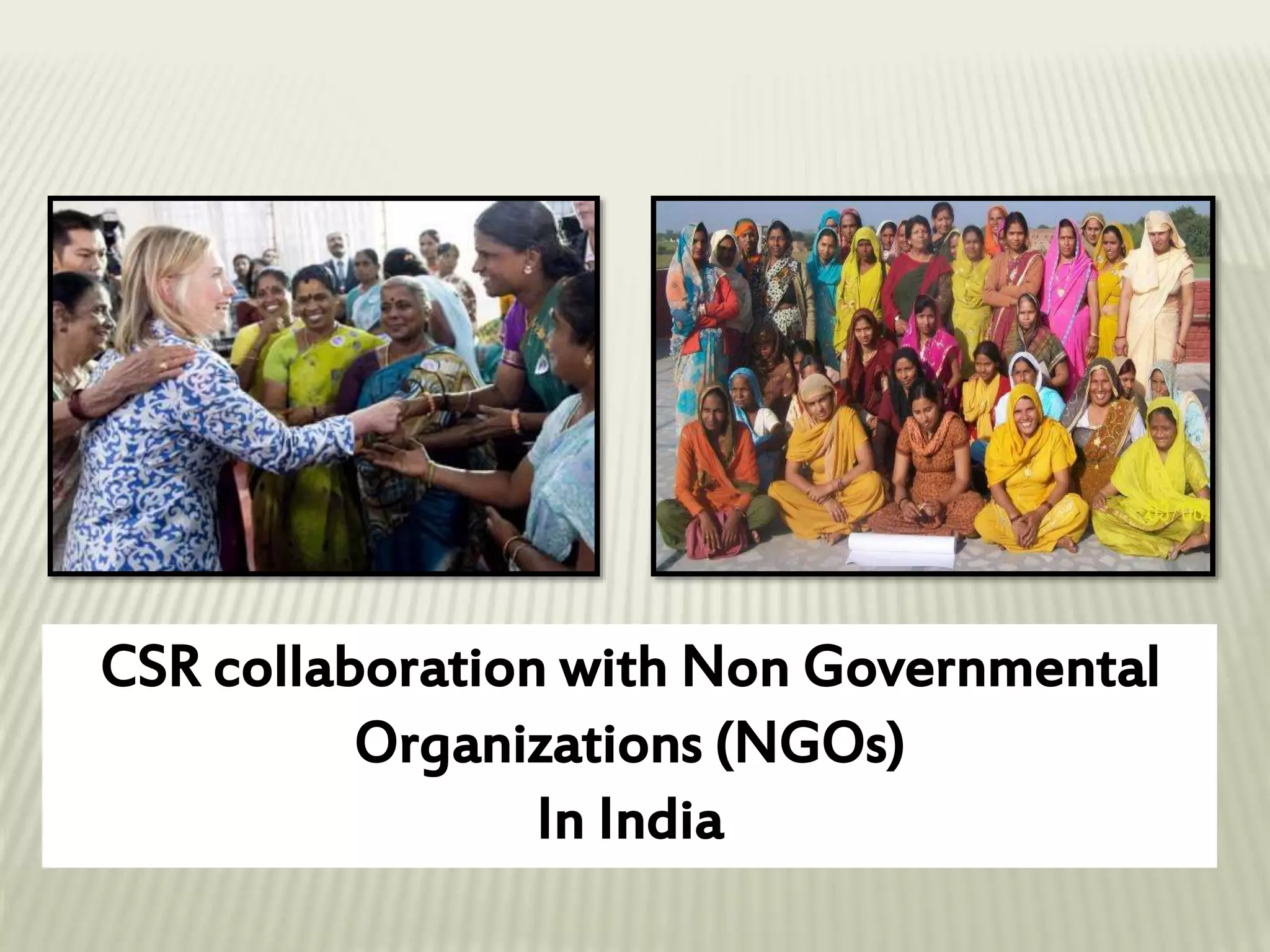
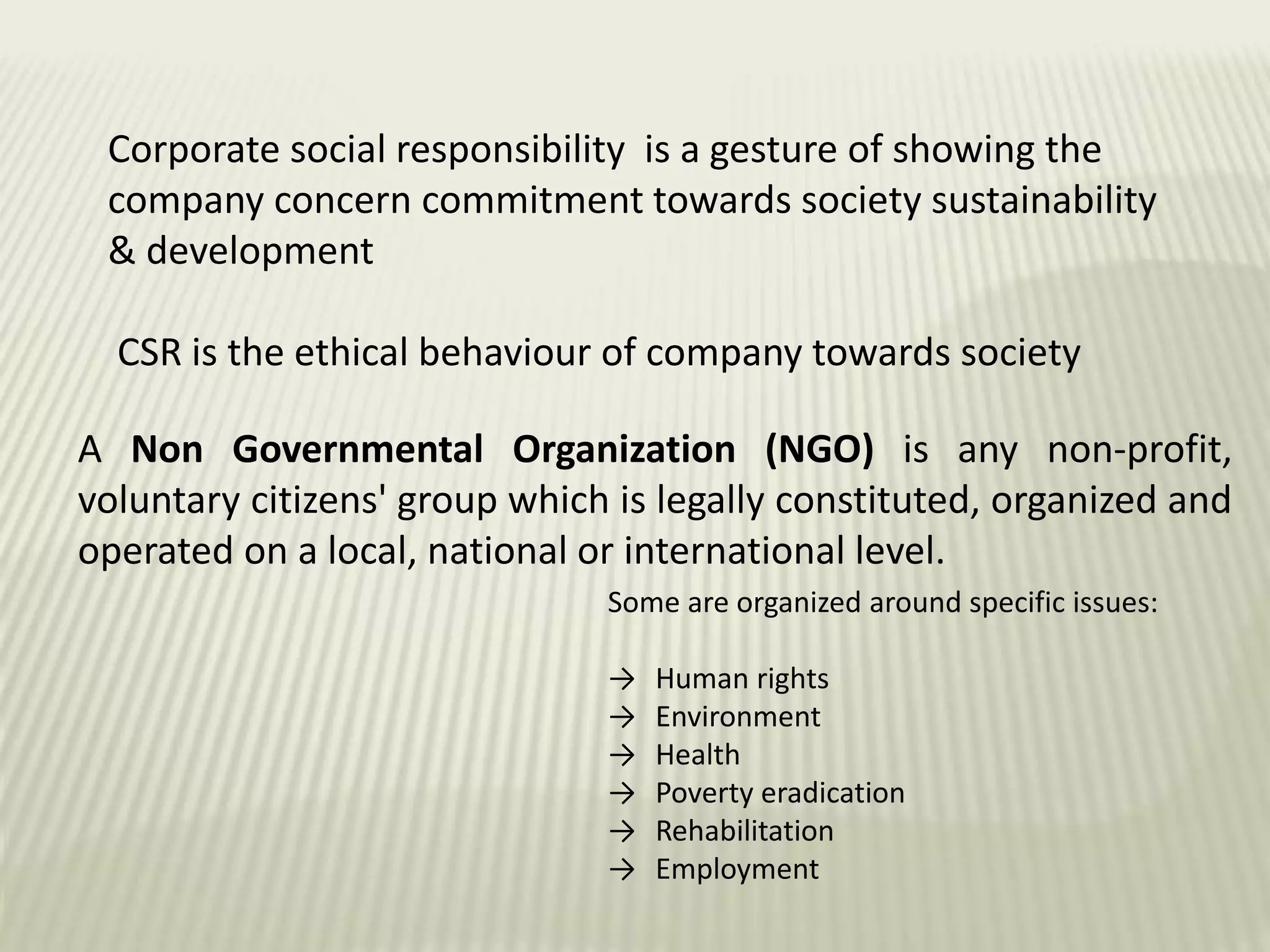
CSR collaboration with Non Governmental
Organizations (NGOs)
In India
Corporate social responsibility is a gesture of showing the
company concern commitment towards society sustainability
& development
CSR is the ethical behaviour of company towards society
A Non Governmental Organization (NGO) is any non-profit,
voluntary citizens' group which is legally constituted, organized and
operated on a local, national or international level.
Some are organized around specific issues:
→ Human rights
→ Environment
→ Health
→ Poverty eradication
→ Rehabilitation
→ Employment
TYPES OF RESPONSIBILITY
→ Towards Society
→ Government
→ Shareholders
→ Employee
→ Customer
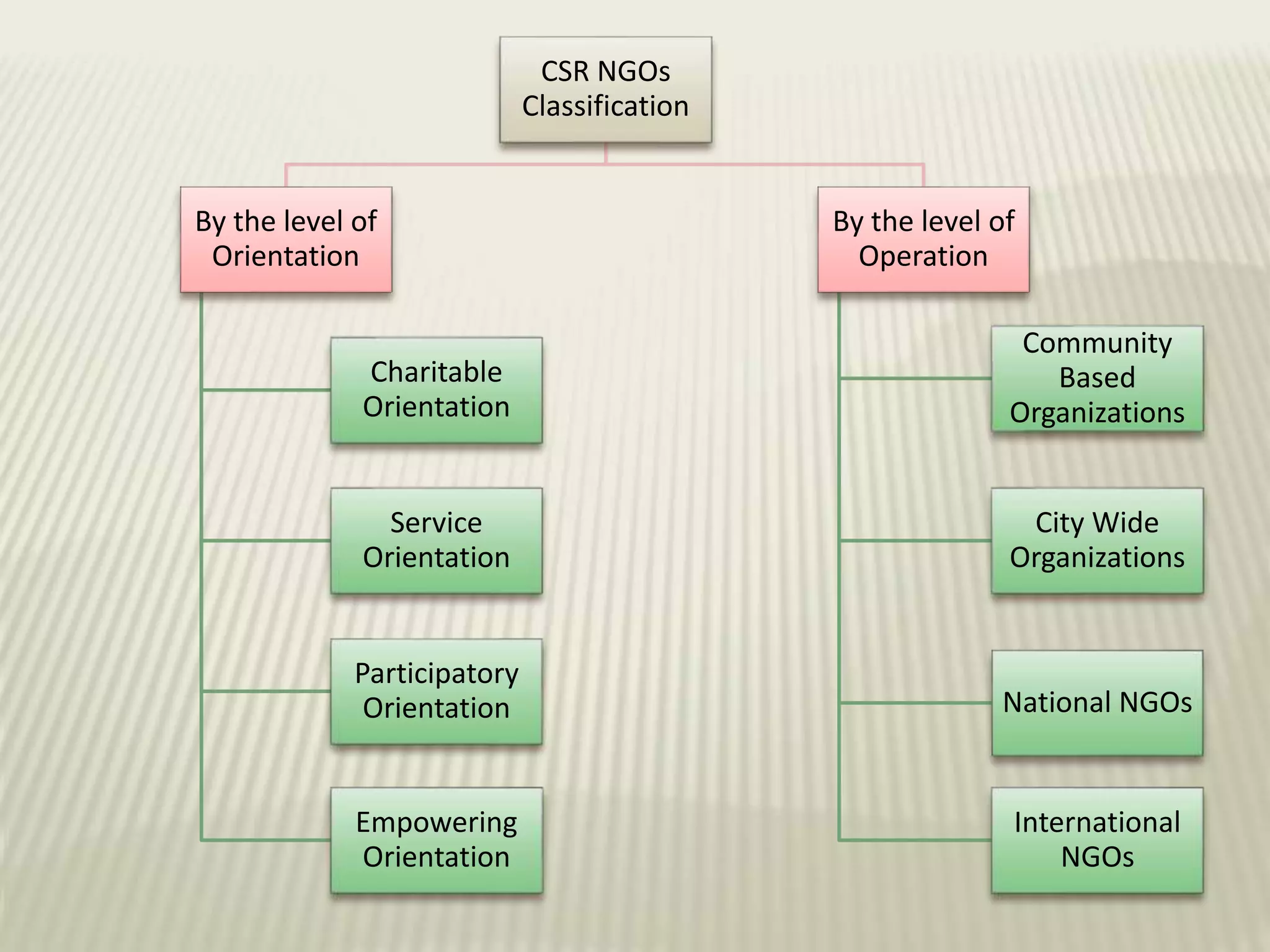
CSR NGOs
Classification
By the level of
Orientation
Charitable
Orientation
Service
Orientation
Participatory
Orientation
Empowering
Orientation
By the level of
Operation
Community
Based
Organizations
City Wide
Organizations
National NGOs
International
NGOs
 Act as a change agent
 Environment
 Safeguarding Human Rights
 Representatives of weaker sections
Responsibilities of NGOs
 Need for honest and dedicated persons.
 Need for transparency to create confidence.
 A proper personnel policy
 Protect the interest of the people rather than
members
 Transparent and easy to operate mechanism.
Challenges to NGOs
Features of NGOs
 Support democratic system
 Function on no profit basis
 Non Political in character
 Clearly defined objectives
 Limited external control
 Voluntary Character
 Wide operational area
 Positive contribution
 Need financial support
 Interest in long-term projects
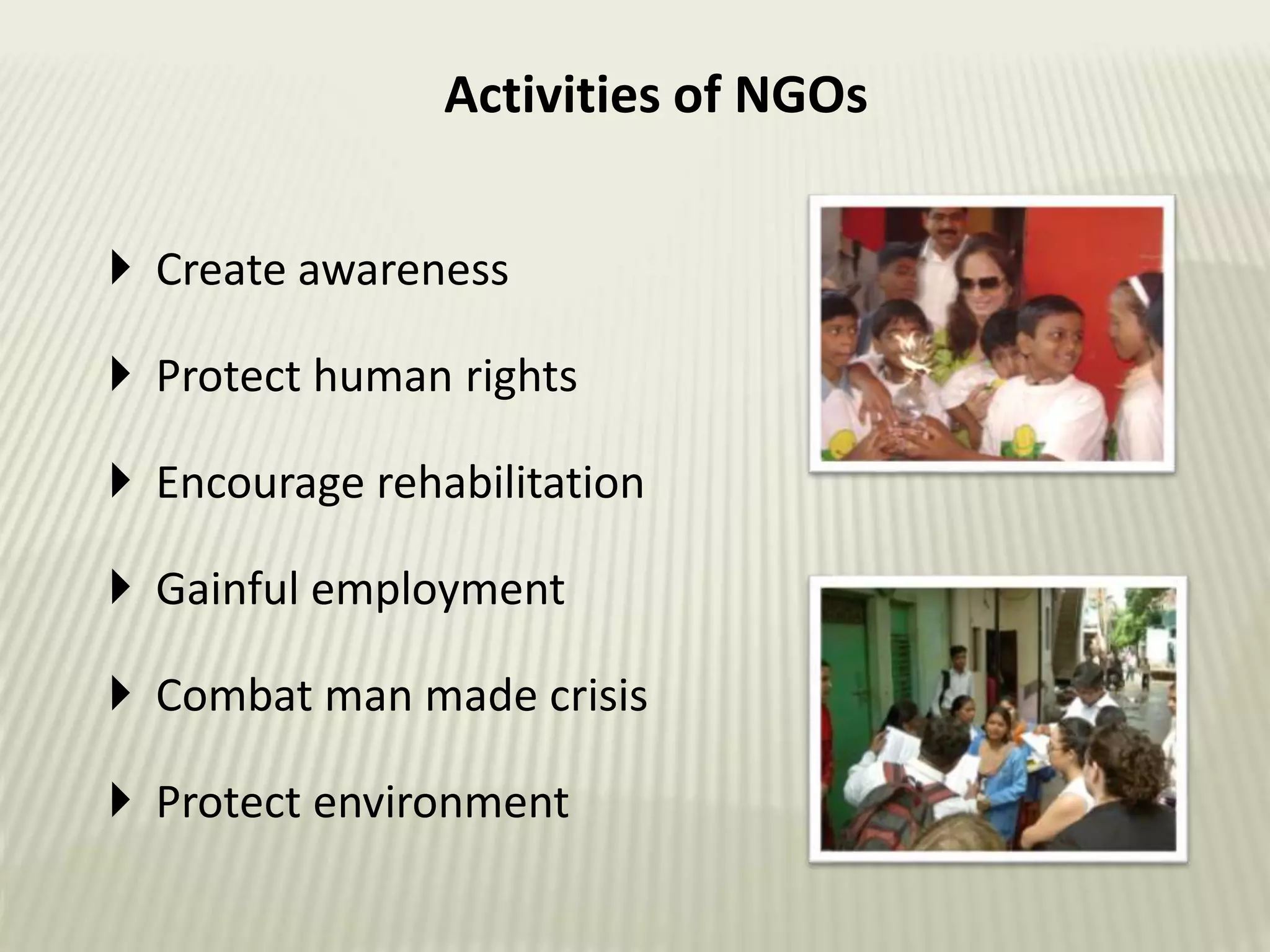
Activities of NGOs
 Create awareness
 Protect human rights
 Encourage rehabilitation
 Gainful employment
 Combat man made crisis
 Protect environment
• To reduce the social cost.
• To enhance the performance of employees.
• It a type of investment.
• It leads to industrial peace.
• It improves the public image.
• Can generate more profit.
• To provide moral justification.
• It satisfies the stakeholders.
• Helps to avoid government regulations & control.
• Enhance the health by non polluting measures.
Why Need for Corporate Social Responsibility
Case Study
Crompton Greaves supports Health initiatives in South India
Crompton Greaves Limited (CG) has partnered with Smile Foundation in Chennai
and Hyderabad to implement a series of initiatives. An Aids Awareness campaign
and Diabetes Health Camp for the underprivileged have been conducted in both the
cities. The awareness campaign was aimed at youth and adults, which saw
enthusiastic participation and debate. Next in line is library support for two Mission
education centres.
Crompton Greaves Limited is a pioneering leader in the management and
application of electrical energy, with a presence in over 10 countries. CG is active in
the global power transmission & distribution arena, and is amongst the world’s top
ten transformer manufacturers.
Case Study
Nerolac supports healthcare of 5050 Smile Children
Kansai Nerolac Paints Limited has partnered with Smile on Wheels to support
the primary health care of the painter community across India. They have
conducted more than 80 health camps during the last three years.
Kansai Nerolac Paints Limited (KNPL), formerly known as Goodlass Nerolac
Paints Ltd., was established in 1920. With over 90 years of strong presence in
the paint industry, KNPL offers a comprehensive range of products both in
Industrial and Decorative businesses.
KNPL is an organization which cares for its people and involves them in the
ambit of social responsibility.
Kansai Nerolac is a responsible organisation and understands its responsibilities
- both internal and external, and is committed to making a difference to the
society it operates in. Nerolac invests in communities to improve the quality of
life and sense of well being of the people. KNPL, under its social outreach
programmes, works in the areas of healthcare, education, environment
preservation and community development.
Evaluation and Rating of NGOs
 No. Of Years in business:
 Reputation
 Certification and Registration:
 Experience in relevant areas
 Partner feedback
 Capabilities and expertise
Benefits of Corporate - NGO partnership
Benefits to the private sector
 Image and credibility
Entering new markets and increasing long term profits
Better CSR policy as part of corporate strategy
NGO’s help to enhance the CSR policies as they have innovative idea to solve the
social issues.
For example: ITC Limited joins with NGOs like Exnora International, Sewa Bharat, and
Action for Social Advancement (ASA) to develop community. There by it creates good
image among the society.
For example Unilever is integrating social innovation strategies in its business operations.
In India, it teamed up with NGOs to create Shakti, a rural network that sells products
adapted to rural customers in more than 100,000 villages, employing 31,000 women. So
from this Shakti movement Unilever reaches the rural areas too
Benefits to the NGO Sector
Financial sustainability and funding for projects
Corporation act as the source of funds for NGO.
Access to free marketing
NGO’s get free advertisement for their social marketing to enhance their NGO’s
brand image.
Example: Times now India’s “Teach India” is famous campaign to teach young children.
Teach India brings the opportunity to teach young children with the guidance of a
multitude of NGOs across India. From this Times group many NGOs are getting free
advertisements.
Requirements for successful implementation of CSR through NGO
Partnerships are most successful when they are established with both parties thinking
about the long-term benefits.
 Effective communication
 Unity of vision and purpose,
 Having positive relation with local authorities and the public sector
For example: In 2000, Environmental Defense teamed up with FedEx Express, the
world's largest express transportation company, to develop a cleaner, more fuel-
efficient delivery truck. These trucks go up to 50% farther on a gallon of fuel than a
conventional truck, reducing greenhouse gas emissions by approximately 30%.
They emit 65% less smog-causing pollution
Conclusion
One of the reasons corporate-NGO partnerships can be
successful is because they are more focused, and target
development on a much smaller scale than larger projects.
They have the capacity to impact fewer people but do so in
more significant way.
Although partnerships may not lead to large scale
improvement in sustainable development and poverty
reduction, they do have the ability to improve the
livelihood of the individuals they specifically target.
Today, Save the Children is
supported by 1,15,000+
individual supporters, 35
corporate and 38
institutional (National and
International) supporters
With this new model of
CSR, corporations are not
detached from society but
established mutual support
relationships so that both
corporations and
communities benefit from
each other.

CSR & NGO Collaboration

  • 1.
    CSR collaboration withNon Governmental Organizations (NGOs) In India
  • 2.
    Corporate social responsibilityis a gesture of showing the company concern commitment towards society sustainability & development CSR is the ethical behaviour of company towards society A Non Governmental Organization (NGO) is any non-profit, voluntary citizens' group which is legally constituted, organized and operated on a local, national or international level. Some are organized around specific issues: → Human rights → Environment → Health → Poverty eradication → Rehabilitation → Employment
  • 3.
    TYPES OF RESPONSIBILITY →Towards Society → Government → Shareholders → Employee → Customer
  • 4.
    CSR NGOs Classification By thelevel of Orientation Charitable Orientation Service Orientation Participatory Orientation Empowering Orientation By the level of Operation Community Based Organizations City Wide Organizations National NGOs International NGOs
  • 5.
     Act asa change agent  Environment  Safeguarding Human Rights  Representatives of weaker sections Responsibilities of NGOs
  • 6.
     Need forhonest and dedicated persons.  Need for transparency to create confidence.  A proper personnel policy  Protect the interest of the people rather than members  Transparent and easy to operate mechanism. Challenges to NGOs
  • 7.
    Features of NGOs Support democratic system  Function on no profit basis  Non Political in character  Clearly defined objectives  Limited external control  Voluntary Character  Wide operational area  Positive contribution  Need financial support  Interest in long-term projects
  • 8.
    Activities of NGOs Create awareness  Protect human rights  Encourage rehabilitation  Gainful employment  Combat man made crisis  Protect environment
  • 9.
    • To reducethe social cost. • To enhance the performance of employees. • It a type of investment. • It leads to industrial peace. • It improves the public image. • Can generate more profit. • To provide moral justification. • It satisfies the stakeholders. • Helps to avoid government regulations & control. • Enhance the health by non polluting measures. Why Need for Corporate Social Responsibility
  • 10.
    Case Study Crompton Greavessupports Health initiatives in South India Crompton Greaves Limited (CG) has partnered with Smile Foundation in Chennai and Hyderabad to implement a series of initiatives. An Aids Awareness campaign and Diabetes Health Camp for the underprivileged have been conducted in both the cities. The awareness campaign was aimed at youth and adults, which saw enthusiastic participation and debate. Next in line is library support for two Mission education centres. Crompton Greaves Limited is a pioneering leader in the management and application of electrical energy, with a presence in over 10 countries. CG is active in the global power transmission & distribution arena, and is amongst the world’s top ten transformer manufacturers.
  • 11.
    Case Study Nerolac supportshealthcare of 5050 Smile Children Kansai Nerolac Paints Limited has partnered with Smile on Wheels to support the primary health care of the painter community across India. They have conducted more than 80 health camps during the last three years. Kansai Nerolac Paints Limited (KNPL), formerly known as Goodlass Nerolac Paints Ltd., was established in 1920. With over 90 years of strong presence in the paint industry, KNPL offers a comprehensive range of products both in Industrial and Decorative businesses. KNPL is an organization which cares for its people and involves them in the ambit of social responsibility. Kansai Nerolac is a responsible organisation and understands its responsibilities - both internal and external, and is committed to making a difference to the society it operates in. Nerolac invests in communities to improve the quality of life and sense of well being of the people. KNPL, under its social outreach programmes, works in the areas of healthcare, education, environment preservation and community development.
  • 12.
    Evaluation and Ratingof NGOs  No. Of Years in business:  Reputation  Certification and Registration:  Experience in relevant areas  Partner feedback  Capabilities and expertise
  • 13.
    Benefits of Corporate- NGO partnership Benefits to the private sector  Image and credibility Entering new markets and increasing long term profits Better CSR policy as part of corporate strategy NGO’s help to enhance the CSR policies as they have innovative idea to solve the social issues. For example: ITC Limited joins with NGOs like Exnora International, Sewa Bharat, and Action for Social Advancement (ASA) to develop community. There by it creates good image among the society. For example Unilever is integrating social innovation strategies in its business operations. In India, it teamed up with NGOs to create Shakti, a rural network that sells products adapted to rural customers in more than 100,000 villages, employing 31,000 women. So from this Shakti movement Unilever reaches the rural areas too
  • 14.
    Benefits to theNGO Sector Financial sustainability and funding for projects Corporation act as the source of funds for NGO. Access to free marketing NGO’s get free advertisement for their social marketing to enhance their NGO’s brand image. Example: Times now India’s “Teach India” is famous campaign to teach young children. Teach India brings the opportunity to teach young children with the guidance of a multitude of NGOs across India. From this Times group many NGOs are getting free advertisements.
  • 15.
    Requirements for successfulimplementation of CSR through NGO Partnerships are most successful when they are established with both parties thinking about the long-term benefits.  Effective communication  Unity of vision and purpose,  Having positive relation with local authorities and the public sector For example: In 2000, Environmental Defense teamed up with FedEx Express, the world's largest express transportation company, to develop a cleaner, more fuel- efficient delivery truck. These trucks go up to 50% farther on a gallon of fuel than a conventional truck, reducing greenhouse gas emissions by approximately 30%. They emit 65% less smog-causing pollution
  • 16.
    Conclusion One of thereasons corporate-NGO partnerships can be successful is because they are more focused, and target development on a much smaller scale than larger projects. They have the capacity to impact fewer people but do so in more significant way. Although partnerships may not lead to large scale improvement in sustainable development and poverty reduction, they do have the ability to improve the livelihood of the individuals they specifically target.
  • 17.
    Today, Save theChildren is supported by 1,15,000+ individual supporters, 35 corporate and 38 institutional (National and International) supporters With this new model of CSR, corporations are not detached from society but established mutual support relationships so that both corporations and communities benefit from each other.