Risk Management
Introduction to
Risk Management
(Theory & Practice)
DCU Risk & Compliance Officer
November 2015
Risk Management
Sections
1) Aims of presentation 7) Tips for success
2) What is Risk Management (RM)? 8) Why RM may fail
3) RM Cycle 9) Summary & conclusion
4) Categories of risk
5) Risk Register
6) Risk Appetite
Risk Management
Aims of this presentation
• To explain why it is relevant
• To explain its components i.e. the “Risk Cycle”
• Guidance on
Preparing a “Risk Register”
Risk management techniques
Reporting on risks
Risk Management
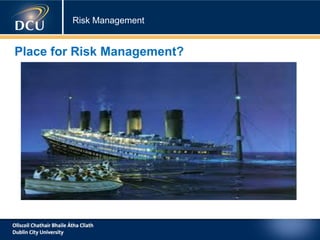
Place for Risk Management?
Risk Management
What is Risk Management?
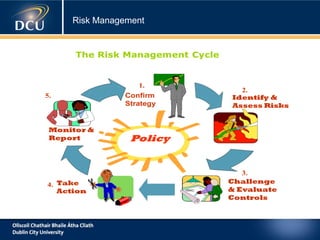
It is a process to:
 Identify all relevant risks
 Assess / rank those risks
 Address the risks in order of priority
 Monitor risks & report on their management
Risk Management
Risk Management – why do we need it?
Promotes good management
May be a legal requirement depending upon industry or
sector
Resources available are limited – therefore a focused
response to Risk Management is needed
Risk Management
What is a Risk?
 A risk is an uncertain event which may occur in the future
 A risk may prevent or delay the achievement of an
organization’s or units objectives or goals
 A risk is not certain – Its likelihood can only be estimated
Note: Not all risk is bad, some level of risk must be
taken in order to progress / prevent stagnation.
Risk Management
Risk Management
Risk Management Cycle – Step 1
Mission
•Define Purpose
Strategy
•High level Plan
Goals
•Unit Specific Targets
Risk Management
Risk Management Cycle – Step 2
Risk Identification – what are the threats and uncertainties
associated with my organization’s or units objectives?
• Separate out the risk into its cause & possible effect
• Be concise & clear
• Do not concentrate on symptoms only
Risk Management
Risk Management Cycle – Step 2 cont.
• Assess the risk’s
 Impact
 Likelihood
(Guidance on both later!)
• Prioritize the risks
• Hint: Get input from appropriate individuals
Risk Management
Risk Management Cycle – Step 3
Challenge & Evaluate Controls
Control: Policy, action, procedure or process designed to
prevent risk or to limit its impact
Do they work, are they effective?
Residual Risk only should be measured
Risk Management
Risk Management Cycle – Step 4
Take Action!
 For serious risks where controls are
A) Weak
B) Absent
 For risks where the Risk Appetite is exceeded
 Examine Cost vs. Benefit
Risk Management
Risk Management Cycle – Step 4 cont.
Types of Action
A) Tolerate
B) Treat
C) Substitute
D) Terminate
(The choice of the above will be decided upon by your risk
appetite)
Risk Management
Risk Management Cycle – Step 5
Monitor & Report
 Use a standard format for capturing risk data e.g. a “Risk Register”
 Review all risks at least annually
 Serious risks to be reviewed more often depending on circumstances
 Report on risk to senior management / Board
 Make Risk Register available to stakeholders to show good
governance
Risk Management
Categories of Risks
 There are multiple ways into which risks can be
categorized
 Final categories used will depend upon each
organizations / unit’s circumstances
 Goal is to cluster risks into standard, meaningful
& actionable groupings
 What follows is one example of a type of
categorization
Risk Management
Categories of Risks
Financial
 Reduction in funding
 Failure to safeguard assets
 Poor cash flow management
 Lack of value for money
 Fraud / theft
 Poor budgeting
Risk Management
Categories of Risks cont.
Operational
These risks result from failed or inappropriate policies,
procedures, systems or activities e.g.
 Failure of an IT system
 Poor quality of services delivered
 Lack of succession planning
 Health & Safety risks
 Staff skill levels
 No process to track contractual commitments
Risk Management
Categories of Risks cont.
Reputational
• Organization engages in activities that could
threaten it’s good name
 Through association with other bodies
 Staff / members acting in a criminal or
unethical way
• Poor stakeholder relations
Risk Management
Categories of Risk cont.
Governance & Compliance
• Lack of oversight by Board
• Segregation of duties not defined formally
• Ensuring compliance with funders terms and conditions
• Compliance with applicable legislation
 Safeguarding of vulnerable individuals
 Taxation Law
 Data Protection
 Health & Safety Law
Risk Management
Categories of Risk cont.
Strategic
• Engages in activity at variance with its
stated objectives
• Fails to engage in an activity that would
support its stated objectives
Risk Management
Risk Register
a) What is it?
b) Components
c) How to report on it
Risk Management
Risk Register cont.
 A Risk Register is a management tool used to
record relevant details relating to risks.
 It is a database of information on risks.
 Best kept simple to begin with!
Risk Management – Register Example
Risk Management
Parts of a Risk Register
Risk Description – Clear description of risk, its cause
& consequence
Controls / Actions already in place – List what is actually happening
now which reduces the impact of a risk or its likelihood
Impact – scale of 1 to 5 (1 = minor, 5 = catastrophic)
(Note this is to be residual impact only)
Likelihood – scale of 1 to 5 (1 = remote, 5 = unavoidable)
(Note this is to be residual likelihood only)
Weighting – Its Risk Ranking: a calculated figure i.e. impact x
likelihood
Risk Management
Parts of a Risk Register cont.
Risk Owner – The administrative unit, management position
or group who are in the best position to manage the risk on
an on-going basis
Further Actions Required – The controls / solutions which
have yet to be acted upon which could reduce the impact or
likelihood of a risk
Date – The expected date as to when the actions shown
under further actions required will be in place & effectively
addressing the risk
Risk Management – Emample of a Matrix
Risk Management
Tips for Success
 Involve all levels of staff & management in the process
 Check controls are relevant & effective
 Ensure risk owner takes responsibility for management of
risks under their control
 Focus on risk cause, not its symptoms
Risk Management
Why Risk Management May Fail
 Limitations of scope
 Lack of top management support
 Did not engage all stakeholders
 Failure to share information
 RM not embedded within planning & management
system
Risk Management
Summary & Conclusion
We have covered:
 Definition of risk
 Risk Management cycle
 Categories of risk
 Risk Register – how to guide
 Possible pit falls in a Risk Management process
Risk Management
Place for Risk Management?
Risk Management
Thank You

Risk Mgt Training Slides.pdf

  • 1.
    Risk Management Introduction to RiskManagement (Theory & Practice) DCU Risk & Compliance Officer November 2015
  • 2.
    Risk Management Sections 1) Aimsof presentation 7) Tips for success 2) What is Risk Management (RM)? 8) Why RM may fail 3) RM Cycle 9) Summary & conclusion 4) Categories of risk 5) Risk Register 6) Risk Appetite
  • 3.
    Risk Management Aims ofthis presentation • To explain why it is relevant • To explain its components i.e. the “Risk Cycle” • Guidance on Preparing a “Risk Register” Risk management techniques Reporting on risks
  • 4.
    Risk Management Place forRisk Management?
  • 5.
    Risk Management What isRisk Management? It is a process to:  Identify all relevant risks  Assess / rank those risks  Address the risks in order of priority  Monitor risks & report on their management
  • 6.
    Risk Management Risk Management– why do we need it? Promotes good management May be a legal requirement depending upon industry or sector Resources available are limited – therefore a focused response to Risk Management is needed
  • 7.
    Risk Management What isa Risk?  A risk is an uncertain event which may occur in the future  A risk may prevent or delay the achievement of an organization’s or units objectives or goals  A risk is not certain – Its likelihood can only be estimated Note: Not all risk is bad, some level of risk must be taken in order to progress / prevent stagnation.
  • 8.
  • 9.
    Risk Management Risk ManagementCycle – Step 1 Mission •Define Purpose Strategy •High level Plan Goals •Unit Specific Targets
  • 10.
    Risk Management Risk ManagementCycle – Step 2 Risk Identification – what are the threats and uncertainties associated with my organization’s or units objectives? • Separate out the risk into its cause & possible effect • Be concise & clear • Do not concentrate on symptoms only
  • 11.
    Risk Management Risk ManagementCycle – Step 2 cont. • Assess the risk’s  Impact  Likelihood (Guidance on both later!) • Prioritize the risks • Hint: Get input from appropriate individuals
  • 12.
    Risk Management Risk ManagementCycle – Step 3 Challenge & Evaluate Controls Control: Policy, action, procedure or process designed to prevent risk or to limit its impact Do they work, are they effective? Residual Risk only should be measured
  • 13.
    Risk Management Risk ManagementCycle – Step 4 Take Action!  For serious risks where controls are A) Weak B) Absent  For risks where the Risk Appetite is exceeded  Examine Cost vs. Benefit
  • 14.
    Risk Management Risk ManagementCycle – Step 4 cont. Types of Action A) Tolerate B) Treat C) Substitute D) Terminate (The choice of the above will be decided upon by your risk appetite)
  • 15.
    Risk Management Risk ManagementCycle – Step 5 Monitor & Report  Use a standard format for capturing risk data e.g. a “Risk Register”  Review all risks at least annually  Serious risks to be reviewed more often depending on circumstances  Report on risk to senior management / Board  Make Risk Register available to stakeholders to show good governance
  • 16.
    Risk Management Categories ofRisks  There are multiple ways into which risks can be categorized  Final categories used will depend upon each organizations / unit’s circumstances  Goal is to cluster risks into standard, meaningful & actionable groupings  What follows is one example of a type of categorization
  • 17.
    Risk Management Categories ofRisks Financial  Reduction in funding  Failure to safeguard assets  Poor cash flow management  Lack of value for money  Fraud / theft  Poor budgeting
  • 18.
    Risk Management Categories ofRisks cont. Operational These risks result from failed or inappropriate policies, procedures, systems or activities e.g.  Failure of an IT system  Poor quality of services delivered  Lack of succession planning  Health & Safety risks  Staff skill levels  No process to track contractual commitments
  • 19.
    Risk Management Categories ofRisks cont. Reputational • Organization engages in activities that could threaten it’s good name  Through association with other bodies  Staff / members acting in a criminal or unethical way • Poor stakeholder relations
  • 20.
    Risk Management Categories ofRisk cont. Governance & Compliance • Lack of oversight by Board • Segregation of duties not defined formally • Ensuring compliance with funders terms and conditions • Compliance with applicable legislation  Safeguarding of vulnerable individuals  Taxation Law  Data Protection  Health & Safety Law
  • 21.
    Risk Management Categories ofRisk cont. Strategic • Engages in activity at variance with its stated objectives • Fails to engage in an activity that would support its stated objectives
  • 22.
    Risk Management Risk Register a)What is it? b) Components c) How to report on it
  • 23.
    Risk Management Risk Registercont.  A Risk Register is a management tool used to record relevant details relating to risks.  It is a database of information on risks.  Best kept simple to begin with!
  • 24.
    Risk Management –Register Example
  • 25.
    Risk Management Parts ofa Risk Register Risk Description – Clear description of risk, its cause & consequence Controls / Actions already in place – List what is actually happening now which reduces the impact of a risk or its likelihood Impact – scale of 1 to 5 (1 = minor, 5 = catastrophic) (Note this is to be residual impact only) Likelihood – scale of 1 to 5 (1 = remote, 5 = unavoidable) (Note this is to be residual likelihood only) Weighting – Its Risk Ranking: a calculated figure i.e. impact x likelihood
  • 26.
    Risk Management Parts ofa Risk Register cont. Risk Owner – The administrative unit, management position or group who are in the best position to manage the risk on an on-going basis Further Actions Required – The controls / solutions which have yet to be acted upon which could reduce the impact or likelihood of a risk Date – The expected date as to when the actions shown under further actions required will be in place & effectively addressing the risk
  • 27.
    Risk Management –Emample of a Matrix
  • 28.
    Risk Management Tips forSuccess  Involve all levels of staff & management in the process  Check controls are relevant & effective  Ensure risk owner takes responsibility for management of risks under their control  Focus on risk cause, not its symptoms
  • 29.
    Risk Management Why RiskManagement May Fail  Limitations of scope  Lack of top management support  Did not engage all stakeholders  Failure to share information  RM not embedded within planning & management system
  • 30.
    Risk Management Summary &Conclusion We have covered:  Definition of risk  Risk Management cycle  Categories of risk  Risk Register – how to guide  Possible pit falls in a Risk Management process
  • 31.
    Risk Management Place forRisk Management?
  • 32.