Presenter: Joan Letting
OVERVIEW OF KEY IDEAS
Content
Synopsis
Introduction
Background
Types of Social Comparison
Examples
Social Comparison in Health Communication
Conclusion
Introduction
How many times have you compared
yourself to your friends or colleagues
using a trait that you consider desirable,
for example, money or success?
This comparison is known as social
comparison.
Proposed in 1954 by psychologist
Leon Festinger
Suggested that people have an innate
drive to evaluate themselves, often in
comparison to others


believed that we engage in this
comparison process as a way of
establishing a benchmark by which
we can make accurate evaluations of
ourselves
Determine whether we are good
enough (abilities) or correct
(opinions)
Set a benchmark of what we aim
to achieve
Festinger (1954) argued that we are
driven to assess our abilities and
opinions to:
1.
2.
This benchmark is referred to as the
level of aspiration.
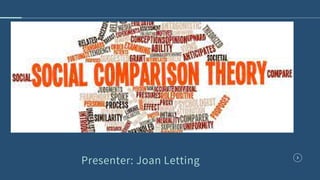
Social
Comparison
Theory
There are two kinds
of social
comparison
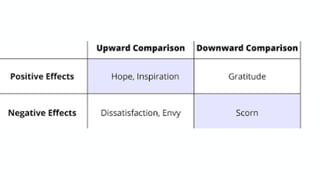
upward social
comparison
downward social
comparison.
Takes place when we compare
ourselves with those whom we believe
are better than us.
Often focuses on the desire to improve
our current status or level of ability
We might compare ourselves to
someone better off and look for ways
that we can achieve similar results.


Upward Social Comparison
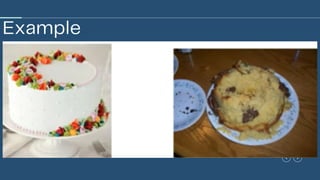
Example
Downward Social
Comparison
Takes place when we compare
ourselves to others who are worse off
than us.
Such downward comparisons are
often centered on making ourselves
feel better about our abilities or traits.
We might not be great at something, but
at least we are better off than someone
else.
Example
A pupil in a school in Nairobi Pupils in a school in Tiaty, Baringo
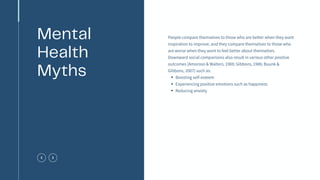
Boosting self-esteem
Experiencing positive emotions such as happiness
Reducing anxiety
People compare themselves to those who are better when they want
inspiration to improve, and they compare themselves to those who
are worse when they want to feel better about themselves.
Downward social comparisons also result in various other positive
outcomes (Amoroso & Walters, 1969; Gibbons, 1986; Buunk &
Gibbons, 2007) such as:
Mental
Health
Myths
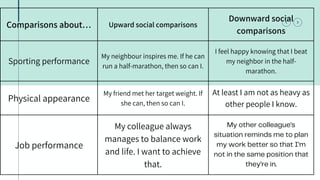
Comparisons about… Upward social comparisons
Downward social
comparisons
Sporting performance
My neighbour inspires me. If he can
run a half-marathon, then so can I.
I feel happy knowing that I beat
my neighbor in the half-
marathon.
Physical appearance
My friend met her target weight. If
she can, then so can I.
At least I am not as heavy as
other people I know.
Job performance
My colleague always
manages to balance work
and life. I want to achieve
that.
My other colleague’s
situation reminds me to plan
my work better so that I’m
not in the same position that
they’re in.
Intelligence
My friend is smarter than
I am. She just gets it.
My colleague struggles all the time with
the same topics, whereas it just clicks for
me.
Relationships
Couple Z makes it look
so easy. They get along
so well and never fight,
unlike us.
When I see couple X fight, I’m reminded
to be grateful for my relationship. It
could be a lot worse!
Money
I want to work hard so
that I can earn the same
amount as my boss.
Before he knew it, he was laid off. At
least I have a job, but it could change
any day.
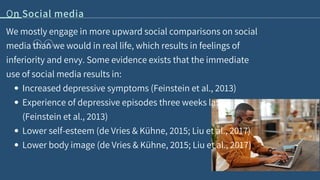
On Social media
Increased depressive symptoms (Feinstein et al., 2013)
Experience of depressive episodes three weeks later
(Feinstein et al., 2013)
Lower self-esteem (de Vries & Kühne, 2015; Liu et al., 2017)
Lower body image (de Vries & Kühne, 2015; Liu et al., 2017)
We mostly engage in more upward social comparisons on social
media than we would in real life, which results in feelings of
inferiority and envy. Some evidence exists that the immediate
use of social media results in:
In health communication


In the health domain, the comparison provides information
about medical risks, identifies behaviours that are health-
promoting and health-damaging, and clarifies whether the
individual has sufficient ability to perform the requisite
behaviours. Self-enhancement refers to the desire to feel
better or protect oneself from the consequences of
threatening information (Wills, 1981; Wood, Taylor &
Lichtman, 1985).
This motive is relevant to health because the occurrence or
prospect of personal illness and its consequences are
inherently threatening to the physical and psychological well-
being of the self.
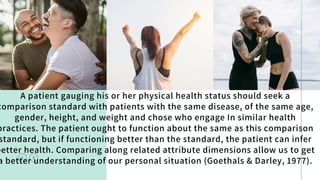
A patient gauging his or her physical health status should seek a
comparison standard with patients with the same disease, of the same age,
gender, height, and weight and chose who engage In similar health
practices. The patient ought to function about the same as this comparison
standard, but if functioning better than the standard, the patient can infer
better health. Comparing along related attribute dimensions allow us to get
a better understanding of our personal situation (Goethals & Darley, 1977).
Some times, however, people want to know more than simply that they are
n good or poor health, but what they are capable of achieving ("Can I do X?).
For example, chronic illness patients want to know whether they will get
better or worse: "Can I return to my 40-hour a week job?" "Am I again able to
play sports with my children or peers?" and so on.
One way to answer such questions is to compare with someone-referred to as
a proxy who seems to have a similar level of ability and who has already
succeeded at the task (Wheeler, Martin, & Suls, 1997). If people have the
same amount or more ability than the proxy does, they can conclude with
some confidence that they could also do as well.
(Goethals & Darley, 1977).
Prior to or following surgery, patients may be
asked to view videotapes depicting the
procedure and its sequelae and what practices
should be followed post-discharge. Often, these
videotapes feature real patients or actors
posing as patients who describe their
experiences.
More informal health communications may
be transmitted in patient support groups
where some comparisons may be implicit
and explicit.
A surgery patient recovering in the hospital may
feel better after comparing with the patient in
the next bed who is experiencing more pain and
adversity after experiencing the same surgery.
Social
Comparison in
health
Communication
Buunk, B. P., & Brenninkmeijer, V. (2001). When individuals dislike exposure to an
actively coping role model: Mood change as related to depression and social
comparison orientation. European Journal of Social Psychology, 31(5), 537–548.
Feinstein, B. A., Hershenberg, R., Bhatia, V., Latack, J. A., Meuwly, N., & Davila, J. (2013).
Negative social comparison on Facebook and depressive symptoms: Rumination as a
mechanism. Psychology of Popular Media Culture, 2(3), 161–170.
Festinger L. A theory of social comparison processes. Human Relations. 1954;7(2):117-
140. doi:10.1177/001872675400700202
Festinger, L. (1954). A theory of social comparison processes. Human Relations, 7(2),
117–140.
Kesici S, Erdogan A. Mathematics anxiety according to middle school students'
achievement motivation and social comparison. Education. 2010;131(1):54-63.
Suls, J., & Bruchmann, K. (2013). Social comparison and persuasion in health
communications. In L. Martin & R. DiMatteo (Eds.). Oxford Handbook of Health
Communication, Behavior Change, and Treatment Adherence. NY: Oxford University
Press.
References

Social Comparison Theory.pdf

  • 1.
  • 2.
    OVERVIEW OF KEYIDEAS Content Synopsis Introduction Background Types of Social Comparison Examples Social Comparison in Health Communication Conclusion
  • 3.
    Introduction How many timeshave you compared yourself to your friends or colleagues using a trait that you consider desirable, for example, money or success? This comparison is known as social comparison.
  • 4.
    Proposed in 1954by psychologist Leon Festinger Suggested that people have an innate drive to evaluate themselves, often in comparison to others believed that we engage in this comparison process as a way of establishing a benchmark by which we can make accurate evaluations of ourselves
  • 5.
    Determine whether weare good enough (abilities) or correct (opinions) Set a benchmark of what we aim to achieve Festinger (1954) argued that we are driven to assess our abilities and opinions to: 1. 2. This benchmark is referred to as the level of aspiration. Social Comparison Theory
  • 7.
    There are twokinds of social comparison upward social comparison downward social comparison.
  • 8.
    Takes place whenwe compare ourselves with those whom we believe are better than us. Often focuses on the desire to improve our current status or level of ability We might compare ourselves to someone better off and look for ways that we can achieve similar results. Upward Social Comparison
  • 9.
  • 10.
    Downward Social Comparison Takes placewhen we compare ourselves to others who are worse off than us. Such downward comparisons are often centered on making ourselves feel better about our abilities or traits. We might not be great at something, but at least we are better off than someone else.
  • 11.
    Example A pupil ina school in Nairobi Pupils in a school in Tiaty, Baringo
  • 12.
    Boosting self-esteem Experiencing positiveemotions such as happiness Reducing anxiety People compare themselves to those who are better when they want inspiration to improve, and they compare themselves to those who are worse when they want to feel better about themselves. Downward social comparisons also result in various other positive outcomes (Amoroso & Walters, 1969; Gibbons, 1986; Buunk & Gibbons, 2007) such as: Mental Health Myths
  • 13.
    Comparisons about… Upwardsocial comparisons Downward social comparisons Sporting performance My neighbour inspires me. If he can run a half-marathon, then so can I. I feel happy knowing that I beat my neighbor in the half- marathon. Physical appearance My friend met her target weight. If she can, then so can I. At least I am not as heavy as other people I know. Job performance My colleague always manages to balance work and life. I want to achieve that. My other colleague’s situation reminds me to plan my work better so that I’m not in the same position that they’re in.
  • 14.
    Intelligence My friend issmarter than I am. She just gets it. My colleague struggles all the time with the same topics, whereas it just clicks for me. Relationships Couple Z makes it look so easy. They get along so well and never fight, unlike us. When I see couple X fight, I’m reminded to be grateful for my relationship. It could be a lot worse! Money I want to work hard so that I can earn the same amount as my boss. Before he knew it, he was laid off. At least I have a job, but it could change any day.
  • 16.
    On Social media Increaseddepressive symptoms (Feinstein et al., 2013) Experience of depressive episodes three weeks later (Feinstein et al., 2013) Lower self-esteem (de Vries & Kühne, 2015; Liu et al., 2017) Lower body image (de Vries & Kühne, 2015; Liu et al., 2017) We mostly engage in more upward social comparisons on social media than we would in real life, which results in feelings of inferiority and envy. Some evidence exists that the immediate use of social media results in:
  • 18.
    In health communication Inthe health domain, the comparison provides information about medical risks, identifies behaviours that are health- promoting and health-damaging, and clarifies whether the individual has sufficient ability to perform the requisite behaviours. Self-enhancement refers to the desire to feel better or protect oneself from the consequences of threatening information (Wills, 1981; Wood, Taylor & Lichtman, 1985). This motive is relevant to health because the occurrence or prospect of personal illness and its consequences are inherently threatening to the physical and psychological well- being of the self.
  • 19.
    A patient gauginghis or her physical health status should seek a comparison standard with patients with the same disease, of the same age, gender, height, and weight and chose who engage In similar health practices. The patient ought to function about the same as this comparison standard, but if functioning better than the standard, the patient can infer better health. Comparing along related attribute dimensions allow us to get a better understanding of our personal situation (Goethals & Darley, 1977).
  • 20.
    Some times, however,people want to know more than simply that they are n good or poor health, but what they are capable of achieving ("Can I do X?). For example, chronic illness patients want to know whether they will get better or worse: "Can I return to my 40-hour a week job?" "Am I again able to play sports with my children or peers?" and so on. One way to answer such questions is to compare with someone-referred to as a proxy who seems to have a similar level of ability and who has already succeeded at the task (Wheeler, Martin, & Suls, 1997). If people have the same amount or more ability than the proxy does, they can conclude with some confidence that they could also do as well. (Goethals & Darley, 1977).
  • 21.
    Prior to orfollowing surgery, patients may be asked to view videotapes depicting the procedure and its sequelae and what practices should be followed post-discharge. Often, these videotapes feature real patients or actors posing as patients who describe their experiences. More informal health communications may be transmitted in patient support groups where some comparisons may be implicit and explicit. A surgery patient recovering in the hospital may feel better after comparing with the patient in the next bed who is experiencing more pain and adversity after experiencing the same surgery. Social Comparison in health Communication
  • 23.
    Buunk, B. P.,& Brenninkmeijer, V. (2001). When individuals dislike exposure to an actively coping role model: Mood change as related to depression and social comparison orientation. European Journal of Social Psychology, 31(5), 537–548. Feinstein, B. A., Hershenberg, R., Bhatia, V., Latack, J. A., Meuwly, N., & Davila, J. (2013). Negative social comparison on Facebook and depressive symptoms: Rumination as a mechanism. Psychology of Popular Media Culture, 2(3), 161–170. Festinger L. A theory of social comparison processes. Human Relations. 1954;7(2):117- 140. doi:10.1177/001872675400700202 Festinger, L. (1954). A theory of social comparison processes. Human Relations, 7(2), 117–140. Kesici S, Erdogan A. Mathematics anxiety according to middle school students' achievement motivation and social comparison. Education. 2010;131(1):54-63. Suls, J., & Bruchmann, K. (2013). Social comparison and persuasion in health communications. In L. Martin & R. DiMatteo (Eds.). Oxford Handbook of Health Communication, Behavior Change, and Treatment Adherence. NY: Oxford University Press. References