Downloaded 25 times
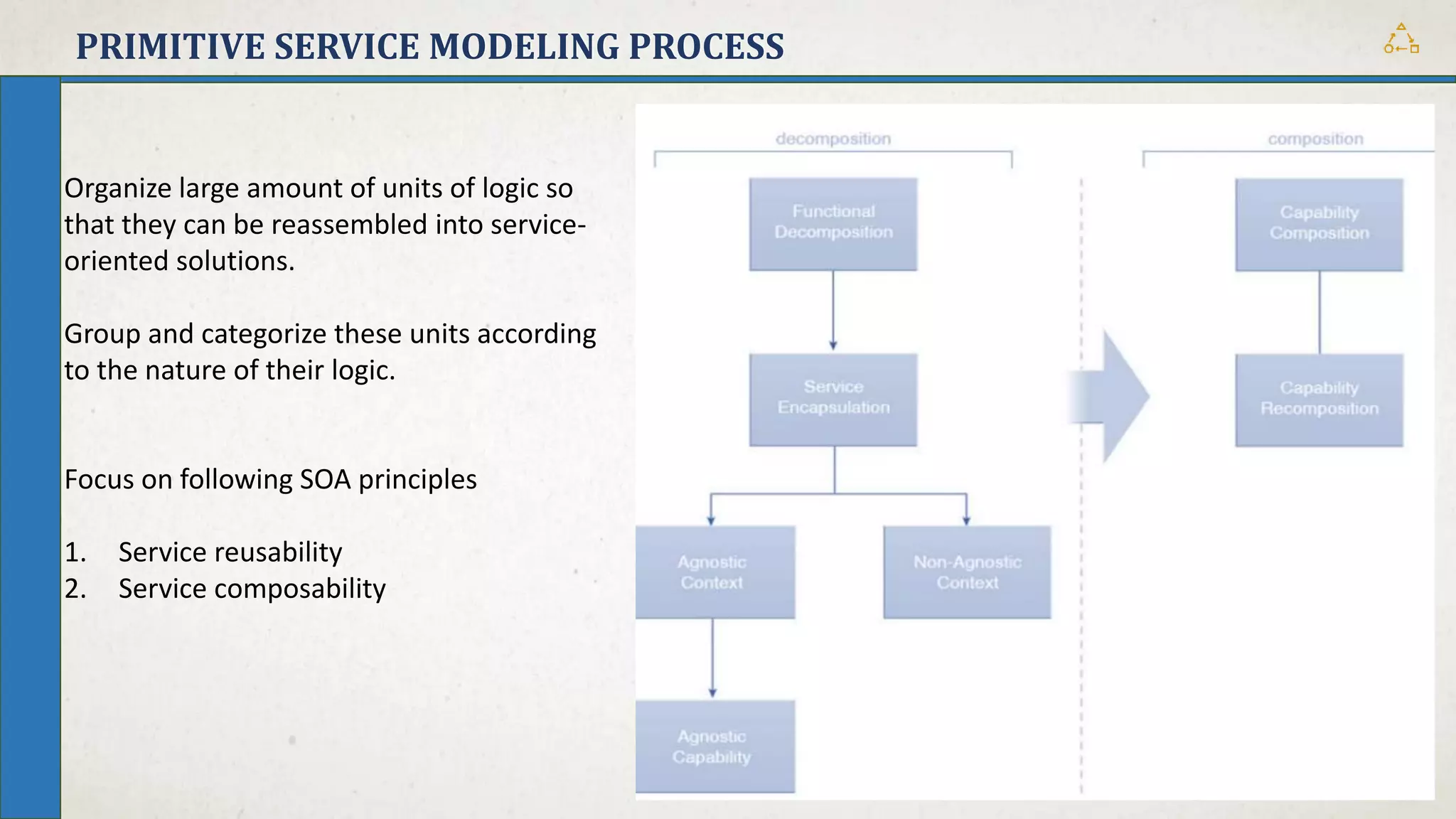
![PROCESS MODELING [1. FUNCTIONAL DECOMPOSITION]
Purpose : How can a large business problem be solved without having to build a standalone
body of solution logic?
Solution :
To apply service-orientation, we first must break down a business process by functionally
decomposing it into a set of desirable actions
Functional decomposition is Application of the separation of concerns theory.](https://image.slidesharecdn.com/2-170410102613/75/SOA-Course-service-process-model-6-2048.jpg)
![PROCESS MODELING [1. FUNCTIONAL DECOMPOSITION]
Impacts :
Require attention on interconnectivity, security, reliability, and maintenance between
distributed solution logics
If the quality of the business process definition is poor, then the resulting concerns will
form a weak foundation for subsequent service definition.
Relationships :
Functional Decomposition forms the basis for all of the patterns
prepares the concerns that are subsequently addressed by solution logic that begins to
take shape with the application of Service Encapsulation](https://image.slidesharecdn.com/2-170410102613/75/SOA-Course-service-process-model-7-2048.jpg)
![PROCESS MODELING [2. SERVICE ENCAPSULATION]
Purpose : How can solution logic be made available as a resource of the enterprise?
Solution :
Solution logic can be encapsulated by and exposed as a service (positioned as enterprise resource)
Solution logic capable of functioning beyond the boundary for which it is initially delivered
enterprise where individual solutions use logic encapsulated as services and vice versa ( as shared services )](https://image.slidesharecdn.com/2-170410102613/75/SOA-Course-service-process-model-8-2048.jpg)
![PROCESS MODELING [2. SERVICE ENCAPSULATION]
Application : ( identify solution logic that can be encapsulate)
Does logic contain functionality useful to parts of the enterprise outside of the current application
boundary? ( if yes , logic increased value potential to be enterprise resources )
Does logic designed to leverage enterprise resources also have the potential to become an
enterprise resource? ( after agnostic logic is initially separated , it will be clear if new logic can
leverage existing enterprise resource , if so , some or all of its functionality can also be positioned
as an enterprise resource)
Does implementation of logic require hard constraints
that make it impractical or impossible to position
logic as an effective enterprise resource?
(may be real-world limitations prevent from being
encapsulated as a service)](https://image.slidesharecdn.com/2-170410102613/75/SOA-Course-service-process-model-9-2048.jpg)
![PROCESS MODELING [2. SERVICE ENCAPSULATION]
If service-orientation design principles cannot be applied to a meaningful extent,
then logic not likely justify for service encapsulation
Relationships :
For encapsulated solution logic to become effective member of service inventory, it needs to be further
shaped by other patterns and principles
Encapsulated solution logic subsequently grouped into
• Single service ( non-agnostic context) [ entity – utility]
• OR multi-purpose services ( Agnostic context) [ task – orchestration ]](https://image.slidesharecdn.com/2-170410102613/75/SOA-Course-service-process-model-10-2048.jpg)
![PROCESS MODELING [3. AGNOSTIC CONTEXT]
Purpose : How can multi-purpose service logic be positioned as an effective enterprise resource?
Solution :
Isolate logic that is not specific to one purpose into separate services with distinct agnostic contexts
positions reusable solution logic at an enterprise level
Apply service reusability principle](https://image.slidesharecdn.com/2-170410102613/75/SOA-Course-service-process-model-11-2048.jpg)
![PROCESS MODELING [3. AGNOSTIC CONTEXT]
Application :
Subset of the solution logic being further decomposed and then distributed into services with specific
agnostic contexts
Agnostic logic is defined and continually refined into a set
of candidate service contexts.
form the basis of Entity Abstraction and Utility Abstraction
Impacts :
Increase quantity of services required to solve a given problem
Leads to additional design considerations and performance
overhead associated with service compositions.
The governance effort increased
Also the governance of the overall architecture is also
impacted as the quantity of agnostic services
within an inventory grows.](https://image.slidesharecdn.com/2-170410102613/75/SOA-Course-service-process-model-12-2048.jpg)
![PROCESS MODELING [3. AGNOSTIC CONTEXT]
Relationships :
Closest relationship is between Agnostic Context and Agnostic Capability
Other patterns apply specialized variations on agnostic context such as
Entity Abstraction and Utility Abstraction](https://image.slidesharecdn.com/2-170410102613/75/SOA-Course-service-process-model-13-2048.jpg)
![PROCESS MODELING [4. AGNOSTIC CAPABILITY]
Purpose : How can multipurpose service logic be made effectively consumable and composable ?
Solution : Agnostic service logic is partitioned into a set of well-defined capabilities that address
common concerns not specific to any one problem](https://image.slidesharecdn.com/2-170410102613/75/SOA-Course-service-process-model-14-2048.jpg)
![PROCESS MODELING [4. AGNOSTIC CAPABILITY]
Relationships :
considered a continuation of Agnostic Context](https://image.slidesharecdn.com/2-170410102613/75/SOA-Course-service-process-model-15-2048.jpg)
![PROCESS MODELING [4. AGNOSTIC CAPABILITY]
After applying Entity Abstraction :](https://image.slidesharecdn.com/2-170410102613/75/SOA-Course-service-process-model-16-2048.jpg)
![PROCESS MODELING [4. AGNOSTIC CAPABILITY]
After applying Utility Abstraction :](https://image.slidesharecdn.com/2-170410102613/75/SOA-Course-service-process-model-17-2048.jpg)
![PROCESS MODELING [4. AGNOSTIC CAPABILITY] SAMPLE
Service definitions, each with capabilities that address the processing requirements of specific business process
After further service modeling, the definitions are refined with agnostic capabilities.](https://image.slidesharecdn.com/2-170410102613/75/SOA-Course-service-process-model-18-2048.jpg)
![PROCESS MODELING [5. NON-AGNOSTIC CONTEXT]
Purpose : How can single-purpose service logic be positioned as an effective enterprise resource?
Solution :
Non-agnostic solution logic suitable for service encapsulation can be located within services
that reside as official members of a service inventory](https://image.slidesharecdn.com/2-170410102613/75/SOA-Course-service-process-model-19-2048.jpg)
![PROCESS MODELING [5. NON-AGNOSTIC CONTEXT]
Application :
Non-agnostic service logic is shaped via the same governing design principles as agnostic Services
Most commonly applied in combination with Process Abstraction
No rules as to whether this pattern should be applied before or after Agnostic Context
Impacts :
Initial delivery will be more expensive and
more time-consuming
The ultimate ROI can therefore be significantly
lower than with agnostic services](https://image.slidesharecdn.com/2-170410102613/75/SOA-Course-service-process-model-20-2048.jpg)
![PROCESS MODELING [5. NON-AGNOSTIC CONTEXT]
Relationships :
Non-Agnostic Context is subsequent to Service Encapsulation
Based on task-centric service models so major relation with process abstraction
and process centralization patterns](https://image.slidesharecdn.com/2-170410102613/75/SOA-Course-service-process-model-21-2048.jpg)
![PROCESS MODELING [5. NON-AGNOSTIC CONTEXT]
After applying Process Abstraction :](https://image.slidesharecdn.com/2-170410102613/75/SOA-Course-service-process-model-22-2048.jpg)



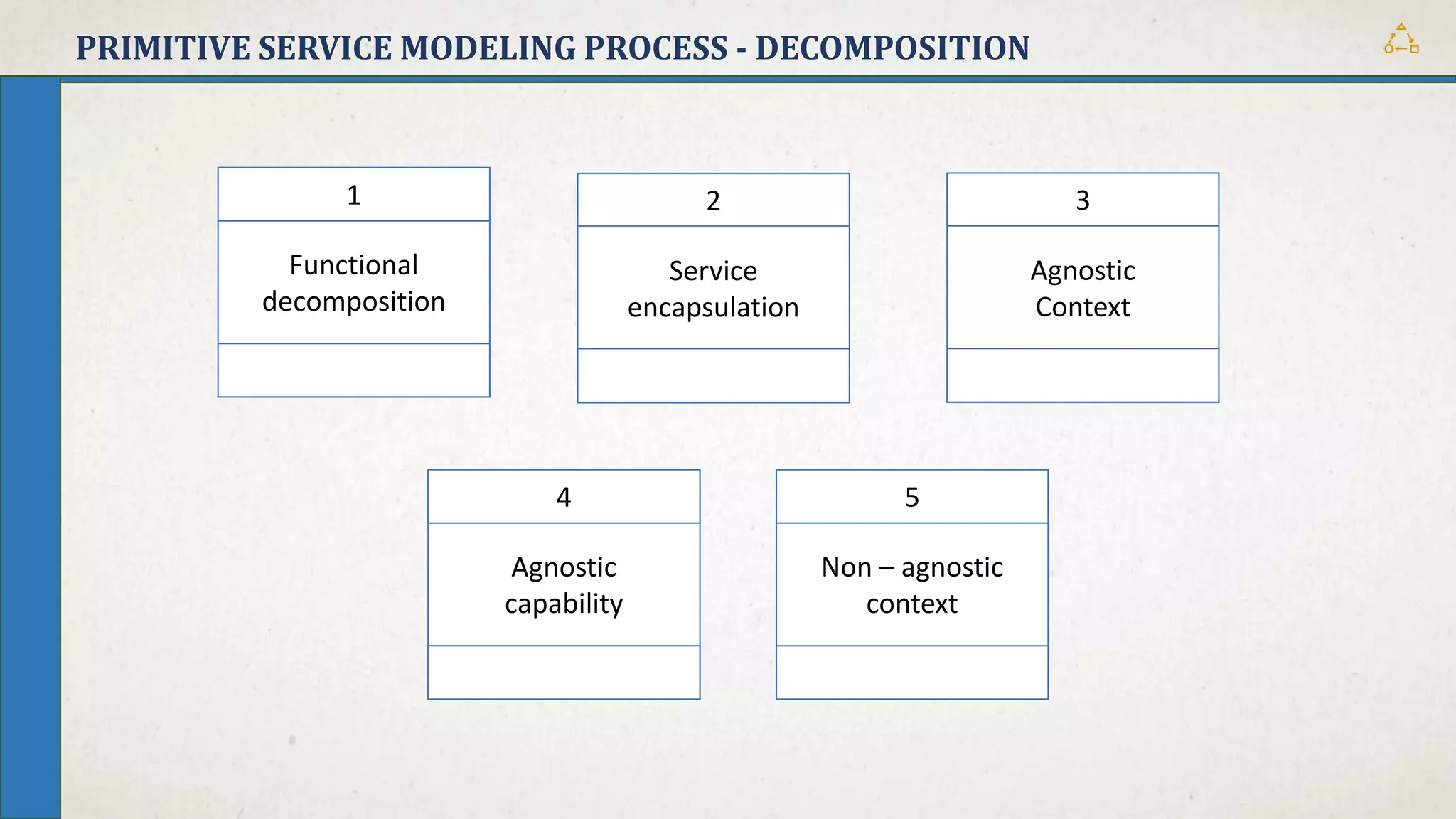
This document discusses the primitive service modeling process for organizing business logic into reusable services. It describes 5 steps: 1) functional decomposition, 2) service encapsulation, 3) agnostic context, 4) agnostic capability, and 5) non-agnostic context. The goal is to break down business processes, encapsulate solution logic as services, isolate reusable logic, define well-defined capabilities, and incorporate single-purpose logic respectively, following SOA principles of reusability and composability. Relationships between the steps are also examined to structure logic into a service inventory.


