Service Oriented Architecture: 10
SOA Technology: SOAP
Prof Neeraj Bhargava
Vaibhav Khanna
Department of Computer Science
School of Engineering and Systems Sciences
Maharshi Dayanand Saraswati University Ajmer
Simple Object Access Protocol (SOAP)
• SOAP was originally conceived as a technology
to bridge the gap between disparate RPC-
based communication platforms
• SOAP has evolved into the most widely
supported messaging format and protocol for
use with XML Web services
• SOAP is also frequently referred to as the
Service-Oriented Architecture (or Application)
Protocol
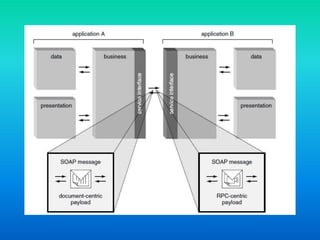
SOAP Message formats
• The SOAP specification establishes a standard
message format that consists of an XML
document capable of hosting RPC and document-
centric data
• This facilitates synchronous (request and
response) as well as asynchronous (process
driven) data exchange models
• Thus SOAP establishes two primary standard
message formats.
• Additionally the SOAP message may deliver its
data as an attachment.
SOAP messaging framework
• SOAP institutes a method of communication
based on Web services framework
• A SOAP node represents the processing logic
responsible for transmitting, receiving, and
performing a variety of processing tasks on SOAP
messages.
• These are also sometimes presented as SOAP
server or a SOAP listener or SOAP routers
• SOAP node as the underlying transport
mechanism for a Web service.
SOAP Node Types
• Like Web services, SOAP nodes can exist as
initial senders, intermediaries, and ultimate
• receivers. Whereas Web services are also
classified as requestors and providers,
• SOAP nodes performing the equivalent tasks
(sending, receiving) are referred to as
• SOAP senders and SOAP receivers
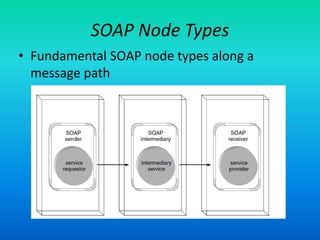
SOAP Node Types
• Fundamental SOAP node types along a
message path
Roles of SOAP Nodes
• As with Web service roles, the same SOAP node
can act as different types depending on its
position within the message path and the state of
the current business activity.
• For instance, a SOAP node transmitting a
message as the initial sender can later receive a
response as the ultimate receiver.
• A intermediary SOAP node go through the
transition of being a SOAP receiver and then
becoming a sender during the processing of a
SOAP message.
SOAP message structure
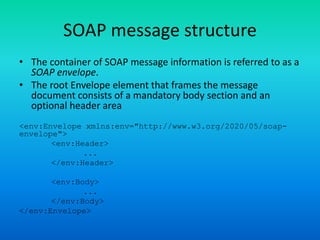
• The container of SOAP message information is referred to as a
SOAP envelope.
• The root Envelope element that frames the message
document consists of a mandatory body section and an
optional header area
<env:Envelope xmlns:env="http://www.w3.org/2020/05/soap-
envelope">
<env:Header>
...
</env:Header>
<env:Body>
...
</env:Body>
</env:Envelope>
The Header construct
• The SOAP header is expressed using the Header construct, which
can contain one or more sections or blocks.
<env:Envelope
xmlns:env="http://www.w3.org/2020/05/soap-
envelope">
<env:Header>
<n:shipping >
UPS
</n:shipping>
</env:Header>
<env:Body>
...
</env:Body>
</env:Envelope>
Common uses of header blocks
Common uses of header blocks include:
• Implementation of (predefined or application-
specific) SOAP extensions, such as those
introduced by second-generation specifications
• Identification of target SOAP intermediaries
providing supplementary meta information about
the SOAP message
• While a SOAP message progresses along a
message path, intermediaries may add, remove,
or process information in SOAP header blocks.
Body construct
• Body construct, this section acts as a
container for the data being delivered by the
SOAP message.
• Data within the SOAP body is often referred to
as the payload or payload data.
• The Body construct can also be used to host
exception information within nested Fault
elements
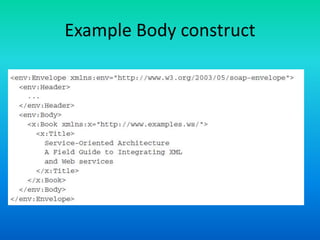
Example Body construct
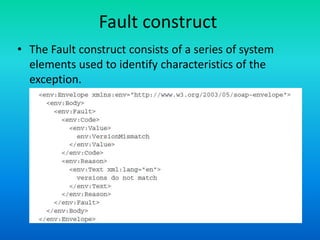
Fault construct
• The Fault construct consists of a series of system
elements used to identify characteristics of the
exception.
SUMMARY SOAP
• Implementations of the SOAP messaging framework
can be collectively conceptualized as an end-to-end
messaging engine that drives communication
throughout contemporary service-oriented
architectures.
• A SOAP message consists of a simple XML document
structure.
• The parent envelope construct houses an optional
header and a required body construct.
• Exception information can be placed in a special Fault
element that is nested within the message body.
Assignment
• Discuss the structure and functioning of
simple SOAP Messages

Soa 10 soa technology soap

  • 1.
    Service Oriented Architecture:10 SOA Technology: SOAP Prof Neeraj Bhargava Vaibhav Khanna Department of Computer Science School of Engineering and Systems Sciences Maharshi Dayanand Saraswati University Ajmer
  • 2.
    Simple Object AccessProtocol (SOAP) • SOAP was originally conceived as a technology to bridge the gap between disparate RPC- based communication platforms • SOAP has evolved into the most widely supported messaging format and protocol for use with XML Web services • SOAP is also frequently referred to as the Service-Oriented Architecture (or Application) Protocol
  • 3.
    SOAP Message formats •The SOAP specification establishes a standard message format that consists of an XML document capable of hosting RPC and document- centric data • This facilitates synchronous (request and response) as well as asynchronous (process driven) data exchange models • Thus SOAP establishes two primary standard message formats. • Additionally the SOAP message may deliver its data as an attachment.
  • 5.
    SOAP messaging framework •SOAP institutes a method of communication based on Web services framework • A SOAP node represents the processing logic responsible for transmitting, receiving, and performing a variety of processing tasks on SOAP messages. • These are also sometimes presented as SOAP server or a SOAP listener or SOAP routers • SOAP node as the underlying transport mechanism for a Web service.
  • 6.
    SOAP Node Types •Like Web services, SOAP nodes can exist as initial senders, intermediaries, and ultimate • receivers. Whereas Web services are also classified as requestors and providers, • SOAP nodes performing the equivalent tasks (sending, receiving) are referred to as • SOAP senders and SOAP receivers
  • 7.
    SOAP Node Types •Fundamental SOAP node types along a message path
  • 8.
    Roles of SOAPNodes • As with Web service roles, the same SOAP node can act as different types depending on its position within the message path and the state of the current business activity. • For instance, a SOAP node transmitting a message as the initial sender can later receive a response as the ultimate receiver. • A intermediary SOAP node go through the transition of being a SOAP receiver and then becoming a sender during the processing of a SOAP message.
  • 9.
    SOAP message structure •The container of SOAP message information is referred to as a SOAP envelope. • The root Envelope element that frames the message document consists of a mandatory body section and an optional header area <env:Envelope xmlns:env="http://www.w3.org/2020/05/soap- envelope"> <env:Header> ... </env:Header> <env:Body> ... </env:Body> </env:Envelope>
  • 10.
    The Header construct •The SOAP header is expressed using the Header construct, which can contain one or more sections or blocks. <env:Envelope xmlns:env="http://www.w3.org/2020/05/soap- envelope"> <env:Header> <n:shipping > UPS </n:shipping> </env:Header> <env:Body> ... </env:Body> </env:Envelope>
  • 11.
    Common uses ofheader blocks Common uses of header blocks include: • Implementation of (predefined or application- specific) SOAP extensions, such as those introduced by second-generation specifications • Identification of target SOAP intermediaries providing supplementary meta information about the SOAP message • While a SOAP message progresses along a message path, intermediaries may add, remove, or process information in SOAP header blocks.
  • 12.
    Body construct • Bodyconstruct, this section acts as a container for the data being delivered by the SOAP message. • Data within the SOAP body is often referred to as the payload or payload data. • The Body construct can also be used to host exception information within nested Fault elements
  • 13.
  • 14.
    Fault construct • TheFault construct consists of a series of system elements used to identify characteristics of the exception.
  • 15.
    SUMMARY SOAP • Implementationsof the SOAP messaging framework can be collectively conceptualized as an end-to-end messaging engine that drives communication throughout contemporary service-oriented architectures. • A SOAP message consists of a simple XML document structure. • The parent envelope construct houses an optional header and a required body construct. • Exception information can be placed in a special Fault element that is nested within the message body.
  • 16.
    Assignment • Discuss thestructure and functioning of simple SOAP Messages