1
MANAGEMENT OF SNAKE-
BITE
Dr. Afia Sultana
Intern Doctor,BDS
Medicine Unit-5
Rajshahi Medical College Hospital
2
INTRODUCTION
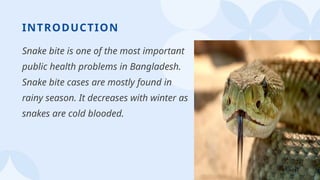
Snake bite is one of the most important
public health problems in Bangladesh.
Snake bite cases are mostly found in
rainy season. It decreases with winter as
snakes are cold blooded.
3
EPIDEMIOLOGY
• The incidence density of snakebite in rural Bangladesh is
623/100000 person years with an estimated 6041 death
annually.
• Neurotoxic snakes (cobra,kraits) are causing significant
mortality and morbidity.
• During the monsoon ,snakebite occurrences increase as
snake leave their shelter due to rainfall.
4
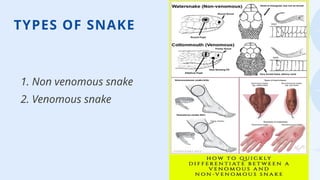
TYPES OF SNAKE
1. Non venomous snake
2. Venomous snake
5
6
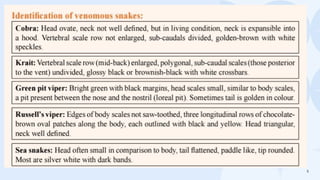
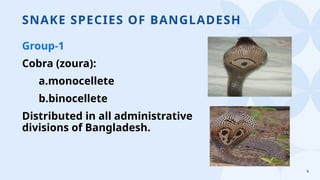
SNAKE SPECIES OF BANGLADESH
Group-1
Cobra (zoura):
a.monocellete
b.binocellete
Distributed in all administrative
divisions of Bangladesh.
7
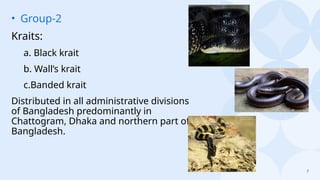
• Group-2
Kraits:
a. Black krait
b. Wall’s krait
c.Banded krait
Distributed in all administrative divisions
of Bangladesh predominantly in
Chattogram, Dhaka and northern part of
Bangladesh.
8
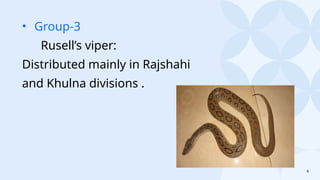
• Group-3
Rusell’s viper:
Distributed mainly in Rajshahi
and Khulna divisions .
9
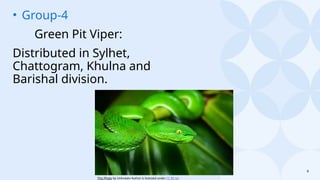
• Group-4
Green Pit Viper:
Distributed in Sylhet,
Chattogram, Khulna and
Barishal division.
This Photo by Unknown Author is licensed under CC BY-SA
10
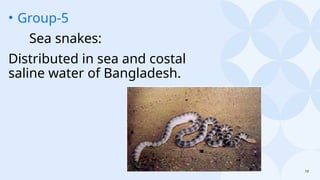
• Group-5
Sea snakes:
Distributed in sea and costal
saline water of Bangladesh.
11
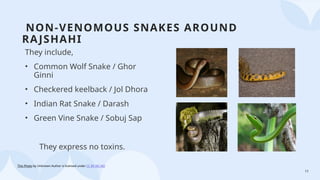
NON-VENOMOUS SNAKES AROUND
RAJSHAHI
They include,
• Common Wolf Snake / Ghor
Ginni
• Checkered keelback / Jol Dhora
• Indian Rat Snake / Darash
• Green Vine Snake / Sobuj Sap
They express no toxins.
This Photo by Unknown Author is licensed under CC BY-NC-ND
12
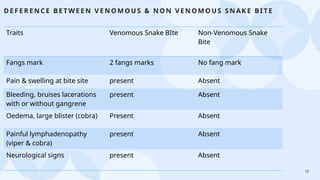
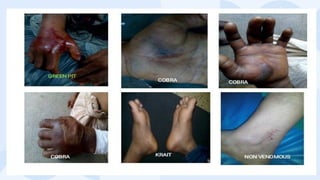
D E FE RE N CE BE TW E EN V E N O MO US & N O N V EN OM OU S SN AK E B ITE
Traits Venomous Snake BIte Non-Venomous Snake
Bite
Fangs mark 2 fangs marks No fang mark
Pain & swelling at bite site present Absent
Bleeding, bruises lacerations
with or without gangrene
present Absent
Oedema, large blister (cobra) Present Absent
Painful lymphadenopathy
(viper & cobra)
present Absent
Neurological signs present Absent
13
14
SITES OF BITE
1.Cobra-
hand and feet
2.Krait-
Anywhere of the body
3.Green snake-
head and face
4.Sea snake-
hand
15
IDENTIFICATION OF VENOMOUS SNAKE BITE
A bite by a venomous snake which produces specific symptoms and
signs or syndrome is considered as a venomous snake bite.
It is important to note that a bite by venomous snake may not always
produce features of envenoming:
*50% of bites by Rusell’s vipers
*30% of bites by Cobras
do not result in any symptoms and signs of envenoming-term as DRY
BITE.
16
CLINICAL FEATURES
Symptoms
Non-specific symptoms:
Headache,
nausea,
vomiting,
abdominal pain
17
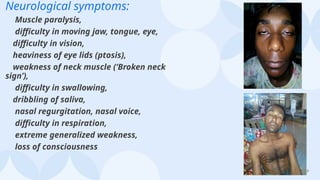
Neurological symptoms:
Muscle paralysis,
difficulty in moving jaw, tongue, eye,
difficulty in vision,
heaviness of eye lids (ptosis),
weakness of neck muscle (‘Broken neck
sign’),
difficulty in swallowing,
dribbling of saliva,
nasal regurgitation, nasal voice,
difficulty in respiration,
extreme generalized weakness,
loss of consciousness
18
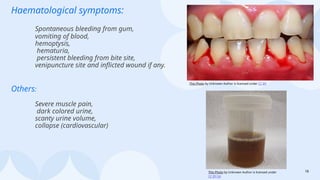
Haematological symptoms:
Spontaneous bleeding from gum,
vomiting of blood,
hemoptysis,
hematuria,
persistent bleeding from bite site,
venipuncture site and inflicted wound if any.
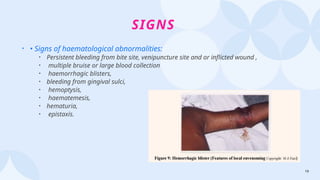
Others:
Severe muscle pain,
dark colored urine,
scanty urine volume,
collapse (cardiovascular)
This Photo by Unknown Author is licensed under CC BY
This Photo by Unknown Author is licensed under
CC BY-SA
19
SIGNS
• • Signs of haematological abnormalities:
• Persistent bleeding from bite site, venipuncture site and or inflicted wound ,
• multiple bruise or large blood collection
• haemorrhagic blisters,
• bleeding from gingival sulci,
• hemoptysis,
• haematemesis,
• hematuria,
• epistaxis.
20
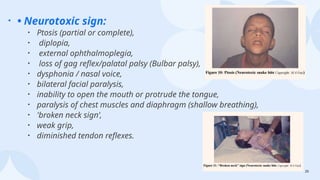
• • Neurotoxic sign:
• Ptosis (partial or complete),
• diplopia,
• external ophthalmoplegia,
• loss of gag reflex/palatal palsy (Bulbar palsy),
• dysphonia / nasal voice,
• bilateral facial paralysis,
• inability to open the mouth or protrude the tongue,
• paralysis of chest muscles and diaphragm (shallow breathing),
• 'broken neck sign’,
• weak grip,
• diminished tendon reflexes.
21
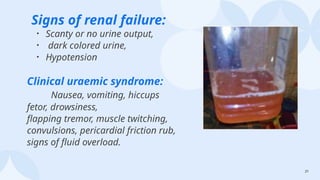
Signs of renal failure:
• Scanty or no urine output,
• dark colored urine,
• Hypotension
Clinical uraemic syndrome:
Nausea, vomiting, hiccups
fetor, drowsiness,
flapping tremor, muscle twitching,
convulsions, pericardial friction rub,
signs of fluid overload.
22
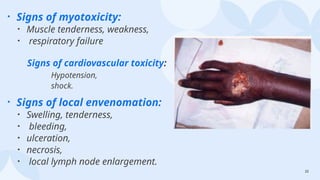
• Signs of myotoxicity:
• Muscle tenderness, weakness,
• respiratory failure
Signs of cardiovascular toxicity:
Hypotension,
shock.
• Signs of local envenomation:
• Swelling, tenderness,
• bleeding,
• ulceration,
• necrosis,
• local lymph node enlargement.
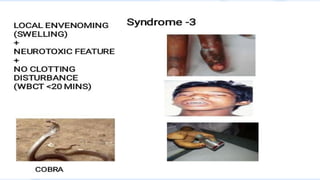
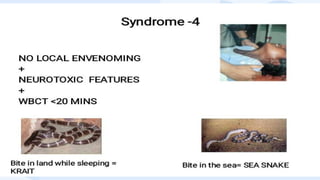
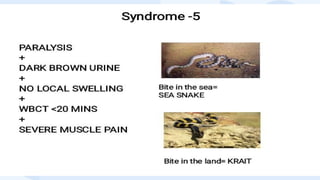
SYNDROMIC
APPROACH
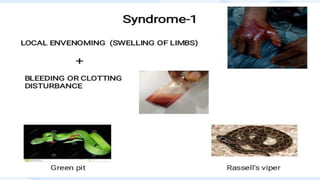
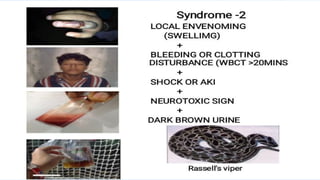
SN AK E BIT E E N V E N O MATIO N S YN DRO M ES F O R S OU TH -E AS T AS IA
24
25
26
27
28
29
INVESTIGATION OR LABORATORY
TESTS
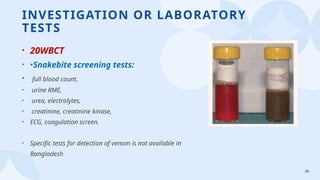
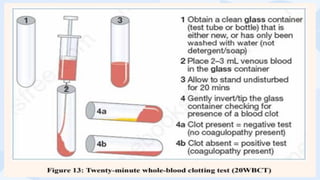
• 20WBCT
• •Snakebite screening tests:
• full blood count,
• urine RME,
• urea, electrolytes,
• creatinine, creatinine kinase,
• ECG, coagulation screen.
• Specific tests for detection of venom is not available in
Bangladesh
30
31
PRE HOSPITAL MANAGEMENT
First Aid:
• Effective first-aid treatment should be carried out immediately or
very soon after the snake bite; before the patient reaches Hospital
• Recommended first aid methods:
1. Reassurance:
• Patient should be advised not to get panicked. He should be told
that majority of snakes are non-venomous; moreover, venomous
snakes sometimes fail to inject enough venom effectively during
bites.
32
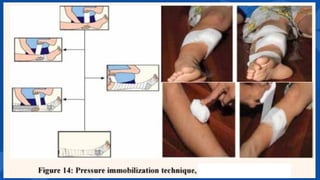
• 2. Immobilization:
• Make sure that bitten limb (hand or leg) is immobile
and the victim must be kept still.
Advise:
Bite in lower limb: “Sit down, do not walk”. Bite in upper limb:
“Do not move the limb”. Immobilize the bitten limb with a
splint or sling as practiced in fracture of long bone. Ideal is to
provide pressure immobilization.
34
3.Wash the bitten area: gently with soap and water, or wipe
with a wet cloth and cover with bandage
4. Place patient in the lateral recumbent position.
5. Remove as early as possible all rings, bangles, anklets,
cords or clothing, ‘Tabij’, ‘Taga’ etc., which may cause
constriction if swelling occur.
6. Quick transport: seek help to get the patient rapidly
transferred to a hospital by motorbike or ambulance. (O)
35
7. If non-breathing, insert an oral airway or perform rescue breathing if
necessary.
8. If the snake is killed somehow, bring it to hospital. Be
careful and do not handle snakes bare handedly as they
might pretend to be dead. Do not waste time for catching or
killing the snake.
36
🚫 SOME DON’T 🚫
• 1.Do not apply tourniquets/ligature in the bitten limb.
• 2. Do not cut or prick with needles or use any topical cream.
• 3. Do not waste time unnecessarily seeking treatment provided by
traditional healers (Ozhas).
• 4. Do not provide anything by mouth if the victim has difficulty in
swallowing/talking, vomiting, nasal voice or excessive salivation.
• 5. Do not cauterize by using chemicals.
• 6. Do not apply alcohol.
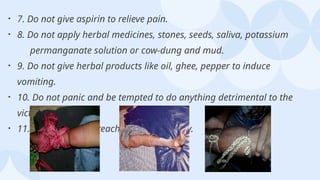
• 7. Do not give aspirin to relieve pain.
• 8. Do not apply herbal medicines, stones, seeds, saliva, potassium
permanganate solution or cow-dung and mud.
• 9. Do not give herbal products like oil, ghee, pepper to induce
vomiting.
• 10. Do not panic and be tempted to do anything detrimental to the
victim.
• 11. Do not delay in reaching health facility.
38
HOSPITAL MANAGEMENT
After taking proper history, you must follow the following steps:
• 1.Rapid clinical assessment And resuscitation
• 2.Give TT and TIG first
• 3. Approach for specific treatment
• 4.Give antibiotic if there is possibility of infection
• 5. If neurological or severe haematological involvement
consider ICU support.
39
SPECIFIC THERAPY: INDICATION OF ANTIVENOM
• Antivenom treatment is recommended if and when a patient with proven or suspected
snake-bite develops one or more of following features
• Systemic envenoming:
• 1. Haemostatic abnormalities:
• Spontaneous systemic bleeding (clinical),
Coagulopathy (20WBCT or other laboratory tests such as prothrombin time)
or thrombocytopenia (<100 x 109/litre or 100 000/cu mm) (laboratory).
• 2.Neurotoxic signs:
• ptosis, external ophthalmoplegia, paralysis etc (clinical).
40
3. Cardiovascular abnormalities:
hypotension, shock, cardiac arrhythmia (clinical)
4. Acute kidney injury (renal failure):
oliguria/anuria (clinical), rising blood creatinine/ urea (laboratory).
(Haemoglobin-/myoglobin-uria:)
dark brown urine (clinical), urine dipsticks, other evidence of
intra-mascular haemolysis or generalized rhabdomyolysis (muscle aches
and pains, hyperkalaemia) (clinical, laboratory).
41
LOCAL ENVENOMING
* Local swelling involving more than half of the bitten limb (in the
absence of a tourniquet) within 48 hours of the bite.
* Swelling after bites on the digits (toes and especially fingers).
* Rapid extension of swelling (for example, beyond the wrist or
ankle within a few hours of bite on the hands or feet).
* Development of an enlarged tender lymph node draining the
bitten limb
42
IT IS NEVER TOO LATE TO GIVE AV PROVIDED
THE INDICATIONS ARE PRESENT:
• 1. Only if features of systemic envenoming are present for
bites of snakes mentioned in the previous slides.
• 2. Do not give antivenom for local envenoming alone,
except for cobra and Russell’s viper bites when indicated
43
ANTI VENOM THERAPY
• Commence AV as soon as systemic envenoming is detected.
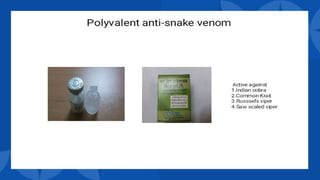
• • Dose: 100 ml (10 ampoules) of Indian polyvalent AV mixed with 100 ml
of normal saline should be infused intravenously over one hour. Adult
and children should receive same dose of AV. Start infusion at a lower
rate for 10-15 minutes.
• Before initiating antivenom, prophylactic subcutaneous adrenaline
(dose- adult 0.25 ml of 0.1% solution and in children 0.005 mg/kg)
should be given to the victim (T).
•
Click icon to add picture
45
CAUTION
Have Adrenaline (+Inj Hydrocortisone, Inj Anti
histamine) available at bedside
Observe the patient carefully during the time of
administration of antivenom and up to 3 hours
for signs of anaphylaxis.
MONITOR Pulse, blood pressure and respiration
and observe for the appearance of a rash
46
CRITERIA FOR REPEATING THE INITIAL DOSE OF ANTIVENOM
• Persisting or deteriorating signs of systemic envenoming
e.g.
• a) If no improvement or deterioration of neurotoxic features (Cobra
or Krait) 1-2 hours after completion of antivenom.
• b) Persistence or recurrence of blood incoagulability after 6 hours of
antivenom treatment.
• The endpoint of AV therapy is reversal of coagulopathy as determined
by serial performance of the 20WBC
47
CONTRAINDICATIONS TO ANTIVENOM
There is no absolute contraindication to
antivenom treatment, but patients who have
reacted to horse (equine) or sheep (ovine)
serum in the past and those with a strong
history of atopic disease (specially severe
asthma) should be given antivenom only if they
have signs of systemic envenoming.
48
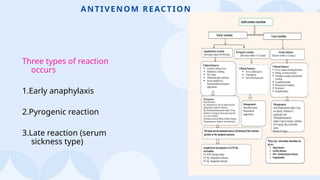
ANTIVENOM REACTION
Three types of reaction
occurs
1.Early anaphylaxis
2.Pyrogenic reaction
3.Late reaction (serum
sickness type)
49
CONSERVATIVE TREATMENT WHEN NO ANTIVENOM
IS AVAILABLE
Neurotoxic envenoming with respiratory paralysis:
Assisted ventilation with room air or oxygen has proved
effecttive, and has been followed by complete recovery, even
after being maintained for periods of more than one month.
•Manual ventilation (anaesthetic bag) by relays of doctors,
medical students, relatives and nurses has been effective
where no mechanical ventilator was available.
50
•Neostigmine/Atropine Combination: (Indicated for
neurotoxic features only)
•Anticholinesterases should always be tried (O) for
neurotoxic bites of cobra and also judicially for
krait .
51
• Haemostatic abnormalities:
Strict bed rest to avoid even minor trauma;
transfusion of clotting factors and platelets; ideally, fresh
frozen plasma (FFP) and cryoprecipitate with platelet
concentrates or, if these are not available, fresh whole
blood.
Intramuscular injections should be avoided.
52
Shock, myocardial damage:
Hypovolaemia should be corrected with
colloid/crystalloids, controlled by observation of the
central venous pressure.
Ancillary pressor drugs (dopamine or epinephrine-
adrenaline) may also be needed.
Patients with hypotension associated with bradycardia
should be treated with atropine.
53
REFERRAL
The patients with any of the following complications may be referred to
higher centre:
1. Prolonged clotting time/ bleeding time (haematological)
2. Respiratory difficulty or evidence of respiratory failure /ARDS
3. Extra ocular muscle involvement (ptosis,opthalmoplegia), encephalopathy
4. Evidence of early capillary leak
5.Features of impending renal failure
6. Any bleeding manifestations
7. Adverse reaction to AV administration
54
FOLLOW UP
Detection of AV reaction:
*early reaction 3 hours,
* serum sickness-
weekly once for three weeks
Detection of late sequalae following envenomation:
* physical disability or psychiatric disability –
3 months and 6 months after bite.
55
Thank you

snake byte presentation by Dr afia - Copy.pptx

  • 1.
    1 MANAGEMENT OF SNAKE- BITE Dr.Afia Sultana Intern Doctor,BDS Medicine Unit-5 Rajshahi Medical College Hospital
  • 2.
    2 INTRODUCTION Snake bite isone of the most important public health problems in Bangladesh. Snake bite cases are mostly found in rainy season. It decreases with winter as snakes are cold blooded.
  • 3.
    3 EPIDEMIOLOGY • The incidencedensity of snakebite in rural Bangladesh is 623/100000 person years with an estimated 6041 death annually. • Neurotoxic snakes (cobra,kraits) are causing significant mortality and morbidity. • During the monsoon ,snakebite occurrences increase as snake leave their shelter due to rainfall.
  • 4.
    4 TYPES OF SNAKE 1.Non venomous snake 2. Venomous snake
  • 5.
  • 6.
    6 SNAKE SPECIES OFBANGLADESH Group-1 Cobra (zoura): a.monocellete b.binocellete Distributed in all administrative divisions of Bangladesh.
  • 7.
    7 • Group-2 Kraits: a. Blackkrait b. Wall’s krait c.Banded krait Distributed in all administrative divisions of Bangladesh predominantly in Chattogram, Dhaka and northern part of Bangladesh.
  • 8.
    8 • Group-3 Rusell’s viper: Distributedmainly in Rajshahi and Khulna divisions .
  • 9.
    9 • Group-4 Green PitViper: Distributed in Sylhet, Chattogram, Khulna and Barishal division. This Photo by Unknown Author is licensed under CC BY-SA
  • 10.
    10 • Group-5 Sea snakes: Distributedin sea and costal saline water of Bangladesh.
  • 11.
    11 NON-VENOMOUS SNAKES AROUND RAJSHAHI Theyinclude, • Common Wolf Snake / Ghor Ginni • Checkered keelback / Jol Dhora • Indian Rat Snake / Darash • Green Vine Snake / Sobuj Sap They express no toxins. This Photo by Unknown Author is licensed under CC BY-NC-ND
  • 12.
    12 D E FERE N CE BE TW E EN V E N O MO US & N O N V EN OM OU S SN AK E B ITE Traits Venomous Snake BIte Non-Venomous Snake Bite Fangs mark 2 fangs marks No fang mark Pain & swelling at bite site present Absent Bleeding, bruises lacerations with or without gangrene present Absent Oedema, large blister (cobra) Present Absent Painful lymphadenopathy (viper & cobra) present Absent Neurological signs present Absent
  • 13.
  • 14.
    14 SITES OF BITE 1.Cobra- handand feet 2.Krait- Anywhere of the body 3.Green snake- head and face 4.Sea snake- hand
  • 15.
    15 IDENTIFICATION OF VENOMOUSSNAKE BITE A bite by a venomous snake which produces specific symptoms and signs or syndrome is considered as a venomous snake bite. It is important to note that a bite by venomous snake may not always produce features of envenoming: *50% of bites by Rusell’s vipers *30% of bites by Cobras do not result in any symptoms and signs of envenoming-term as DRY BITE.
  • 16.
  • 17.
    17 Neurological symptoms: Muscle paralysis, difficultyin moving jaw, tongue, eye, difficulty in vision, heaviness of eye lids (ptosis), weakness of neck muscle (‘Broken neck sign’), difficulty in swallowing, dribbling of saliva, nasal regurgitation, nasal voice, difficulty in respiration, extreme generalized weakness, loss of consciousness
  • 18.
    18 Haematological symptoms: Spontaneous bleedingfrom gum, vomiting of blood, hemoptysis, hematuria, persistent bleeding from bite site, venipuncture site and inflicted wound if any. Others: Severe muscle pain, dark colored urine, scanty urine volume, collapse (cardiovascular) This Photo by Unknown Author is licensed under CC BY This Photo by Unknown Author is licensed under CC BY-SA
  • 19.
    19 SIGNS • • Signsof haematological abnormalities: • Persistent bleeding from bite site, venipuncture site and or inflicted wound , • multiple bruise or large blood collection • haemorrhagic blisters, • bleeding from gingival sulci, • hemoptysis, • haematemesis, • hematuria, • epistaxis.
  • 20.
    20 • • Neurotoxicsign: • Ptosis (partial or complete), • diplopia, • external ophthalmoplegia, • loss of gag reflex/palatal palsy (Bulbar palsy), • dysphonia / nasal voice, • bilateral facial paralysis, • inability to open the mouth or protrude the tongue, • paralysis of chest muscles and diaphragm (shallow breathing), • 'broken neck sign’, • weak grip, • diminished tendon reflexes.
  • 21.
    21 Signs of renalfailure: • Scanty or no urine output, • dark colored urine, • Hypotension Clinical uraemic syndrome: Nausea, vomiting, hiccups fetor, drowsiness, flapping tremor, muscle twitching, convulsions, pericardial friction rub, signs of fluid overload.
  • 22.
    22 • Signs ofmyotoxicity: • Muscle tenderness, weakness, • respiratory failure Signs of cardiovascular toxicity: Hypotension, shock. • Signs of local envenomation: • Swelling, tenderness, • bleeding, • ulceration, • necrosis, • local lymph node enlargement.
  • 23.
    SYNDROMIC APPROACH SN AK EBIT E E N V E N O MATIO N S YN DRO M ES F O R S OU TH -E AS T AS IA
  • 24.
  • 25.
  • 26.
  • 27.
  • 28.
  • 29.
    29 INVESTIGATION OR LABORATORY TESTS •20WBCT • •Snakebite screening tests: • full blood count, • urine RME, • urea, electrolytes, • creatinine, creatinine kinase, • ECG, coagulation screen. • Specific tests for detection of venom is not available in Bangladesh
  • 30.
  • 31.
    31 PRE HOSPITAL MANAGEMENT FirstAid: • Effective first-aid treatment should be carried out immediately or very soon after the snake bite; before the patient reaches Hospital • Recommended first aid methods: 1. Reassurance: • Patient should be advised not to get panicked. He should be told that majority of snakes are non-venomous; moreover, venomous snakes sometimes fail to inject enough venom effectively during bites.
  • 32.
    32 • 2. Immobilization: •Make sure that bitten limb (hand or leg) is immobile and the victim must be kept still. Advise: Bite in lower limb: “Sit down, do not walk”. Bite in upper limb: “Do not move the limb”. Immobilize the bitten limb with a splint or sling as practiced in fracture of long bone. Ideal is to provide pressure immobilization.
  • 34.
    34 3.Wash the bittenarea: gently with soap and water, or wipe with a wet cloth and cover with bandage 4. Place patient in the lateral recumbent position. 5. Remove as early as possible all rings, bangles, anklets, cords or clothing, ‘Tabij’, ‘Taga’ etc., which may cause constriction if swelling occur. 6. Quick transport: seek help to get the patient rapidly transferred to a hospital by motorbike or ambulance. (O)
  • 35.
    35 7. If non-breathing,insert an oral airway or perform rescue breathing if necessary. 8. If the snake is killed somehow, bring it to hospital. Be careful and do not handle snakes bare handedly as they might pretend to be dead. Do not waste time for catching or killing the snake.
  • 36.
    36 🚫 SOME DON’T🚫 • 1.Do not apply tourniquets/ligature in the bitten limb. • 2. Do not cut or prick with needles or use any topical cream. • 3. Do not waste time unnecessarily seeking treatment provided by traditional healers (Ozhas). • 4. Do not provide anything by mouth if the victim has difficulty in swallowing/talking, vomiting, nasal voice or excessive salivation. • 5. Do not cauterize by using chemicals. • 6. Do not apply alcohol.
  • 37.
    • 7. Donot give aspirin to relieve pain. • 8. Do not apply herbal medicines, stones, seeds, saliva, potassium permanganate solution or cow-dung and mud. • 9. Do not give herbal products like oil, ghee, pepper to induce vomiting. • 10. Do not panic and be tempted to do anything detrimental to the victim. • 11. Do not delay in reaching health facility.
  • 38.
    38 HOSPITAL MANAGEMENT After takingproper history, you must follow the following steps: • 1.Rapid clinical assessment And resuscitation • 2.Give TT and TIG first • 3. Approach for specific treatment • 4.Give antibiotic if there is possibility of infection • 5. If neurological or severe haematological involvement consider ICU support.
  • 39.
    39 SPECIFIC THERAPY: INDICATIONOF ANTIVENOM • Antivenom treatment is recommended if and when a patient with proven or suspected snake-bite develops one or more of following features • Systemic envenoming: • 1. Haemostatic abnormalities: • Spontaneous systemic bleeding (clinical), Coagulopathy (20WBCT or other laboratory tests such as prothrombin time) or thrombocytopenia (<100 x 109/litre or 100 000/cu mm) (laboratory). • 2.Neurotoxic signs: • ptosis, external ophthalmoplegia, paralysis etc (clinical).
  • 40.
    40 3. Cardiovascular abnormalities: hypotension,shock, cardiac arrhythmia (clinical) 4. Acute kidney injury (renal failure): oliguria/anuria (clinical), rising blood creatinine/ urea (laboratory). (Haemoglobin-/myoglobin-uria:) dark brown urine (clinical), urine dipsticks, other evidence of intra-mascular haemolysis or generalized rhabdomyolysis (muscle aches and pains, hyperkalaemia) (clinical, laboratory).
  • 41.
    41 LOCAL ENVENOMING * Localswelling involving more than half of the bitten limb (in the absence of a tourniquet) within 48 hours of the bite. * Swelling after bites on the digits (toes and especially fingers). * Rapid extension of swelling (for example, beyond the wrist or ankle within a few hours of bite on the hands or feet). * Development of an enlarged tender lymph node draining the bitten limb
  • 42.
    42 IT IS NEVERTOO LATE TO GIVE AV PROVIDED THE INDICATIONS ARE PRESENT: • 1. Only if features of systemic envenoming are present for bites of snakes mentioned in the previous slides. • 2. Do not give antivenom for local envenoming alone, except for cobra and Russell’s viper bites when indicated
  • 43.
    43 ANTI VENOM THERAPY •Commence AV as soon as systemic envenoming is detected. • • Dose: 100 ml (10 ampoules) of Indian polyvalent AV mixed with 100 ml of normal saline should be infused intravenously over one hour. Adult and children should receive same dose of AV. Start infusion at a lower rate for 10-15 minutes. • Before initiating antivenom, prophylactic subcutaneous adrenaline (dose- adult 0.25 ml of 0.1% solution and in children 0.005 mg/kg) should be given to the victim (T). •
  • 44.
    Click icon toadd picture
  • 45.
    45 CAUTION Have Adrenaline (+InjHydrocortisone, Inj Anti histamine) available at bedside Observe the patient carefully during the time of administration of antivenom and up to 3 hours for signs of anaphylaxis. MONITOR Pulse, blood pressure and respiration and observe for the appearance of a rash
  • 46.
    46 CRITERIA FOR REPEATINGTHE INITIAL DOSE OF ANTIVENOM • Persisting or deteriorating signs of systemic envenoming e.g. • a) If no improvement or deterioration of neurotoxic features (Cobra or Krait) 1-2 hours after completion of antivenom. • b) Persistence or recurrence of blood incoagulability after 6 hours of antivenom treatment. • The endpoint of AV therapy is reversal of coagulopathy as determined by serial performance of the 20WBC
  • 47.
    47 CONTRAINDICATIONS TO ANTIVENOM Thereis no absolute contraindication to antivenom treatment, but patients who have reacted to horse (equine) or sheep (ovine) serum in the past and those with a strong history of atopic disease (specially severe asthma) should be given antivenom only if they have signs of systemic envenoming.
  • 48.
    48 ANTIVENOM REACTION Three typesof reaction occurs 1.Early anaphylaxis 2.Pyrogenic reaction 3.Late reaction (serum sickness type)
  • 49.
    49 CONSERVATIVE TREATMENT WHENNO ANTIVENOM IS AVAILABLE Neurotoxic envenoming with respiratory paralysis: Assisted ventilation with room air or oxygen has proved effecttive, and has been followed by complete recovery, even after being maintained for periods of more than one month. •Manual ventilation (anaesthetic bag) by relays of doctors, medical students, relatives and nurses has been effective where no mechanical ventilator was available.
  • 50.
    50 •Neostigmine/Atropine Combination: (Indicatedfor neurotoxic features only) •Anticholinesterases should always be tried (O) for neurotoxic bites of cobra and also judicially for krait .
  • 51.
    51 • Haemostatic abnormalities: Strictbed rest to avoid even minor trauma; transfusion of clotting factors and platelets; ideally, fresh frozen plasma (FFP) and cryoprecipitate with platelet concentrates or, if these are not available, fresh whole blood. Intramuscular injections should be avoided.
  • 52.
    52 Shock, myocardial damage: Hypovolaemiashould be corrected with colloid/crystalloids, controlled by observation of the central venous pressure. Ancillary pressor drugs (dopamine or epinephrine- adrenaline) may also be needed. Patients with hypotension associated with bradycardia should be treated with atropine.
  • 53.
    53 REFERRAL The patients withany of the following complications may be referred to higher centre: 1. Prolonged clotting time/ bleeding time (haematological) 2. Respiratory difficulty or evidence of respiratory failure /ARDS 3. Extra ocular muscle involvement (ptosis,opthalmoplegia), encephalopathy 4. Evidence of early capillary leak 5.Features of impending renal failure 6. Any bleeding manifestations 7. Adverse reaction to AV administration
  • 54.
    54 FOLLOW UP Detection ofAV reaction: *early reaction 3 hours, * serum sickness- weekly once for three weeks Detection of late sequalae following envenomation: * physical disability or psychiatric disability – 3 months and 6 months after bite.
  • 55.