SMSVN – PMP Training Course 2013 - Chapter 1 Prepared by Nam Trung - 02/07/2013
SMSVN – PMP TRAINING CLASS 2013 (PMBOK 5TH)
 Course Introduction
 Purposes
 Schedule
 Ground Rules
 Chapter 1: Introduction to Project Management
1
SMSVN – PMP Training Course 2013 - Chapter 1 Prepared by Nam Trung - 02/07/2013
COURSE INTRODUCTION
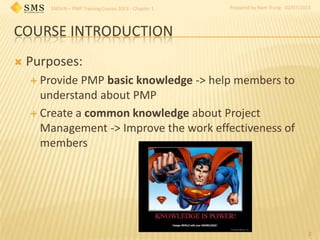
 Purposes:
 Provide PMP basic knowledge -> help members to
understand about PMP
 Create a common knowledge about Project
Management -> Improve the work effectiveness of
members
2
SMSVN – PMP Training Course 2013 - Chapter 1 Prepared by Nam Trung - 02/07/2013
COURSE INTRODUCTION
 Schedule:
 15 sessions (13 chapters, 2 exams)
 2 sessions /week: Tuesday and Friday
 Class time: 16:00 to 17:00
 2 Exams:
 Midterm: cover 50% of knowledge and take 30% of mark
 Final: cover 100% of knowledge and take 70% of mark
 Exam structure:
 Each exam includes 50 questions
 Pass: over 60% mark
3
SMSVN – PMP Training Course 2013 - Chapter 1 Prepared by Nam Trung - 02/07/2013
COURSE INTRODUCTION
 Ground rules:
 Class-monitor: ?
 Late:
 5 minutes -> ?VND
 10 minutes -> ?VND
 15 minutes -> ?VND
 Absent: -> ?VND
 Mobile phone: -> silent mode
 Ipad/tablet: -> dictionary function only
4
SMSVN – PMP Training Course 2013 - Chapter 1 Prepared by Nam Trung - 02/07/2013
CHAPTER 1: INTRODUCTION TO PROJECT MANAGEMENT
5
LET’S THINK AS A PROJECT MANAGER
SMSVN – PMP Training Course 2013 - Chapter 1 Prepared by Nam Trung - 02/07/2013
ADVANTAGES OF USING FORMAL PROJECT MANAGEMENT
 Better control of financial, physical, and human
resources
 Improved customer relations
 Shorter development times
 Lower costs
 Higher quality and increased reliability
 Higher profit margins
 Improved productivity
 Better internal coordination
 Higher worker morale (less stress)
6
SMSVN – PMP Training Course 2013 - Chapter 1 Prepared by Nam Trung - 02/07/2013
WHAT IS PROJECT?
 A Project is a temporary endeavor undertaken to
create a unique, product, service, or result.
 temporary endeavor: with a beginning and an end
 unique: only one
 example?
 Project vs Operation (ongoing) work
7
SMSVN – PMP Training Course 2013 - Chapter 1 Prepared by Nam Trung - 02/07/2013
REASONS TO START A PROJECT?
 Market demand
 Strategic opportunity/business need
 Customer request
 Technological advancement
 Legal requirements
 Ecological Impacts
 Social need
8
SMSVN – PMP Training Course 2013 - Chapter 1 Prepared by Nam Trung - 02/07/2013
PROGRAMS AND PORTFOLIO
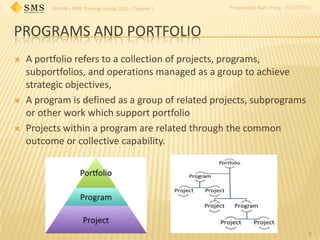
 A portfolio refers to a collection of projects, programs,
subportfolios, and operations managed as a group to achieve
strategic objectives,
 A program is defined as a group of related projects, subprograms
or other work which support portfolio
 Projects within a program are related through the common
outcome or collective capability.
9
SMSVN – PMP Training Course 2013 - Chapter 1 Prepared by Nam Trung - 02/07/2013
WHAT IS PROJECT MANAGEMENT?
 The application of knowledge, skills, tools and technique
to project activities to meet project requirements
 Project Management is accomplished through the
application and integration of the processes such as
 Initiating
 Planning
 Executing
 Monitoring and Controlling
 Closing
 Due to the nature of change, managing project is iterative
and goes through progressive elaboration throughout the
project’s lifecycle
10
SMSVN – PMP Training Course 2013 - Chapter 1 Prepared by Nam Trung - 02/07/2013
THE TRIPLE CONSTRAINT OF PROJECT MANAGEMENT
It is the project manager‘s duty to balance and
achieve these three often-competing goals.
11
SMSVN – PMP Training Course 2013 - Chapter 1 Prepared by Nam Trung - 02/07/2013
CONSTRAINTS OF PROJECT MANAGEMENT
12
SMSVN – PMP Training Course 2013 - Chapter 1 Prepared by Nam Trung - 02/07/2013
WHO INVOLVE IN PROJECT?
 Project Sponsor is the person who is providing the financial resources
for the project, Formally accepts the product of the project.
 Project Manager is the person responsible for accomplishing the
project objectives.
 Project Coordinator
 has some power to make decisions
 has some authority
 reports to a higher-level manager
 Project Expediter
 acts primarily as a staff assistant
 as communications coordinator.
 cannot personally make or enforce decisions
 Project Team includes PM and the group of individuals who act
together in performing the work of project to achieve its objectives.
13
SMSVN – PMP Training Course 2013 - Chapter 1 Prepared by Nam Trung - 02/07/2013
WHO INVOLVE IN PROJECT?
Stakeholders: are persons or organizations who are actively involved
in the project or whose interests may positively or negatively
affected by the performance or completion of the project.
 Stakeholders have varying levels of responsibility and authority
and can change over the project life cycle
 Project management team must continuously identify both
external and internal stakeholders
 Project manager must manage the influence of various
stakeholders in relation to the requirements and balance
stakeholders’ interest
14
SMSVN – PMP Training Course 2013 - Chapter 1 Prepared by Nam Trung - 02/07/2013
ROLE OF PROJECT MANAGER
 Responsibilities and Competencies of the PM
PMs have the responisibility to satisfy the needs:
task needs, team needs and individual needs.
Effective PMs need the following competencies:
 Knowledge: know about project management
 Performance: what able to do or accomplish
 Personal: how PMs behave when performing the
project
15
SMSVN – PMP Training Course 2013 - Chapter 1 Prepared by Nam Trung - 02/07/2013
ROLE OF PROJECT MANAGER
 Interpersonal Skills of a PM: Effective PMs require a balance of
ethical, interpersonal, and conceptual skills that help them
analyze situations and interact appropriately. Important skills:
 Leadership
 Team building
 Motivation
 Communication
 Influencing
 Decision making
 Political and cultural awareness
 Negotiation
 Trust building
 Conflict Management
 Coaching
16
SMSVN – PMP Training Course 2013 - Chapter 1 Prepared by Nam Trung - 02/07/2013
PMO – PROJECT MANAGEMENT OFFICE
A department that centralizes the management of
projects. A PMO performs a number of functions that
may include but are notlimited to:
 Managing shared resources across projects
 Coaching, mentoring, training and oversight
 Monitoring compliance with PM standards,
policies, procedures and templates
 Developing and managing project policies, procedures,
templates and other shared documentation (Organizational
Process Assets)
 Coordinating communication across projects
17
SMSVN – PMP Training Course 2013 - Chapter 1 Prepared by Nam Trung - 02/07/2013
EEF - ENTERPRISE ENVIRONMENTAL FACTORS
 Refer to both internal & external environmental
factors that surround or influence a project’s
success
 As an input in almost all project management
process
 May enhance or constrain project management
options
 May have positive or negative influence on the
outcome
18
SMSVN – PMP Training Course 2013 - Chapter 1 Prepared by Nam Trung - 02/07/2013
EEF - ENTERPRISE ENVIRONMENTAL FACTORS
 EEF Examples:
 Organizational culture, structure, and processes
 Government or industry standards
 Infrastructure
 Existing human resources
 Personnel administration
 Company work authorization systems
 Marketplace conditions
 Stakeholder risk tolerances
 Political climate
 Organization’s established communications channels
 Commercial databases
 Project management information
19
SMSVN – PMP Training Course 2013 - Chapter 1 Prepared by Nam Trung - 02/07/2013
REVIEW
 Why formal Project Management?
 What is Project?
 Reasons to start a project?
 Portfolio?
 Program?
 What is Project Management?
 What are 5 Process Groups?
 Triple contraint of project management?
 Contraints of project management?
 Project Sponsor?
 Project Manager?
 Project Coordinator?
 Project Expeditor?
 Project Team?
 Stakeholders?
 PMO?
 EEF?
20

Smsvn pmp training_slides_chapter_1

  • 1.
    SMSVN – PMPTraining Course 2013 - Chapter 1 Prepared by Nam Trung - 02/07/2013 SMSVN – PMP TRAINING CLASS 2013 (PMBOK 5TH)  Course Introduction  Purposes  Schedule  Ground Rules  Chapter 1: Introduction to Project Management 1
  • 2.
    SMSVN – PMPTraining Course 2013 - Chapter 1 Prepared by Nam Trung - 02/07/2013 COURSE INTRODUCTION  Purposes:  Provide PMP basic knowledge -> help members to understand about PMP  Create a common knowledge about Project Management -> Improve the work effectiveness of members 2
  • 3.
    SMSVN – PMPTraining Course 2013 - Chapter 1 Prepared by Nam Trung - 02/07/2013 COURSE INTRODUCTION  Schedule:  15 sessions (13 chapters, 2 exams)  2 sessions /week: Tuesday and Friday  Class time: 16:00 to 17:00  2 Exams:  Midterm: cover 50% of knowledge and take 30% of mark  Final: cover 100% of knowledge and take 70% of mark  Exam structure:  Each exam includes 50 questions  Pass: over 60% mark 3
  • 4.
    SMSVN – PMPTraining Course 2013 - Chapter 1 Prepared by Nam Trung - 02/07/2013 COURSE INTRODUCTION  Ground rules:  Class-monitor: ?  Late:  5 minutes -> ?VND  10 minutes -> ?VND  15 minutes -> ?VND  Absent: -> ?VND  Mobile phone: -> silent mode  Ipad/tablet: -> dictionary function only 4
  • 5.
    SMSVN – PMPTraining Course 2013 - Chapter 1 Prepared by Nam Trung - 02/07/2013 CHAPTER 1: INTRODUCTION TO PROJECT MANAGEMENT 5 LET’S THINK AS A PROJECT MANAGER
  • 6.
    SMSVN – PMPTraining Course 2013 - Chapter 1 Prepared by Nam Trung - 02/07/2013 ADVANTAGES OF USING FORMAL PROJECT MANAGEMENT  Better control of financial, physical, and human resources  Improved customer relations  Shorter development times  Lower costs  Higher quality and increased reliability  Higher profit margins  Improved productivity  Better internal coordination  Higher worker morale (less stress) 6
  • 7.
    SMSVN – PMPTraining Course 2013 - Chapter 1 Prepared by Nam Trung - 02/07/2013 WHAT IS PROJECT?  A Project is a temporary endeavor undertaken to create a unique, product, service, or result.  temporary endeavor: with a beginning and an end  unique: only one  example?  Project vs Operation (ongoing) work 7
  • 8.
    SMSVN – PMPTraining Course 2013 - Chapter 1 Prepared by Nam Trung - 02/07/2013 REASONS TO START A PROJECT?  Market demand  Strategic opportunity/business need  Customer request  Technological advancement  Legal requirements  Ecological Impacts  Social need 8
  • 9.
    SMSVN – PMPTraining Course 2013 - Chapter 1 Prepared by Nam Trung - 02/07/2013 PROGRAMS AND PORTFOLIO  A portfolio refers to a collection of projects, programs, subportfolios, and operations managed as a group to achieve strategic objectives,  A program is defined as a group of related projects, subprograms or other work which support portfolio  Projects within a program are related through the common outcome or collective capability. 9
  • 10.
    SMSVN – PMPTraining Course 2013 - Chapter 1 Prepared by Nam Trung - 02/07/2013 WHAT IS PROJECT MANAGEMENT?  The application of knowledge, skills, tools and technique to project activities to meet project requirements  Project Management is accomplished through the application and integration of the processes such as  Initiating  Planning  Executing  Monitoring and Controlling  Closing  Due to the nature of change, managing project is iterative and goes through progressive elaboration throughout the project’s lifecycle 10
  • 11.
    SMSVN – PMPTraining Course 2013 - Chapter 1 Prepared by Nam Trung - 02/07/2013 THE TRIPLE CONSTRAINT OF PROJECT MANAGEMENT It is the project manager‘s duty to balance and achieve these three often-competing goals. 11
  • 12.
    SMSVN – PMPTraining Course 2013 - Chapter 1 Prepared by Nam Trung - 02/07/2013 CONSTRAINTS OF PROJECT MANAGEMENT 12
  • 13.
    SMSVN – PMPTraining Course 2013 - Chapter 1 Prepared by Nam Trung - 02/07/2013 WHO INVOLVE IN PROJECT?  Project Sponsor is the person who is providing the financial resources for the project, Formally accepts the product of the project.  Project Manager is the person responsible for accomplishing the project objectives.  Project Coordinator  has some power to make decisions  has some authority  reports to a higher-level manager  Project Expediter  acts primarily as a staff assistant  as communications coordinator.  cannot personally make or enforce decisions  Project Team includes PM and the group of individuals who act together in performing the work of project to achieve its objectives. 13
  • 14.
    SMSVN – PMPTraining Course 2013 - Chapter 1 Prepared by Nam Trung - 02/07/2013 WHO INVOLVE IN PROJECT? Stakeholders: are persons or organizations who are actively involved in the project or whose interests may positively or negatively affected by the performance or completion of the project.  Stakeholders have varying levels of responsibility and authority and can change over the project life cycle  Project management team must continuously identify both external and internal stakeholders  Project manager must manage the influence of various stakeholders in relation to the requirements and balance stakeholders’ interest 14
  • 15.
    SMSVN – PMPTraining Course 2013 - Chapter 1 Prepared by Nam Trung - 02/07/2013 ROLE OF PROJECT MANAGER  Responsibilities and Competencies of the PM PMs have the responisibility to satisfy the needs: task needs, team needs and individual needs. Effective PMs need the following competencies:  Knowledge: know about project management  Performance: what able to do or accomplish  Personal: how PMs behave when performing the project 15
  • 16.
    SMSVN – PMPTraining Course 2013 - Chapter 1 Prepared by Nam Trung - 02/07/2013 ROLE OF PROJECT MANAGER  Interpersonal Skills of a PM: Effective PMs require a balance of ethical, interpersonal, and conceptual skills that help them analyze situations and interact appropriately. Important skills:  Leadership  Team building  Motivation  Communication  Influencing  Decision making  Political and cultural awareness  Negotiation  Trust building  Conflict Management  Coaching 16
  • 17.
    SMSVN – PMPTraining Course 2013 - Chapter 1 Prepared by Nam Trung - 02/07/2013 PMO – PROJECT MANAGEMENT OFFICE A department that centralizes the management of projects. A PMO performs a number of functions that may include but are notlimited to:  Managing shared resources across projects  Coaching, mentoring, training and oversight  Monitoring compliance with PM standards, policies, procedures and templates  Developing and managing project policies, procedures, templates and other shared documentation (Organizational Process Assets)  Coordinating communication across projects 17
  • 18.
    SMSVN – PMPTraining Course 2013 - Chapter 1 Prepared by Nam Trung - 02/07/2013 EEF - ENTERPRISE ENVIRONMENTAL FACTORS  Refer to both internal & external environmental factors that surround or influence a project’s success  As an input in almost all project management process  May enhance or constrain project management options  May have positive or negative influence on the outcome 18
  • 19.
    SMSVN – PMPTraining Course 2013 - Chapter 1 Prepared by Nam Trung - 02/07/2013 EEF - ENTERPRISE ENVIRONMENTAL FACTORS  EEF Examples:  Organizational culture, structure, and processes  Government or industry standards  Infrastructure  Existing human resources  Personnel administration  Company work authorization systems  Marketplace conditions  Stakeholder risk tolerances  Political climate  Organization’s established communications channels  Commercial databases  Project management information 19
  • 20.
    SMSVN – PMPTraining Course 2013 - Chapter 1 Prepared by Nam Trung - 02/07/2013 REVIEW  Why formal Project Management?  What is Project?  Reasons to start a project?  Portfolio?  Program?  What is Project Management?  What are 5 Process Groups?  Triple contraint of project management?  Contraints of project management?  Project Sponsor?  Project Manager?  Project Coordinator?  Project Expeditor?  Project Team?  Stakeholders?  PMO?  EEF? 20