SMART QUILL

P.SRIKANTH
AIM OF THE PRESENTATION


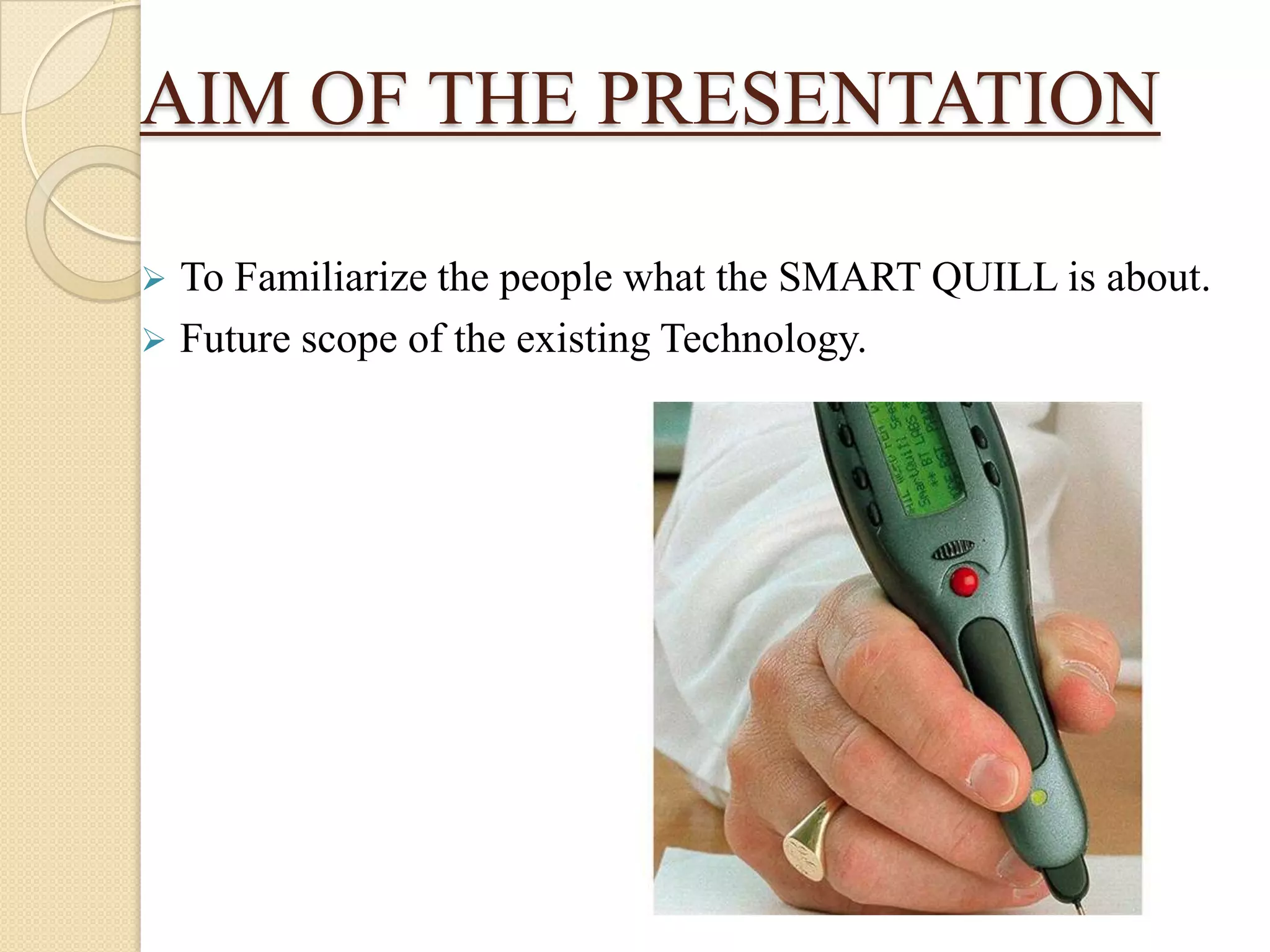
To Familiarize the people what the SMART QUILL is about.
 Future scope of the existing Technology.
INTRODUCTION


Smart quill was invented by LYNDSEY WILLIAMS of
Microsoft Research's Cambridge UK lab along with
British Telecommunications.

It is basically called the “PEN FOR THE NEW
MILLENIUM”.
 It is claimed to be the biggest revolution in hand writing
since the invention of pen.

ABOUT SMART QUILL
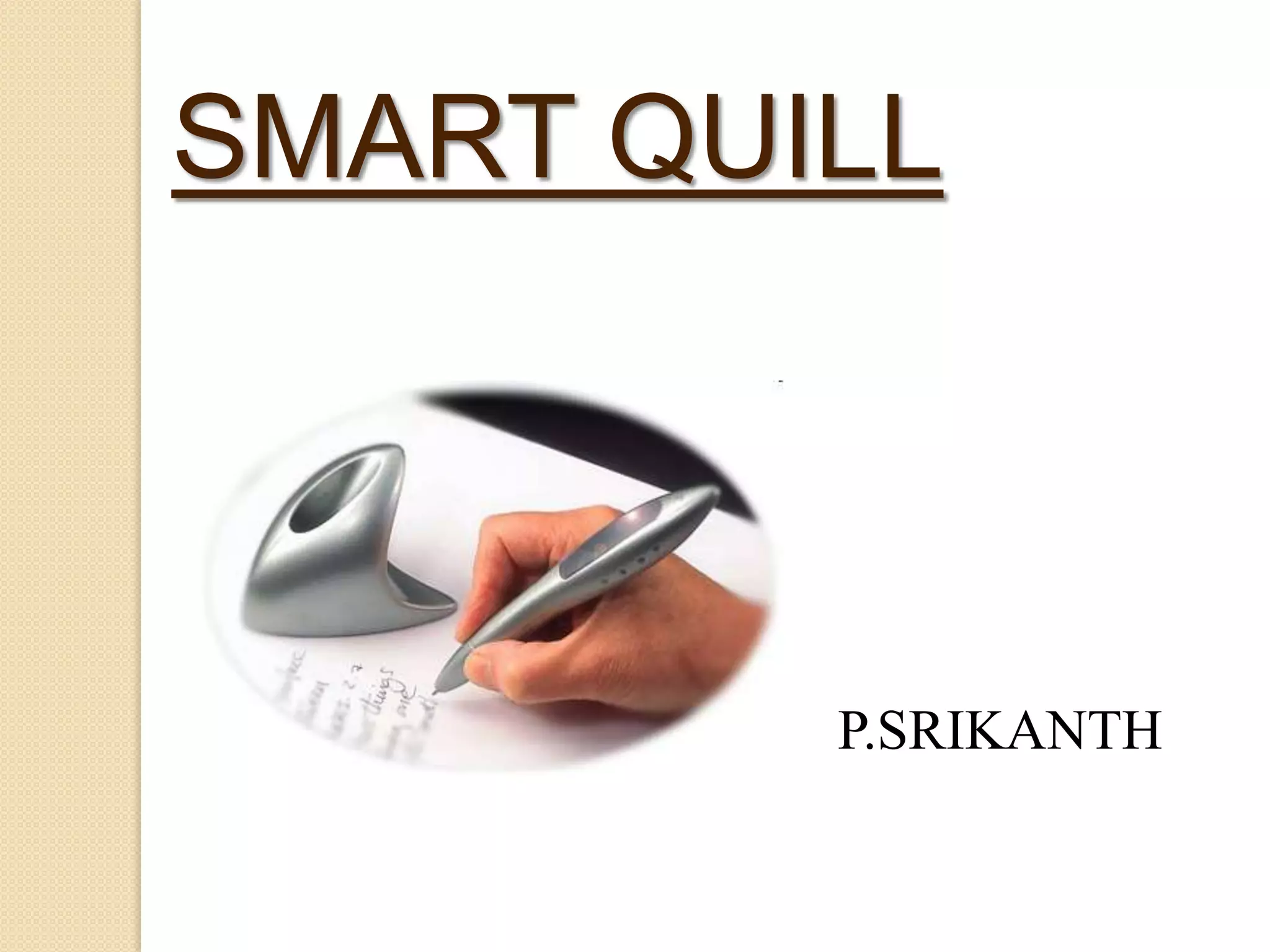
Smart quill is a pen which remembers the word that
writes and transfer them into computer text.
Smart quill contains sensors that record the movement
of the pen by using earth’s gravity.

It can record the writings irrespective of the platform
used.
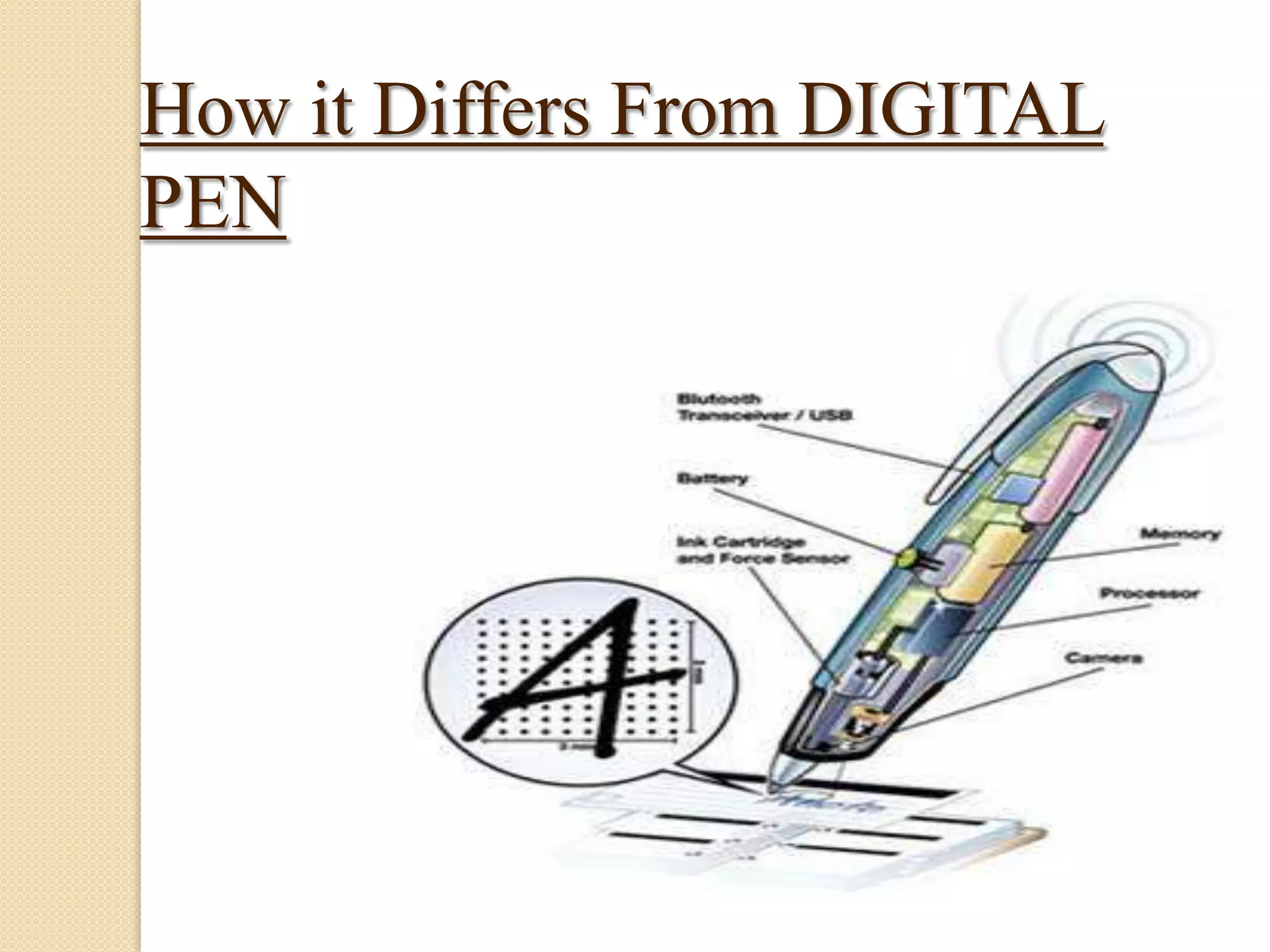
How it Differs From DIGITAL
PEN
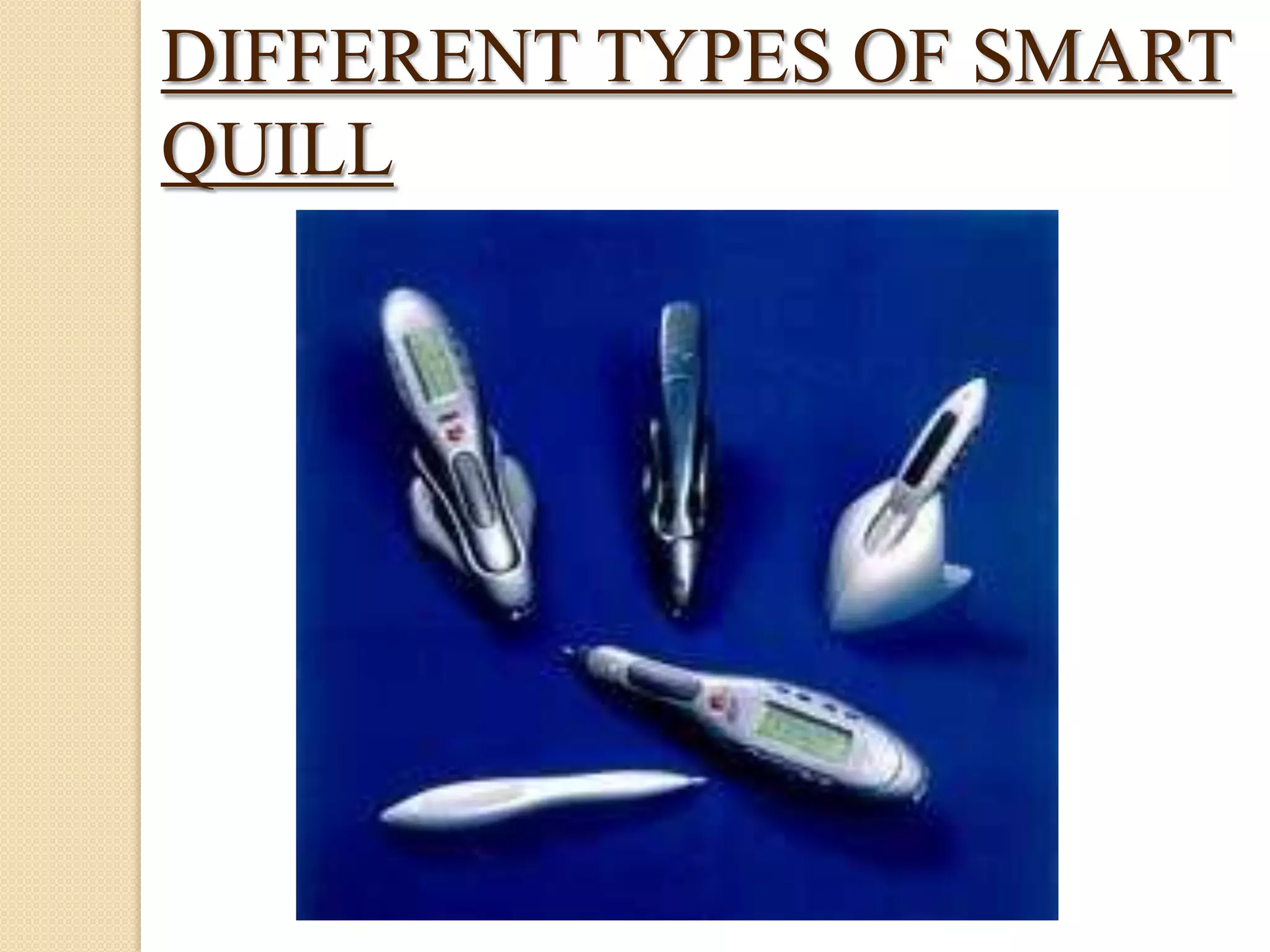
DIFFERENT TYPES OF SMART
QUILL
WORKING OF SMART QUILL.
Users can enter the information into this pen by pressing start
button and write down what they like to enter.
Accelerometers sense the movement of the pen and sends to
the micro controller(PIC 8 bit MC ) which from number of
modes select the response.
MEMS technology tilt sensors are used for the tilt functions.
4 MB EEPROM is the memory used. Hence about ten pages
of notes can be stored in the pen.
Two AAA batteries are used for the power supply.
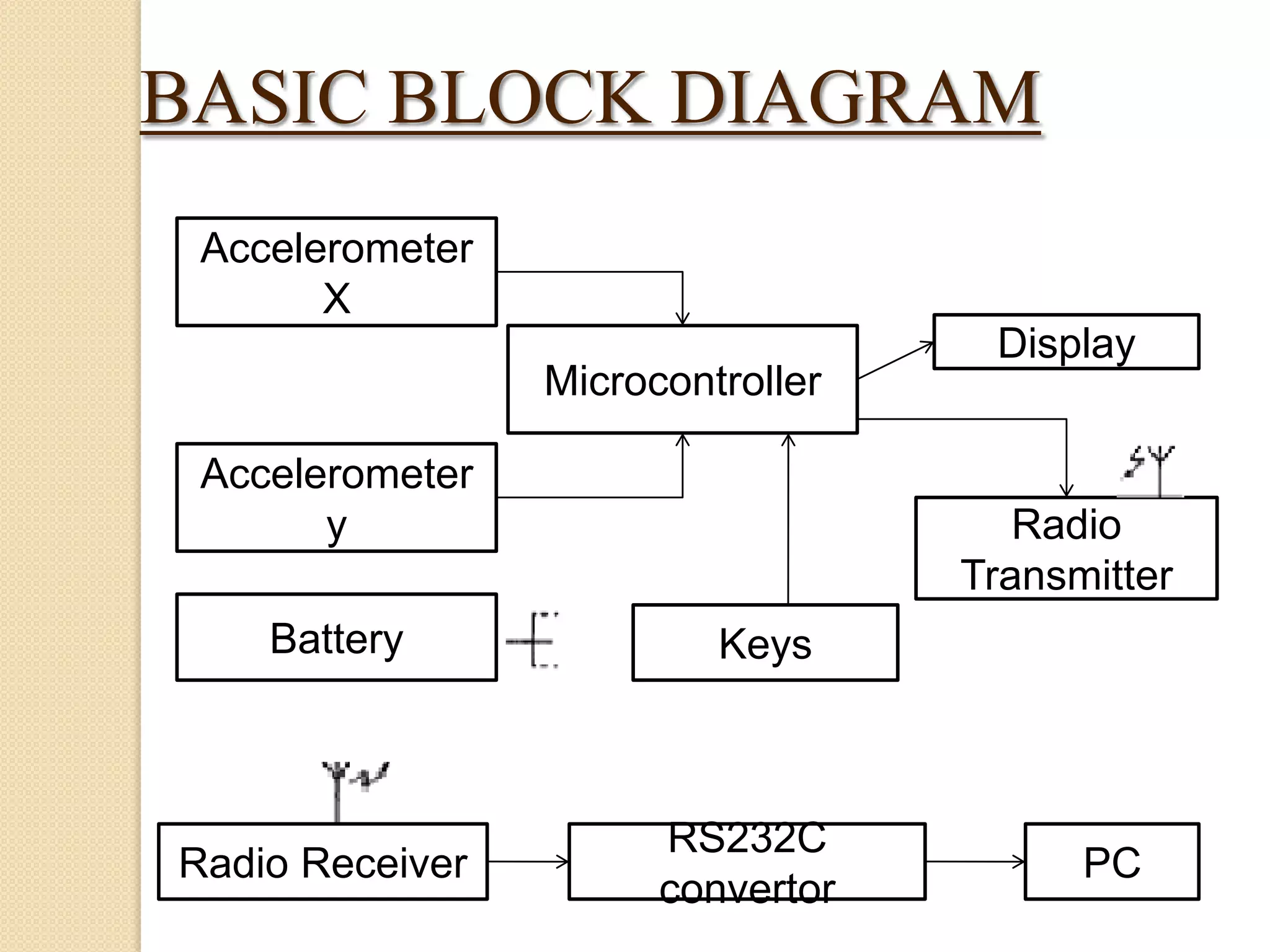
BASIC BLOCK DIAGRAM
Accelerometer
X
Microcontroller

Accelerometer
y
Battery

Radio Receiver

Display

Radio
Transmitter
Keys

RS232C
convertor

PC
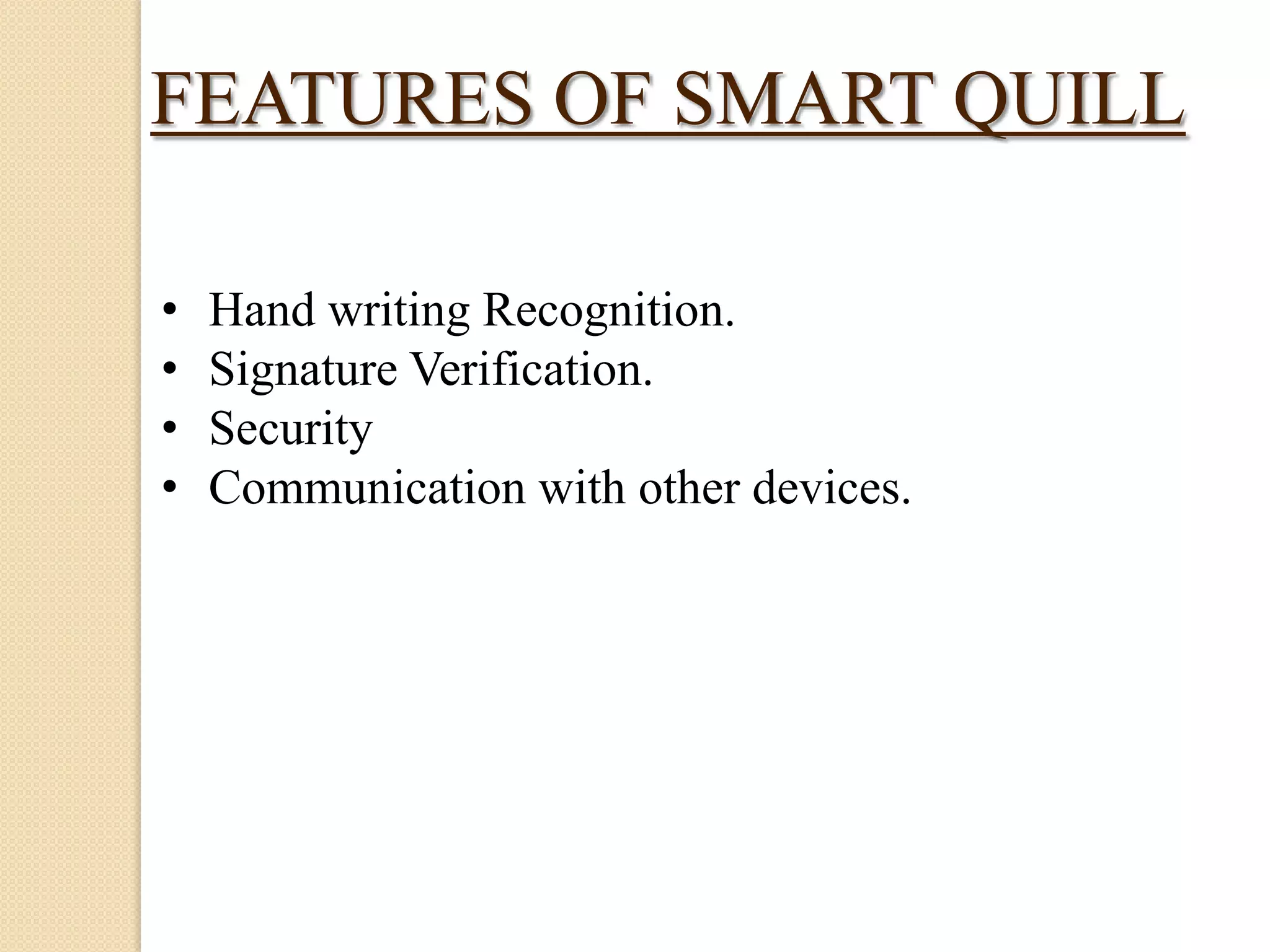
FEATURES OF SMART QUILL
•
•
•
•

Hand writing Recognition.
Signature Verification.
Security
Communication with other devices.
HAND WRITING RECOGNITION
AND SIGNATURE VERIFICATION
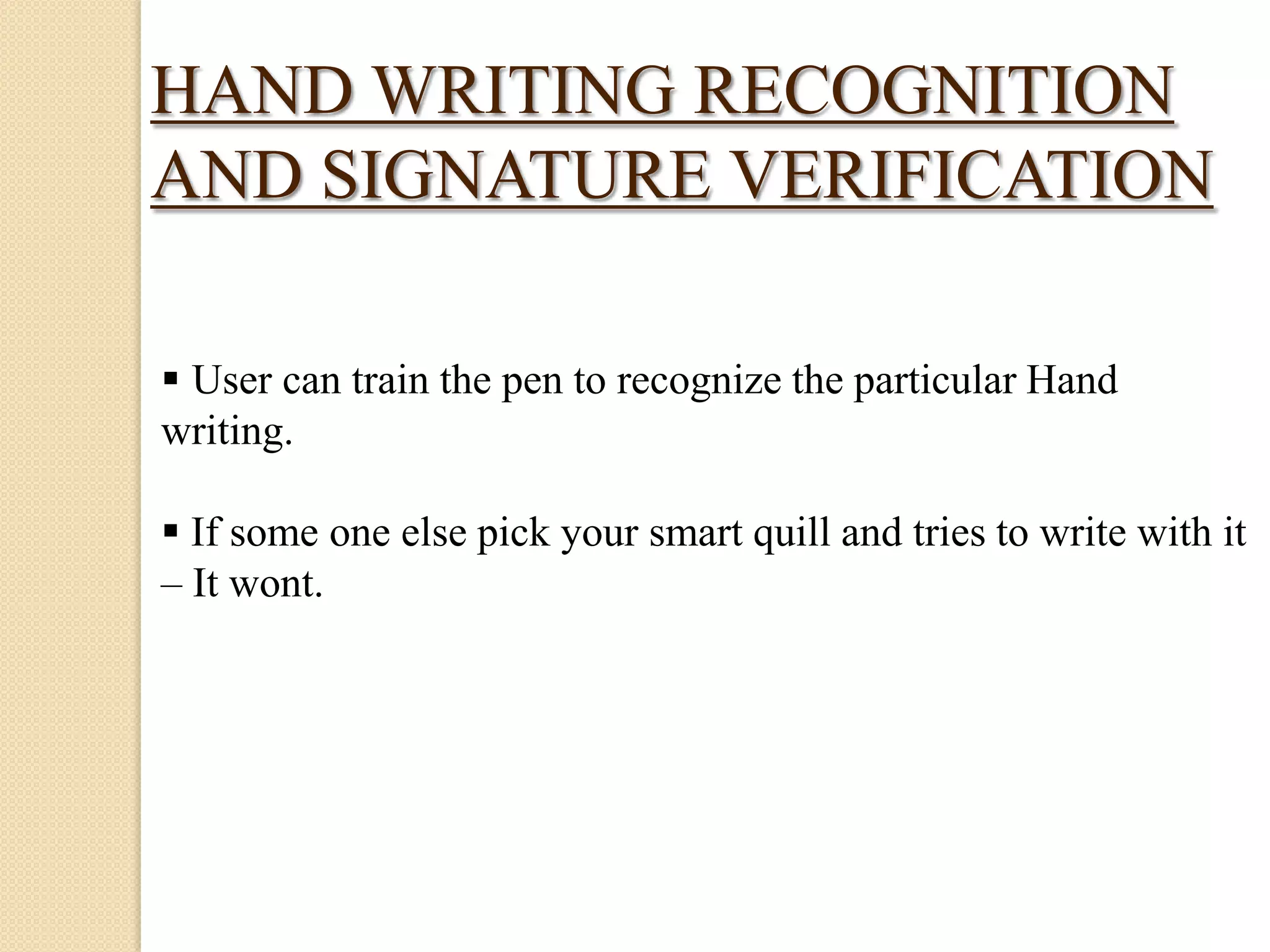
 User can train the pen to recognize the particular Hand
writing.
 If some one else pick your smart quill and tries to write with it
– It wont.
HAND WRITING RECOGNITION
AND SIGNATURE VERIFICATION
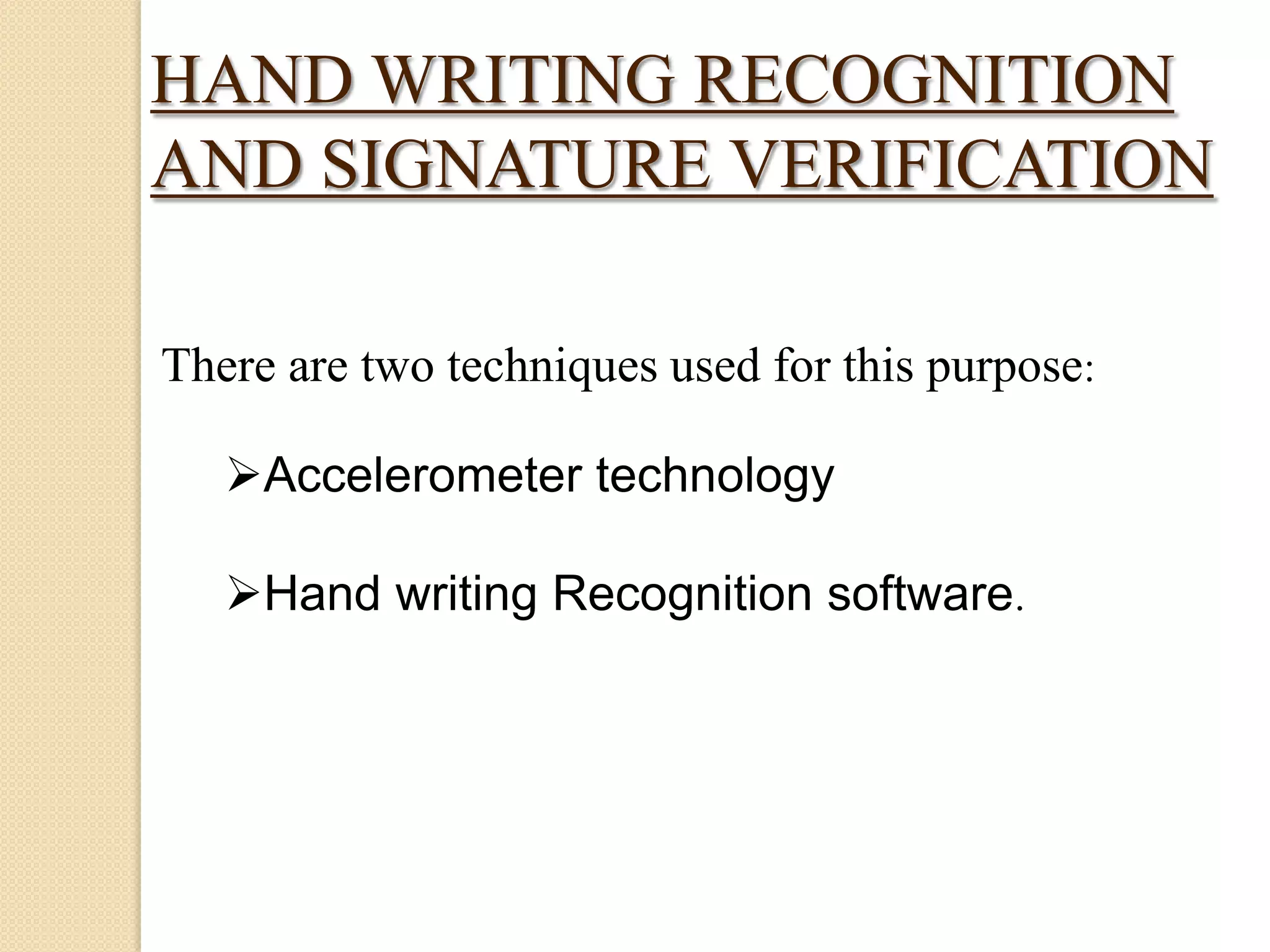
There are two techniques used for this purpose:
Accelerometer technology

Hand writing Recognition software.
ACCELEROMETER TECHNOLOGY
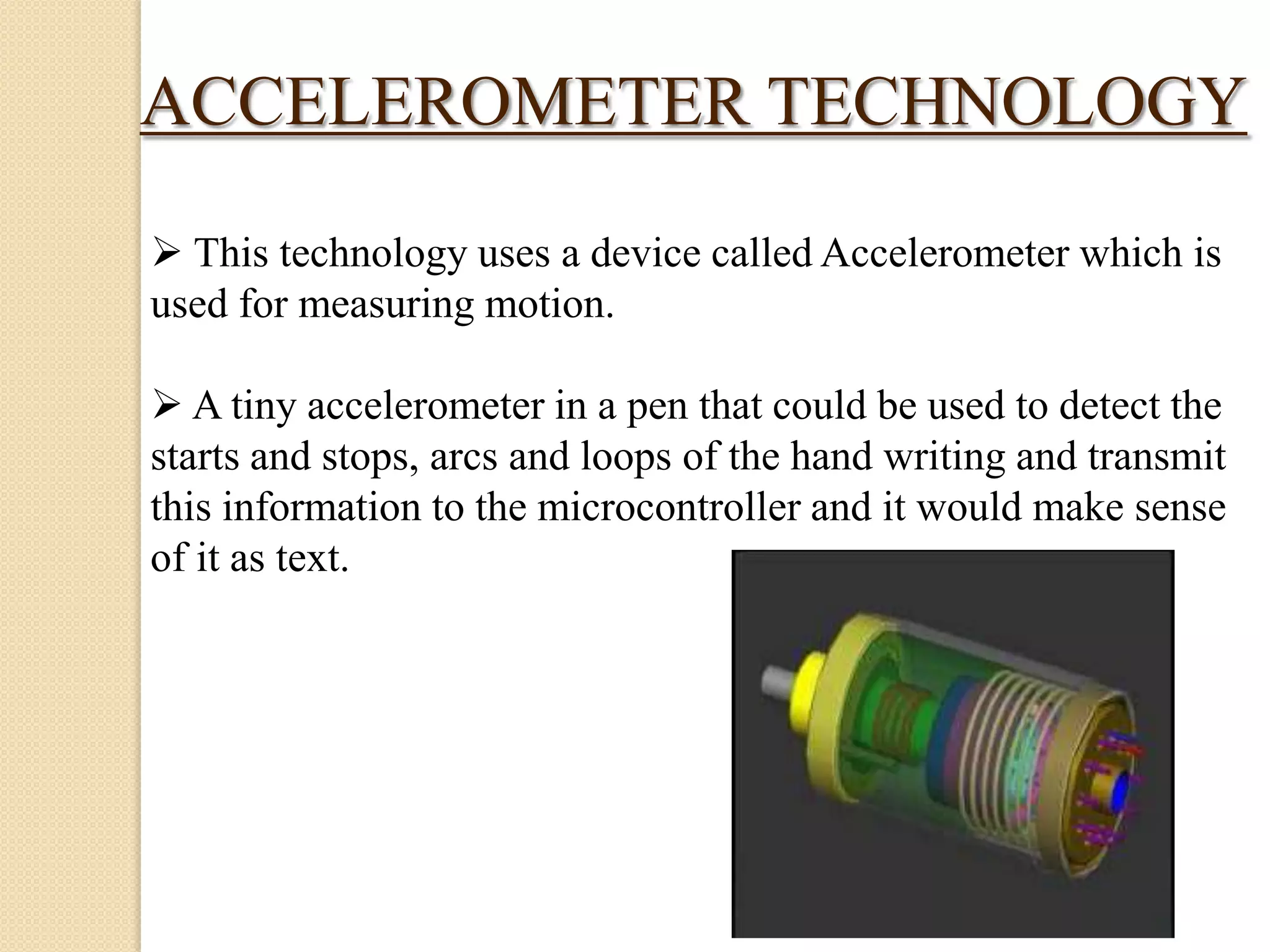
 This technology uses a device called Accelerometer which is
used for measuring motion.
 A tiny accelerometer in a pen that could be used to detect the
starts and stops, arcs and loops of the hand writing and transmit
this information to the microcontroller and it would make sense
of it as text.
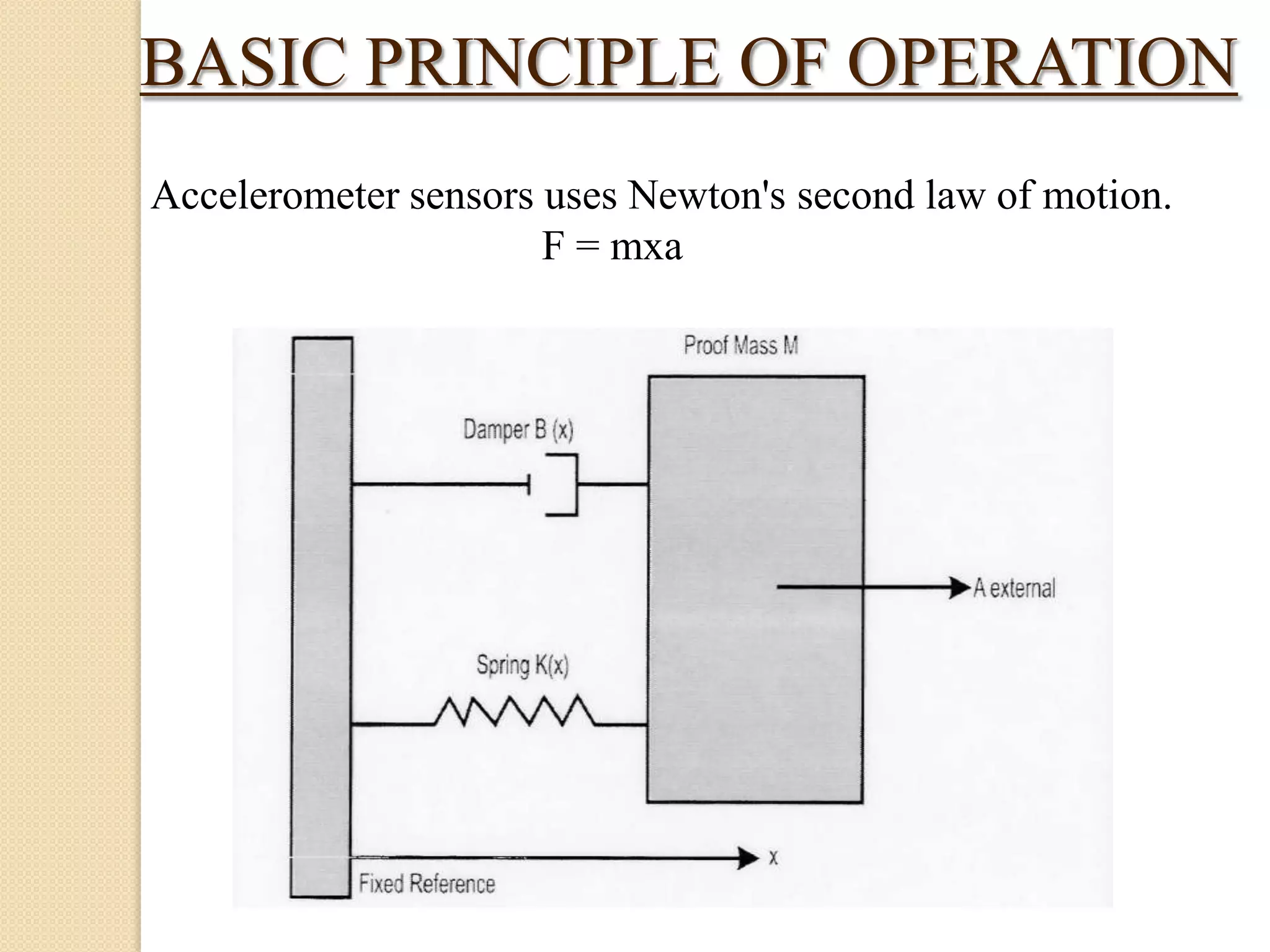
BASIC PRINCIPLE OF OPERATION
Accelerometer sensors uses Newton's second law of motion.
F = mxa
ACCELEROMETER TECHNOLOGY
There are two types of accelerometers :
1. Two axes accelerometer : This accelerometer measures
the acceleration in two axes. An example for two axes
accelerometer is ADXL202 accelerometer.
2. Three axes accelerometer : This accelerometer measures
the acceleration in three axes. An example for three axes
accelerometer is Tronics +/- 2g accelerometer.
HAND WRITING
RECOGNITION SOFTWARE
This software embedded in the micro processor of the pen is
used to recognize the handwriting of the user.

 TWO phases in Handwriting Recognition.
i. Handwriting Transcription
ii. Handwriting Recognition
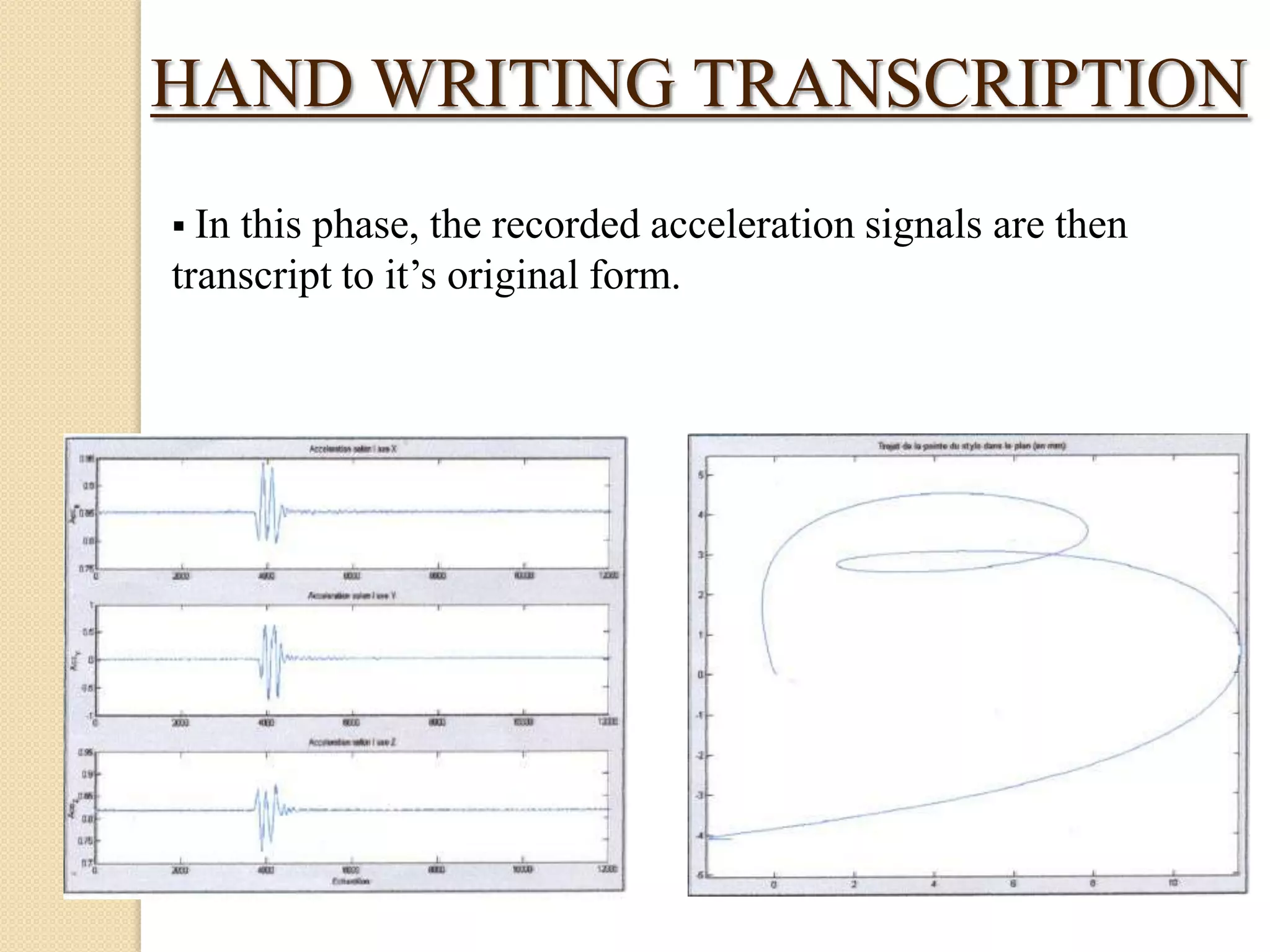
HAND WRITING TRANSCRIPTION
 In

this phase, the recorded acceleration signals are then
transcript to it’s original form.
HAND WRITING RECOGNITION
• In this phase the characters and signatures are recognized.
METHOD:
We use simple Euclidian Distance as the
comparison process and of course the decision process is the

smaller distance found.
SECURITY
Smart Quill pens are trained to recognize only the owner's
handwriting, making it a valuable security tool.
The inventor of the Smart Quill, Lyndsay Williams, states

“Consistency of handwriting, rather than neatness, is
the only condition for accuracy."
DISPLAY TECHNOLOGY
 KOPIN

CORP’s cyber display technology is used.

Uses high-performance single-crystal silicon
transistors.
Cyber display is ¼ inch LCD display screen.
Typical pixel size is 15 micrometer square. As a result
small display for resolution is possible.
Back light used since LCD is a non – emissive device.
COMMUNICATION WITH
OTHER DEVICES
The current proto type hooks up to a PC via cable and
electronic docking station called an “ink well.”
 The data stored in the memory is uploaded to the personal
computer when it is placed into a docking station.
 An electronic docking station is a small cabinet to which a
laptop or notebook computer can be attached for use as desktop
computer, usually have a connector for externally connected
devices such as hard drives or scanners.
.
HANDWRITING MOVEMENT
ANALYSIS SOFTWARE
Com PET (Computerized Penmanship Evaluation Tool)
MovAlyzeR4
ScriptAlyzeR
Neuroskill
POWER SAVING
 Small screen size requires less battery power.
No movement of the pen causes auto power down.
Uses microcontroller PIC16C74 which has NANO WATT
XLP(Extreme Low Power) Technology
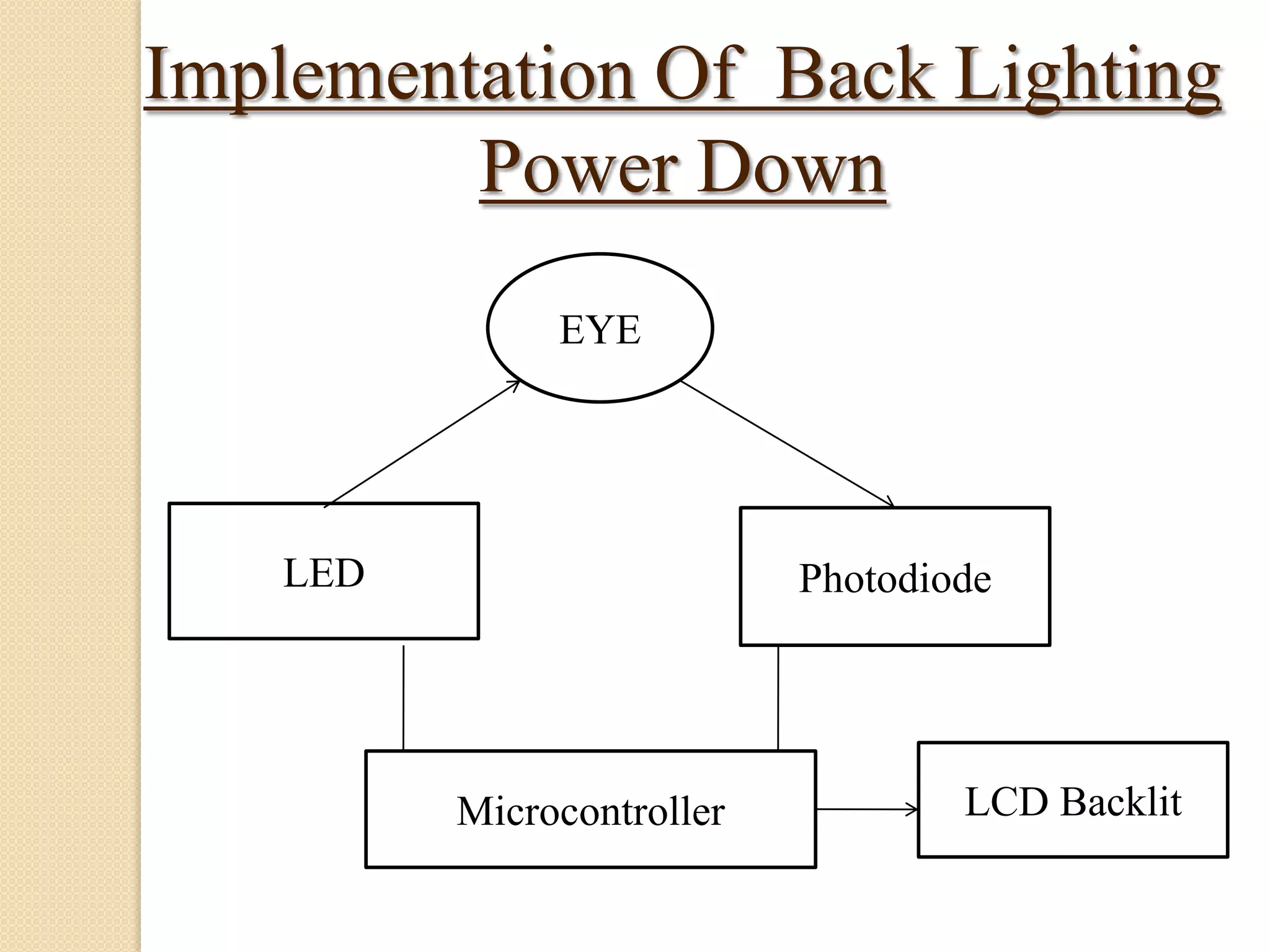
Implementation Of Back Lighting Power Down..
Implementation Of Back Lighting
Power Down
EYE

LED

Photodiode

Microcontroller

LCD Backlit
MEMORY
•Smart quill has 4 MB EEPROM.

•At a time up to up to 10 pages of notes can be stored locally on
the pen.
•The data is stored in the memory on the pen until it is uploaded
to the personal computer.
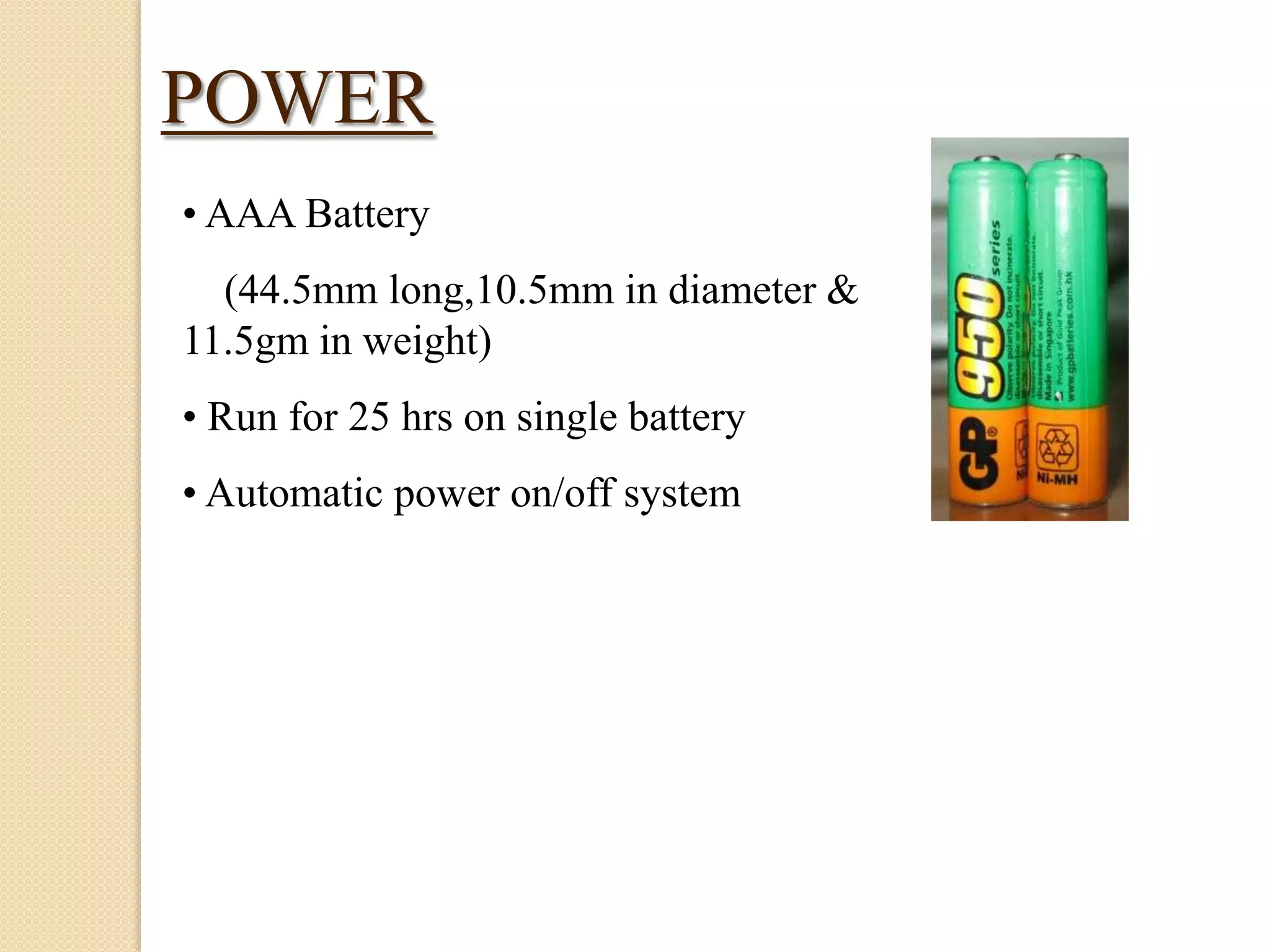
POWER
• AAA Battery
(44.5mm long,10.5mm in diameter &
11.5gm in weight)
• Run for 25 hrs on single battery
• Automatic power on/off system
ADVANTAGES
 Smart

quill can read on any flat surface (not only
on paper).
It is password protected.

 Highly convenient and portable.
 It can link to modems, printer etc
APPLICATIONS
 The information stored in the pen can be input to other
services such as mobile phones, printers, modems, desktop
computers for different applications.
Replace keyboard with Smart Quill.

Smart Quill synchronizes files, e-mails and messages to PC.
Useful in video conferencing, classroom lectures.

It also provides handheld computer applications such as
digital diary, contacts, calculators etc.
DISADVANTAGES
It is inconvenient for the persons with hand tremors.
Bigger size than normal pen.
It is expensive.
FUTURE SCOPE
It can be further developed for cursive writings and
traditional languages.
Refabrication and Reducing the size.

Cost Reduction.
Smartquill

Smartquill

  • 1.
  • 2.
    AIM OF THEPRESENTATION  To Familiarize the people what the SMART QUILL is about.  Future scope of the existing Technology.
  • 3.
    INTRODUCTION  Smart quill wasinvented by LYNDSEY WILLIAMS of Microsoft Research's Cambridge UK lab along with British Telecommunications. It is basically called the “PEN FOR THE NEW MILLENIUM”.  It is claimed to be the biggest revolution in hand writing since the invention of pen. 
  • 4.
    ABOUT SMART QUILL Smartquill is a pen which remembers the word that writes and transfer them into computer text. Smart quill contains sensors that record the movement of the pen by using earth’s gravity. It can record the writings irrespective of the platform used.
  • 5.
    How it DiffersFrom DIGITAL PEN
  • 6.
    DIFFERENT TYPES OFSMART QUILL
  • 8.
    WORKING OF SMARTQUILL. Users can enter the information into this pen by pressing start button and write down what they like to enter. Accelerometers sense the movement of the pen and sends to the micro controller(PIC 8 bit MC ) which from number of modes select the response. MEMS technology tilt sensors are used for the tilt functions. 4 MB EEPROM is the memory used. Hence about ten pages of notes can be stored in the pen. Two AAA batteries are used for the power supply.
  • 9.
    BASIC BLOCK DIAGRAM Accelerometer X Microcontroller Accelerometer y Battery RadioReceiver Display Radio Transmitter Keys RS232C convertor PC
  • 10.
    FEATURES OF SMARTQUILL • • • • Hand writing Recognition. Signature Verification. Security Communication with other devices.
  • 11.
    HAND WRITING RECOGNITION ANDSIGNATURE VERIFICATION  User can train the pen to recognize the particular Hand writing.  If some one else pick your smart quill and tries to write with it – It wont.
  • 12.
    HAND WRITING RECOGNITION ANDSIGNATURE VERIFICATION There are two techniques used for this purpose: Accelerometer technology Hand writing Recognition software.
  • 13.
    ACCELEROMETER TECHNOLOGY  Thistechnology uses a device called Accelerometer which is used for measuring motion.  A tiny accelerometer in a pen that could be used to detect the starts and stops, arcs and loops of the hand writing and transmit this information to the microcontroller and it would make sense of it as text.
  • 14.
    BASIC PRINCIPLE OFOPERATION Accelerometer sensors uses Newton's second law of motion. F = mxa
  • 15.
    ACCELEROMETER TECHNOLOGY There aretwo types of accelerometers : 1. Two axes accelerometer : This accelerometer measures the acceleration in two axes. An example for two axes accelerometer is ADXL202 accelerometer. 2. Three axes accelerometer : This accelerometer measures the acceleration in three axes. An example for three axes accelerometer is Tronics +/- 2g accelerometer.
  • 16.
    HAND WRITING RECOGNITION SOFTWARE Thissoftware embedded in the micro processor of the pen is used to recognize the handwriting of the user.  TWO phases in Handwriting Recognition. i. Handwriting Transcription ii. Handwriting Recognition
  • 17.
    HAND WRITING TRANSCRIPTION In this phase, the recorded acceleration signals are then transcript to it’s original form.
  • 18.
    HAND WRITING RECOGNITION •In this phase the characters and signatures are recognized. METHOD: We use simple Euclidian Distance as the comparison process and of course the decision process is the smaller distance found.
  • 19.
    SECURITY Smart Quill pensare trained to recognize only the owner's handwriting, making it a valuable security tool. The inventor of the Smart Quill, Lyndsay Williams, states “Consistency of handwriting, rather than neatness, is the only condition for accuracy."
  • 20.
    DISPLAY TECHNOLOGY  KOPIN CORP’scyber display technology is used. Uses high-performance single-crystal silicon transistors. Cyber display is ¼ inch LCD display screen. Typical pixel size is 15 micrometer square. As a result small display for resolution is possible. Back light used since LCD is a non – emissive device.
  • 21.
    COMMUNICATION WITH OTHER DEVICES Thecurrent proto type hooks up to a PC via cable and electronic docking station called an “ink well.”  The data stored in the memory is uploaded to the personal computer when it is placed into a docking station.  An electronic docking station is a small cabinet to which a laptop or notebook computer can be attached for use as desktop computer, usually have a connector for externally connected devices such as hard drives or scanners. .
  • 22.
    HANDWRITING MOVEMENT ANALYSIS SOFTWARE ComPET (Computerized Penmanship Evaluation Tool) MovAlyzeR4 ScriptAlyzeR Neuroskill
  • 23.
    POWER SAVING  Smallscreen size requires less battery power. No movement of the pen causes auto power down. Uses microcontroller PIC16C74 which has NANO WATT XLP(Extreme Low Power) Technology Implementation Of Back Lighting Power Down..
  • 24.
    Implementation Of BackLighting Power Down EYE LED Photodiode Microcontroller LCD Backlit
  • 25.
    MEMORY •Smart quill has4 MB EEPROM. •At a time up to up to 10 pages of notes can be stored locally on the pen. •The data is stored in the memory on the pen until it is uploaded to the personal computer.
  • 26.
    POWER • AAA Battery (44.5mmlong,10.5mm in diameter & 11.5gm in weight) • Run for 25 hrs on single battery • Automatic power on/off system
  • 27.
    ADVANTAGES  Smart quill canread on any flat surface (not only on paper). It is password protected.  Highly convenient and portable.  It can link to modems, printer etc
  • 28.
    APPLICATIONS  The informationstored in the pen can be input to other services such as mobile phones, printers, modems, desktop computers for different applications. Replace keyboard with Smart Quill. Smart Quill synchronizes files, e-mails and messages to PC. Useful in video conferencing, classroom lectures. It also provides handheld computer applications such as digital diary, contacts, calculators etc.
  • 29.
    DISADVANTAGES It is inconvenientfor the persons with hand tremors. Bigger size than normal pen. It is expensive.
  • 30.
    FUTURE SCOPE It canbe further developed for cursive writings and traditional languages. Refabrication and Reducing the size. Cost Reduction.