I Am Discovering Materials
Qatar Achievement
MOHMMAD FAISAL IBRAHEEM
HANEY
MOHAMED MANSOR SAEED AL-
GAHTANI
• Introduction
• Activity 1: Evading Motion Detection
• Activity 2: Taking a Tour of Some Sensors
• Activity 3: Making a Microphone
• Activity 4: Exploring the Piezo Effect: The inside story
• Activity 5: Measuring the Piezoelectric & Pyroelectric
Response
• Design Project: Designing A Coin Counter
• Product Idea: Smart Street Lights
INTRODUCTION
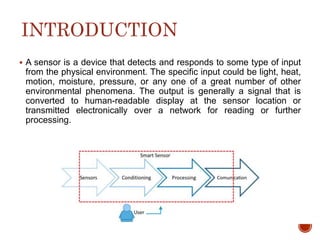
 A sensor is a device that detects and responds to some type of input
from the physical environment. The specific input could be light, heat,
motion, moisture, pressure, or any one of a great number of other
environmental phenomena. The output is generally a signal that is
converted to human-readable display at the sensor location or
transmitted electronically over a network for reading or further
processing.
Activity 1: Evading Motion
Detector
Objective: TRYING TO EVADE A MOTION DETECTOR SENSOR
by predicting it’s range and functionality:
Procedures: We tried evading the motion sensor by:
 Predicting it's range
 Puttying different batteries
 Using cardboard and plastic even cloth
 We also tried to walk really slow
Activity 1: Evading Motion
Detector
Results:
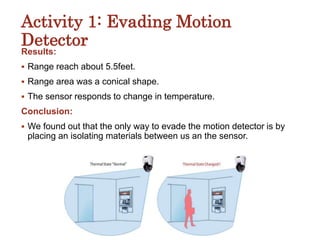
 Range reach about 5.5feet.
 Range area was a conical shape.
 The sensor responds to change in temperature.
Conclusion:
 We found out that the only way to evade the motion detector is by
placing an isolating materials between us an the sensor.
Activity 2: Taking A Tour Of Some
Sensors
Objectives:
 To explore different types of sensors.
 Understand the different types of stimuli
and responses
Procedure:
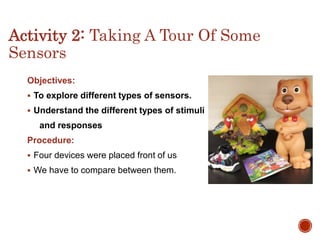
 Four devices were placed front of us
 We have to compare between them.
Activity 2: Taking A Tour Of Some
Sensors
Conclusion :
• after exploring many sensors ,we realized that each smart sensor has
a different stimulus and different response depending on its purpose.
Sensor Stimulus Response
Music card Opening the card Sound
Shoe Pressure Light
Talking tom Sound and Touch Sound (recorded voice)
Sound birds Sound and touch Sound & Movement
As we explored some types of smart sensor, we concluded the
following :
Objective:
Make and understand how the microphone works.
Procedures:
• We made a microphone from a PVDF film.
• We used flexible PVDF and rigid PVDF.
PVDF Rigid Rigid attached to
substance
Flexible Flexible attached
to substance
Flick Clear Sound Clear Sound Faint Sound Faint Sound
Scratch Medium Sound Clear Sound Clear Sound Clear Sound
Blow Faint Sound Faint Sound Clear Sound Clear Sound
Talk Faint Sound Faint Sound Clear Sound Clear Sound
Conclusion : after testing them out , we found out that the flexible PVDF is more
sensitive
Activity 3: Making a Microphone
Objectives: To recognize the structure of polymer model of C2F2H2:
Part a: building the
PVDF monomer
We used the molecular - kits
to build the monomer
C2F2H2 (Difluoroethylene)
Part b: building the PVDF
polymer
Then we built the PVDF
(Polyvinylidene fluoride) of
the repeating units of
C2F2H2.
Part c: Seeing the structure at
work
When bending the film we noticed that
bending one direction produces a
positive voltage and a bend in the
opposite direction Produces a
negative voltage. the faster the
bending the large potential
We learnt that the Piezoelectric effect is the ability of certain material to
generate an electric charge in response to applied mechanical stress.
Mass V1 V2 V3 Average
Small 0.032 0.076 0.036 -0.048
Medium 0.056 0.110 0.051 -0.072
Large 0.126 0.149 0.227 -0.167
Procedure:
 We dropped iron balls on the PVDF and we recorded the voltage
Height v1 v2 v3 Average
5in 0.037 0.012 0.037 0.029
10in 0.120 0.076 0.032 0.076
First We tested different ball sizes all dropped from the
same height
Then we tested different heights for the same ball size
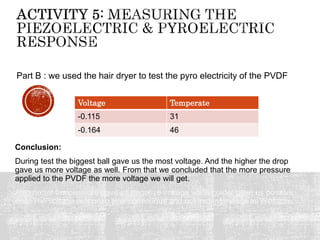
Conclusion:
During test the biggest ball gave us the most voltage. And the higher the drop
gave us more voltage as well. From that we concluded that the more pressure
applied to the PVDF the more voltage we will get.
Also hotter temperature gave us negative voltage while colder gave us positive
one. The voltage response was continuous and not instantaneous as pressure.
Voltage Temperate
-0.115 31
-0.164 46
Part B : we used the hair dryer to test the pyro electricity of the PVDF
Design Project: Coin Counter
The aim of this project is to apply what we have learnt during
the previous activities to construct an actual application.
Procedures:
• Drop three coins on the PVDF then make a table
for the mass and the voltage.
• We had one known mass of one of the coins
• After that we dropped the coins from the same
height for three times on the PVDF then we took
the average.
• From the equation below we calculated the mass.
𝒎 𝟏
𝒗 𝟏
=
𝒎 𝟐
𝒗 𝟐
Design Project: Coin Counter
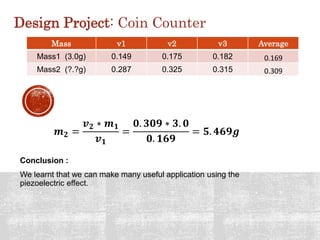
Conclusion :
We learnt that we can make many useful application using the
piezoelectric effect.
Mass v1 v2 v3 Average
Mass1 (3.0g) 0.149 0.175 0.182 0.169
Mass2 (?.?g) 0.287 0.325 0.315 0.309
𝒎 𝟐 =
𝒗 𝟐 ∗ 𝒎 𝟏
𝒗 𝟏
=
𝟎. 𝟑𝟎𝟗 ∗ 𝟑. 𝟎
𝟎. 𝟏𝟔𝟗
= 𝟓. 𝟒𝟔𝟗𝒈
PRODUCT IDEA
SMART STREET LIGHTS
• We have noticed that many times during night time. The streets
would be lit while there are no passing cars or people on the
streets.
• We noticed that this is a waste of energy. And we thought of
how we can solve this problem.
• Our idea is about a smart sensor that can be placed in the
street to detect any movement of a passing car/person. If a
movement is detected the street lights will light up, otherwise
the lights would be very dim if not off.
SMART STREET LIGHTS
PRODUCT STORY
The idea came to us when our physics teacher asked us how can
we preserve energy. We thought, why are the streets lit at night
without any car or any person passing through the street? We
asked ourselves a question; How can we control the lights so
that we can preserve energy and use the lights only when we
need them? After searching for multiple solutions we came up
with the idea of smart street Lights.
SMART STREET LIGHTS
Benefits And Recommendations
• We knew that this idea of detecting the presence of cars has
already been applied in signals, so we thought we can apply
the same concept on the Street Lights.
• This sensor can be used not only in the streets but also in
houses and buildings for preserving energy.
CONCLUSIONS
We have acquired many soft skills, knowledge
and technical skills. Have gained information
about new applications we did not know before
about sensors. We also learnt how to do
research.
Thank you to everyone who have Supported us During
our Journey In Al-bairaq Project.
We would also like to Thank Al-bairaq Team And The
Sponsors Who Gave us The Opportunity To Participate
In Al-bairaq Project, Create And Innovate.

Smart Sensors, Smart Street Lights IDM13

  • 1.
    I Am DiscoveringMaterials Qatar Achievement MOHMMAD FAISAL IBRAHEEM HANEY MOHAMED MANSOR SAEED AL- GAHTANI
  • 2.
    • Introduction • Activity1: Evading Motion Detection • Activity 2: Taking a Tour of Some Sensors • Activity 3: Making a Microphone • Activity 4: Exploring the Piezo Effect: The inside story • Activity 5: Measuring the Piezoelectric & Pyroelectric Response • Design Project: Designing A Coin Counter • Product Idea: Smart Street Lights
  • 3.
    INTRODUCTION  A sensoris a device that detects and responds to some type of input from the physical environment. The specific input could be light, heat, motion, moisture, pressure, or any one of a great number of other environmental phenomena. The output is generally a signal that is converted to human-readable display at the sensor location or transmitted electronically over a network for reading or further processing.
  • 4.
    Activity 1: EvadingMotion Detector Objective: TRYING TO EVADE A MOTION DETECTOR SENSOR by predicting it’s range and functionality: Procedures: We tried evading the motion sensor by:  Predicting it's range  Puttying different batteries  Using cardboard and plastic even cloth  We also tried to walk really slow
  • 5.
    Activity 1: EvadingMotion Detector Results:  Range reach about 5.5feet.  Range area was a conical shape.  The sensor responds to change in temperature. Conclusion:  We found out that the only way to evade the motion detector is by placing an isolating materials between us an the sensor.
  • 6.
    Activity 2: TakingA Tour Of Some Sensors Objectives:  To explore different types of sensors.  Understand the different types of stimuli and responses Procedure:  Four devices were placed front of us  We have to compare between them.
  • 7.
    Activity 2: TakingA Tour Of Some Sensors Conclusion : • after exploring many sensors ,we realized that each smart sensor has a different stimulus and different response depending on its purpose. Sensor Stimulus Response Music card Opening the card Sound Shoe Pressure Light Talking tom Sound and Touch Sound (recorded voice) Sound birds Sound and touch Sound & Movement As we explored some types of smart sensor, we concluded the following :
  • 8.
    Objective: Make and understandhow the microphone works. Procedures: • We made a microphone from a PVDF film. • We used flexible PVDF and rigid PVDF. PVDF Rigid Rigid attached to substance Flexible Flexible attached to substance Flick Clear Sound Clear Sound Faint Sound Faint Sound Scratch Medium Sound Clear Sound Clear Sound Clear Sound Blow Faint Sound Faint Sound Clear Sound Clear Sound Talk Faint Sound Faint Sound Clear Sound Clear Sound Conclusion : after testing them out , we found out that the flexible PVDF is more sensitive Activity 3: Making a Microphone
  • 9.
    Objectives: To recognizethe structure of polymer model of C2F2H2: Part a: building the PVDF monomer We used the molecular - kits to build the monomer C2F2H2 (Difluoroethylene) Part b: building the PVDF polymer Then we built the PVDF (Polyvinylidene fluoride) of the repeating units of C2F2H2. Part c: Seeing the structure at work When bending the film we noticed that bending one direction produces a positive voltage and a bend in the opposite direction Produces a negative voltage. the faster the bending the large potential We learnt that the Piezoelectric effect is the ability of certain material to generate an electric charge in response to applied mechanical stress.
  • 10.
    Mass V1 V2V3 Average Small 0.032 0.076 0.036 -0.048 Medium 0.056 0.110 0.051 -0.072 Large 0.126 0.149 0.227 -0.167 Procedure:  We dropped iron balls on the PVDF and we recorded the voltage Height v1 v2 v3 Average 5in 0.037 0.012 0.037 0.029 10in 0.120 0.076 0.032 0.076 First We tested different ball sizes all dropped from the same height Then we tested different heights for the same ball size
  • 11.
    Conclusion: During test thebiggest ball gave us the most voltage. And the higher the drop gave us more voltage as well. From that we concluded that the more pressure applied to the PVDF the more voltage we will get. Also hotter temperature gave us negative voltage while colder gave us positive one. The voltage response was continuous and not instantaneous as pressure. Voltage Temperate -0.115 31 -0.164 46 Part B : we used the hair dryer to test the pyro electricity of the PVDF
  • 12.
    Design Project: CoinCounter The aim of this project is to apply what we have learnt during the previous activities to construct an actual application. Procedures: • Drop three coins on the PVDF then make a table for the mass and the voltage. • We had one known mass of one of the coins • After that we dropped the coins from the same height for three times on the PVDF then we took the average. • From the equation below we calculated the mass. 𝒎 𝟏 𝒗 𝟏 = 𝒎 𝟐 𝒗 𝟐
  • 13.
    Design Project: CoinCounter Conclusion : We learnt that we can make many useful application using the piezoelectric effect. Mass v1 v2 v3 Average Mass1 (3.0g) 0.149 0.175 0.182 0.169 Mass2 (?.?g) 0.287 0.325 0.315 0.309 𝒎 𝟐 = 𝒗 𝟐 ∗ 𝒎 𝟏 𝒗 𝟏 = 𝟎. 𝟑𝟎𝟗 ∗ 𝟑. 𝟎 𝟎. 𝟏𝟔𝟗 = 𝟓. 𝟒𝟔𝟗𝒈
  • 14.
    PRODUCT IDEA SMART STREETLIGHTS • We have noticed that many times during night time. The streets would be lit while there are no passing cars or people on the streets. • We noticed that this is a waste of energy. And we thought of how we can solve this problem. • Our idea is about a smart sensor that can be placed in the street to detect any movement of a passing car/person. If a movement is detected the street lights will light up, otherwise the lights would be very dim if not off.
  • 15.
    SMART STREET LIGHTS PRODUCTSTORY The idea came to us when our physics teacher asked us how can we preserve energy. We thought, why are the streets lit at night without any car or any person passing through the street? We asked ourselves a question; How can we control the lights so that we can preserve energy and use the lights only when we need them? After searching for multiple solutions we came up with the idea of smart street Lights.
  • 16.
    SMART STREET LIGHTS BenefitsAnd Recommendations • We knew that this idea of detecting the presence of cars has already been applied in signals, so we thought we can apply the same concept on the Street Lights. • This sensor can be used not only in the streets but also in houses and buildings for preserving energy.
  • 17.
    CONCLUSIONS We have acquiredmany soft skills, knowledge and technical skills. Have gained information about new applications we did not know before about sensors. We also learnt how to do research.
  • 18.
    Thank you toeveryone who have Supported us During our Journey In Al-bairaq Project. We would also like to Thank Al-bairaq Team And The Sponsors Who Gave us The Opportunity To Participate In Al-bairaq Project, Create And Innovate.