Formal Models of Social Processes
Computational Justice for Fair and Sustainable
Resource Allocation in Socio-Technical Systems
Jeremy Pitt
Department of Electrical and Electronic Engineering
SMART Institute, University of Wollongong, 28/11/2014
Agenda
Problem statement: resource allocation in open system
Formalisation of Ostrom’s institutional design principles for
sustainable resource allocation
Formalisation of Rescher’s theory of distributive justice for fair
resource allocation
Computational justice in socio-technical systems
(Why It Matters)
Summary and conclusions
Jeremy Pitt Formal Models of Social Processes 2 / 22
Context
Open systems
autonomous, heterogeneous, (possibly) competing components
‘Technical’ systems – composed of purely computing agents
Grid computing, cloud computing, . . .
Ad hoc networks, sensor networks, vehicular networks, . . .
Virtual organisations, . . .
Reconfigurable manufacturing, evolvable manufacturing, . . .
Power systems, . . .
Common problem: a requirement for the agents (aka
appropriators) to collectivise and distribute resources,
in the context of . . .
Jeremy Pitt Formal Models of Social Processes 3 / 22
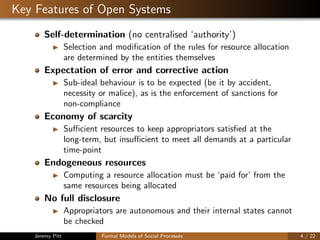
Key Features of Open Systems
Self-determination (no centralised ‘authority’)
Selection and modification of the rules for resource allocation
are determined by the entities themselves
Expectation of error and corrective action
Sub-ideal behaviour is to be expected (be it by accident,
necessity or malice), as is the enforcement of sanctions for
non-compliance
Economy of scarcity
Sufficient resources to keep appropriators satisfied at the
long-term, but insufficient to meet all demands at a particular
time-point
Endogeneous resources
Computing a resource allocation must be ‘paid for’ from the
same resources being allocated
No full disclosure
Appropriators are autonomous and their internal states cannot
be checked
Jeremy Pitt Formal Models of Social Processes 4 / 22
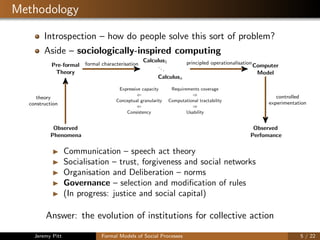
Methodology
Introspection – how do people solve this sort of problem?
Aside – sociologically-inspired computing
Pre-formal
Theory
Calculus1
...
Calculusn
Computer
Model
Observed
Phenomena
Observed
Perfomance
Expressive capacity Requirements coverage
⇐ ⇒
Conceptual granularity Computational tractability
⇐ ⇒
Consistency Usability
formal characterisation principled operationalisation
theory
construction
controlled
experimentation
Communication – speech act theory
Socialisation – trust, forgiveness and social networks
Organisation and Deliberation – norms
Governance – selection and modification of rules
(In progress: justice and social capital)
Answer: the evolution of institutions for collective action
Jeremy Pitt Formal Models of Social Processes 5 / 22
Common-Pool Resource Management
People are very good at “making stuff up”
In particular, making up and writing down conventional rules
to (voluntarily) regulate/organise their own behaviour
Elinor Ostrom (Nobel Laureate for Economic Science, 2009)
Common-pool resource (CPR) management by
self-governing institutions
Avoidance (not refutation) of ‘the tragedy of the commons’
Alternative to privatisation or centralisation
Role-based protocols for implementing conventional
procedures
Self-organisation: change the rules according to other
(‘fixed’, ‘pre-defined’) sets of rules
Self-determination: those affected by the rules participate in
their selection
Jeremy Pitt Formal Models of Social Processes 6 / 22
Self-Governing the Commons with Institutions
Definition: “set of working rules that are used to determine
who is eligible to make decisions in some arena, what actions
are allowed or constrained, ... [and] contain prescriptions that
forbid, permit or require some action or outcome” [Ostrom]
Conventionally agreed, mutually understood, monitored and
enforced, mutable and nested
Nesting: tripartite analysis
operational-, collective- and constitutional-choice rules
Decision arenas [Action Situations]
Requires representation of Institutionalised Power
Jeremy Pitt Formal Models of Social Processes 7 / 22
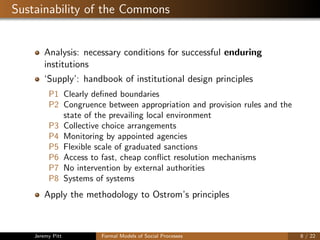
Sustainability of the Commons
Analysis: necessary conditions for successful enduring
institutions
‘Supply’: handbook of institutional design principles
P1 Clearly defined boundaries
P2 Congruence between appropriation and provision rules and the
state of the prevailing local environment
P3 Collective choice arrangements
P4 Monitoring by appointed agencies
P5 Flexible scale of graduated sanctions
P6 Access to fast, cheap conflict resolution mechanisms
P7 No intervention by external authorities
P8 Systems of systems
Apply the methodology to Ostrom’s principles
Jeremy Pitt Formal Models of Social Processes 8 / 22
Self-Organising Electronic Institutions (SOEI)
Electronic Institutions
Formalise structural, functional and procedural aspects of
institutions in mathematical or computational form
Self-Organising: selection and modification of structures,
functions, and procedures are determined by the members
inc
rep
1
1 1 2
3
4
4’
5
a b b a
a b b ∼ a
A DG
A = DG
A
DG
ADG
ADG
ADG
scr1
scr2
ocr1
scr4
scr5
wdMethod
raMethod
wdMethod
v(·)
v(·)
M 7! [0, P]
M 7! [0, P]
SC
v(·)
{SC [ OC}
chair
chair
chair
chair
chair
(a) Institution 1
scr1
scr2
ocr2
scr3
scr4
scr5
wdMethod
raMethod
W
wdMethod
v(·)
v(·)
M 7! [0, P]
M 7! [0, P]
v(·) W
SC
v(·)
{SC [ OC}
chair
chair
chair
chair
chair
chair
(b) Institution 2
Figure 1: Rules relationships: solid lines denote input and output of the rules; dashed lines denote chair assignment. (a) ...
(b) ...
scr3 scr2
scr1
ocr1
wdMethod DG1
raMethod
wdMethodDG3 DG2
{v(·)}a2DG3 {v(·)}a2DG2
{v(·)}a2DG1
{da(·)}a2A
{ra(·)}a2A
(a) Institution 1
scr3 scr2
scr1 scr4
ocr2
wdMethod DG1
WraMethod
DG1
wdMethodDG3 DG2
{v(·)}a2DG3
{v(·)}a2DG2
{v(·)}a2DG1 {v(·)}a2DG1
W
{da(·)}a2A
{ra(·)}a2A
(b) Institution 2
Figure 2: Rules relationships: solid lines denote input and output of the rules; dashed lines denote chair assignment. (a) ...
(b) ...
Self-Organising electronic institutions represented in
framework of dynamic norm-governed systems (Artikis, 2012)
SOEI encapsulating Ostrom’s institutional design principles can
be axiomatised in computational logic using the Event
Calculus, and directly executed
Experiments showed that the more principles that were
axiomatised, it was more likely that the institution could
maintain ‘high’ levels of membership and sustain the resource
Jeremy Pitt Formal Models of Social Processes 9 / 22
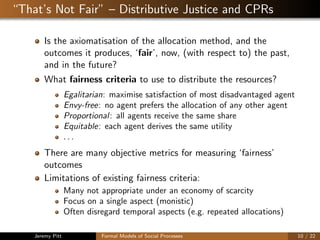
“That’s Not Fair” – Distributive Justice and CPRs
Is the axiomatisation of the allocation method, and the
outcomes it produces, ‘fair’, now, (with respect to) the past,
and in the future?
What fairness criteria to use to distribute the resources?
Egalitarian: maximise satisfaction of most disadvantaged agent
Envy-free: no agent prefers the allocation of any other agent
Proportional: all agents receive the same share
Equitable: each agent derives the same utility
. . .
There are many objective metrics for measuring ‘fairness’
outcomes
Limitations of existing fairness criteria:
Many not appropriate under an economy of scarcity
Focus on a single aspect (monistic)
Often disregard temporal aspects (e.g. repeated allocations)
Jeremy Pitt Formal Models of Social Processes 10 / 22
Experimental Setting – Linear Public Good Game (LPG)
LPG commonly used to study free-riding in collective action
situations
Variant game: LPG – in each round, each agent:
Determines the resources it has available, gi ∈ [0, 1]
Determines its need for resources, qi ∈ [0, 1]
In an economy of scarcity, qi > gi
Makes a demand for resources, di ∈ [0, 1]
Makes a provision of resources, pi ∈ [0, 1] (pi ≤ gi )
Receives an allocation of resources, ri ∈ [0, 1]
Makes an appropriation of resources, ri ∈ [0, 1]
Agents may not comply, ri > ri
Utility in LPG : accrued resources Ri = ri + (gi − pi )
Ui =
aqi + b(Ri − qi ), if Ri ≥ qi
aRi − c(qi − Ri ), otherwise
Jeremy Pitt Formal Models of Social Processes 11 / 22
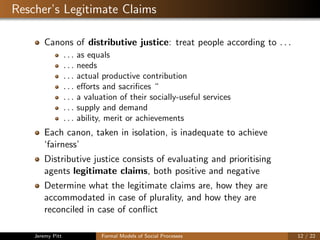
Rescher’s Legitimate Claims
Canons of distributive justice: treat people according to . . .
. . . as equals
. . . needs
. . . actual productive contribution
. . . efforts and sacrifices “
. . . a valuation of their socially-useful services
. . . supply and demand
. . . ability, merit or achievements
Each canon, taken in isolation, is inadequate to achieve
‘fairness’
Distributive justice consists of evaluating and prioritising
agents legitimate claims, both positive and negative
Determine what the legitimate claims are, how they are
accommodated in case of plurality, and how they are
reconciled in case of conflict
Jeremy Pitt Formal Models of Social Processes 12 / 22
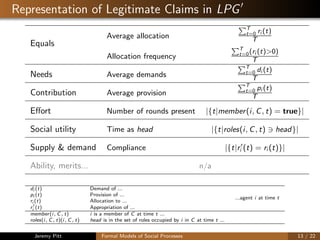
Representation of Legitimate Claims in LPG
Equals
Average allocation
T
t=0 ri (t)
T
Allocation frequency
T
t=0(ri (t)>0)
T
Needs Average demands
T
t=0 di (t)
T
Contribution Average provision
T
t=0 pi (t)
T
Effort Number of rounds present |{t|member(i, C, t) = true}|
Social utility Time as head |{t|roles(i, C, t) head}|
Supply & demand Compliance |{t|ri (t) = ri (t)}|
Ability, merits... n/a
di (t) Demand of ...
...agent i at time t
pi (t) Provision of ...
ri (t) Allocation to ...
ri (t) Appropriation of ...
member(i, C, t) i is a member of C at time t ...
roles(i, C, t)(i, C, t) head is in the set of roles occupied by i in C at time t ...
Jeremy Pitt Formal Models of Social Processes 13 / 22
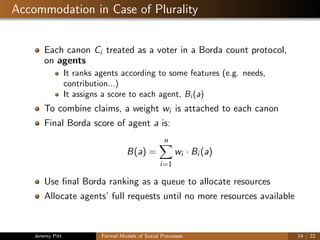
Accommodation in Case of Plurality
Each canon Ci treated as a voter in a Borda count protocol,
on agents
It ranks agents according to some features (e.g. needs,
contribution...)
It assigns a score to each agent, Bi (a)
To combine claims, a weight wi is attached to each canon
Final Borda score of agent a is:
B(a) =
n
i=1
wi · Bi (a)
Use final Borda ranking as a queue to allocate resources
Allocate agents’ full requests until no more resources available
Jeremy Pitt Formal Models of Social Processes 14 / 22
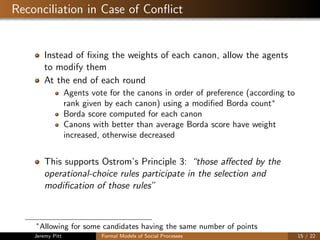
Reconciliation in Case of Conflict
Instead of fixing the weights of each canon, allow the agents
to modify them
At the end of each round
Agents vote for the canons in order of preference (according to
rank given by each canon) using a modified Borda count∗
Borda score computed for each canon
Canons with better than average Borda score have weight
increased, otherwise decreased
This supports Ostrom’s Principle 3: “those affected by the
operational-choice rules participate in the selection and
modification of those rules”
∗
Allowing for some candidates having the same number of points
Jeremy Pitt Formal Models of Social Processes 15 / 22
Some results
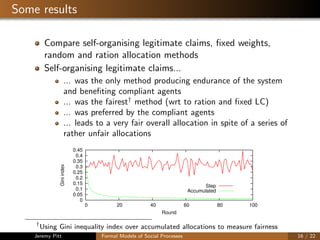
Compare self-organising legitimate claims, fixed weights,
random and ration allocation methods
Self-organising legitimate claims...
... was the only method producing endurance of the system
and benefiting compliant agents
... was the fairest†
method (wrt to ration and fixed LC)
... was preferred by the compliant agents
... leads to a very fair overall allocation in spite of a series of
rather unfair allocations
0
0.05
0.1
0.15
0.2
0.25
0.3
0.35
0.4
0.45
0 20 40 60 80 100
Giniindex
Round
Step
Accumulated
†
Using Gini inequality index over accumulated allocations to measure fairness
Jeremy Pitt Formal Models of Social Processes 16 / 22
Ramifications
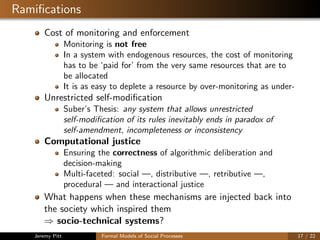
Cost of monitoring and enforcement
Monitoring is not free
In a system with endogenous resources, the cost of monitoring
has to be ‘paid for’ from the very same resources that are to
be allocated
It is as easy to deplete a resource by over-monitoring as under-
Unrestricted self-modification
Suber’s Thesis: any system that allows unrestricted
self-modification of its rules inevitably ends in paradox of
self-amendment, incompleteness or inconsistency
Computational justice
Ensuring the correctness of algorithmic deliberation and
decision-making
Multi-faceted: social —, distributive —, retributive —,
procedural — and interactional justice
What happens when these mechanisms are injected back into
the society which inspired them
⇒ socio-technical systems?
Jeremy Pitt Formal Models of Social Processes 17 / 22
Why It Matters
Grid in 2050: for a variety of reasons
Economic
(Geo)Political
Regulatory
Environmental
Demographic
It is to be expected at best power rationing, at worst blackouts
What is required
Unbundle the SmartMeter: generative platform for co-design
Smart Appliances: programmable intelligence ‘at the edge’
Community Energy Systems: localised provision, nested
enterprises, polycentric governance
Then we can use fairness algorithms for algorithmic
self-governance and computational justice
Jeremy Pitt Formal Models of Social Processes 18 / 22
Smart Grids as a Socio-Technical System
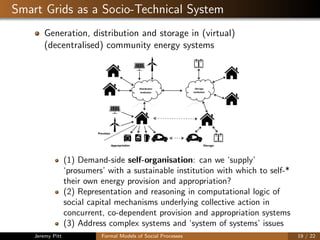
Generation, distribution and storage in (virtual)
(decentralised) community energy systems
(1) Demand-side self-organisation: can we ‘supply’
‘prosumers’ with a sustainable institution with which to self-*
their own energy provision and appropriation?
(2) Representation and reasoning in computational logic of
social capital mechanisms underlying collective action in
concurrent, co-dependent provision and appropriation systems
(3) Address complex systems and ‘system of systems’ issues
Jeremy Pitt Formal Models of Social Processes 19 / 22
Complex Systems and ‘Systems of Systems’
Aspects only partially explored/explained in Ostrom’s theories
Institutional power
Fairness
Psychological processes
Complex systems
Nested enterprises, ‘system of systems’ and polycentric
governance
Investigating algorithmic self-governance based on
holonic institutions/institutionalised holonics
An alternative approach to smart(er) cities: Ostromopolis
stromopolis
O
Jeremy Pitt Formal Models of Social Processes 20 / 22
Summary and Conclusions
Original problem – sustainable resource allocation in open
systems
Formal model of Ostrom’s institutional design principles
Issue of fairness – fair resource allocation in open systems
Formal model of Rescher’s theory of distributive justice
Fair and sustainable resource allocation in socio-technical
systems
(Towards) Formal models of collective awareness, social
capital, and computational justice
We end up with alternative approach to smart(er) cities:
Ostromopolis
If the only solution you have
is an Ostrom-shaped hammer,
then every problem you face
is a collective action-shaped nail
Jeremy Pitt Formal Models of Social Processes 21 / 22
Acknowledgements
UK EPSRC and EU for funding
Many people for collaborations etc.
Jeremy Pitt Formal Models of Social Processes 22 / 22

SMART Seminar Series: Formal Models of Social Processes

  • 1.
    Formal Models ofSocial Processes Computational Justice for Fair and Sustainable Resource Allocation in Socio-Technical Systems Jeremy Pitt Department of Electrical and Electronic Engineering SMART Institute, University of Wollongong, 28/11/2014
  • 2.
    Agenda Problem statement: resourceallocation in open system Formalisation of Ostrom’s institutional design principles for sustainable resource allocation Formalisation of Rescher’s theory of distributive justice for fair resource allocation Computational justice in socio-technical systems (Why It Matters) Summary and conclusions Jeremy Pitt Formal Models of Social Processes 2 / 22
  • 3.
    Context Open systems autonomous, heterogeneous,(possibly) competing components ‘Technical’ systems – composed of purely computing agents Grid computing, cloud computing, . . . Ad hoc networks, sensor networks, vehicular networks, . . . Virtual organisations, . . . Reconfigurable manufacturing, evolvable manufacturing, . . . Power systems, . . . Common problem: a requirement for the agents (aka appropriators) to collectivise and distribute resources, in the context of . . . Jeremy Pitt Formal Models of Social Processes 3 / 22
  • 4.
    Key Features ofOpen Systems Self-determination (no centralised ‘authority’) Selection and modification of the rules for resource allocation are determined by the entities themselves Expectation of error and corrective action Sub-ideal behaviour is to be expected (be it by accident, necessity or malice), as is the enforcement of sanctions for non-compliance Economy of scarcity Sufficient resources to keep appropriators satisfied at the long-term, but insufficient to meet all demands at a particular time-point Endogeneous resources Computing a resource allocation must be ‘paid for’ from the same resources being allocated No full disclosure Appropriators are autonomous and their internal states cannot be checked Jeremy Pitt Formal Models of Social Processes 4 / 22
  • 5.
    Methodology Introspection – howdo people solve this sort of problem? Aside – sociologically-inspired computing Pre-formal Theory Calculus1 ... Calculusn Computer Model Observed Phenomena Observed Perfomance Expressive capacity Requirements coverage ⇐ ⇒ Conceptual granularity Computational tractability ⇐ ⇒ Consistency Usability formal characterisation principled operationalisation theory construction controlled experimentation Communication – speech act theory Socialisation – trust, forgiveness and social networks Organisation and Deliberation – norms Governance – selection and modification of rules (In progress: justice and social capital) Answer: the evolution of institutions for collective action Jeremy Pitt Formal Models of Social Processes 5 / 22
  • 6.
    Common-Pool Resource Management Peopleare very good at “making stuff up” In particular, making up and writing down conventional rules to (voluntarily) regulate/organise their own behaviour Elinor Ostrom (Nobel Laureate for Economic Science, 2009) Common-pool resource (CPR) management by self-governing institutions Avoidance (not refutation) of ‘the tragedy of the commons’ Alternative to privatisation or centralisation Role-based protocols for implementing conventional procedures Self-organisation: change the rules according to other (‘fixed’, ‘pre-defined’) sets of rules Self-determination: those affected by the rules participate in their selection Jeremy Pitt Formal Models of Social Processes 6 / 22
  • 7.
    Self-Governing the Commonswith Institutions Definition: “set of working rules that are used to determine who is eligible to make decisions in some arena, what actions are allowed or constrained, ... [and] contain prescriptions that forbid, permit or require some action or outcome” [Ostrom] Conventionally agreed, mutually understood, monitored and enforced, mutable and nested Nesting: tripartite analysis operational-, collective- and constitutional-choice rules Decision arenas [Action Situations] Requires representation of Institutionalised Power Jeremy Pitt Formal Models of Social Processes 7 / 22
  • 8.
    Sustainability of theCommons Analysis: necessary conditions for successful enduring institutions ‘Supply’: handbook of institutional design principles P1 Clearly defined boundaries P2 Congruence between appropriation and provision rules and the state of the prevailing local environment P3 Collective choice arrangements P4 Monitoring by appointed agencies P5 Flexible scale of graduated sanctions P6 Access to fast, cheap conflict resolution mechanisms P7 No intervention by external authorities P8 Systems of systems Apply the methodology to Ostrom’s principles Jeremy Pitt Formal Models of Social Processes 8 / 22
  • 9.
    Self-Organising Electronic Institutions(SOEI) Electronic Institutions Formalise structural, functional and procedural aspects of institutions in mathematical or computational form Self-Organising: selection and modification of structures, functions, and procedures are determined by the members inc rep 1 1 1 2 3 4 4’ 5 a b b a a b b ∼ a A DG A = DG A DG ADG ADG ADG scr1 scr2 ocr1 scr4 scr5 wdMethod raMethod wdMethod v(·) v(·) M 7! [0, P] M 7! [0, P] SC v(·) {SC [ OC} chair chair chair chair chair (a) Institution 1 scr1 scr2 ocr2 scr3 scr4 scr5 wdMethod raMethod W wdMethod v(·) v(·) M 7! [0, P] M 7! [0, P] v(·) W SC v(·) {SC [ OC} chair chair chair chair chair chair (b) Institution 2 Figure 1: Rules relationships: solid lines denote input and output of the rules; dashed lines denote chair assignment. (a) ... (b) ... scr3 scr2 scr1 ocr1 wdMethod DG1 raMethod wdMethodDG3 DG2 {v(·)}a2DG3 {v(·)}a2DG2 {v(·)}a2DG1 {da(·)}a2A {ra(·)}a2A (a) Institution 1 scr3 scr2 scr1 scr4 ocr2 wdMethod DG1 WraMethod DG1 wdMethodDG3 DG2 {v(·)}a2DG3 {v(·)}a2DG2 {v(·)}a2DG1 {v(·)}a2DG1 W {da(·)}a2A {ra(·)}a2A (b) Institution 2 Figure 2: Rules relationships: solid lines denote input and output of the rules; dashed lines denote chair assignment. (a) ... (b) ... Self-Organising electronic institutions represented in framework of dynamic norm-governed systems (Artikis, 2012) SOEI encapsulating Ostrom’s institutional design principles can be axiomatised in computational logic using the Event Calculus, and directly executed Experiments showed that the more principles that were axiomatised, it was more likely that the institution could maintain ‘high’ levels of membership and sustain the resource Jeremy Pitt Formal Models of Social Processes 9 / 22
  • 10.
    “That’s Not Fair”– Distributive Justice and CPRs Is the axiomatisation of the allocation method, and the outcomes it produces, ‘fair’, now, (with respect to) the past, and in the future? What fairness criteria to use to distribute the resources? Egalitarian: maximise satisfaction of most disadvantaged agent Envy-free: no agent prefers the allocation of any other agent Proportional: all agents receive the same share Equitable: each agent derives the same utility . . . There are many objective metrics for measuring ‘fairness’ outcomes Limitations of existing fairness criteria: Many not appropriate under an economy of scarcity Focus on a single aspect (monistic) Often disregard temporal aspects (e.g. repeated allocations) Jeremy Pitt Formal Models of Social Processes 10 / 22
  • 11.
    Experimental Setting –Linear Public Good Game (LPG) LPG commonly used to study free-riding in collective action situations Variant game: LPG – in each round, each agent: Determines the resources it has available, gi ∈ [0, 1] Determines its need for resources, qi ∈ [0, 1] In an economy of scarcity, qi > gi Makes a demand for resources, di ∈ [0, 1] Makes a provision of resources, pi ∈ [0, 1] (pi ≤ gi ) Receives an allocation of resources, ri ∈ [0, 1] Makes an appropriation of resources, ri ∈ [0, 1] Agents may not comply, ri > ri Utility in LPG : accrued resources Ri = ri + (gi − pi ) Ui = aqi + b(Ri − qi ), if Ri ≥ qi aRi − c(qi − Ri ), otherwise Jeremy Pitt Formal Models of Social Processes 11 / 22
  • 12.
    Rescher’s Legitimate Claims Canonsof distributive justice: treat people according to . . . . . . as equals . . . needs . . . actual productive contribution . . . efforts and sacrifices “ . . . a valuation of their socially-useful services . . . supply and demand . . . ability, merit or achievements Each canon, taken in isolation, is inadequate to achieve ‘fairness’ Distributive justice consists of evaluating and prioritising agents legitimate claims, both positive and negative Determine what the legitimate claims are, how they are accommodated in case of plurality, and how they are reconciled in case of conflict Jeremy Pitt Formal Models of Social Processes 12 / 22
  • 13.
    Representation of LegitimateClaims in LPG Equals Average allocation T t=0 ri (t) T Allocation frequency T t=0(ri (t)>0) T Needs Average demands T t=0 di (t) T Contribution Average provision T t=0 pi (t) T Effort Number of rounds present |{t|member(i, C, t) = true}| Social utility Time as head |{t|roles(i, C, t) head}| Supply & demand Compliance |{t|ri (t) = ri (t)}| Ability, merits... n/a di (t) Demand of ... ...agent i at time t pi (t) Provision of ... ri (t) Allocation to ... ri (t) Appropriation of ... member(i, C, t) i is a member of C at time t ... roles(i, C, t)(i, C, t) head is in the set of roles occupied by i in C at time t ... Jeremy Pitt Formal Models of Social Processes 13 / 22
  • 14.
    Accommodation in Caseof Plurality Each canon Ci treated as a voter in a Borda count protocol, on agents It ranks agents according to some features (e.g. needs, contribution...) It assigns a score to each agent, Bi (a) To combine claims, a weight wi is attached to each canon Final Borda score of agent a is: B(a) = n i=1 wi · Bi (a) Use final Borda ranking as a queue to allocate resources Allocate agents’ full requests until no more resources available Jeremy Pitt Formal Models of Social Processes 14 / 22
  • 15.
    Reconciliation in Caseof Conflict Instead of fixing the weights of each canon, allow the agents to modify them At the end of each round Agents vote for the canons in order of preference (according to rank given by each canon) using a modified Borda count∗ Borda score computed for each canon Canons with better than average Borda score have weight increased, otherwise decreased This supports Ostrom’s Principle 3: “those affected by the operational-choice rules participate in the selection and modification of those rules” ∗ Allowing for some candidates having the same number of points Jeremy Pitt Formal Models of Social Processes 15 / 22
  • 16.
    Some results Compare self-organisinglegitimate claims, fixed weights, random and ration allocation methods Self-organising legitimate claims... ... was the only method producing endurance of the system and benefiting compliant agents ... was the fairest† method (wrt to ration and fixed LC) ... was preferred by the compliant agents ... leads to a very fair overall allocation in spite of a series of rather unfair allocations 0 0.05 0.1 0.15 0.2 0.25 0.3 0.35 0.4 0.45 0 20 40 60 80 100 Giniindex Round Step Accumulated † Using Gini inequality index over accumulated allocations to measure fairness Jeremy Pitt Formal Models of Social Processes 16 / 22
  • 17.
    Ramifications Cost of monitoringand enforcement Monitoring is not free In a system with endogenous resources, the cost of monitoring has to be ‘paid for’ from the very same resources that are to be allocated It is as easy to deplete a resource by over-monitoring as under- Unrestricted self-modification Suber’s Thesis: any system that allows unrestricted self-modification of its rules inevitably ends in paradox of self-amendment, incompleteness or inconsistency Computational justice Ensuring the correctness of algorithmic deliberation and decision-making Multi-faceted: social —, distributive —, retributive —, procedural — and interactional justice What happens when these mechanisms are injected back into the society which inspired them ⇒ socio-technical systems? Jeremy Pitt Formal Models of Social Processes 17 / 22
  • 18.
    Why It Matters Gridin 2050: for a variety of reasons Economic (Geo)Political Regulatory Environmental Demographic It is to be expected at best power rationing, at worst blackouts What is required Unbundle the SmartMeter: generative platform for co-design Smart Appliances: programmable intelligence ‘at the edge’ Community Energy Systems: localised provision, nested enterprises, polycentric governance Then we can use fairness algorithms for algorithmic self-governance and computational justice Jeremy Pitt Formal Models of Social Processes 18 / 22
  • 19.
    Smart Grids asa Socio-Technical System Generation, distribution and storage in (virtual) (decentralised) community energy systems (1) Demand-side self-organisation: can we ‘supply’ ‘prosumers’ with a sustainable institution with which to self-* their own energy provision and appropriation? (2) Representation and reasoning in computational logic of social capital mechanisms underlying collective action in concurrent, co-dependent provision and appropriation systems (3) Address complex systems and ‘system of systems’ issues Jeremy Pitt Formal Models of Social Processes 19 / 22
  • 20.
    Complex Systems and‘Systems of Systems’ Aspects only partially explored/explained in Ostrom’s theories Institutional power Fairness Psychological processes Complex systems Nested enterprises, ‘system of systems’ and polycentric governance Investigating algorithmic self-governance based on holonic institutions/institutionalised holonics An alternative approach to smart(er) cities: Ostromopolis stromopolis O Jeremy Pitt Formal Models of Social Processes 20 / 22
  • 21.
    Summary and Conclusions Originalproblem – sustainable resource allocation in open systems Formal model of Ostrom’s institutional design principles Issue of fairness – fair resource allocation in open systems Formal model of Rescher’s theory of distributive justice Fair and sustainable resource allocation in socio-technical systems (Towards) Formal models of collective awareness, social capital, and computational justice We end up with alternative approach to smart(er) cities: Ostromopolis If the only solution you have is an Ostrom-shaped hammer, then every problem you face is a collective action-shaped nail Jeremy Pitt Formal Models of Social Processes 21 / 22
  • 22.
    Acknowledgements UK EPSRC andEU for funding Many people for collaborations etc. Jeremy Pitt Formal Models of Social Processes 22 / 22