


PROJECT PRESENTATION ON
KNOWLEDGE
MANAGEMENT SYSTEM IN
LAW
BY
OGUNGBENRO PHILIP MUYIWA
(149503)
INTRODUCTION
REVIEW OF LITERATURES
Knowledge is most commonly defined as what we know. It involves ‘the
mental processes of comprehension, understanding and learning that go on in
the mind, however they also involve interaction with the world outside the
mind, and interaction with others’ (Wilson, 2002). Vat (2003) believes that
knowledge is intriguing as it is always open to interpretation, is constantly
changing, and is constructed over time.
• Knowledge is a human act
• Knowledge is the residue of thinking
• Knowledge is created in the present moment
• Knowledge belongs to communities
• Knowledge circulates through communities in many ways
• New knowledge is created at the boundaries of old.
KNOWLEDGE CREATION
TECHNOLOGIES
As well as technologies designed to enable the sharing of knowledge, there is
also an increasing number of tools aimed at supporting the creation of
knowledge – helping to generate information and knowledge from data. A
few examples are briefly mentioned here for general interest only:
Data mining
Business intelligence
Information system
Data warehouse
Decision support system
Information storage and retrieval
RELATED WORKS
LexisNexis Total Search offers knowledge management benefits by
delivering the prior work product of the firm to the practicing lawyer in a
convenient and seamless way.
KnowledgeBase Manager Pro is commonly used to complement a help
desk or for sharing information among
employees within the organization or business unit.
Interspire Knowledge Manager makes publishing, sharing and
collaborating on knowledge easy. Click on a feature below to learn
more about it.
AIM AND OBJECTIVES
AIM
• The aim of this project is to ensure adoption of new technology by lawyers in
doing their job.
OBJECTIVES
• To ensure proper keeping of records of past cases.
• Ensuring safety of old all documents associated with cases.
• Create a data warehouse where the detail of a particular case can be
stored and retrieved when the need arise
• Adequate representation of all forms of explicit 'knowledge artifacts' such as
presentations, website, blog, documents, publications and journals.
• Let users collaborate in creating and sharing information.
METHODOLOGY
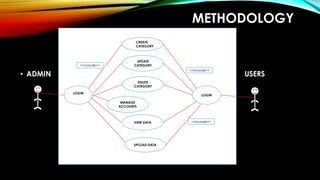
• ADMIN USERS
UPDATE
CATEGORY
DELETE
CATEGORY
VIEW DATA
UPLOAD DATA
CREATE
CATEGORY
MANAGE
ACCOUNTS
LOGIN
LOGIN
<<include>>
<<include>>
<<include>>
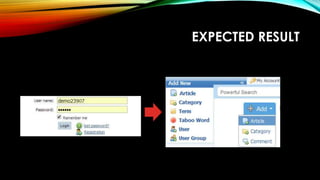
EXPECTED RESULT
CONCLUSION
• To draw the curtain, the advantages of KMS can not be over emphasized
which includes;
• Promotes creating new knowledge and innovation
• Reduce costs of being effective and increases innovation
• Preserve existing knowledge
• Reduce the K-loss from employees who leave
• Increase collaboration and K-sharing to enhance skills
• Increase productivity by making knowledge accessible
• Enables a “pro-active learning and decision culture”
• Helps staff do the right things, and do them right

Seminar presentation format

  • 1.
    PROJECT PRESENTATION ON KNOWLEDGE MANAGEMENTSYSTEM IN LAW BY OGUNGBENRO PHILIP MUYIWA (149503)
  • 2.
  • 3.
    REVIEW OF LITERATURES Knowledgeis most commonly defined as what we know. It involves ‘the mental processes of comprehension, understanding and learning that go on in the mind, however they also involve interaction with the world outside the mind, and interaction with others’ (Wilson, 2002). Vat (2003) believes that knowledge is intriguing as it is always open to interpretation, is constantly changing, and is constructed over time. • Knowledge is a human act • Knowledge is the residue of thinking • Knowledge is created in the present moment • Knowledge belongs to communities • Knowledge circulates through communities in many ways • New knowledge is created at the boundaries of old.
  • 4.
    KNOWLEDGE CREATION TECHNOLOGIES As wellas technologies designed to enable the sharing of knowledge, there is also an increasing number of tools aimed at supporting the creation of knowledge – helping to generate information and knowledge from data. A few examples are briefly mentioned here for general interest only: Data mining Business intelligence Information system Data warehouse Decision support system Information storage and retrieval
  • 5.
    RELATED WORKS LexisNexis TotalSearch offers knowledge management benefits by delivering the prior work product of the firm to the practicing lawyer in a convenient and seamless way. KnowledgeBase Manager Pro is commonly used to complement a help desk or for sharing information among employees within the organization or business unit. Interspire Knowledge Manager makes publishing, sharing and collaborating on knowledge easy. Click on a feature below to learn more about it.
  • 6.
    AIM AND OBJECTIVES AIM •The aim of this project is to ensure adoption of new technology by lawyers in doing their job. OBJECTIVES • To ensure proper keeping of records of past cases. • Ensuring safety of old all documents associated with cases. • Create a data warehouse where the detail of a particular case can be stored and retrieved when the need arise • Adequate representation of all forms of explicit 'knowledge artifacts' such as presentations, website, blog, documents, publications and journals. • Let users collaborate in creating and sharing information.
  • 7.
    METHODOLOGY • ADMIN USERS UPDATE CATEGORY DELETE CATEGORY VIEWDATA UPLOAD DATA CREATE CATEGORY MANAGE ACCOUNTS LOGIN LOGIN <<include>> <<include>> <<include>>
  • 8.
  • 9.
    CONCLUSION • To drawthe curtain, the advantages of KMS can not be over emphasized which includes; • Promotes creating new knowledge and innovation • Reduce costs of being effective and increases innovation • Preserve existing knowledge • Reduce the K-loss from employees who leave • Increase collaboration and K-sharing to enhance skills • Increase productivity by making knowledge accessible • Enables a “pro-active learning and decision culture” • Helps staff do the right things, and do them right