Page 1 of 7
Graduation Project Proposal
Project Information
Project Title Department/Faculty/University Project Field/Discipline
Early detection system for plants leaves pests Information Technology department,
Faculty of Computers and Information,
Cairo University
ICT for Agriculture, Image
processing, Machine Learning
Advisors’ Names Advisors’ Mobile Numbers Advisors’ Email Addresses
Prof. Aboul Ella Hassanein,
Information Technology department, Faculty of Computers and
Information, Cairo University
01114567956 aboitcairo@gmail.com
Dr. Nashwa Elbendary,
Business Information Systems (BIS) Dept.,
College of Management and Technology, Dokki Campus
Arab Academy for Science, Technology, and Maritime Transport
01005201630 nashwa.elbendary@ieee.org
Students’ Names Students’ Mobile Numbers Students’ Email Addresses
Ahmed Gamal Sayed Ewais 01153347212 zaeemkingdom@gmail.com
Ahmed Osman Awadallah Mohamed 01147459790 a.osman_1994@yahoo.com
Is this project part of a mega-project at the same institution? Yes No (If yes, please submit all proposals together.)
If the project is sponsored by or initiated by an ICT company, please state its name:
Page 2 of 7
Motivation
Please write why you chose this project idea, explaining clearly the problem that the project is addressing
Agriculture decides economy and food security of the nations. However, there are certain issues with field crops,
whether in open-fields or in greenhouses, such as identifying deficiency of nutrition in plants and identifying various
diseases and pests which affect crops. Early detection of pests in field crops is essential, in order for the farmer to
take proper corrective actions for controlling that problem, and accordingly to minimize crops losses. This project
aims at developing an early warning system via automatic early detection of diseases and pests on plants leaves
based on image processing and machine learning as well as the Internet of Things (IoT) technologies. The system
presented in this project helps the farmer to avoid misidentification of pests and diseases that may lead to incorrect
controls and actions leading to wasting money and serious problems to crops and the whole yield. Also, the proposed
system provides farmers with a number of important features such as availability, accuracy, dependability, .. etc. as
commonly farmers may face situations with agricultural experts such as, having to go long distances for approaching
the expert and expert may not be available at that time or the expert whom a farmer contacts, may not have sufficient
knowledge to advise the farmer concerning certain crops pests or diseases.
Accordingly, the presented early detection system provides extra extension service aids side by side with the
agricultural experts who give farmers suggestions regarding detection of diseases in order to increase the crop
productivity.
The main result of this project is a tested and validated prototype of automatic early detection and warning system of
diseases and pests on plants leaves that is based on image processing and machine learning as well as the Internet
of Things (IoT) technologies. The potential beneficiaries/users of the output of this project are the farmers as it helps
them to avoid misidentification of pests and diseases that may lead to incorrect controls and actions leading to
wasting money and serious problems to crops and the whole yield. Also, the proposed system provides farmers with
a number of important features such as availability, accuracy, dependability, .. etc. Accordingly, the presented early
detection system provides extra extension service aids side by side with the agricultural experts who give farmers
suggestions regarding detection of diseases in order to increase the crop productivity.
Block Diagram
Page 3 of 7
Please insert the project detailed block diagram below, (Please highlight the parts that will be implemented in different colors than the parts that will be purchased)
Page 4 of 7
Prototype Description and Specifications
Please note that ITAC only funds projects that result in a prototype. Include a clear description of how the prototype will operate, explaining a scenario/use case of
the operation. Also include the performance metrics you target in the prototype.
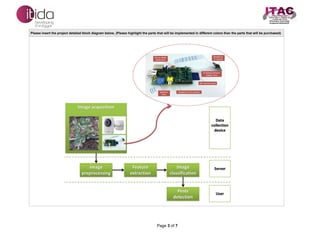
The proposed automatic early detection and warning system of diseases and pests on plants leaves is based on image processing and machine
learning as well as the Internet of Things (IoT) technologies. It consists of five phases, which take place on data collection device, server, and
used sides, as described in the figure showing the general structure of the proposed system.
1- Image acquisition [on the data collection device] (by developing and using a device based on a micro-controller and a camera with
wireless connectivity). The output of this phase is a number of captures images for plans leaves.
2- Pre-processing [on the server] (by applying images filtering and segmentation). The output of this phase is image segments
containing the leaves from the images of phase (1).
3- Feature extraction [on the server] (using feature extraction algorithms to build feature vectors). The output of this phase is a number
of feature vectors corresponding to the segmented images resulted from phase (2).
4- Classification [on the server] (using classification algorithms to recognize the leaves with anomalies or holes due to being infected
by pests). The output of this phase is a decision whether the input images contain infected plans or not.
Decision [on the user device] where the decision of pests detection will be sent to be viewed on the user device interface.
So, A pre-usage training phase will be implemented in order to store both the normal and infected plants leaves descriptors into a dataset on
the devices’ memory units, as follows:
1. A dataset of normal and infected plants leaves images, labelled with their status, will be constructed.
2. For each image in the dataset, a pre-processing step is being applied (Gray-Scale Conversion).
3. The output image from the pre-processing step is being entered into the feature extraction step.
4. A dataset of the resulted descriptors of the plants leaves images, will be constructed and saved on the devices’ memory units for
further usage in the infection recognition phase.
After, having the training phase done, the recognition phase is being achieved, as follows:
1. The user holds the device with its camera directed to the plants leaves.
2. A picture is being captured for the plant leaves using the device’s camera.
3. A descriptor is being constructed for the captured image as previously stated during the training phase (steps 2, 3).
4. A matching step will be implemented via computing the similarity measurement (using similarity functions) for the processed/
descriptor and the descriptors in the database of the training images, which is already saved on the device’s memory unit.
5. The output of the matching step will be the index of the descriptor with the highest similarity score.
6. The status of the plant leaves that achieved a correct match will be retrieved and displayed via the user’s device interface.
Page 5 of 7
Project Plan
Please define the approach and phases to deliver the intended project outcome.
1. Surveying the most common pests that infect plants.
2. Decide the type of plants and the type of disease to be considered in the developed prototype.
3. Collecting images to build an images dataset for both normal and infected plants leaves.
4. Collaborating with an agricultural expert to set labels for each one of the collected images.
5. Designing and developing a database containing the gathered data.
6. Developing a clear description for the prototype of the proposed system and how it will operate as well as its
development requirements.
7. Purchase the Raspberry Pi device and other components for the prototype.
8. Training on how to operate and program Raspberry Pi Platform.
9. Develop the system Open CV code for image processing which will be put on the circuit board connecting all
the components to each other.
10.Finishing Application and Hardware.
11.Connect the application to the hardware.
12.Deliver working Prototype.
13.Inviting users to test the prototype to report bugs and reviews.
14.Constructing a clear description for the system and how it will operate.
15.Write the project documentation.
16.Delivering the intended project outcomes.
17.Publishing a conference paper of the proposed project.
Prototype Prospects
Page 6 of 7
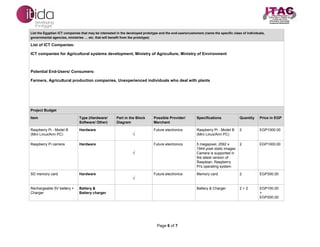
List the Egyptian ICT companies that may be interested in the developed prototype and the end-users/customers (name the specific class of individuals,
governmental agencies, ministries … etc. that will benefit from the prototype)
List of ICT Companies:
ICT companies for Agricultural systems development, Ministry of Agriculture, Ministry of Environment
Potential End-Users/ Consumers:
Farmers, Agricultural production companies, Unexperienced individuals who deal with plants
Project Budget
Item Type (Hardware/
Software/ Other)
Part in the Block
Diagram
Possible Provider/
Merchant
Specifications Quantity Price in EGP
Raspberry Pi - Model B
(Mini Linux/Arm PC)
Hardware
√
Future electronics Raspberry Pi - Model B
(Mini Linux/Arm PC)
2 EGP1000.00
Raspberry Pi camera Hardware
√
Future electronics 5 megapixel, 2592 x
1944 pixel static images
Camera is supported in
the latest version of
Raspbian, Raspberry
Pi's operating system
2 EGP1000.00
SD memory card Hardware
√
Future electronics Memory card 2 EGP300.00
Rechargeable 5V battery +
Charger
Battery &
Battery charger
Battery & Charger 2 + 2 EGP100.00
+
EGP200.00
Page 7 of 7
DVI to HDMI Cable - 1.5 m
[CABLE.HDMI.TO.DVI]
Cable
√
RAM electronics DVI to HDMI Cable -
1.5 m
DVI-D connector (male)
/ HDMI connector (male)
Cable 1.5M
2 EGP100.00
Unit casing Casing Fab Lab Casing for the
Raspberry Pi based
prototype
2 EGP300.00
Mini SonicPi Raspberry Pi
Speakers
Hardware
√
RAM electronics Raspberry Pi Speakers 2 EGP300.00
Power Supply Micro USB
Charger Adapter (DC 5V 1A
1000mA)
Hardware
√
Future electronics AC to DC power supply
delivers 5V at 1A with a
standard USB 'A'
connector for the output.
2 EGP200.00
Training Others Fab Lab Egypt + Online
material
Training on developing
optimized codes for
Raspberry Pi’s OS and
Android mobile App.s
3 EGP2500.00
Documentation Others Designing and preparing
a final revised copy of
the project’s
documentation
5 EGP2000.00
Publication Others International conference Publishing a conference
paper of the proposed
prototypes
1 EGP2000.00
Grand Total EGP10,00.00

Graduation Project Proposal October 2014

  • 1.
    Page 1 of7 Graduation Project Proposal Project Information Project Title Department/Faculty/University Project Field/Discipline Early detection system for plants leaves pests Information Technology department, Faculty of Computers and Information, Cairo University ICT for Agriculture, Image processing, Machine Learning Advisors’ Names Advisors’ Mobile Numbers Advisors’ Email Addresses Prof. Aboul Ella Hassanein, Information Technology department, Faculty of Computers and Information, Cairo University 01114567956 aboitcairo@gmail.com Dr. Nashwa Elbendary, Business Information Systems (BIS) Dept., College of Management and Technology, Dokki Campus Arab Academy for Science, Technology, and Maritime Transport 01005201630 nashwa.elbendary@ieee.org Students’ Names Students’ Mobile Numbers Students’ Email Addresses Ahmed Gamal Sayed Ewais 01153347212 zaeemkingdom@gmail.com Ahmed Osman Awadallah Mohamed 01147459790 a.osman_1994@yahoo.com Is this project part of a mega-project at the same institution? Yes No (If yes, please submit all proposals together.) If the project is sponsored by or initiated by an ICT company, please state its name:
  • 2.
    Page 2 of7 Motivation Please write why you chose this project idea, explaining clearly the problem that the project is addressing Agriculture decides economy and food security of the nations. However, there are certain issues with field crops, whether in open-fields or in greenhouses, such as identifying deficiency of nutrition in plants and identifying various diseases and pests which affect crops. Early detection of pests in field crops is essential, in order for the farmer to take proper corrective actions for controlling that problem, and accordingly to minimize crops losses. This project aims at developing an early warning system via automatic early detection of diseases and pests on plants leaves based on image processing and machine learning as well as the Internet of Things (IoT) technologies. The system presented in this project helps the farmer to avoid misidentification of pests and diseases that may lead to incorrect controls and actions leading to wasting money and serious problems to crops and the whole yield. Also, the proposed system provides farmers with a number of important features such as availability, accuracy, dependability, .. etc. as commonly farmers may face situations with agricultural experts such as, having to go long distances for approaching the expert and expert may not be available at that time or the expert whom a farmer contacts, may not have sufficient knowledge to advise the farmer concerning certain crops pests or diseases. Accordingly, the presented early detection system provides extra extension service aids side by side with the agricultural experts who give farmers suggestions regarding detection of diseases in order to increase the crop productivity. The main result of this project is a tested and validated prototype of automatic early detection and warning system of diseases and pests on plants leaves that is based on image processing and machine learning as well as the Internet of Things (IoT) technologies. The potential beneficiaries/users of the output of this project are the farmers as it helps them to avoid misidentification of pests and diseases that may lead to incorrect controls and actions leading to wasting money and serious problems to crops and the whole yield. Also, the proposed system provides farmers with a number of important features such as availability, accuracy, dependability, .. etc. Accordingly, the presented early detection system provides extra extension service aids side by side with the agricultural experts who give farmers suggestions regarding detection of diseases in order to increase the crop productivity. Block Diagram
  • 3.
    Page 3 of7 Please insert the project detailed block diagram below, (Please highlight the parts that will be implemented in different colors than the parts that will be purchased)
  • 4.
    Page 4 of7 Prototype Description and Specifications Please note that ITAC only funds projects that result in a prototype. Include a clear description of how the prototype will operate, explaining a scenario/use case of the operation. Also include the performance metrics you target in the prototype. The proposed automatic early detection and warning system of diseases and pests on plants leaves is based on image processing and machine learning as well as the Internet of Things (IoT) technologies. It consists of five phases, which take place on data collection device, server, and used sides, as described in the figure showing the general structure of the proposed system. 1- Image acquisition [on the data collection device] (by developing and using a device based on a micro-controller and a camera with wireless connectivity). The output of this phase is a number of captures images for plans leaves. 2- Pre-processing [on the server] (by applying images filtering and segmentation). The output of this phase is image segments containing the leaves from the images of phase (1). 3- Feature extraction [on the server] (using feature extraction algorithms to build feature vectors). The output of this phase is a number of feature vectors corresponding to the segmented images resulted from phase (2). 4- Classification [on the server] (using classification algorithms to recognize the leaves with anomalies or holes due to being infected by pests). The output of this phase is a decision whether the input images contain infected plans or not. Decision [on the user device] where the decision of pests detection will be sent to be viewed on the user device interface. So, A pre-usage training phase will be implemented in order to store both the normal and infected plants leaves descriptors into a dataset on the devices’ memory units, as follows: 1. A dataset of normal and infected plants leaves images, labelled with their status, will be constructed. 2. For each image in the dataset, a pre-processing step is being applied (Gray-Scale Conversion). 3. The output image from the pre-processing step is being entered into the feature extraction step. 4. A dataset of the resulted descriptors of the plants leaves images, will be constructed and saved on the devices’ memory units for further usage in the infection recognition phase. After, having the training phase done, the recognition phase is being achieved, as follows: 1. The user holds the device with its camera directed to the plants leaves. 2. A picture is being captured for the plant leaves using the device’s camera. 3. A descriptor is being constructed for the captured image as previously stated during the training phase (steps 2, 3). 4. A matching step will be implemented via computing the similarity measurement (using similarity functions) for the processed/ descriptor and the descriptors in the database of the training images, which is already saved on the device’s memory unit. 5. The output of the matching step will be the index of the descriptor with the highest similarity score. 6. The status of the plant leaves that achieved a correct match will be retrieved and displayed via the user’s device interface.
  • 5.
    Page 5 of7 Project Plan Please define the approach and phases to deliver the intended project outcome. 1. Surveying the most common pests that infect plants. 2. Decide the type of plants and the type of disease to be considered in the developed prototype. 3. Collecting images to build an images dataset for both normal and infected plants leaves. 4. Collaborating with an agricultural expert to set labels for each one of the collected images. 5. Designing and developing a database containing the gathered data. 6. Developing a clear description for the prototype of the proposed system and how it will operate as well as its development requirements. 7. Purchase the Raspberry Pi device and other components for the prototype. 8. Training on how to operate and program Raspberry Pi Platform. 9. Develop the system Open CV code for image processing which will be put on the circuit board connecting all the components to each other. 10.Finishing Application and Hardware. 11.Connect the application to the hardware. 12.Deliver working Prototype. 13.Inviting users to test the prototype to report bugs and reviews. 14.Constructing a clear description for the system and how it will operate. 15.Write the project documentation. 16.Delivering the intended project outcomes. 17.Publishing a conference paper of the proposed project. Prototype Prospects
  • 6.
    Page 6 of7 List the Egyptian ICT companies that may be interested in the developed prototype and the end-users/customers (name the specific class of individuals, governmental agencies, ministries … etc. that will benefit from the prototype) List of ICT Companies: ICT companies for Agricultural systems development, Ministry of Agriculture, Ministry of Environment Potential End-Users/ Consumers: Farmers, Agricultural production companies, Unexperienced individuals who deal with plants Project Budget Item Type (Hardware/ Software/ Other) Part in the Block Diagram Possible Provider/ Merchant Specifications Quantity Price in EGP Raspberry Pi - Model B (Mini Linux/Arm PC) Hardware √ Future electronics Raspberry Pi - Model B (Mini Linux/Arm PC) 2 EGP1000.00 Raspberry Pi camera Hardware √ Future electronics 5 megapixel, 2592 x 1944 pixel static images Camera is supported in the latest version of Raspbian, Raspberry Pi's operating system 2 EGP1000.00 SD memory card Hardware √ Future electronics Memory card 2 EGP300.00 Rechargeable 5V battery + Charger Battery & Battery charger Battery & Charger 2 + 2 EGP100.00 + EGP200.00
  • 7.
    Page 7 of7 DVI to HDMI Cable - 1.5 m [CABLE.HDMI.TO.DVI] Cable √ RAM electronics DVI to HDMI Cable - 1.5 m DVI-D connector (male) / HDMI connector (male) Cable 1.5M 2 EGP100.00 Unit casing Casing Fab Lab Casing for the Raspberry Pi based prototype 2 EGP300.00 Mini SonicPi Raspberry Pi Speakers Hardware √ RAM electronics Raspberry Pi Speakers 2 EGP300.00 Power Supply Micro USB Charger Adapter (DC 5V 1A 1000mA) Hardware √ Future electronics AC to DC power supply delivers 5V at 1A with a standard USB 'A' connector for the output. 2 EGP200.00 Training Others Fab Lab Egypt + Online material Training on developing optimized codes for Raspberry Pi’s OS and Android mobile App.s 3 EGP2500.00 Documentation Others Designing and preparing a final revised copy of the project’s documentation 5 EGP2000.00 Publication Others International conference Publishing a conference paper of the proposed prototypes 1 EGP2000.00 Grand Total EGP10,00.00