An Introduction to
SMART stands for Self-Management and Recovery Training.
SMART is basically a set of tools and skills.
The free meetings (online and face-to-face) and discussions
are opportunities to learn, practice and refine these skills.
1.
2.

3.

4.

Motivation to Abstain - Enhancing and maintaining
motivation to abstain from addictive behavior
Coping with Urges - Learning how to cope with urges
and cravings
Problem Solving - Using rational ways to manage
thoughts, feelings and behaviors
Lifestyle Balance – Balancing short-term and longterm pleasures and satisfactions in life
•

SMART views reason and scientific knowledge as the final
authority.
SMART evolves as scientific knowledge evolves.
A religious or spiritual belief is not required.
However, many SMART participants hold religious or spiritual
beliefs, although we do not focus on these in SMART.
At SMART the emphasis is self-empowerment.
1.
2.

3.
4.

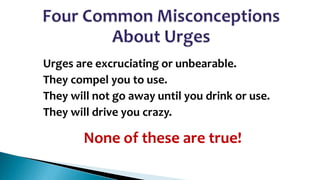
Urges are excruciating or unbearable.
They compel you to use.
They will not go away until you drink or use.
They will drive you crazy.

None of these are true!
•

•

•

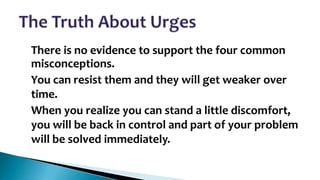
There is no evidence to support the four common
misconceptions.
You can resist them and they will get weaker over
time.
When you realize you can stand a little discomfort,
you will be back in control and part of your problem
will be solved immediately.
•

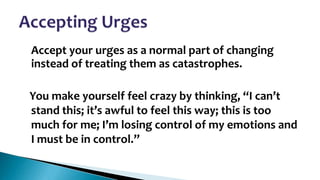
Accept your urges as a normal part of changing
instead of treating them as catastrophes.
You make yourself feel crazy by thinking, “I can’t
stand this; it’s awful to feel this way; this is too
much for me; I’m losing control of my emotions and
I must be in control.”
•
•
•
•
•

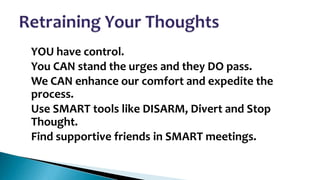
YOU have control.
You CAN stand the urges and they DO pass.
We CAN enhance our comfort and expedite the
process.
Use SMART tools like DISARM, Divert and Stop
Thought.
Find supportive friends in SMART meetings.
•
•

•

•

Use SMART tools like CBA (Cost/Benefit Analysis), ABC
and Brainstorming
Listen to the voices in your head. SMART builds up the
rational voice and disputes the enemy voice that
encourages us to use.
Commit to short-term sobriety so you can think clearly
while working on recovery.
Commit to attend X number of meetings – say two
months - to get to know SMART.
•

•

•

•

Build on concrete things like developing a VACI
(Vital Absorbing Creative Interest).
SMART prefers to quickly focus on progress and
positive goals.
When “recovery” feels good we are much more
likely to continue.
Yes! You can feel good during recovery!
•

•

•
•

We expose the irrational excuses we give ourselves
for using, and thus see our lives in a new way.
We increase our frustration tolerance.
We can learn to manage our emotions.
What do you wish your life would look like? Move
toward those goals.
•
•
•
•
•
•
•

•
•

ABCs to Dispute Irrational Beliefs
CBA (Cost/Benefit Analysis)
Enhanced Frustration Tolerance
Exchange Vocabulary
Journaling
Relaxation
Brainstorming
Planning
…among other proven methods
•
•
•
•

Stopping an addictive behavior is as easy as just
stopping.
More difficult is learning to live comfortably
without the addictive behavior.
SMART is not about managing away emotions.
SMART is about learning to balance and appreciate
the actual significance of emotions.
•

•

Many people find they experience a wider range of
emotions and feel more alive emotionally, yet they
find this need not create problems or be disturbing.
In this way you can build a happy, healthy lifestyle –
based on your personally chosen values and goals.
•
•
•

People and situations cannot “make” you feel a
certain way.
Your reaction to them is what makes you feel that
way.
This is the critical principle of SMART, and the
cornerstone of the ABC process, which we use to
test the rationality of our thoughts and beliefs.

•

YOU control YOU!
•
•
•

•

Come discuss what happened.
Lapses are not a point to start over, but a point to
get back on the horse and keep riding.
We don’t start over at day zero – we’ve learned too
much to say we’re starting from scratch.
For us, change looks more like an upward spiral
than a straight line.
•

•
•
•

Discussion amongst participants is encouraged, and
proven effective.
Or simply sit back and listen.
You make the choices – this is not a pressure group.
SMART tools are illustrated and practiced BEST on
real-life situations.
•
•
•

•

•
•

Watch the ABC Tutorial slide show.
Watch the CBA Tutorial slide show.
Post a message on our message board and
introduce yourself!
Attend an online meeting.
Read about SMART Recovery Tools.
Order books from our Online Bookstore.
Thank you for your interest in

An Introduction to SMART Recovery

  • 1.
  • 2.
    SMART stands forSelf-Management and Recovery Training. SMART is basically a set of tools and skills. The free meetings (online and face-to-face) and discussions are opportunities to learn, practice and refine these skills.
  • 3.
    1. 2. 3. 4. Motivation to Abstain- Enhancing and maintaining motivation to abstain from addictive behavior Coping with Urges - Learning how to cope with urges and cravings Problem Solving - Using rational ways to manage thoughts, feelings and behaviors Lifestyle Balance – Balancing short-term and longterm pleasures and satisfactions in life
  • 4.
    • SMART views reasonand scientific knowledge as the final authority. SMART evolves as scientific knowledge evolves. A religious or spiritual belief is not required. However, many SMART participants hold religious or spiritual beliefs, although we do not focus on these in SMART. At SMART the emphasis is self-empowerment.
  • 5.
    1. 2. 3. 4. Urges are excruciatingor unbearable. They compel you to use. They will not go away until you drink or use. They will drive you crazy. None of these are true!
  • 6.
    • • • There is noevidence to support the four common misconceptions. You can resist them and they will get weaker over time. When you realize you can stand a little discomfort, you will be back in control and part of your problem will be solved immediately.
  • 7.
    • Accept your urgesas a normal part of changing instead of treating them as catastrophes. You make yourself feel crazy by thinking, “I can’t stand this; it’s awful to feel this way; this is too much for me; I’m losing control of my emotions and I must be in control.”
  • 8.
    • • • • • YOU have control. YouCAN stand the urges and they DO pass. We CAN enhance our comfort and expedite the process. Use SMART tools like DISARM, Divert and Stop Thought. Find supportive friends in SMART meetings.
  • 9.
    • • • • Use SMART toolslike CBA (Cost/Benefit Analysis), ABC and Brainstorming Listen to the voices in your head. SMART builds up the rational voice and disputes the enemy voice that encourages us to use. Commit to short-term sobriety so you can think clearly while working on recovery. Commit to attend X number of meetings – say two months - to get to know SMART.
  • 10.
    • • • • Build on concretethings like developing a VACI (Vital Absorbing Creative Interest). SMART prefers to quickly focus on progress and positive goals. When “recovery” feels good we are much more likely to continue. Yes! You can feel good during recovery!
  • 11.
    • • • • We expose theirrational excuses we give ourselves for using, and thus see our lives in a new way. We increase our frustration tolerance. We can learn to manage our emotions. What do you wish your life would look like? Move toward those goals.
  • 12.
    • • • • • • • • • ABCs to DisputeIrrational Beliefs CBA (Cost/Benefit Analysis) Enhanced Frustration Tolerance Exchange Vocabulary Journaling Relaxation Brainstorming Planning …among other proven methods
  • 13.
    • • • • Stopping an addictivebehavior is as easy as just stopping. More difficult is learning to live comfortably without the addictive behavior. SMART is not about managing away emotions. SMART is about learning to balance and appreciate the actual significance of emotions.
  • 14.
    • • Many people findthey experience a wider range of emotions and feel more alive emotionally, yet they find this need not create problems or be disturbing. In this way you can build a happy, healthy lifestyle – based on your personally chosen values and goals.
  • 15.
    • • • People and situationscannot “make” you feel a certain way. Your reaction to them is what makes you feel that way. This is the critical principle of SMART, and the cornerstone of the ABC process, which we use to test the rationality of our thoughts and beliefs. • YOU control YOU!
  • 16.
    • • • • Come discuss whathappened. Lapses are not a point to start over, but a point to get back on the horse and keep riding. We don’t start over at day zero – we’ve learned too much to say we’re starting from scratch. For us, change looks more like an upward spiral than a straight line.
  • 17.
    • • • • Discussion amongst participantsis encouraged, and proven effective. Or simply sit back and listen. You make the choices – this is not a pressure group. SMART tools are illustrated and practiced BEST on real-life situations.
  • 18.
    • • • • • • Watch the ABCTutorial slide show. Watch the CBA Tutorial slide show. Post a message on our message board and introduce yourself! Attend an online meeting. Read about SMART Recovery Tools. Order books from our Online Bookstore.
  • 19.
    Thank you foryour interest in