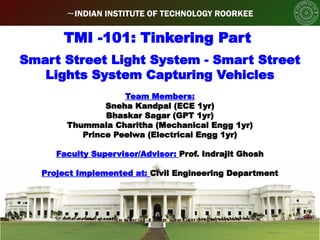
~INDIAN INSTITUTE OF TECHNOLOGY ROORKEE
TMI -101: Tinkering Part
Smart Street Light System - Smart Street
Lights System Capturing Vehicles
Team Members:
Sneha Kandpal (ECE 1yr)
Bhaskar Sagar (GPT 1yr)
Thummala Charitha (Mechanical Engg 1yr)
Prince Peelwa (Electrical Engg 1yr)
Faculty Supervisor/Advisor: Prof. Indrajit Ghosh
Project Implemented at: Civil Engineering Department
~ 2
Understanding of the Problem
Automation plays a very important role in the world economy and in daily life.
Street lighting is one of the important parts. The traditional street lighting that
dims at pre-determined times is relatively simple but with the development of
urbanization, the number of streets has increased rapidly with high traffic
density. This arises the need to design an efficient street lighting system .
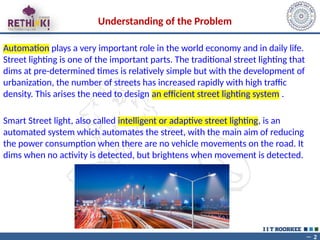
Smart Street light, also called intelligent or adaptive street lighting, is an
automated system which automates the street, with the main aim of reducing
the power consumption when there are no vehicle movements on the road. It
dims when no activity is detected, but brightens when movement is detected.
~ 3
Smart lighting helps cities save energy, lower costs, reduce maintenance—all
while better serving citizens and reducing energy use and CO2 emissions.
Automation and networked control can further increase energy savings and
reduce maintenance spending. Leveraging intelligent control systems can rapidly
increase lighting efficiencies and traffic management
~ 4
Methodology/Approach Adopted for Project
We are approaching towards our project keeping these points in mind-
(1) Improving energy efficiency: Smart street lights can be programmed to
dim or turn off when there's no activity on the road, saving energy.
(2) Enhancing safety: Using sensors to detect vehicles and pedestrians, the
system can provide better lighting when needed, increasing road safety.
(3) Data collection: Capturing data about vehicle movement can be valuable
for traffic management and urban planning.
~ 5
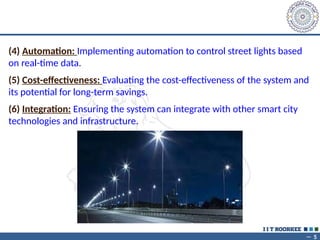
(4) Automation: Implementing automation to control street lights based
on real-time data.
(5) Cost-effectiveness: Evaluating the cost-effectiveness of the system and
its potential for long-term savings.
(6) Integration: Ensuring the system can integrate with other smart city
technologies and infrastructure.
~ 6
Circuit Diagram
~ 7
Equipments Used
LEDs
~ 8
Microcontroller - Small computer on a single
integrated circuit that is designed to control specific
tasks within electronic systems.
Jumper Wire - Connects remote
electric circuits used for printed circuit
boards.
IR Sensor
-A device which detects IR
radiation falling on it.
~ 9
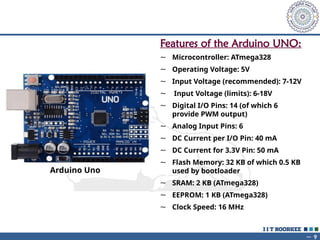
Arduino Uno
Features of the Arduino UNO:
~ Microcontroller: ATmega328
~ Operating Voltage: 5V
~ Input Voltage (recommended): 7-12V
~ Input Voltage (limits): 6-18V
~ Digital I/O Pins: 14 (of which 6
provide PWM output)
~ Analog Input Pins: 6
~ DC Current per I/O Pin: 40 mA
~ DC Current for 3.3V Pin: 50 mA
~ Flash Memory: 32 KB of which 0.5 KB
used by bootloader
~ SRAM: 2 KB (ATmega328)
~ EEPROM: 1 KB (ATmega328)
~ Clock Speed: 16 MHz
~ 10
~ 11
Summary of Current Progress
1. Project Planning and Research:
• Defined project goals and objectives .
• Researched existing smart street light systems and their technologies
• Identified the specific requirements for capturing vehicle information.
2. System Design:
• Designed the architecture of our
smart street light system .
• Determined the hardware
components needed, such as
sensors, cameras, and lights.
• Selected suitable communication
protocols for data transmission
~ 12
THANK YOU

TMIproject Smart Street Light System (Light Capturing)

  • 1.
    ~INDIAN INSTITUTE OFTECHNOLOGY ROORKEE TMI -101: Tinkering Part Smart Street Light System - Smart Street Lights System Capturing Vehicles Team Members: Sneha Kandpal (ECE 1yr) Bhaskar Sagar (GPT 1yr) Thummala Charitha (Mechanical Engg 1yr) Prince Peelwa (Electrical Engg 1yr) Faculty Supervisor/Advisor: Prof. Indrajit Ghosh Project Implemented at: Civil Engineering Department
  • 2.
    ~ 2 Understanding ofthe Problem Automation plays a very important role in the world economy and in daily life. Street lighting is one of the important parts. The traditional street lighting that dims at pre-determined times is relatively simple but with the development of urbanization, the number of streets has increased rapidly with high traffic density. This arises the need to design an efficient street lighting system . Smart Street light, also called intelligent or adaptive street lighting, is an automated system which automates the street, with the main aim of reducing the power consumption when there are no vehicle movements on the road. It dims when no activity is detected, but brightens when movement is detected.
  • 3.
    ~ 3 Smart lightinghelps cities save energy, lower costs, reduce maintenance—all while better serving citizens and reducing energy use and CO2 emissions. Automation and networked control can further increase energy savings and reduce maintenance spending. Leveraging intelligent control systems can rapidly increase lighting efficiencies and traffic management
  • 4.
    ~ 4 Methodology/Approach Adoptedfor Project We are approaching towards our project keeping these points in mind- (1) Improving energy efficiency: Smart street lights can be programmed to dim or turn off when there's no activity on the road, saving energy. (2) Enhancing safety: Using sensors to detect vehicles and pedestrians, the system can provide better lighting when needed, increasing road safety. (3) Data collection: Capturing data about vehicle movement can be valuable for traffic management and urban planning.
  • 5.
    ~ 5 (4) Automation:Implementing automation to control street lights based on real-time data. (5) Cost-effectiveness: Evaluating the cost-effectiveness of the system and its potential for long-term savings. (6) Integration: Ensuring the system can integrate with other smart city technologies and infrastructure.
  • 6.
  • 7.
  • 8.
    ~ 8 Microcontroller -Small computer on a single integrated circuit that is designed to control specific tasks within electronic systems. Jumper Wire - Connects remote electric circuits used for printed circuit boards. IR Sensor -A device which detects IR radiation falling on it.
  • 9.
    ~ 9 Arduino Uno Featuresof the Arduino UNO: ~ Microcontroller: ATmega328 ~ Operating Voltage: 5V ~ Input Voltage (recommended): 7-12V ~ Input Voltage (limits): 6-18V ~ Digital I/O Pins: 14 (of which 6 provide PWM output) ~ Analog Input Pins: 6 ~ DC Current per I/O Pin: 40 mA ~ DC Current for 3.3V Pin: 50 mA ~ Flash Memory: 32 KB of which 0.5 KB used by bootloader ~ SRAM: 2 KB (ATmega328) ~ EEPROM: 1 KB (ATmega328) ~ Clock Speed: 16 MHz
  • 10.
  • 11.
    ~ 11 Summary ofCurrent Progress 1. Project Planning and Research: • Defined project goals and objectives . • Researched existing smart street light systems and their technologies • Identified the specific requirements for capturing vehicle information. 2. System Design: • Designed the architecture of our smart street light system . • Determined the hardware components needed, such as sensors, cameras, and lights. • Selected suitable communication protocols for data transmission
  • 12.