FINAL YEAR PROJECT
SMART CITY:MANAGING APP
T h e I s l a m i a U n i v e r s i t y o f B a h a w a l p u r
2
2
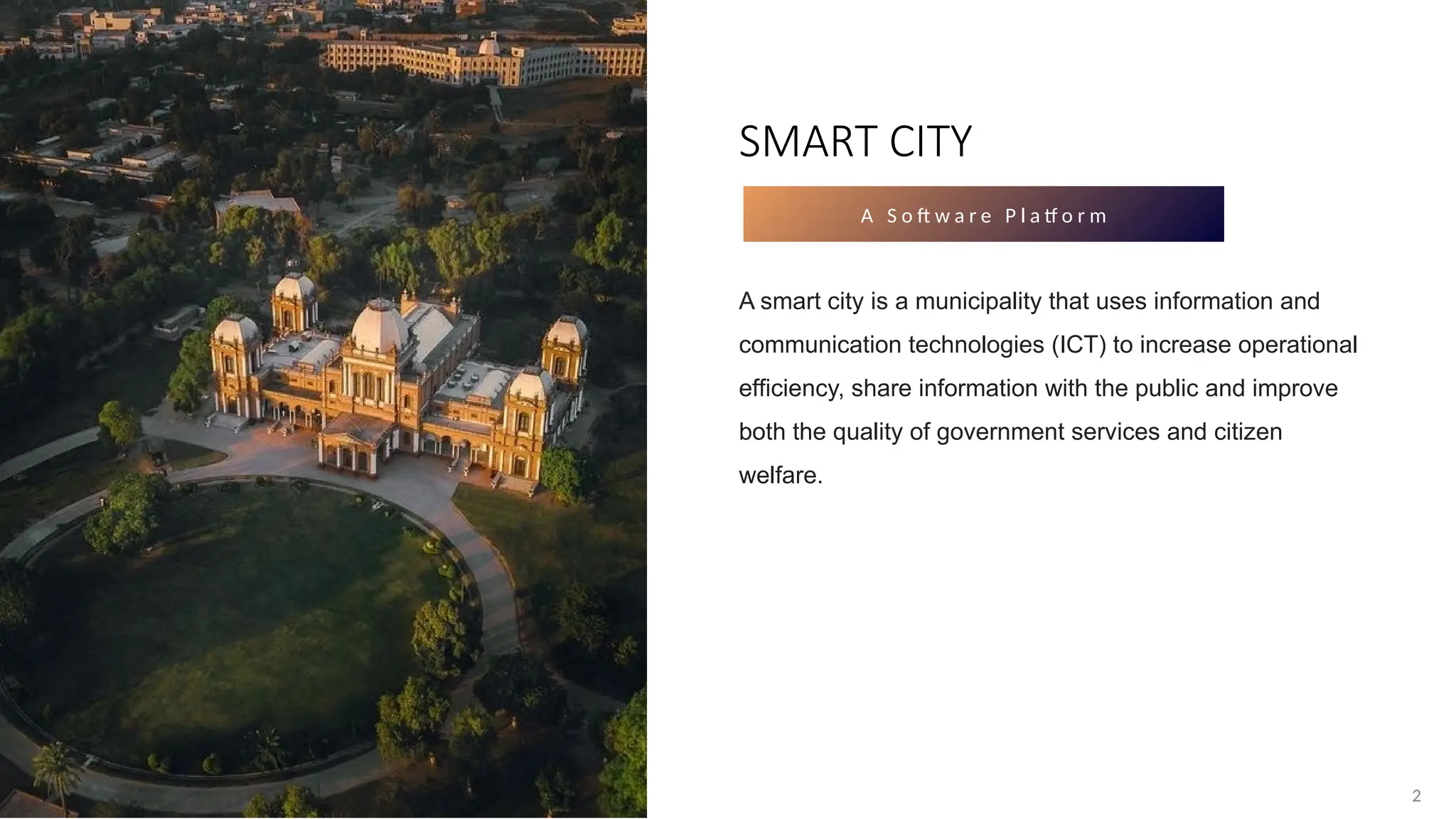
SMART CITY
A smart city is a municipality that uses information and
communication technologies (ICT) to increase operational
efficiency, share information with the public and improve
both the quality of government services and citizen
welfare.
A S o ft w a r e P l a tf o r m
3
PROBLEM STATEMENT
In the current era, Cities have to deal with big social, ecological, and
technological challenges such as digitalization, pollution, traffic
congestion etc.
The main goal of a smart city is
• to optimize city functions
• promote economic growth
• improving the quality of life for citizens
by using smart technologies and data analysis.
Smart city applications help provide solutions such as smart lighting,
smart parking, smart waste management, Air Pollution
Monitoring ,Security(Fire Alarm). These technologies and integrations
are based on sensor-centered collection and analysis of data. They offer
cost-effective and innovative solutions to the growing number of
challenges faced by municipalities.
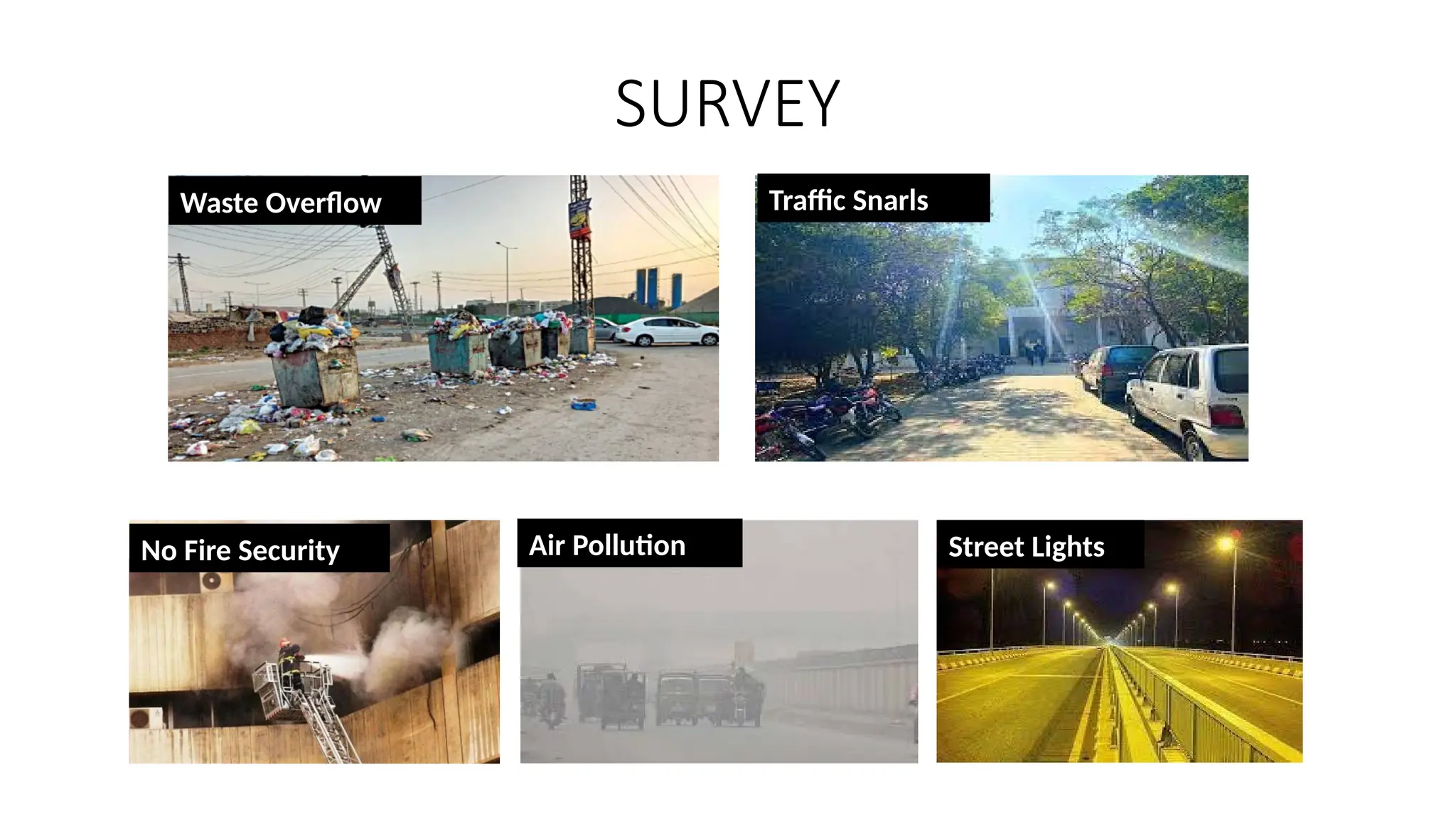
SURVEY
Waste Overflow Traffic Snarls
No Fire Security Air Pollution Street Lights
5
SMART CITY: MANAGING APP
“A N IN T EG R AT E D M IDD L E WA R E E N VI RON M E N T T HAT S UP P ORTS S OF T WA R E
DE VE LOP E RS I N DES I GN IN G , IMP L E ME N T IN G , DE P LOYIN G , A N D MA N AG I N G
A P P L ICAT I ON S FOR S MA RT CIT I ES .”
OBJECTIVE:
IT IN VOLVES I N CR EAT IV E LY COM BIN IN G T HE L ARG E A MOUN TS OF DATA
G E N E R AT E D BY M ULT IP L E CIT Y S OURCES ( S UCH A S S E N S OR N E T WOR KS , T R A FF IC
SYST E M S , US E R DE V ICES , A N D S OCIA L N E T WOR KS ) TO CR EAT E IN T EG R AT E D
S E RV ICES A N D A PP L ICAT ION S , IMP ROVI N G CI T Y S E RV ICES , A N D M AKI N G BE T T E R
US E OF CI T Y R ES OURCES .
6
6
• 1994 – Amsterdam created a virtual ‘digital city’ – De Digital Stad
(DDS) – to promote Internet usage.
• The earliest smart grid project in Teleogestore,Italy in 2005
which offered a saving of 500 million Euros per year.
• 2008 – IBM Smarter Planet project investigated applying sensors,
networks and analytics to urban issues.
• Various smart cities were being developed in the last 20 years
like Los Angeles, Vienna, Rome etc.
HISTORY
7
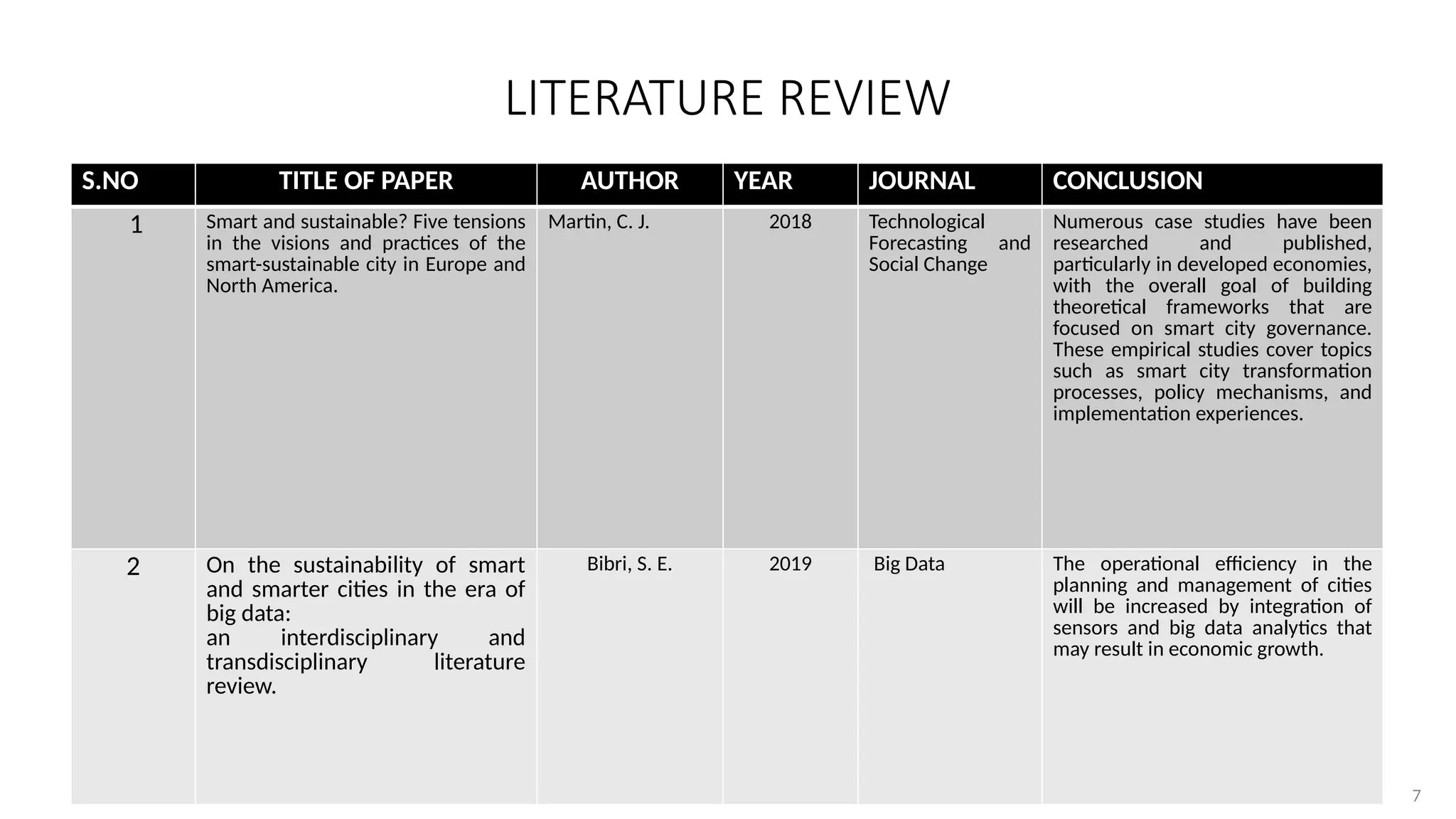
LITERATURE REVIEW
S.NO TITLE OF PAPER AUTHOR YEAR JOURNAL CONCLUSION
1 Smart and sustainable? Five tensions
in the visions and practices of the
smart-sustainable city in Europe and
North America.
Martin, C. J. 2018 Technological
Forecasting and
Social Change
Numerous case studies have been
researched and published,
particularly in developed economies,
with the overall goal of building
theoretical frameworks that are
focused on smart city governance.
These empirical studies cover topics
such as smart city transformation
processes, policy mechanisms, and
implementation experiences.
2 On the sustainability of smart
and smarter cities in the era of
big data:
an interdisciplinary and
transdisciplinary literature
review.
Bibri, S. E. 2019 Big Data The operational efficiency in the
planning and management of cities
will be increased by integration of
sensors and big data analytics that
may result in economic growth.
8
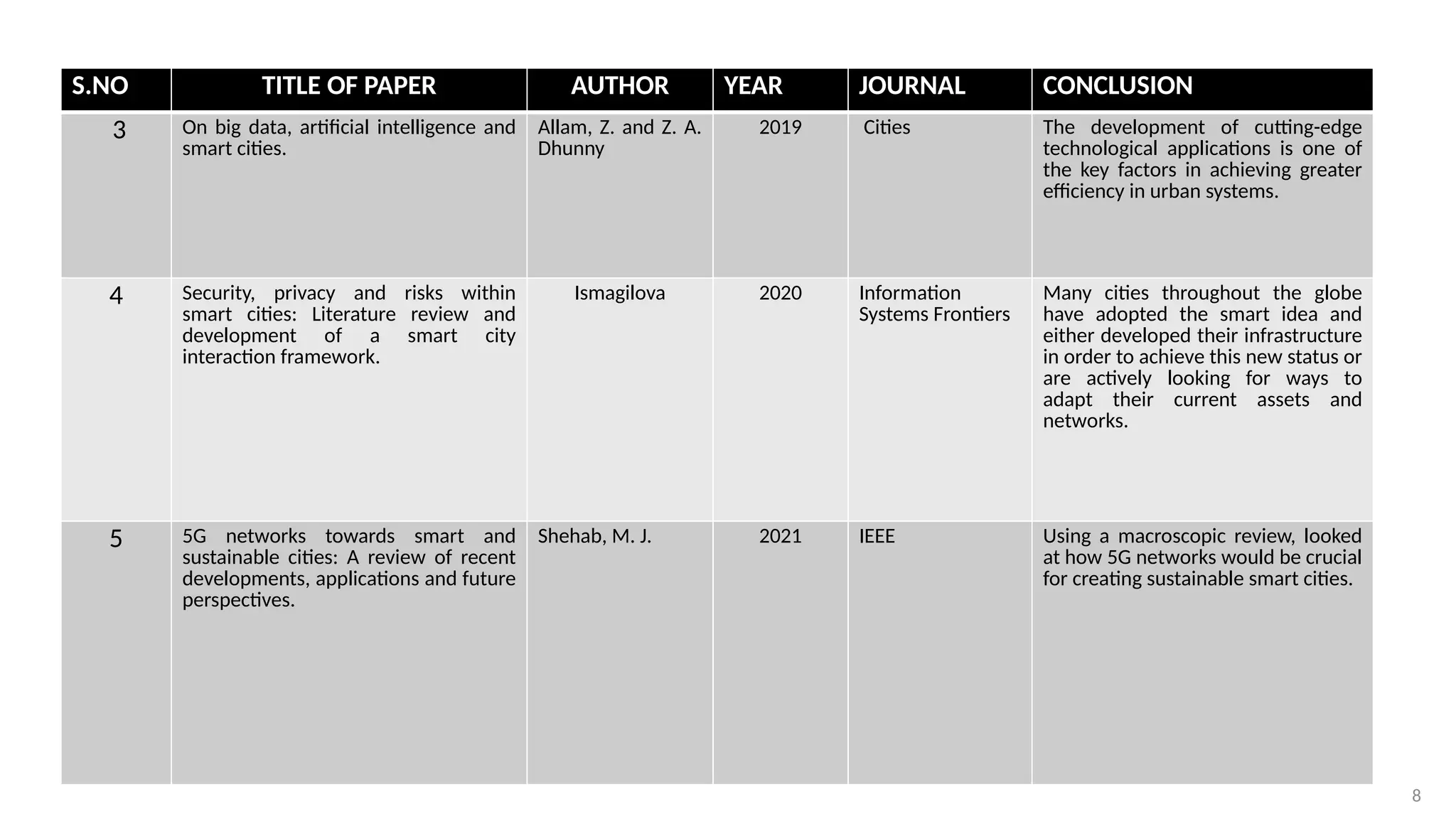
S.NO TITLE OF PAPER AUTHOR YEAR JOURNAL CONCLUSION
3 On big data, artificial intelligence and
smart cities.
Allam, Z. and Z. A.
Dhunny
2019 Cities The development of cutting-edge
technological applications is one of
the key factors in achieving greater
efficiency in urban systems.
4 Security, privacy and risks within
smart cities: Literature review and
development of a smart city
interaction framework.
Ismagilova 2020 Information
Systems Frontiers
Many cities throughout the globe
have adopted the smart idea and
either developed their infrastructure
in order to achieve this new status or
are actively looking for ways to
adapt their current assets and
networks.
5 5G networks towards smart and
sustainable cities: A review of recent
developments, applications and future
perspectives.
Shehab, M. J. 2021 IEEE Using a macroscopic review, looked
at how 5G networks would be crucial
for creating sustainable smart cities.
9
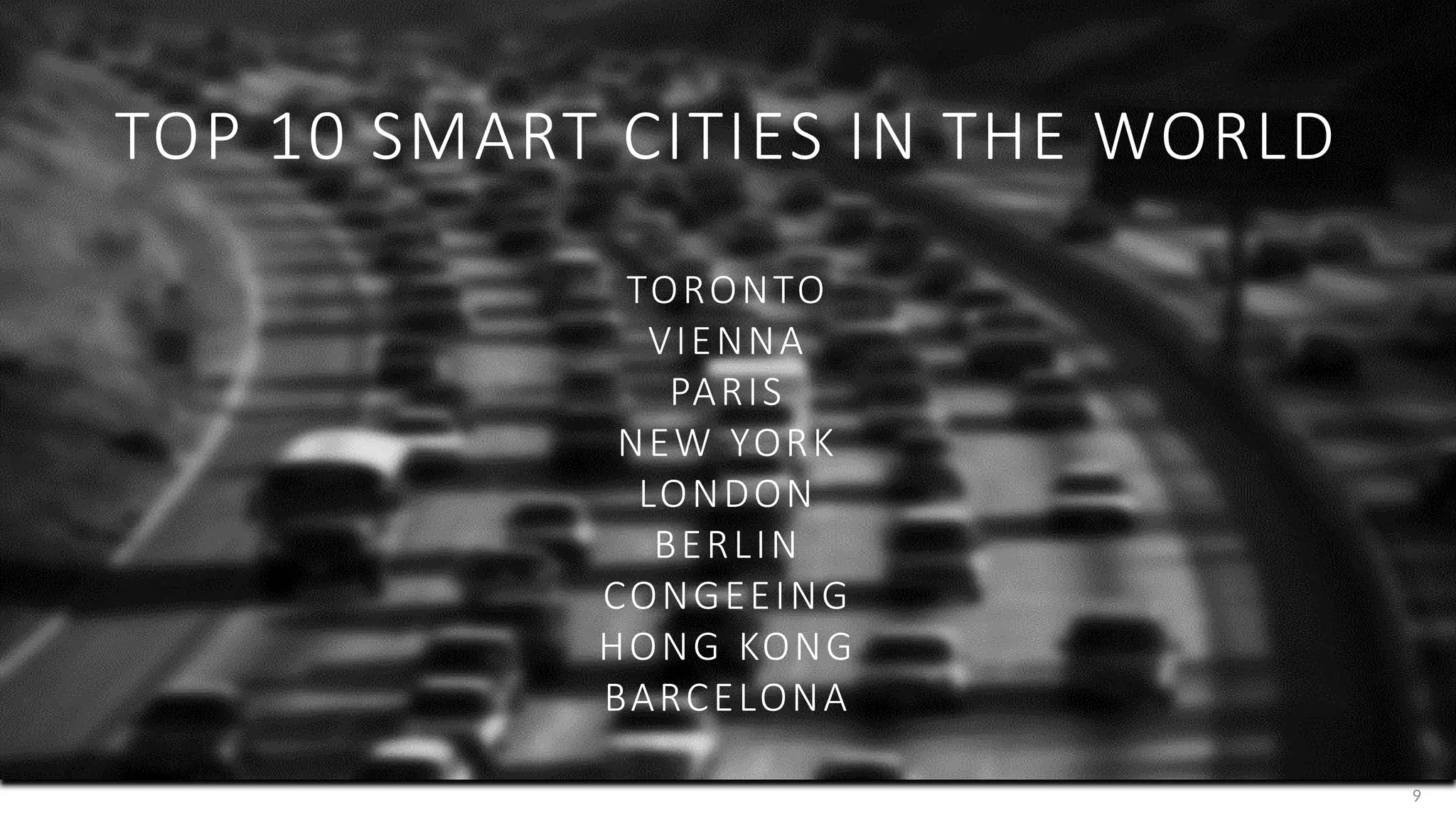
TOP 10 SMART CITIES IN THE WORLD
TORONTO
VIENNA
PARIS
NEW YORK
LONDON
BERLIN
CONGEEING
HONG KONG
BARCELONA
10
10
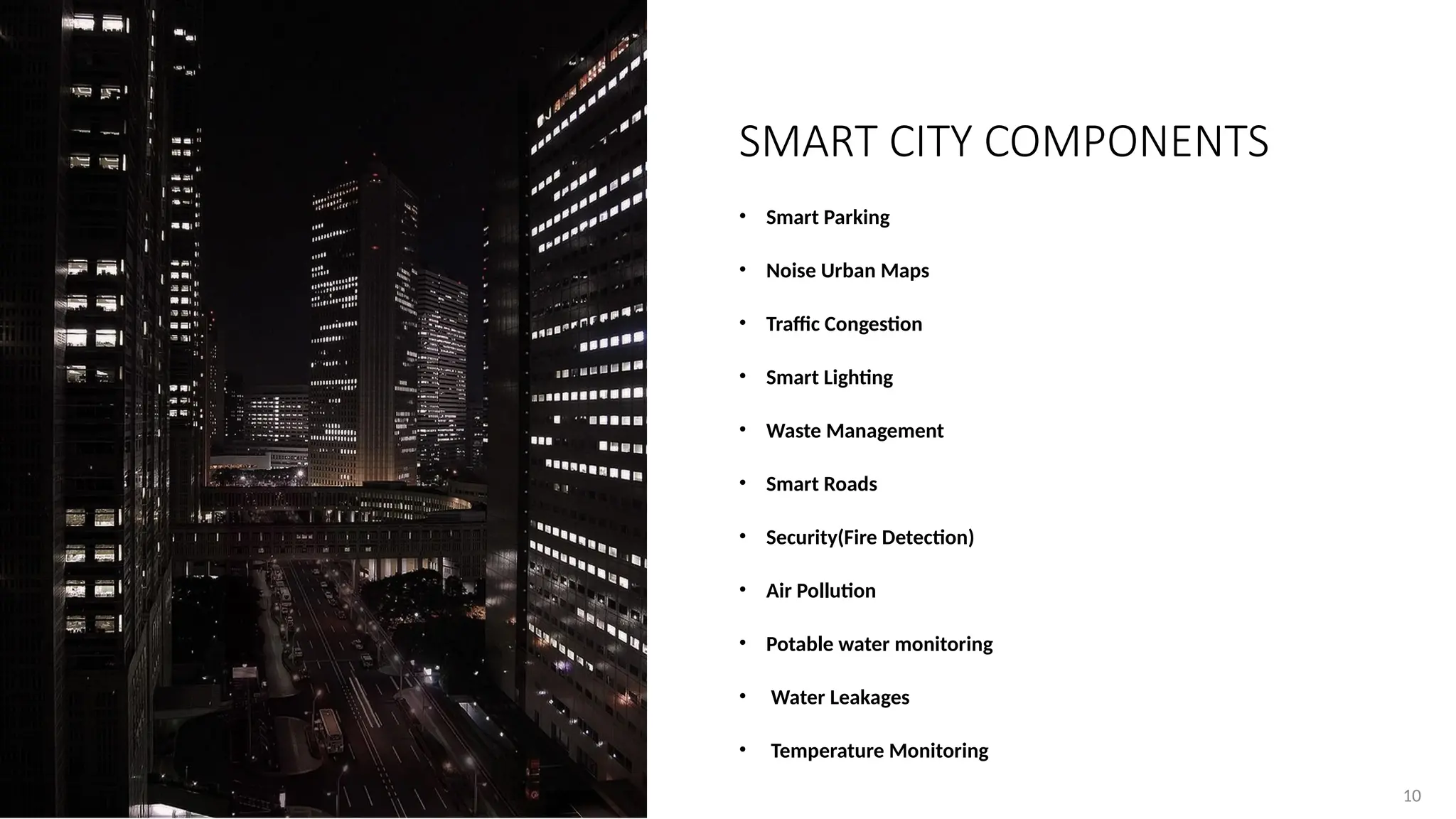
• Smart Parking
• Noise Urban Maps
• Traffic Congestion
• Smart Lighting
• Waste Management
• Smart Roads
• Security(Fire Detection)
• Air Pollution
• Potable water monitoring
• Water Leakages
• Temperature Monitoring
SMART CITY COMPONENTS
11
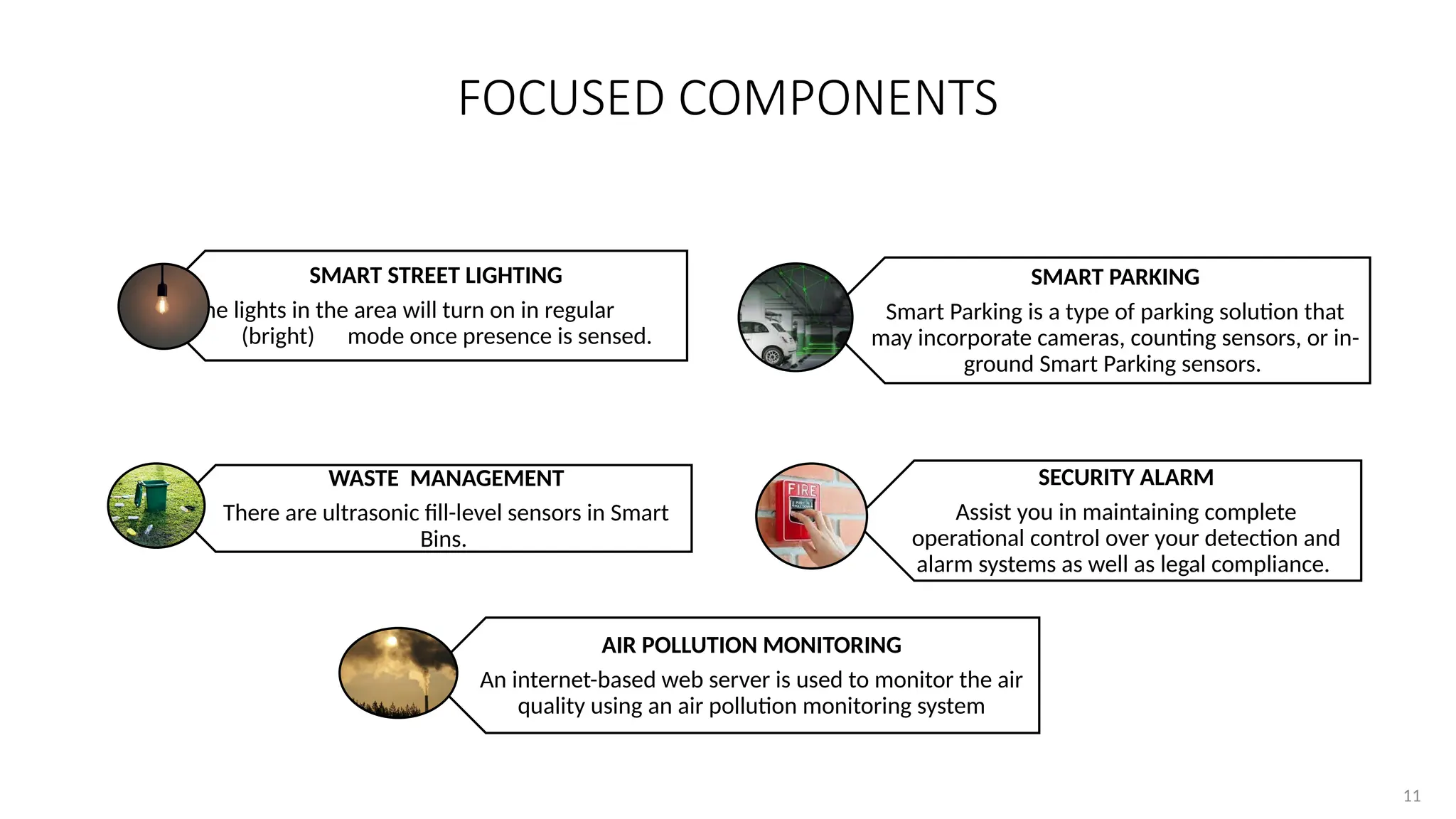
FOCUSED COMPONENTS
SMART STREET LIGHTING
The lights in the area will turn on in regular
(bright) mode once presence is sensed.
WASTE MANAGEMENT
There are ultrasonic fill-level sensors in Smart
Bins.
SMART PARKING
Smart Parking is a type of parking solution that
may incorporate cameras, counting sensors, or in-
ground Smart Parking sensors.
SECURITY ALARM
Assist you in maintaining complete
operational control over your detection and
alarm systems as well as legal compliance.
AIR POLLUTION MONITORING
An internet-based web server is used to monitor the air
quality using an air pollution monitoring system
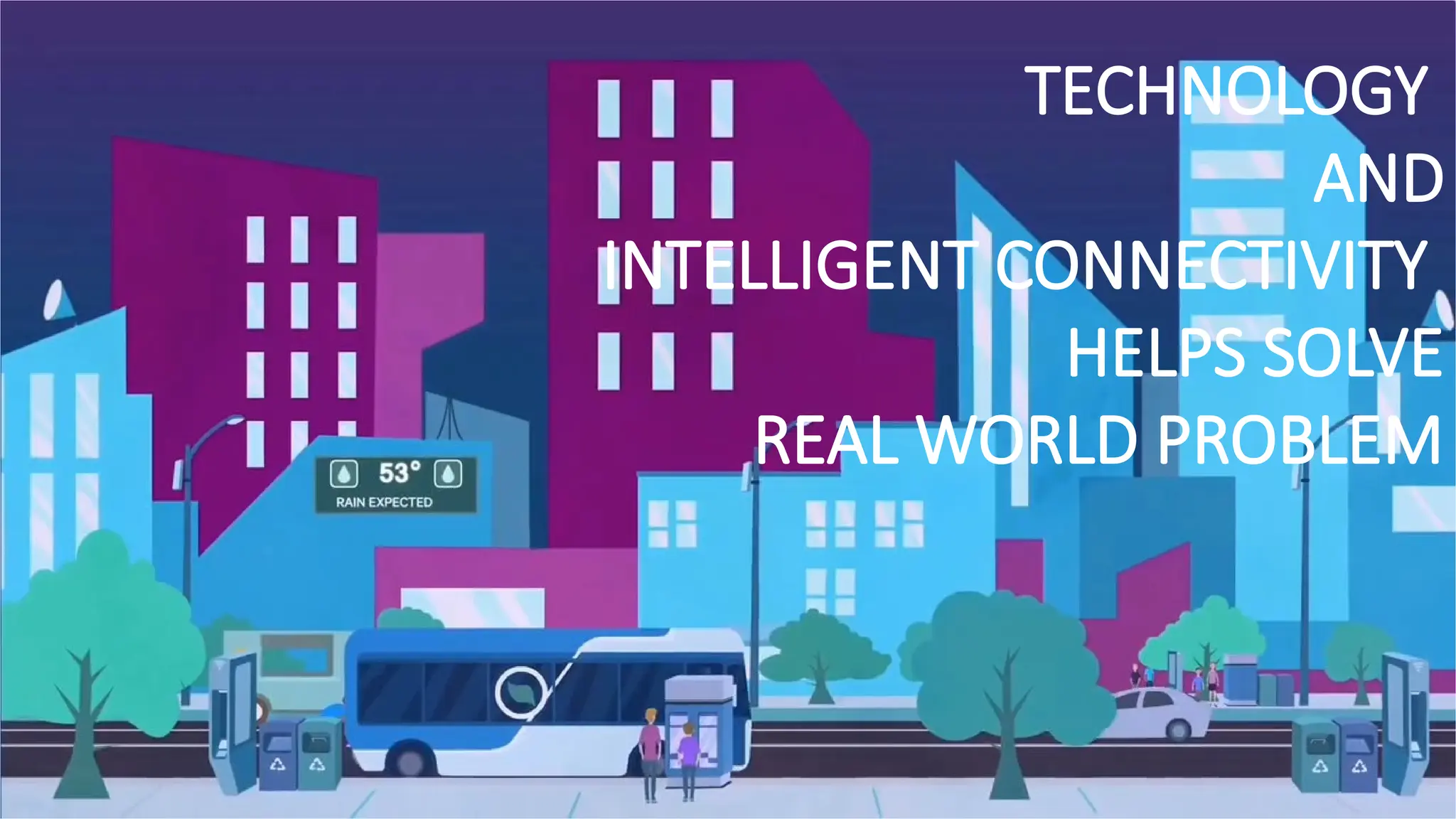
TECHNOLOGY
AND
INTELLIGENT CONNECTIVITY
HELPS SOLVE
REAL WORLD PROBLEM
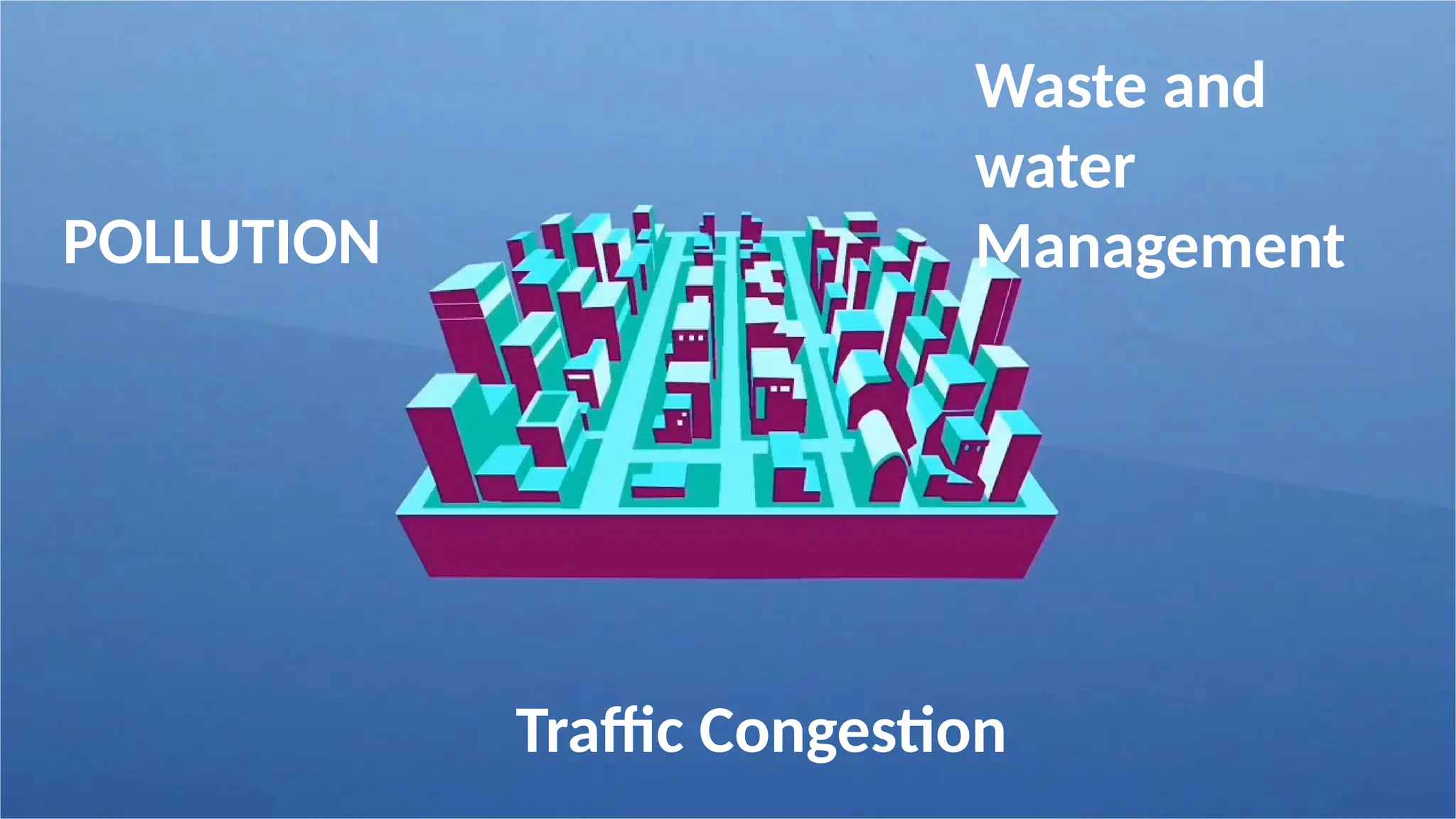
POLLUTION
Waste and
water
Management
Traffic Congestion
LIGHT SYSTEM
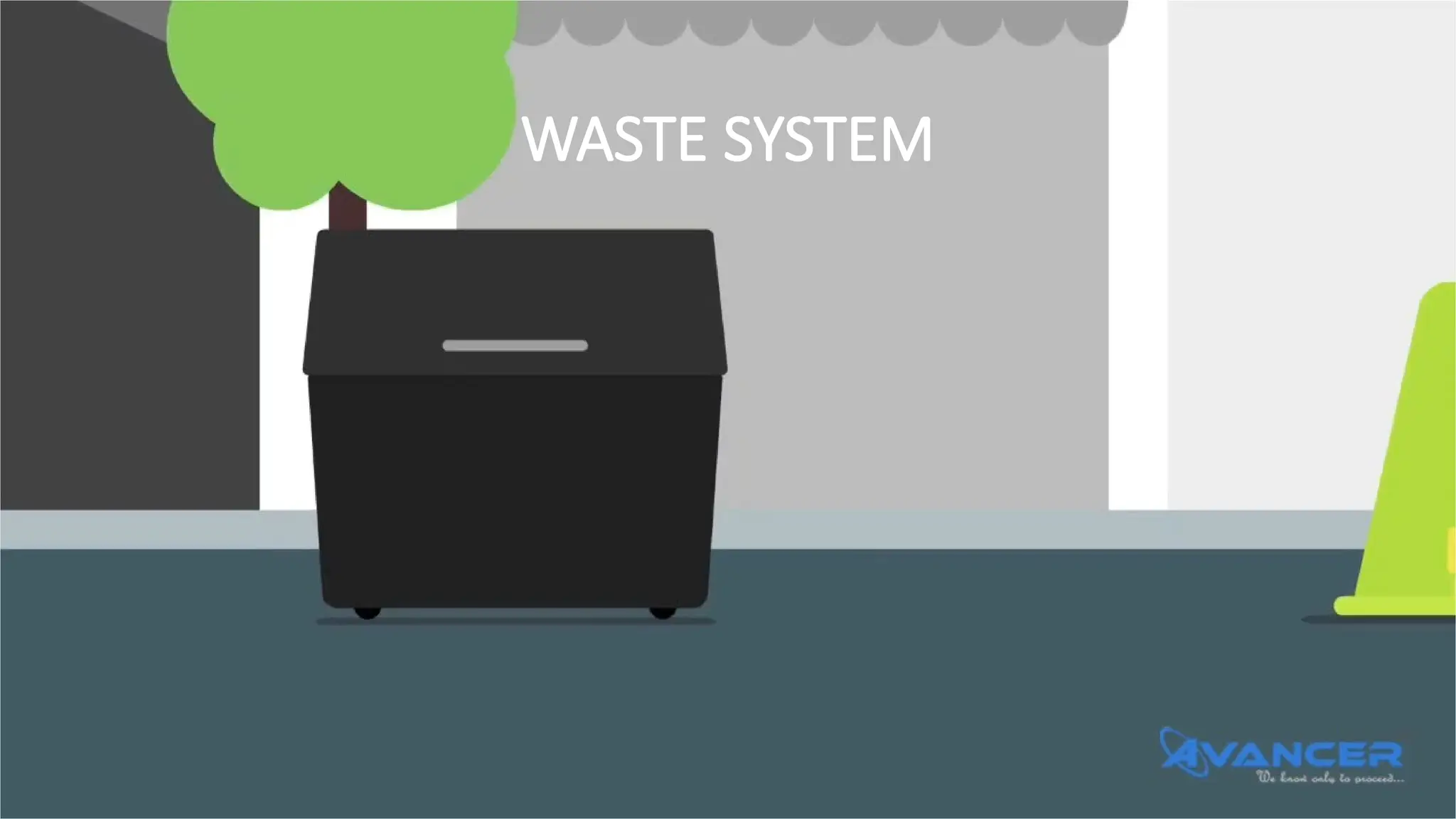
WASTE SYSTEM
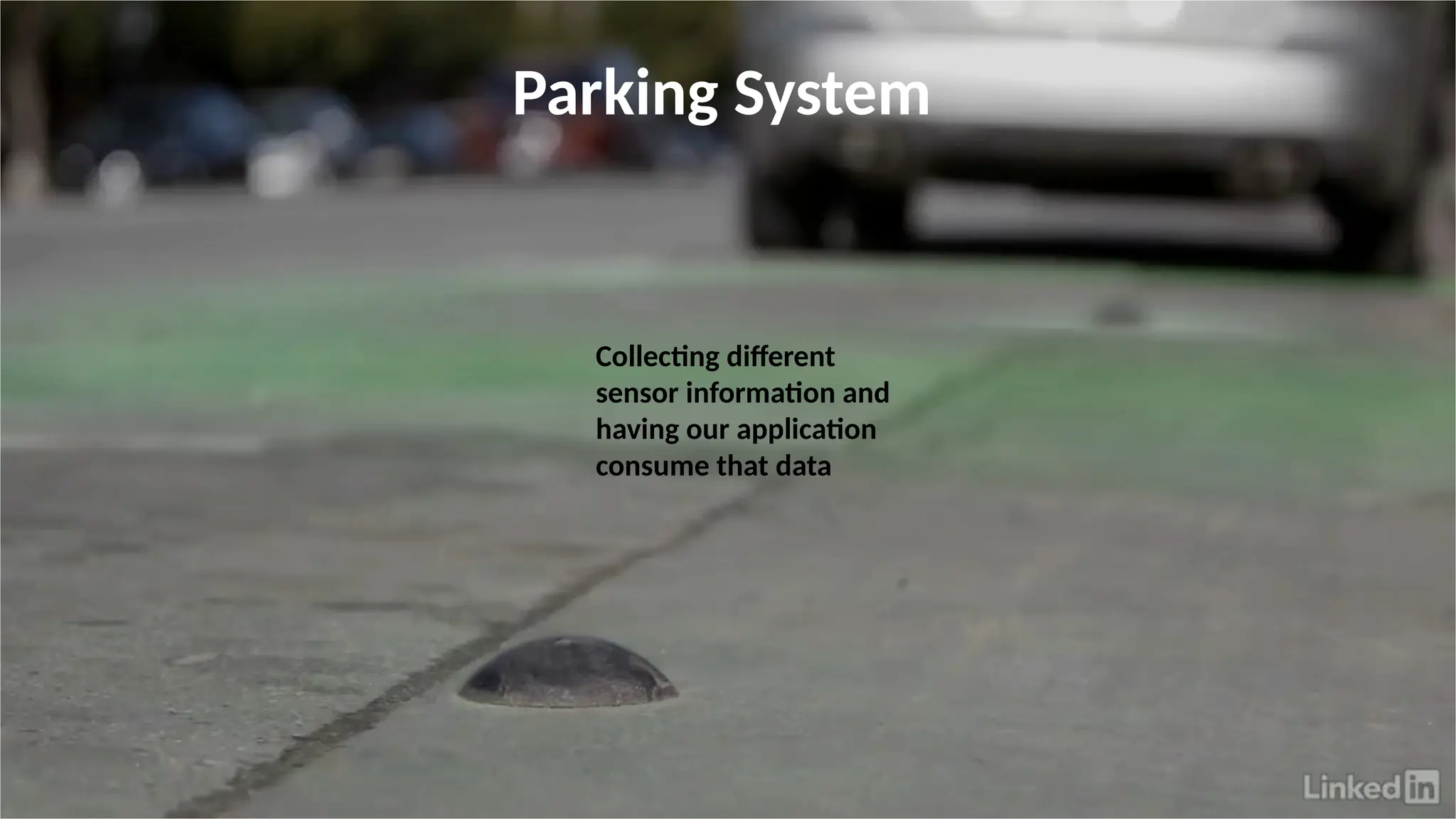
Parking System
Collecting different
sensor information and
having our application
consume that data
17
17
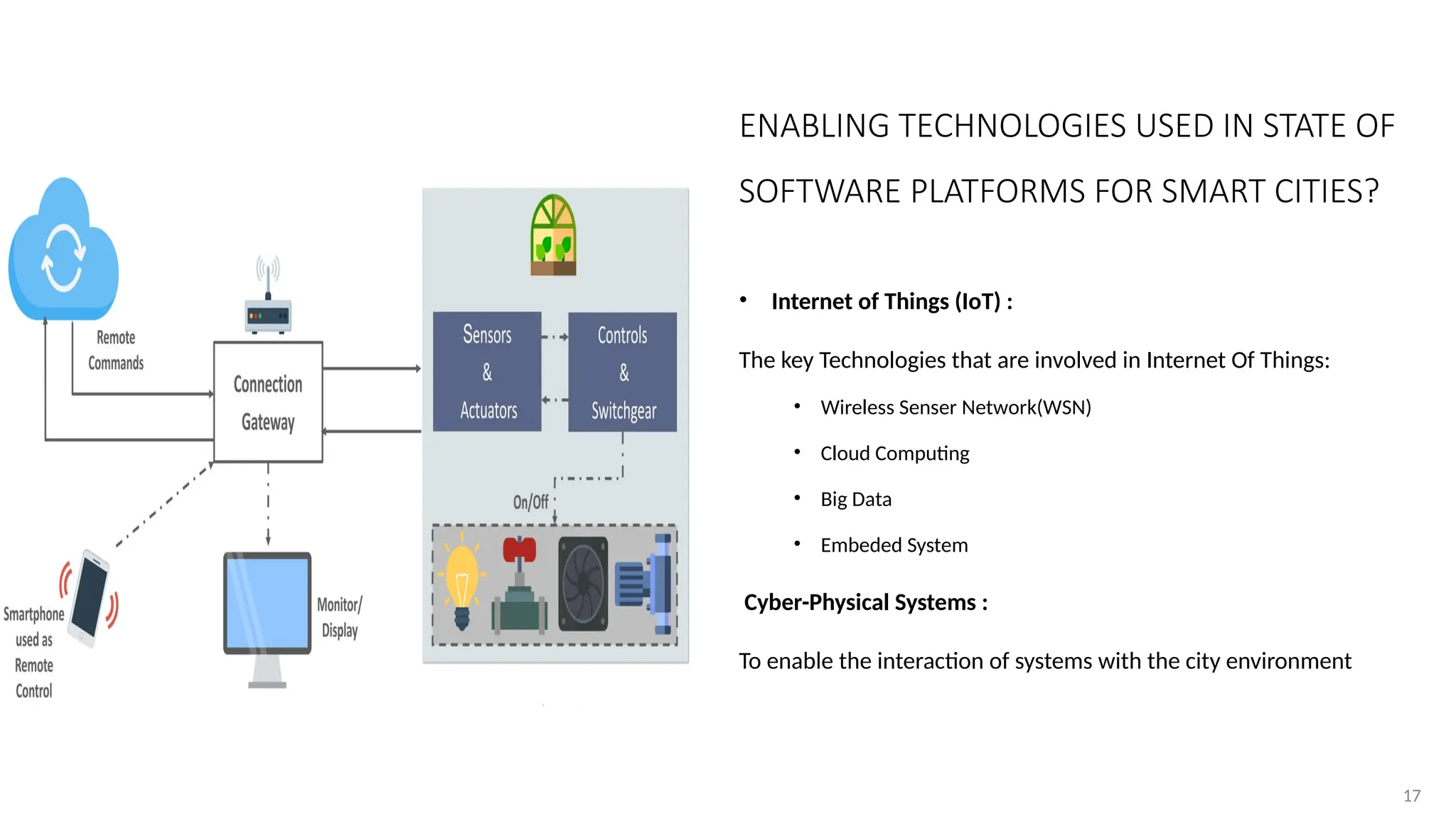
ENABLING TECHNOLOGIES USED IN STATE OF
SOFTWARE PLATFORMS FOR SMART CITIES?
• Internet of Things (IoT) :
The key Technologies that are involved in Internet Of Things:
• Wireless Senser Network(WSN)
• Cloud Computing
• Big Data
• Embeded System
Cyber-Physical Systems :
To enable the interaction of systems with the city environment
18
18
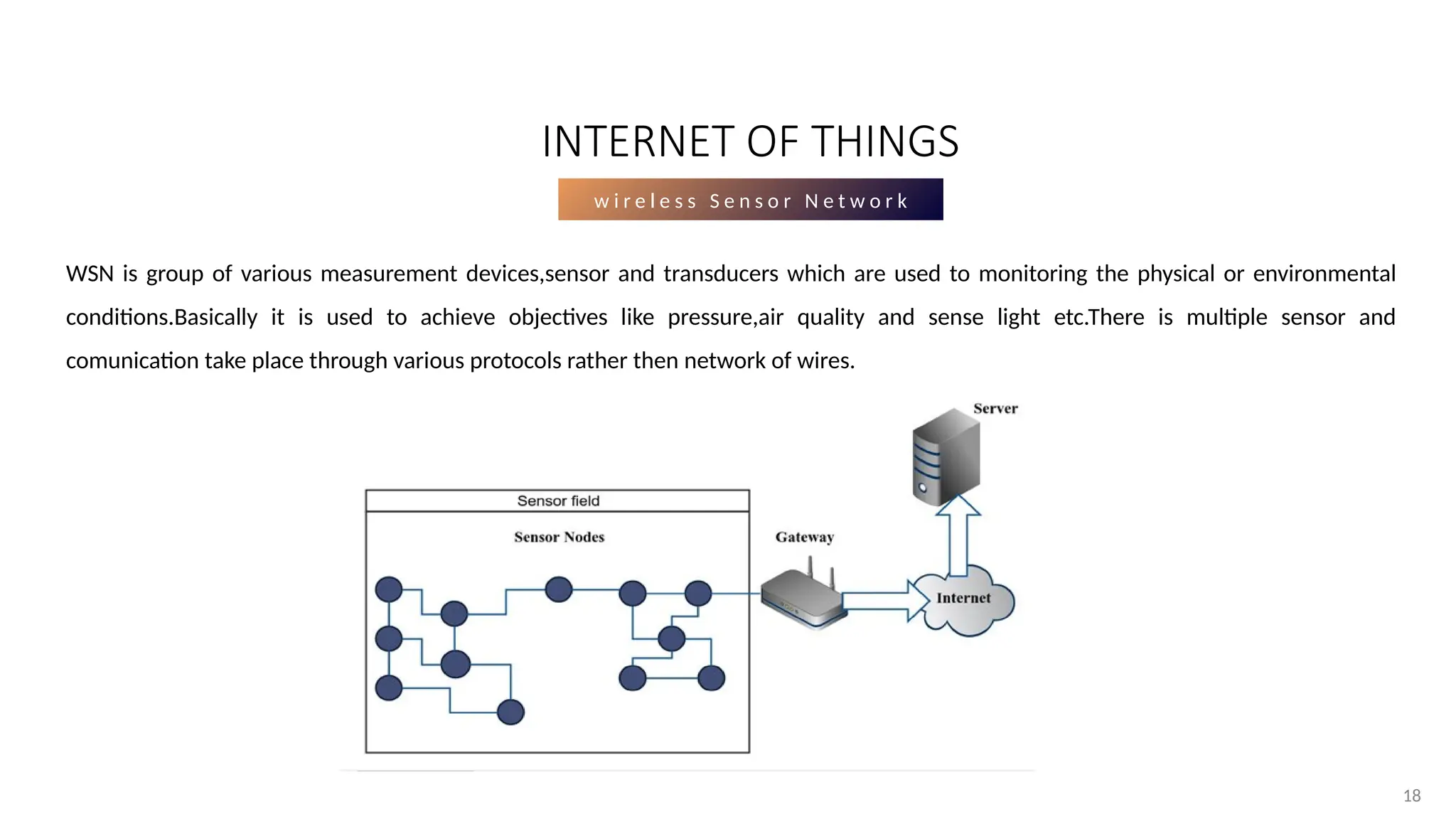
w i r e l e s s S e n s o r N e t w o r k
WSN is group of various measurement devices,sensor and transducers which are used to monitoring the physical or environmental
conditions.Basically it is used to achieve objectives like pressure,air quality and sense light etc.There is multiple sensor and
comunication take place through various protocols rather then network of wires.
INTERNET OF THINGS
19
19
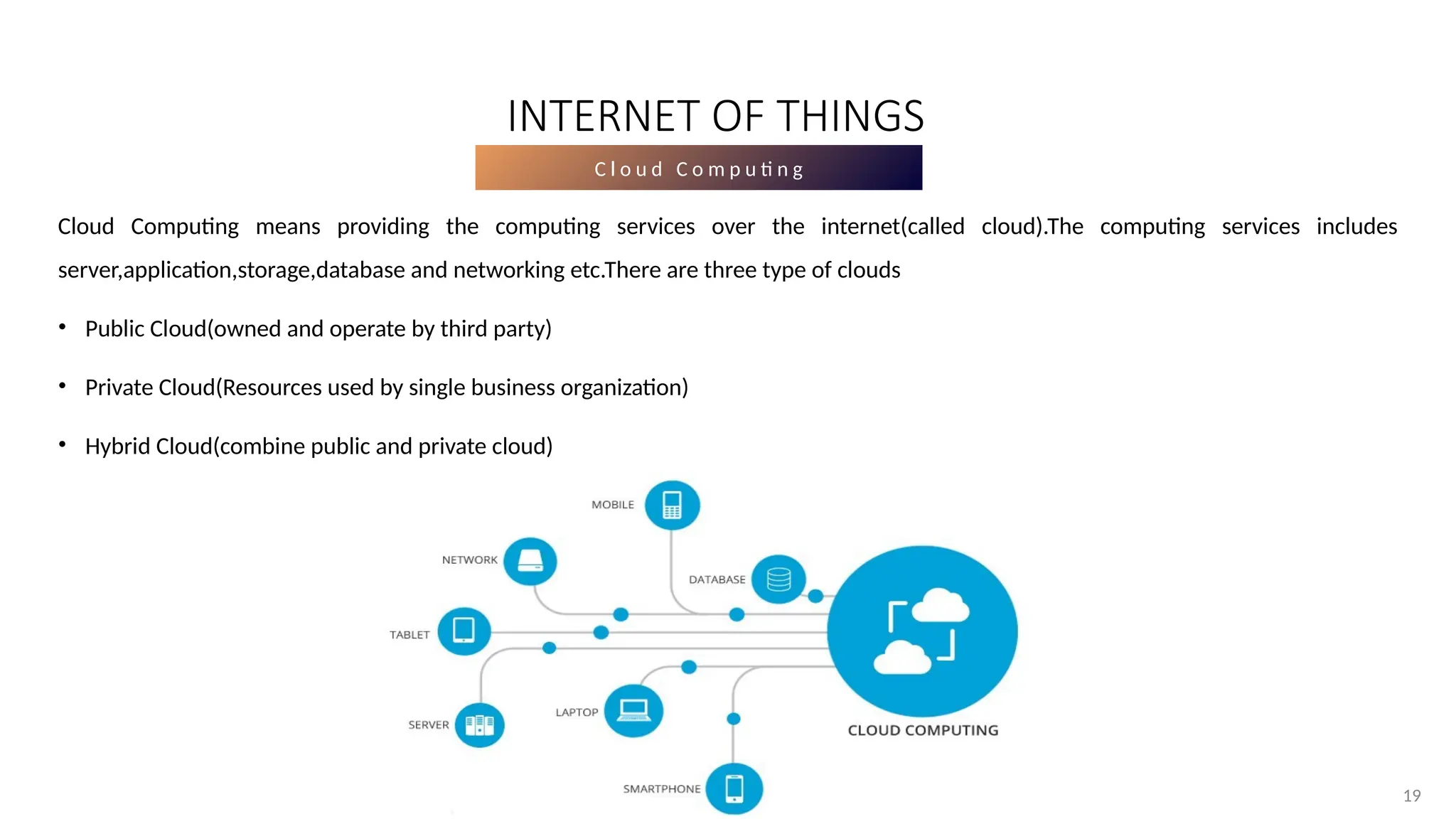
C l o u d C o m p u ti n g
Cloud Computing means providing the computing services over the internet(called cloud).The computing services includes
server,application,storage,database and networking etc.There are three type of clouds
• Public Cloud(owned and operate by third party)
• Private Cloud(Resources used by single business organization)
• Hybrid Cloud(combine public and private cloud)
INTERNET OF THINGS
20
20
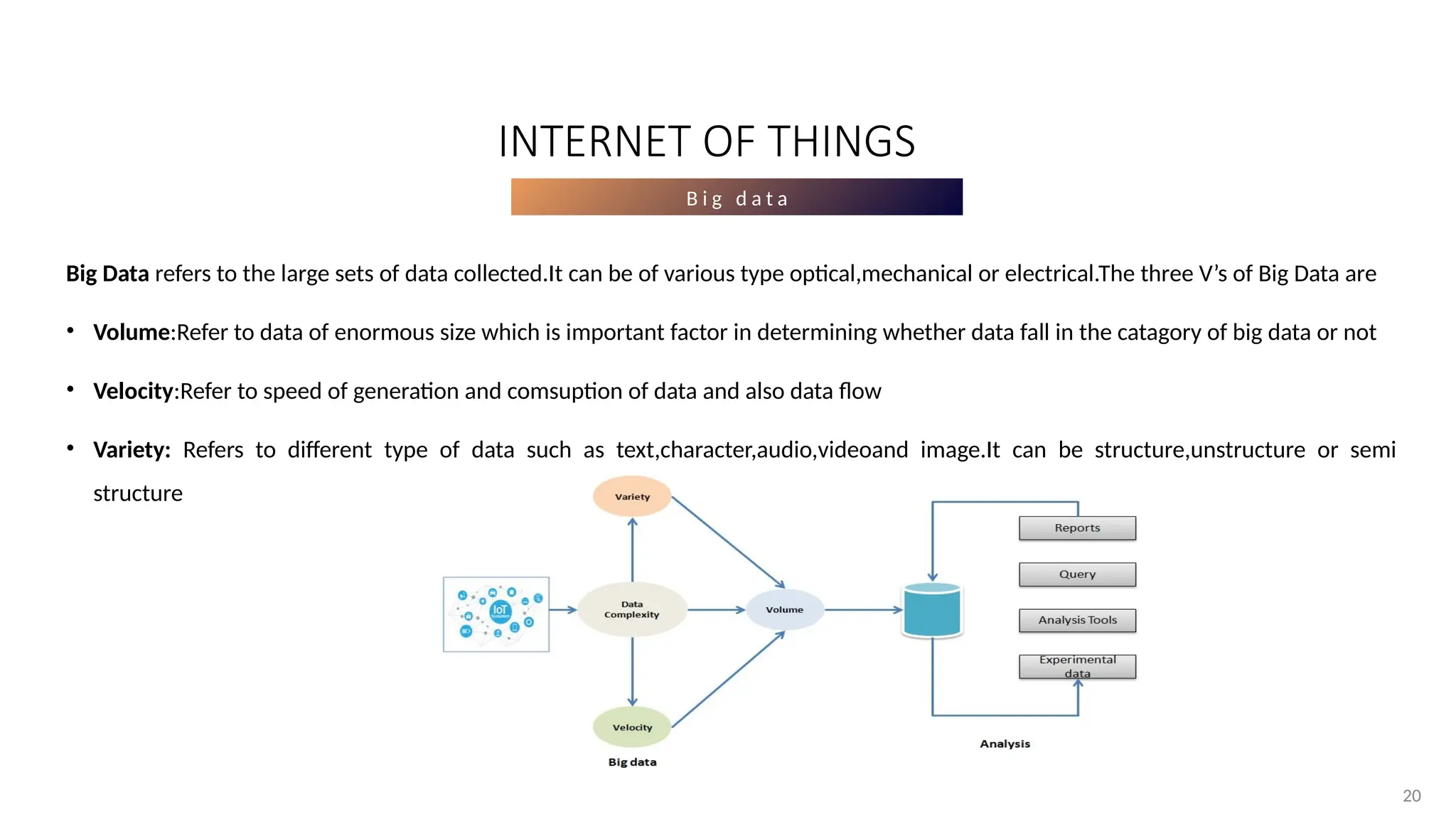
B i g d a t a
Big Data refers to the large sets of data collected.It can be of various type optical,mechanical or electrical.The three V’s of Big Data are
• Volume:Refer to data of enormous size which is important factor in determining whether data fall in the catagory of big data or not
• Velocity:Refer to speed of generation and comsuption of data and also data flow
• Variety: Refers to different type of data such as text,character,audio,videoand image.It can be structure,unstructure or semi
structure
INTERNET OF THINGS
21
21
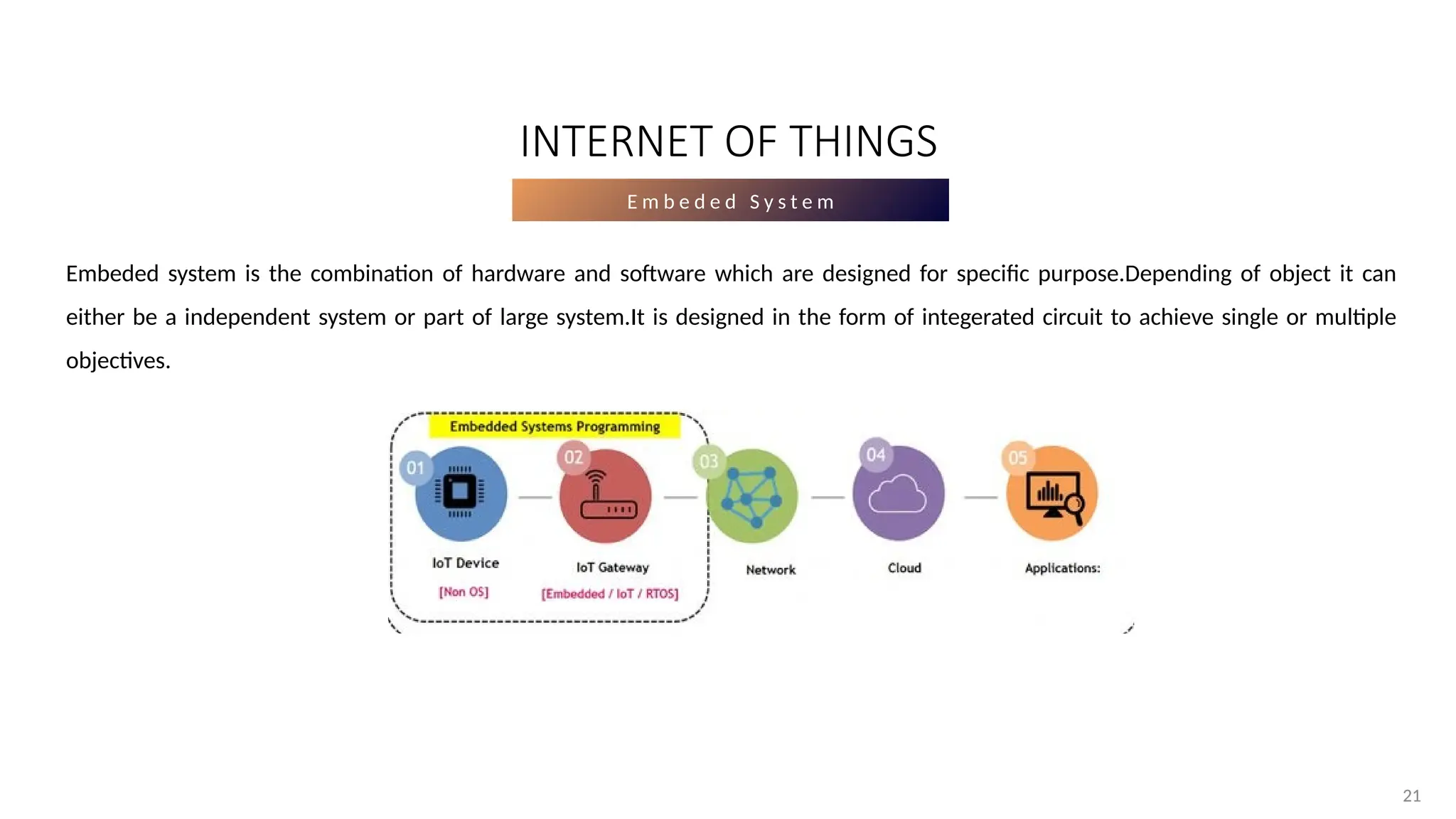
E m b e d e d S y s t e m
Embeded system is the combination of hardware and software which are designed for specific purpose.Depending of object it can
either be a independent system or part of large system.It is designed in the form of integerated circuit to achieve single or multiple
objectives.
INTERNET OF THINGS
22
22
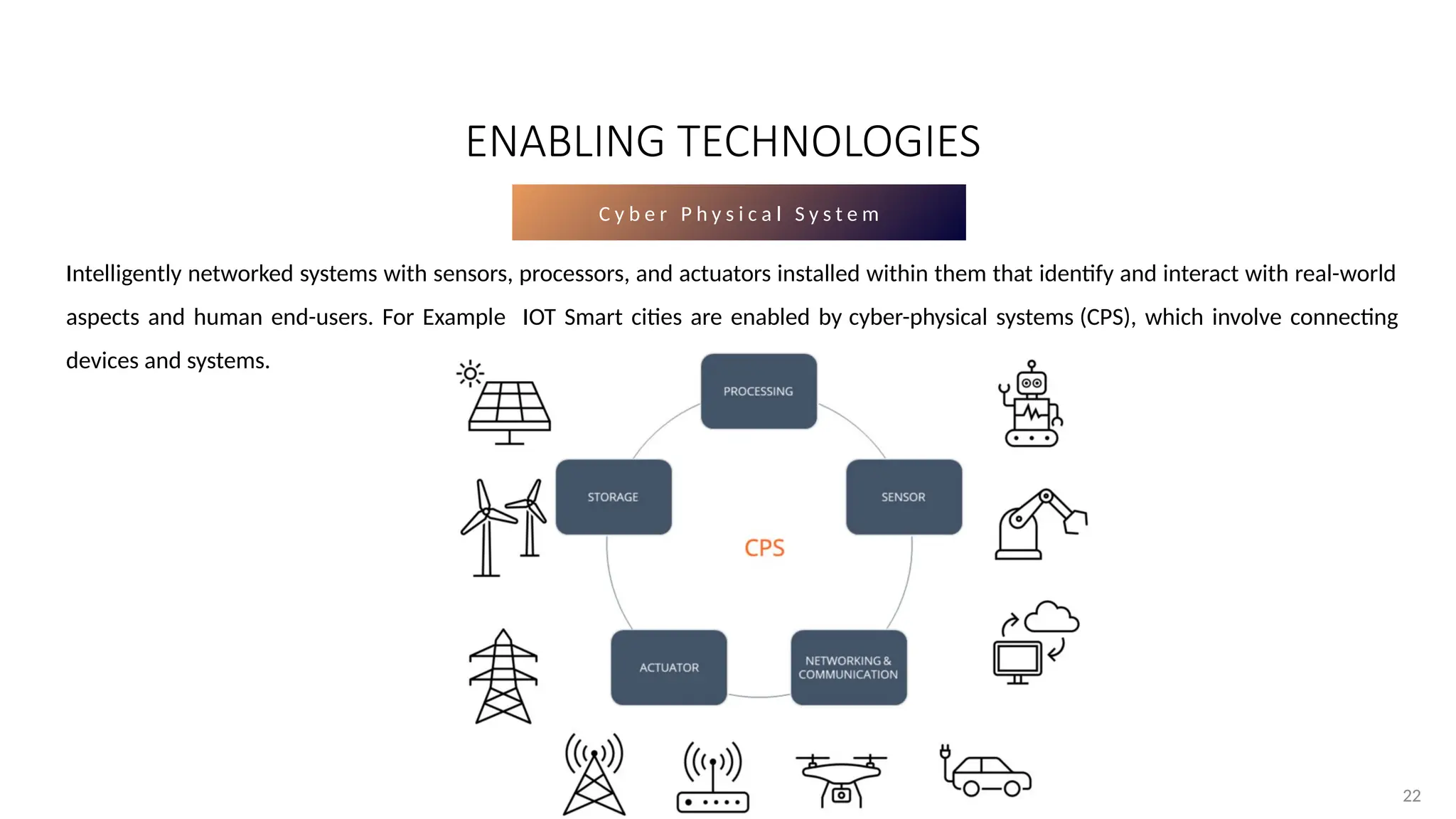
C y b e r P h y s i c a l S y s t e m
Intelligently networked systems with sensors, processors, and actuators installed within them that identify and interact with real-world
aspects and human end-users. For Example IOT Smart cities are enabled by cyber-physical systems (CPS), which involve connecting
devices and systems.
ENABLING TECHNOLOGIES
23
S o ft w a r e To o l s
For the development of android application we use Android Studio.
Android Studio is the official integrated development environment for
Google's Android operating system. It is available for download on
Windows, MACOS and Linux based operating systems. It has following
main module:
• manifests: Contains the AndroidManifest.xml file.
• java: Contains the Java and Kotlin source code files.
• res: Contains all non-code resources such as XML layouts, UI strings, and
bitmap images.
IMPLEMENTATION
24
• Navigation(File Structure)
• Style and formatting
• Version control basics(Enable Version Control Integration)
• Multiple APK support(create separate APKs of an app)
• Resource shrinking (Google Play Service)
• Debug and profile tools(Inline debug)
• Data file access
• Code inspections(automatically runs configured lint checks
and other IDE inspections)
TOOL WINDOW
25
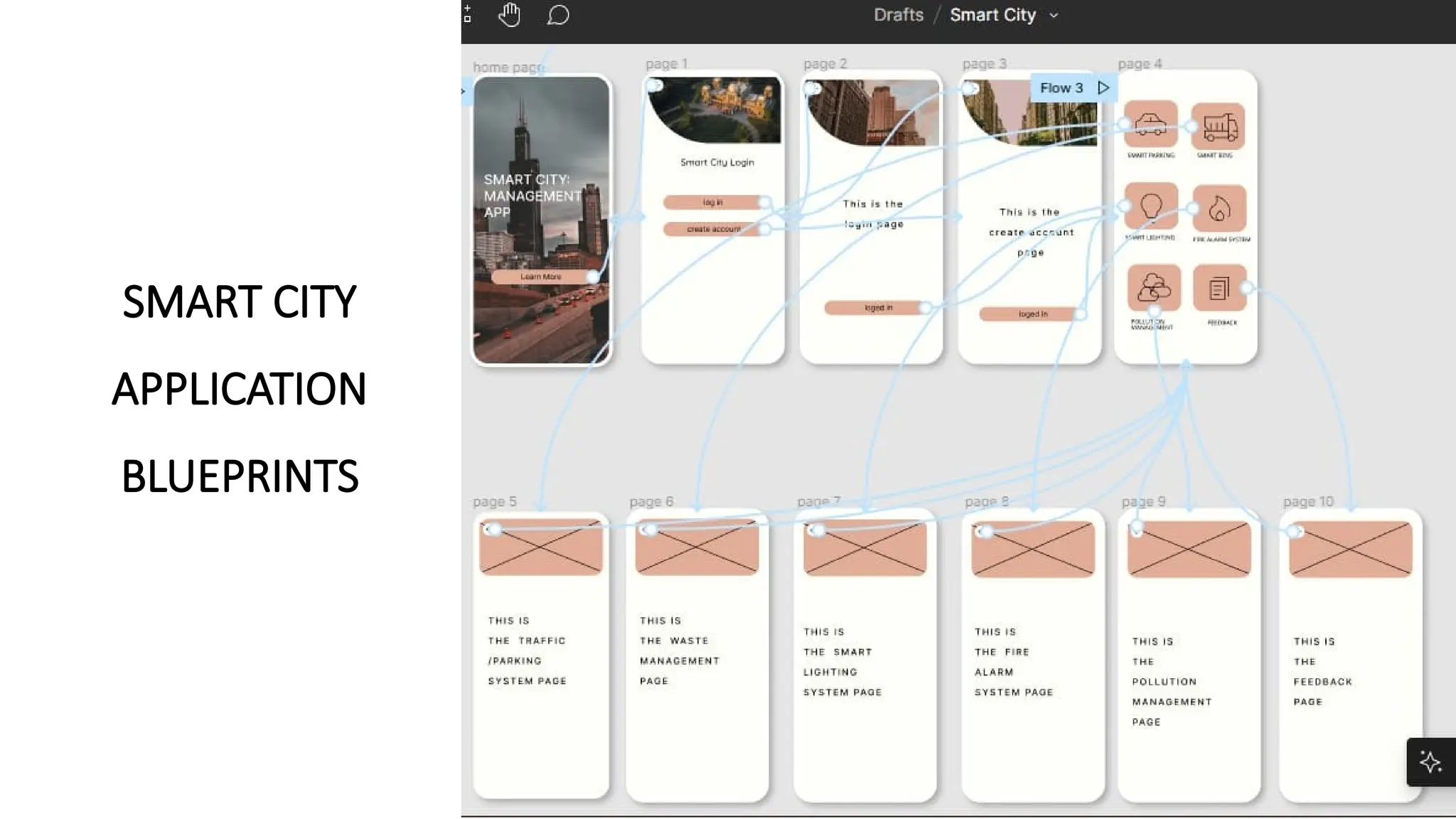
SMART CITY
APPLICATION
BLUEPRINTS
26
H a r d w a r e To o l s
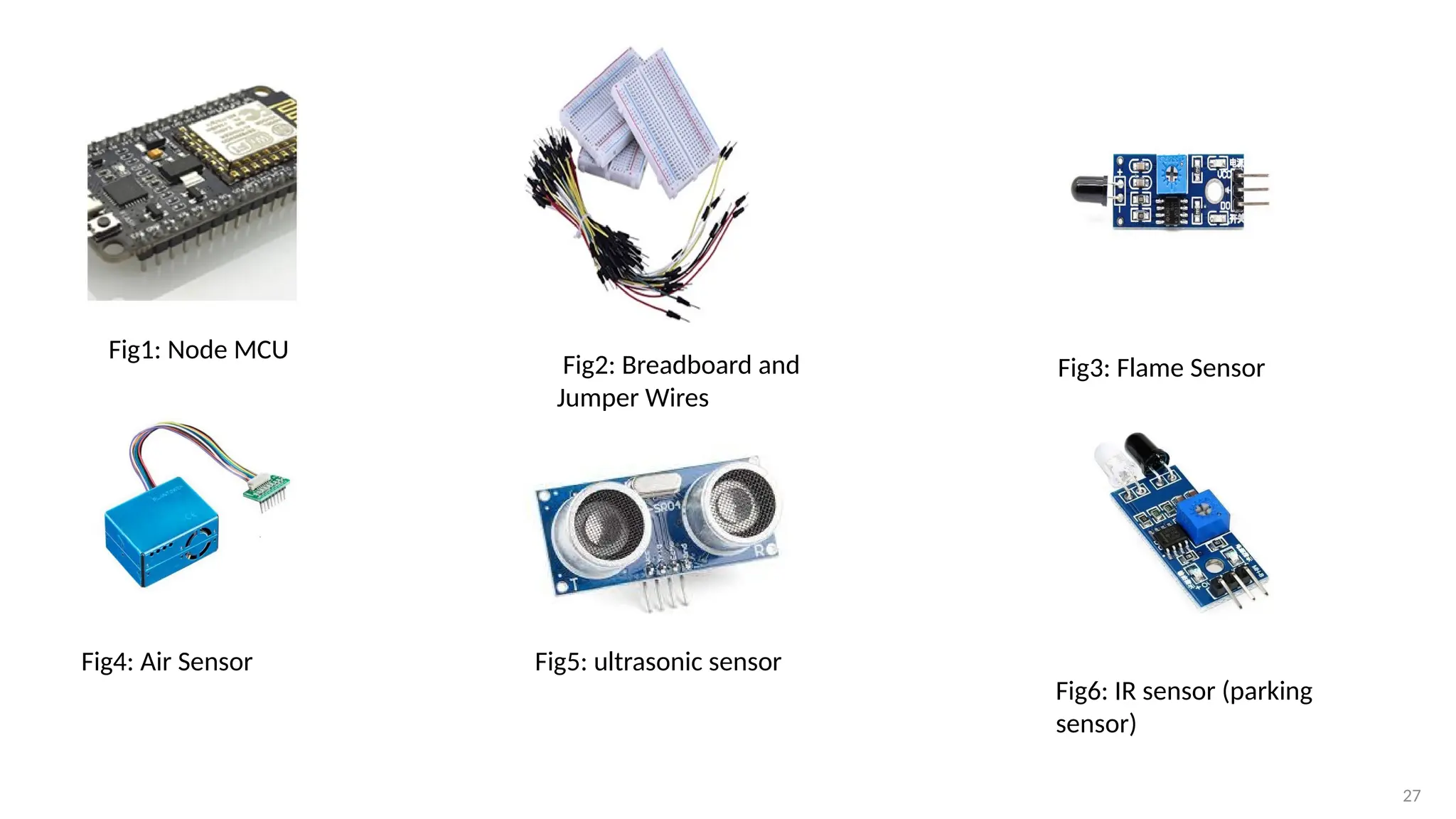
• Node MCU
• Cardboard, thermoform sheets, wires, breadboard.
• Flame Sensor Module is used to detect fire/flame source or other light
sources of the wave length in the range of 760nm – 1100 nm.
• pms5003 np2.5 sensor (air sensor) obtains the number of
suspended particles in the air, i.e. the concentration of particles, and
output them in the form of digital interface.
• ultrasonic sensor (waste sensor) is a long-range ultrasonic transducer is
used to measure fullness levels.
• IR sensor (parking sensor)detect the heat radiation (infrared radiation)
that changes over time and space due to the movement of people.
IMPLEMENTATION(CONTD…)
27
Fig1: Node MCU
Fig2: Breadboard and
Jumper Wires
Fig3: Flame Sensor
Fig4: Air Sensor Fig5: ultrasonic sensor
Fig6: IR sensor (parking
sensor)
28
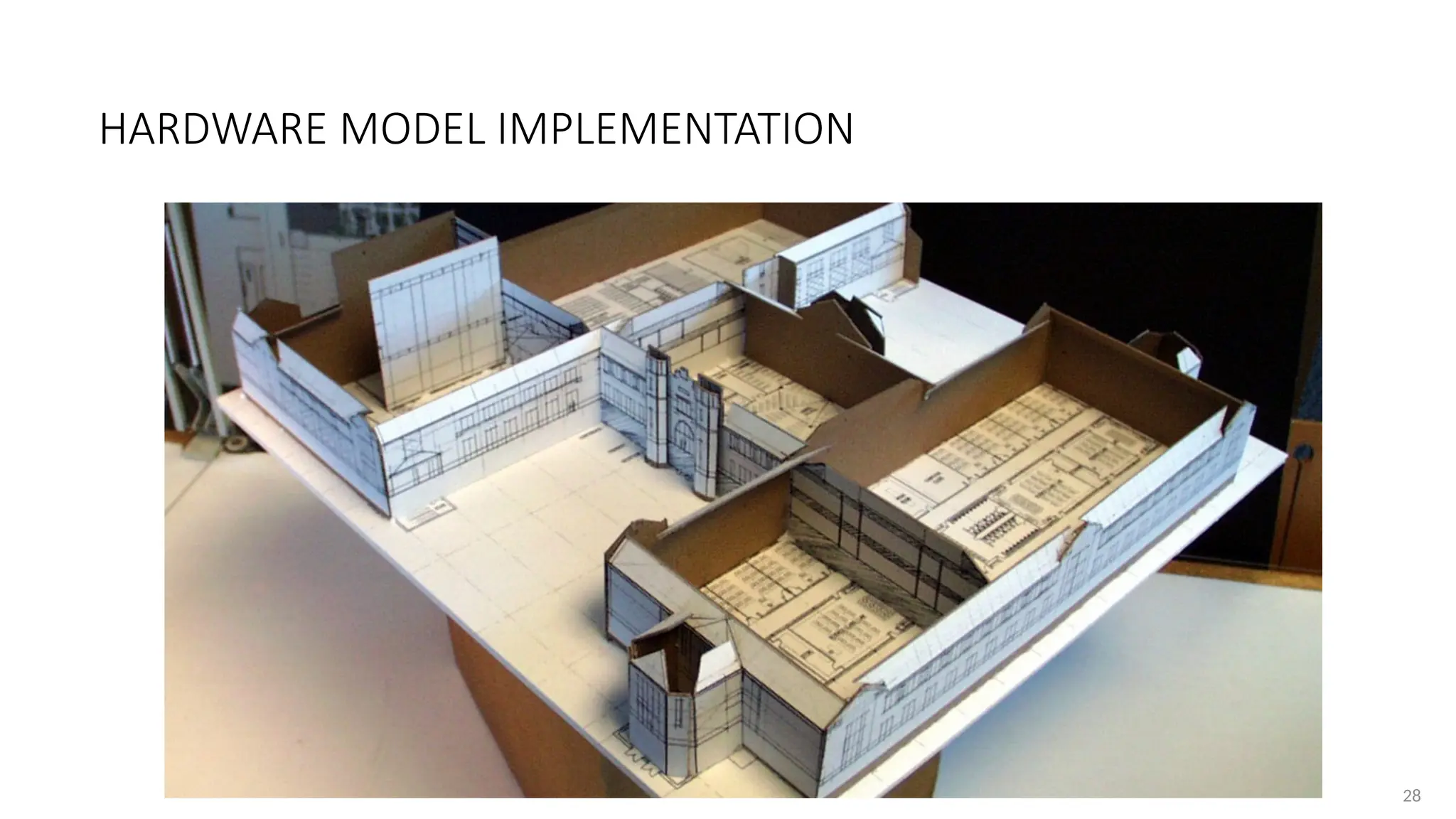
HARDWARE MODEL IMPLEMENTATION
29
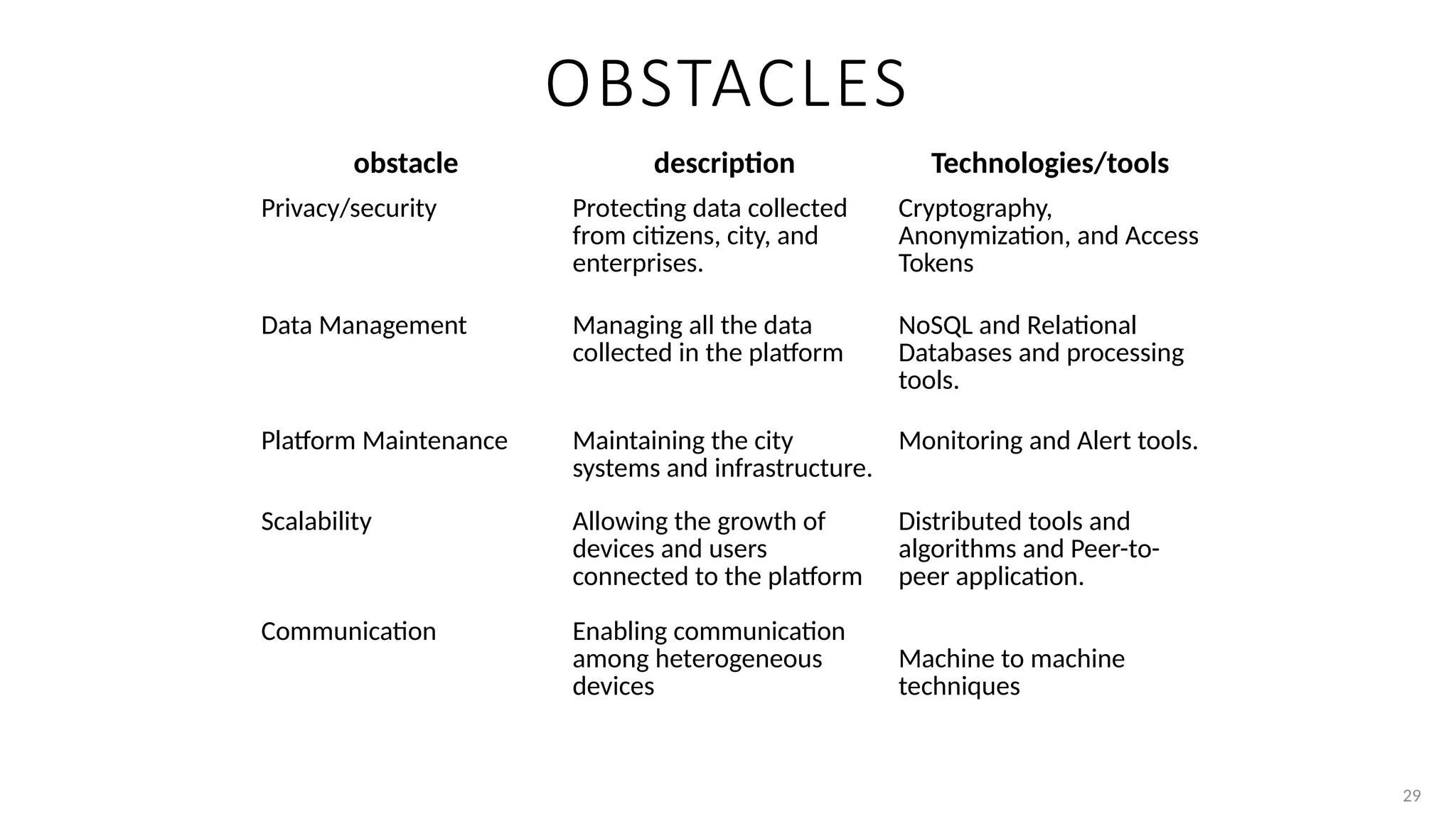
OBSTACLES
obstacle description Technologies/tools
Privacy/security Protecting data collected
from citizens, city, and
enterprises.
Cryptography,
Anonymization, and Access
Tokens
Data Management Managing all the data
collected in the platform
NoSQL and Relational
Databases and processing
tools.
Platform Maintenance Maintaining the city
systems and infrastructure.
Monitoring and Alert tools.
Scalability
Communication
Allowing the growth of
devices and users
connected to the platform
Enabling communication
among heterogeneous
devices
Distributed tools and
algorithms and Peer-to-
peer application.
Machine to machine
techniques
Having a combination of sensor arrays
feeding back to a central point.
Where we can
aggregating that data to
be used in the
application.
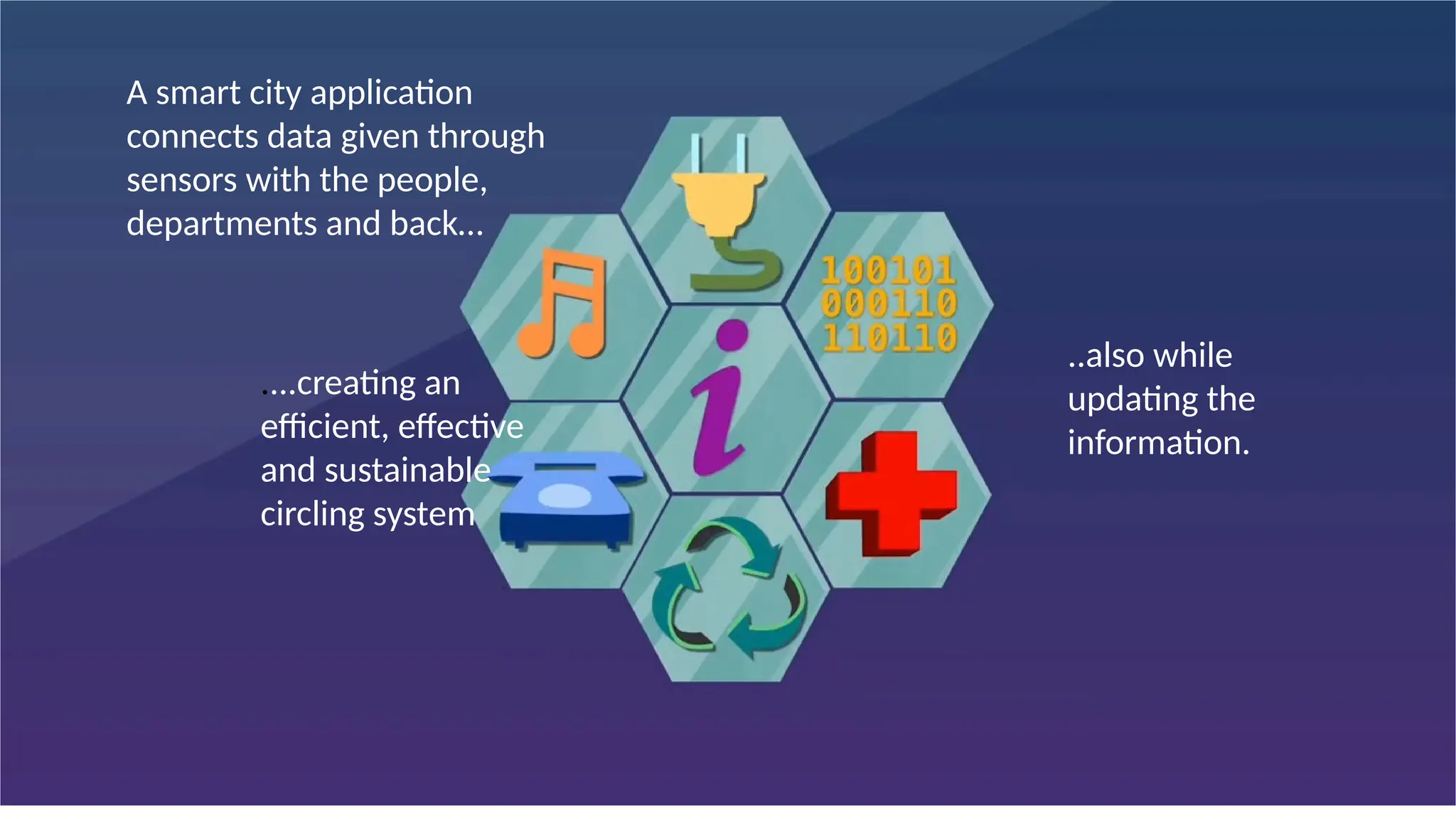
A smart city application
connects data given through
sensors with the people,
departments and back…
....creating an
efficient, effective
and sustainable
circling system
..also while
updating the
information.
03/17/2025 32
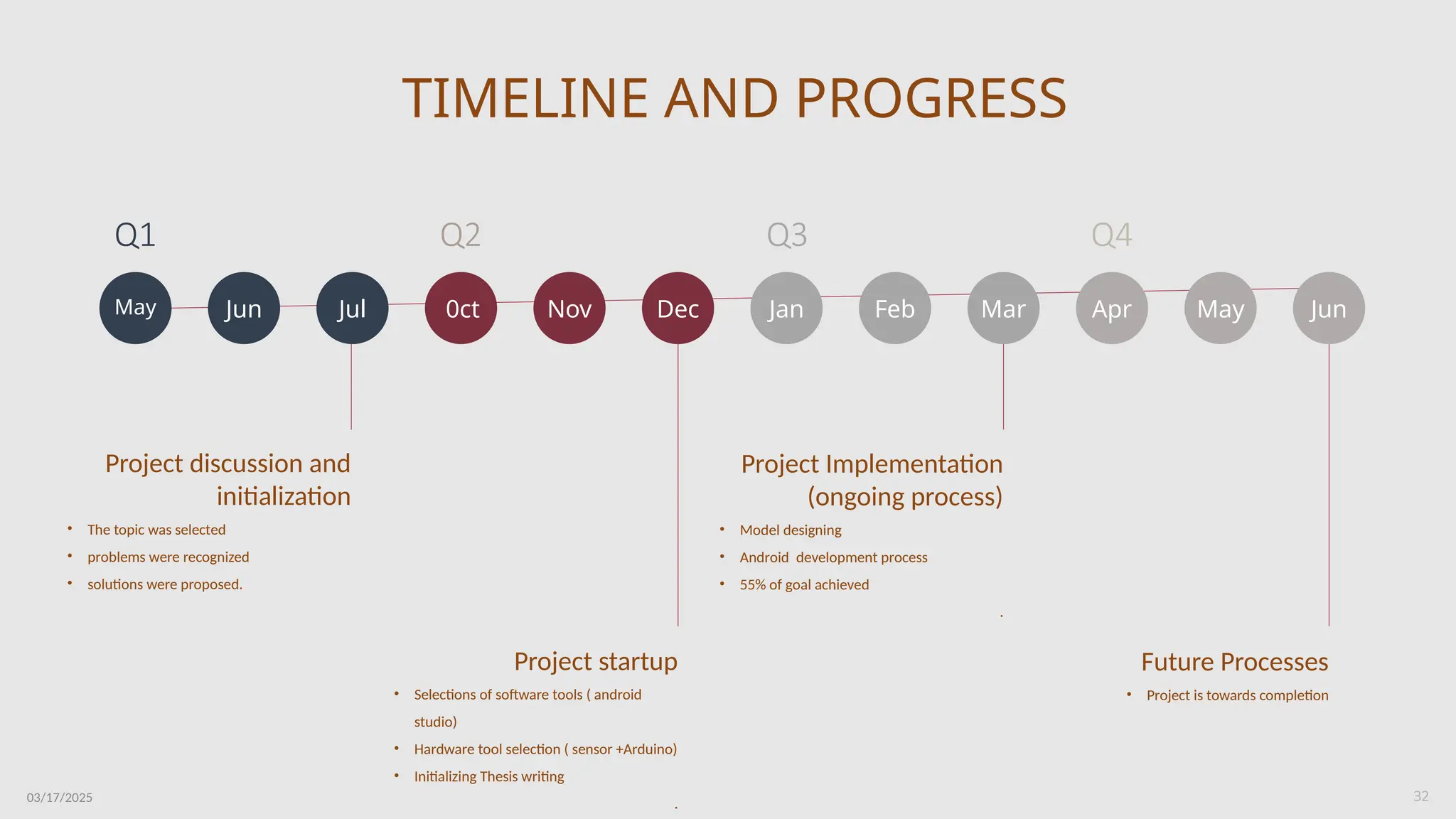
TIMELINE AND PROGRESS
May Jun Jul Nov
0ct Dec Jan Feb Mar Apr May Jun
Project discussion and
initialization
• The topic was selected
• problems were recognized
• solutions were proposed.
Project startup
• Selections of software tools ( android
studio)
• Hardware tool selection ( sensor +Arduino)
• Initializing Thesis writing
.
Project Implementation
(ongoing process)
• Model designing
• Android development process
• 55% of goal achieved
.
Future Processes
• Project is towards completion
Q1 Q2 Q3 Q4
CONCLUSION
As the process of urbanization is accelerating, some municipality problems are emerged such as parking
congestion, insufficient waste management, imperfect pollution monitoring system and waste of electricity.
Iot and cloud computing is adopted to built an efficient environment by designing a smart city application in
a smart environment.
This project can be concluded as a Smart city applications that is designed to take advantage of the smart city
ICT (information communication technology) and collected data that provide value-added smart features.
34
34
[1] Bibri, S. E. (2019). "On the sustainability of smart and smarter cities in the era of big data: an interdisciplinary
and transdisciplinary literature review." Journal of Big Data 6(1): 1-64.
[2] Ismagilova, Elvira, Laurie Hughes, Nripendra P Rana, and Yogesh K Dwivedi. "Security, Privacy and Risks within
Smart Cities: Literature Review and Development of a Smart City Interaction Framework." Information Systems
Frontiers (2020): 1-22.
[3] Shehab, Muhammad J, Ihab Kassem, Adeeb A Kutty, Murat Kucukvar, Nuri Onat, and Tamer Khattab. "5g
Networks Towards Smart and Sustainable Cities: A Review of Recent Developments, Applications and Future
Perspectives." IEEE Access 10 (2021): 2987-3006.
[4] Allam, Zaheer, and Zaynah A Dhunny. "On Big Data, Artificial Intelligence and Smart Cities." Cities 89 (2019): 80-
91.
[5] Martin, Chris J, James Evans, and Andrew Karvonen. "Smart and Sustainable? Five Tensions in the Visions and
Practices of the Smart-Sustainable City in Europe and North America." Technological Forecasting and Social Change
133 (2018): 269-78.
REFERENCES
THANK YOU
Icon
Icon
Icon

https://www.slideshare.net/slideshow/chapter-1-ob-38248150/38248150https://www.slideshare.net/slideshow/chapter-1-ob-38248150/38248150
  • 1.
    FINAL YEAR PROJECT SMARTCITY:MANAGING APP T h e I s l a m i a U n i v e r s i t y o f B a h a w a l p u r
  • 2.
    2 2 SMART CITY A smartcity is a municipality that uses information and communication technologies (ICT) to increase operational efficiency, share information with the public and improve both the quality of government services and citizen welfare. A S o ft w a r e P l a tf o r m
  • 3.
    3 PROBLEM STATEMENT In thecurrent era, Cities have to deal with big social, ecological, and technological challenges such as digitalization, pollution, traffic congestion etc. The main goal of a smart city is • to optimize city functions • promote economic growth • improving the quality of life for citizens by using smart technologies and data analysis. Smart city applications help provide solutions such as smart lighting, smart parking, smart waste management, Air Pollution Monitoring ,Security(Fire Alarm). These technologies and integrations are based on sensor-centered collection and analysis of data. They offer cost-effective and innovative solutions to the growing number of challenges faced by municipalities.
  • 4.
    SURVEY Waste Overflow TrafficSnarls No Fire Security Air Pollution Street Lights
  • 5.
    5 SMART CITY: MANAGINGAPP “A N IN T EG R AT E D M IDD L E WA R E E N VI RON M E N T T HAT S UP P ORTS S OF T WA R E DE VE LOP E RS I N DES I GN IN G , IMP L E ME N T IN G , DE P LOYIN G , A N D MA N AG I N G A P P L ICAT I ON S FOR S MA RT CIT I ES .” OBJECTIVE: IT IN VOLVES I N CR EAT IV E LY COM BIN IN G T HE L ARG E A MOUN TS OF DATA G E N E R AT E D BY M ULT IP L E CIT Y S OURCES ( S UCH A S S E N S OR N E T WOR KS , T R A FF IC SYST E M S , US E R DE V ICES , A N D S OCIA L N E T WOR KS ) TO CR EAT E IN T EG R AT E D S E RV ICES A N D A PP L ICAT ION S , IMP ROVI N G CI T Y S E RV ICES , A N D M AKI N G BE T T E R US E OF CI T Y R ES OURCES .
  • 6.
    6 6 • 1994 –Amsterdam created a virtual ‘digital city’ – De Digital Stad (DDS) – to promote Internet usage. • The earliest smart grid project in Teleogestore,Italy in 2005 which offered a saving of 500 million Euros per year. • 2008 – IBM Smarter Planet project investigated applying sensors, networks and analytics to urban issues. • Various smart cities were being developed in the last 20 years like Los Angeles, Vienna, Rome etc. HISTORY
  • 7.
    7 LITERATURE REVIEW S.NO TITLEOF PAPER AUTHOR YEAR JOURNAL CONCLUSION 1 Smart and sustainable? Five tensions in the visions and practices of the smart-sustainable city in Europe and North America. Martin, C. J. 2018 Technological Forecasting and Social Change Numerous case studies have been researched and published, particularly in developed economies, with the overall goal of building theoretical frameworks that are focused on smart city governance. These empirical studies cover topics such as smart city transformation processes, policy mechanisms, and implementation experiences. 2 On the sustainability of smart and smarter cities in the era of big data: an interdisciplinary and transdisciplinary literature review. Bibri, S. E. 2019 Big Data The operational efficiency in the planning and management of cities will be increased by integration of sensors and big data analytics that may result in economic growth.
  • 8.
    8 S.NO TITLE OFPAPER AUTHOR YEAR JOURNAL CONCLUSION 3 On big data, artificial intelligence and smart cities. Allam, Z. and Z. A. Dhunny 2019 Cities The development of cutting-edge technological applications is one of the key factors in achieving greater efficiency in urban systems. 4 Security, privacy and risks within smart cities: Literature review and development of a smart city interaction framework. Ismagilova 2020 Information Systems Frontiers Many cities throughout the globe have adopted the smart idea and either developed their infrastructure in order to achieve this new status or are actively looking for ways to adapt their current assets and networks. 5 5G networks towards smart and sustainable cities: A review of recent developments, applications and future perspectives. Shehab, M. J. 2021 IEEE Using a macroscopic review, looked at how 5G networks would be crucial for creating sustainable smart cities.
  • 9.
    9 TOP 10 SMARTCITIES IN THE WORLD TORONTO VIENNA PARIS NEW YORK LONDON BERLIN CONGEEING HONG KONG BARCELONA
  • 10.
    10 10 • Smart Parking •Noise Urban Maps • Traffic Congestion • Smart Lighting • Waste Management • Smart Roads • Security(Fire Detection) • Air Pollution • Potable water monitoring • Water Leakages • Temperature Monitoring SMART CITY COMPONENTS
  • 11.
    11 FOCUSED COMPONENTS SMART STREETLIGHTING The lights in the area will turn on in regular (bright) mode once presence is sensed. WASTE MANAGEMENT There are ultrasonic fill-level sensors in Smart Bins. SMART PARKING Smart Parking is a type of parking solution that may incorporate cameras, counting sensors, or in- ground Smart Parking sensors. SECURITY ALARM Assist you in maintaining complete operational control over your detection and alarm systems as well as legal compliance. AIR POLLUTION MONITORING An internet-based web server is used to monitor the air quality using an air pollution monitoring system
  • 12.
  • 13.
  • 14.
  • 15.
  • 16.
    Parking System Collecting different sensorinformation and having our application consume that data
  • 17.
    17 17 ENABLING TECHNOLOGIES USEDIN STATE OF SOFTWARE PLATFORMS FOR SMART CITIES? • Internet of Things (IoT) : The key Technologies that are involved in Internet Of Things: • Wireless Senser Network(WSN) • Cloud Computing • Big Data • Embeded System Cyber-Physical Systems : To enable the interaction of systems with the city environment
  • 18.
    18 18 w i re l e s s S e n s o r N e t w o r k WSN is group of various measurement devices,sensor and transducers which are used to monitoring the physical or environmental conditions.Basically it is used to achieve objectives like pressure,air quality and sense light etc.There is multiple sensor and comunication take place through various protocols rather then network of wires. INTERNET OF THINGS
  • 19.
    19 19 C l ou d C o m p u ti n g Cloud Computing means providing the computing services over the internet(called cloud).The computing services includes server,application,storage,database and networking etc.There are three type of clouds • Public Cloud(owned and operate by third party) • Private Cloud(Resources used by single business organization) • Hybrid Cloud(combine public and private cloud) INTERNET OF THINGS
  • 20.
    20 20 B i gd a t a Big Data refers to the large sets of data collected.It can be of various type optical,mechanical or electrical.The three V’s of Big Data are • Volume:Refer to data of enormous size which is important factor in determining whether data fall in the catagory of big data or not • Velocity:Refer to speed of generation and comsuption of data and also data flow • Variety: Refers to different type of data such as text,character,audio,videoand image.It can be structure,unstructure or semi structure INTERNET OF THINGS
  • 21.
    21 21 E m be d e d S y s t e m Embeded system is the combination of hardware and software which are designed for specific purpose.Depending of object it can either be a independent system or part of large system.It is designed in the form of integerated circuit to achieve single or multiple objectives. INTERNET OF THINGS
  • 22.
    22 22 C y be r P h y s i c a l S y s t e m Intelligently networked systems with sensors, processors, and actuators installed within them that identify and interact with real-world aspects and human end-users. For Example IOT Smart cities are enabled by cyber-physical systems (CPS), which involve connecting devices and systems. ENABLING TECHNOLOGIES
  • 23.
    23 S o ftw a r e To o l s For the development of android application we use Android Studio. Android Studio is the official integrated development environment for Google's Android operating system. It is available for download on Windows, MACOS and Linux based operating systems. It has following main module: • manifests: Contains the AndroidManifest.xml file. • java: Contains the Java and Kotlin source code files. • res: Contains all non-code resources such as XML layouts, UI strings, and bitmap images. IMPLEMENTATION
  • 24.
    24 • Navigation(File Structure) •Style and formatting • Version control basics(Enable Version Control Integration) • Multiple APK support(create separate APKs of an app) • Resource shrinking (Google Play Service) • Debug and profile tools(Inline debug) • Data file access • Code inspections(automatically runs configured lint checks and other IDE inspections) TOOL WINDOW
  • 25.
  • 26.
    26 H a rd w a r e To o l s • Node MCU • Cardboard, thermoform sheets, wires, breadboard. • Flame Sensor Module is used to detect fire/flame source or other light sources of the wave length in the range of 760nm – 1100 nm. • pms5003 np2.5 sensor (air sensor) obtains the number of suspended particles in the air, i.e. the concentration of particles, and output them in the form of digital interface. • ultrasonic sensor (waste sensor) is a long-range ultrasonic transducer is used to measure fullness levels. • IR sensor (parking sensor)detect the heat radiation (infrared radiation) that changes over time and space due to the movement of people. IMPLEMENTATION(CONTD…)
  • 27.
    27 Fig1: Node MCU Fig2:Breadboard and Jumper Wires Fig3: Flame Sensor Fig4: Air Sensor Fig5: ultrasonic sensor Fig6: IR sensor (parking sensor)
  • 28.
  • 29.
    29 OBSTACLES obstacle description Technologies/tools Privacy/securityProtecting data collected from citizens, city, and enterprises. Cryptography, Anonymization, and Access Tokens Data Management Managing all the data collected in the platform NoSQL and Relational Databases and processing tools. Platform Maintenance Maintaining the city systems and infrastructure. Monitoring and Alert tools. Scalability Communication Allowing the growth of devices and users connected to the platform Enabling communication among heterogeneous devices Distributed tools and algorithms and Peer-to- peer application. Machine to machine techniques
  • 30.
    Having a combinationof sensor arrays feeding back to a central point. Where we can aggregating that data to be used in the application.
  • 31.
    A smart cityapplication connects data given through sensors with the people, departments and back… ....creating an efficient, effective and sustainable circling system ..also while updating the information.
  • 32.
    03/17/2025 32 TIMELINE ANDPROGRESS May Jun Jul Nov 0ct Dec Jan Feb Mar Apr May Jun Project discussion and initialization • The topic was selected • problems were recognized • solutions were proposed. Project startup • Selections of software tools ( android studio) • Hardware tool selection ( sensor +Arduino) • Initializing Thesis writing . Project Implementation (ongoing process) • Model designing • Android development process • 55% of goal achieved . Future Processes • Project is towards completion Q1 Q2 Q3 Q4
  • 33.
    CONCLUSION As the processof urbanization is accelerating, some municipality problems are emerged such as parking congestion, insufficient waste management, imperfect pollution monitoring system and waste of electricity. Iot and cloud computing is adopted to built an efficient environment by designing a smart city application in a smart environment. This project can be concluded as a Smart city applications that is designed to take advantage of the smart city ICT (information communication technology) and collected data that provide value-added smart features.
  • 34.
    34 34 [1] Bibri, S.E. (2019). "On the sustainability of smart and smarter cities in the era of big data: an interdisciplinary and transdisciplinary literature review." Journal of Big Data 6(1): 1-64. [2] Ismagilova, Elvira, Laurie Hughes, Nripendra P Rana, and Yogesh K Dwivedi. "Security, Privacy and Risks within Smart Cities: Literature Review and Development of a Smart City Interaction Framework." Information Systems Frontiers (2020): 1-22. [3] Shehab, Muhammad J, Ihab Kassem, Adeeb A Kutty, Murat Kucukvar, Nuri Onat, and Tamer Khattab. "5g Networks Towards Smart and Sustainable Cities: A Review of Recent Developments, Applications and Future Perspectives." IEEE Access 10 (2021): 2987-3006. [4] Allam, Zaheer, and Zaynah A Dhunny. "On Big Data, Artificial Intelligence and Smart Cities." Cities 89 (2019): 80- 91. [5] Martin, Chris J, James Evans, and Andrew Karvonen. "Smart and Sustainable? Five Tensions in the Visions and Practices of the Smart-Sustainable City in Europe and North America." Technological Forecasting and Social Change 133 (2018): 269-78. REFERENCES
  • 35.