Smart Cars
Group 01
Assad Murtaza, Osama Ali , Ali Saif
University of Bahrain
Plan
• Goal and type of the research
• Introduction
• Smart Cars and Smart Infrastructure
• Driving in Smart Roads
• Self-Driving Automobiles
• Detection Technology
• Moral Issues
• Legal Issues
• Conclusion
Goal and type of the
research
Goal: To determine the characteristics that make up smart cars.
Research type: Causal-comparative research
We collected data by analyzing the behavior of automated systems and
their effectiveness as well as the nature of accidents and how they
happen and compared how the normal drivers react to them and what is
the optimal reaction.
Introduction
Smart cars transportation systems can be an important part
of our daily life. Critical difficulties remain unsolved , solving
them will help in enhancing their effectiveness and security
and some of them are being developed related applications
that enhance our everyday exercises. These difficulties
present extraordinary opportunities that will give a
competitive advantage to automobile producers in the car
business. on the off chance that we figure out how to
consolidate the quick paced advancements in the extensive
variety of related designing, interchanges, and data
innovation segments and put these new advances in future
age of vehicles.
Smart Cars and Smart
Infrastructure
• Vehicles will turn out to be completely robotized and street foundations
will likewise change all the more altogether to give better detecting
arrangements
• Models incorporate remotely controllable
• Secretly activated
• Variable-message system
• RFID-type roadside sensors
Driving in Smart Roads
• Intelligent streets are conditions that can persistently adjust to what's
going on around them, they can:
• Communicate with smart cars and people and determine the best path at
the best time for drivers to drive.
• Current in-vehicle uses of GPS, impromptu systems, and sensor systems
are being introduced.
• Future vehicles will carry on increasingly like proficient operators driving
in smart streets.
• Traffic control at convergences could execute driving advances over
systems, rather than depending on traffic lights.
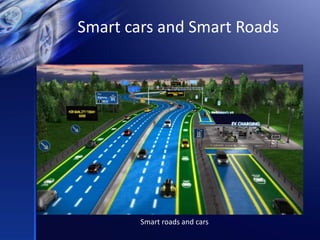
Smart cars and Smart Roads
Smart roads and cars
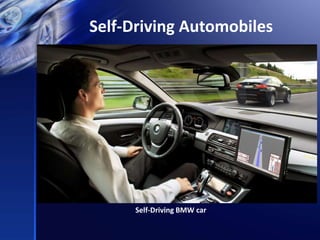
Self-Driving Automobiles
safety features:
• Decrease the likelihood and seriousness of car accidents by
maneuvering impulsive driver behavior.
• Consisting of :Crash Warning System that have been practically
demonstrated to see the unsafe circumstance and naturally control
the vehicle out of risk.
• An impact avoiding framework will take control of the car and apply
brake.
Self-Driving Automobiles
Self-Driving BMW car
Detection Technology
• Hardeware used:
• Front, rear and side sensors: used to enhance the detection
of the proximity of objects.
• 3 main types of sensors:
• Camera: provides visual representation of objects surrounding
The car.
• RADAR: radio detection and ranging used to detect object
movements.
• LIDAR: light detection and ranging.
Moral Issues
• Systematic-activities(like braking, and acceleration)
should be assisted and relieved by the help framework.
• Help framework is a software embedded within the car
system that is responsible for:
• tracking the movement and progress of previous cars
and determine whether to accelerate or break.
• Crash avoiding frame work should be structured as such,
that it should check driver's activities and whether or
not the outcome of those activities will result in an a
change of movement to prevent accident.
• A good understanding of driver's mental behavior and
social motives is important for the development of this
kind of framework.
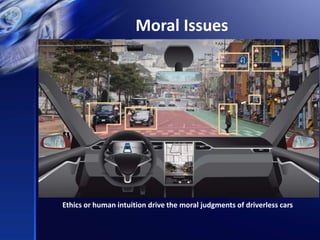
Moral Issues
Ethics or human intuition drive the moral judgments of driverless cars
Legal Issues
• Policy makers should introduce laws that Force automobile
manufacturers to provide:
1. Caution warning systems that warn the driver to take control of the
vehicle incase of incoming threats.
2. Systems that archive car driving history so that they help determine
the cause of accidents and who’s responsible.
• And they should introduce laws that prevent driver’s from being
excused from responsibility as a result of relying on autonomous
driving system.
Conclusion
In this report the fundamental thought of what smart
vehicles later on would be has been examined in
extraordinary detail, their effect on driver's comfort,
security and traffic stream.
The positive and negative impacts of such frameworks are
not totally seen yet. The human factor issues are of
incredible significance and in this way an area in this
report was devoted to this subject.

Smart cars

  • 1.
    Smart Cars Group 01 AssadMurtaza, Osama Ali , Ali Saif University of Bahrain
  • 2.
    Plan • Goal andtype of the research • Introduction • Smart Cars and Smart Infrastructure • Driving in Smart Roads • Self-Driving Automobiles • Detection Technology • Moral Issues • Legal Issues • Conclusion
  • 3.
    Goal and typeof the research Goal: To determine the characteristics that make up smart cars. Research type: Causal-comparative research We collected data by analyzing the behavior of automated systems and their effectiveness as well as the nature of accidents and how they happen and compared how the normal drivers react to them and what is the optimal reaction.
  • 4.
    Introduction Smart cars transportationsystems can be an important part of our daily life. Critical difficulties remain unsolved , solving them will help in enhancing their effectiveness and security and some of them are being developed related applications that enhance our everyday exercises. These difficulties present extraordinary opportunities that will give a competitive advantage to automobile producers in the car business. on the off chance that we figure out how to consolidate the quick paced advancements in the extensive variety of related designing, interchanges, and data innovation segments and put these new advances in future age of vehicles.
  • 5.
    Smart Cars andSmart Infrastructure • Vehicles will turn out to be completely robotized and street foundations will likewise change all the more altogether to give better detecting arrangements • Models incorporate remotely controllable • Secretly activated • Variable-message system • RFID-type roadside sensors
  • 6.
    Driving in SmartRoads • Intelligent streets are conditions that can persistently adjust to what's going on around them, they can: • Communicate with smart cars and people and determine the best path at the best time for drivers to drive. • Current in-vehicle uses of GPS, impromptu systems, and sensor systems are being introduced. • Future vehicles will carry on increasingly like proficient operators driving in smart streets. • Traffic control at convergences could execute driving advances over systems, rather than depending on traffic lights.
  • 7.
    Smart cars andSmart Roads Smart roads and cars
  • 8.
    Self-Driving Automobiles safety features: •Decrease the likelihood and seriousness of car accidents by maneuvering impulsive driver behavior. • Consisting of :Crash Warning System that have been practically demonstrated to see the unsafe circumstance and naturally control the vehicle out of risk. • An impact avoiding framework will take control of the car and apply brake.
  • 9.
  • 10.
    Detection Technology • Hardewareused: • Front, rear and side sensors: used to enhance the detection of the proximity of objects. • 3 main types of sensors: • Camera: provides visual representation of objects surrounding The car. • RADAR: radio detection and ranging used to detect object movements. • LIDAR: light detection and ranging.
  • 11.
    Moral Issues • Systematic-activities(likebraking, and acceleration) should be assisted and relieved by the help framework. • Help framework is a software embedded within the car system that is responsible for: • tracking the movement and progress of previous cars and determine whether to accelerate or break. • Crash avoiding frame work should be structured as such, that it should check driver's activities and whether or not the outcome of those activities will result in an a change of movement to prevent accident. • A good understanding of driver's mental behavior and social motives is important for the development of this kind of framework.
  • 12.
    Moral Issues Ethics orhuman intuition drive the moral judgments of driverless cars
  • 13.
    Legal Issues • Policymakers should introduce laws that Force automobile manufacturers to provide: 1. Caution warning systems that warn the driver to take control of the vehicle incase of incoming threats. 2. Systems that archive car driving history so that they help determine the cause of accidents and who’s responsible. • And they should introduce laws that prevent driver’s from being excused from responsibility as a result of relying on autonomous driving system.
  • 14.
    Conclusion In this reportthe fundamental thought of what smart vehicles later on would be has been examined in extraordinary detail, their effect on driver's comfort, security and traffic stream. The positive and negative impacts of such frameworks are not totally seen yet. The human factor issues are of incredible significance and in this way an area in this report was devoted to this subject.