SMART ANTENNA
RESEARCH TOPIC NEERAJKUMAR
AGENDA
1. History
2. Introduction
3. What is smart antenna?
4. Functioning of smart antenna.
5. Types of smart antenna.
6. Digital beam forming
7. DOA estimation
8. Advantages
9. Application and conclusion
10. Reference
HISTORY
1. The German inventor and physicist Karl F. Braun demonstrated beamforming for the first time in 1905.
2. The Smart Antenna was developed for “Military Communications” and “Intelligence gathering”.
3. New opportunities were created for smart antenna in the year 1990 by satellite broadcasting industries.
INTRODUCTION
 Antenna is electrical device which converted electric power into electromagnetic waves.
 A smart Antenna consist of an antenna array, that changes the array pattern in response to signal environment to
improve the performance of a communication channel.
 Smart antenna is not smart, it is the digital signal processing, along with the antennas, which makes the system
smart.
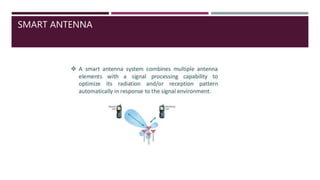
SMART ANTENNA
WHY WE NEED THIS SMART ANTENNA
1. Regular antenna(omnidirectional): generates beams in all directions.
2. Having directional pattern in orthogonal plane and non-directional pattern in given plane.
3. Smart antenna: adaptive antenna utilizes adaptive DSP based techniques and digital technology.
FUNCTIONING OF SMART ANTENNA
1. Estimation of Direction of arrival (DOA)
2. Beamforming Method
1. ESTIMATION OF DIRECTION OF ARRIVAL (DOA)
In smart antennas various techniques like MUSIC (Multiple Signal Classification) and estimation of signal parameters
via rotational invariance techniques (ESPRIT) algorithms are used to find the DOA of a signal.
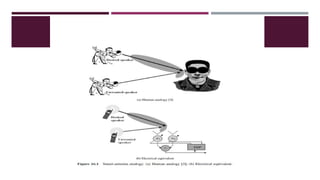
2. BEAMFORMING METHOD
The mobiles or targets at which the signals are to be sent are first sought out and then a radiation pattern of the
antenna array is created by adding the signal phases. At the same time the mobiles which will not need the signal will
be out of pattern
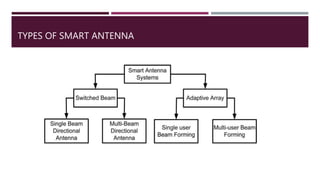
TYPES OF SMART ANTENNA
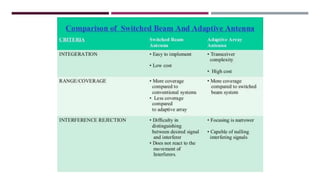
ADAPTIVE ARRAY ANTENNAS
 Has become a core system component in future generation mobile networks.
 Adaptive array allow the antenna to steer the beam to any direction of interest while simultaneously
nulling interfering signals.
 This antennas can track and locate signal
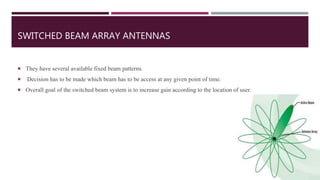
SWITCHED BEAM ARRAY ANTENNAS
 They have several available fixed beam patterns.
 Decision has to be made which beam has to be access at any given point of time.
 Overall goal of the switched beam system is to increase gain according to the location of user.
ADVANTAGES OF SMART ANTENNA SYSTEM:
1. It improves the wireless system performance.
2. It is economic for a large range of potential users.
3. It increases in signal quality, capacity as well as the coverage.
4. It is now possible to multiple channels in spatial dimension.
DISADVANTAGES:
1. Smart Antenna System is complex in design.
2. Very expensive
3. Larger size than traditional one
APPLICATION
1. Acositic signal processing
2. Tracking of RADAR
3. Cellular System
4. It is used in the satellite systems
CONCLUSION
 Smart antennas are the intelligent antenna systems that vastly improve the efficiency of wireless
transmission.
REFERENCES
 https://en.wikipedia.org/wiki/Smart_antenna.
 https://www.slideshare.net/santhu652/smart-antennas-ppt

Smart Antenna

  • 1.
  • 2.
    AGENDA 1. History 2. Introduction 3.What is smart antenna? 4. Functioning of smart antenna. 5. Types of smart antenna. 6. Digital beam forming 7. DOA estimation 8. Advantages 9. Application and conclusion 10. Reference
  • 3.
    HISTORY 1. The Germaninventor and physicist Karl F. Braun demonstrated beamforming for the first time in 1905. 2. The Smart Antenna was developed for “Military Communications” and “Intelligence gathering”. 3. New opportunities were created for smart antenna in the year 1990 by satellite broadcasting industries.
  • 4.
    INTRODUCTION  Antenna iselectrical device which converted electric power into electromagnetic waves.  A smart Antenna consist of an antenna array, that changes the array pattern in response to signal environment to improve the performance of a communication channel.  Smart antenna is not smart, it is the digital signal processing, along with the antennas, which makes the system smart.
  • 5.
  • 6.
    WHY WE NEEDTHIS SMART ANTENNA 1. Regular antenna(omnidirectional): generates beams in all directions. 2. Having directional pattern in orthogonal plane and non-directional pattern in given plane. 3. Smart antenna: adaptive antenna utilizes adaptive DSP based techniques and digital technology.
  • 7.
    FUNCTIONING OF SMARTANTENNA 1. Estimation of Direction of arrival (DOA) 2. Beamforming Method
  • 8.
    1. ESTIMATION OFDIRECTION OF ARRIVAL (DOA) In smart antennas various techniques like MUSIC (Multiple Signal Classification) and estimation of signal parameters via rotational invariance techniques (ESPRIT) algorithms are used to find the DOA of a signal.
  • 9.
    2. BEAMFORMING METHOD Themobiles or targets at which the signals are to be sent are first sought out and then a radiation pattern of the antenna array is created by adding the signal phases. At the same time the mobiles which will not need the signal will be out of pattern
  • 11.
  • 12.
    ADAPTIVE ARRAY ANTENNAS Has become a core system component in future generation mobile networks.  Adaptive array allow the antenna to steer the beam to any direction of interest while simultaneously nulling interfering signals.  This antennas can track and locate signal
  • 13.
    SWITCHED BEAM ARRAYANTENNAS  They have several available fixed beam patterns.  Decision has to be made which beam has to be access at any given point of time.  Overall goal of the switched beam system is to increase gain according to the location of user.
  • 15.
    ADVANTAGES OF SMARTANTENNA SYSTEM: 1. It improves the wireless system performance. 2. It is economic for a large range of potential users. 3. It increases in signal quality, capacity as well as the coverage. 4. It is now possible to multiple channels in spatial dimension.
  • 16.
    DISADVANTAGES: 1. Smart AntennaSystem is complex in design. 2. Very expensive 3. Larger size than traditional one
  • 17.
    APPLICATION 1. Acositic signalprocessing 2. Tracking of RADAR 3. Cellular System 4. It is used in the satellite systems
  • 18.
    CONCLUSION  Smart antennasare the intelligent antenna systems that vastly improve the efficiency of wireless transmission.
  • 19.