SMART ANTENNAS
Presented By :
Content
O Introduction
O What is Smart Antenna?
O Types of Smart Antenna systems
O The goals of a smart antenna system
O Architecture of smart antenna system
O Benefits of Switched Beam and Adaptive Array systems
O Who can use smart antennas ?
O Advantages of smart antenna
O Conclusion
O References
Introduction
O A smart antenna system combines multiple antenna
elements with a signal processing capability to
optimize its radiation and/or reception pattern
automatically in response to the signal environment.
O Beam the radio signal directly at a user to follow the
user as they move.
3
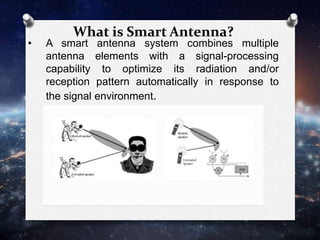
What is Smart Antenna?
• A smart antenna system combines multiple
antenna elements with a signal-processing
capability to optimize its radiation and/or
reception pattern automatically in response to
the signal environment.
•In truth, antennas are not smart—antenna systems
are smart. Generally co-located with a base station, a
smart antenna system combines an antenna array
with a digital signal-processing capability to transmit
and receive in an adaptive, spatially sensitive
manner.
Types of Smart Antenna systems
• Smart antenna systems are customarily
categorized, as either switched beam or
adaptive array systems.
 · Switched beam—a finite number of fixed,
predefined patterns or combining strategies
(sectors)
 · Adaptive array —an infinite number of
patterns (scenario-based) that are adjusted in
real time
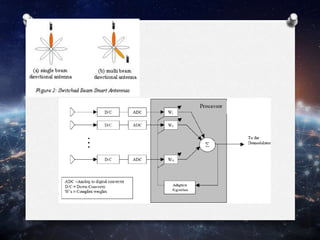
Switched Beam Antennas
• It form multiple fixed beams with heightened
sensitivity in particular directions.
• These antenna systems detect signal strength,
choose from one of several predetermined, fixed
beams, and switch from one beam to another as
the mobile moves throughout the sector.
• switched beam systems combine the outputs of
multiple antennas in such a way as to form finely
sectorized (directional) beams with more
selectivity.
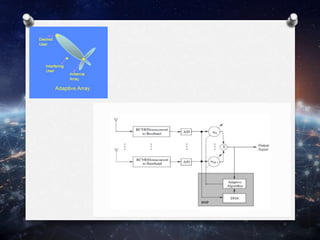
Adaptive Array Antennas
• Adaptive antenna technology represents the most
advanced smart antenna approach by using a
variety of new signal-processing algorithms.
• It provides optimal gain while simultaneously
identifying, tracking, and minimizing interfering
signals.
The goals of a smart antenna system
• The purpose of a smart antenna system is to
augment the signal quality of the radio-based
system through more focused transmission of
radio signals while enhancing capacity through
increased frequency reuse.
• The features of a smart antenna system are
- signal gain.
- inference rejection.
-power efficiency.
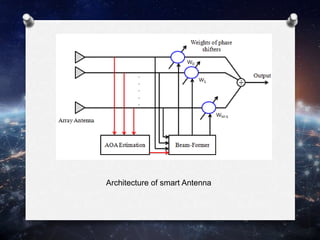
Architecture of smart antenna system
• Switched beam and adaptive array systems enable
a base station to customize the beams they
generate for each remote user effectively by
means of internal feedback control.
• Listening to the cell.(uplink processing).
• Speaking to the users(downlink processing).
Architecture of smart Antenna
Benefits of Switched Beam and
Adaptive Array systems
•Integration.
•Range or coverage.
•Interference suppression.
Who can use smart antennas ?
• Smart antenna technology can significantly improve
wireless system performance and economics for a
range of potential users.
• It enables operators of PCS, cellular, and wireless
local loop (WLL) networks to realize significant
increases in signal quality, capacity, and coverage.
Smart antennas can help systems meet these
requirements in the following manner:
• First, both phased and adaptive arrays provide
increased power by providing higher gain for the
desired signal.
• In terms of interference suppression, phased
arrays reduce the probability of interference with
the narrower beam, and adaptive arrays adjust
the beam pattern to suppress interference.
Advantages of smart antenna
• Phased arrays are mainly being studied for point-
to-point wireless systems, e.g., for wireless local
loops.
• Adaptive arrays are being considered on cellular
terminals where local scattering causes wide
angular spread.
• In the TDMA system ANSI-136 adaptive antenna
algorithms have been widely deployed.
Uses of smart antenna
Conclusion
• The use of smart antennas is not purely a radio
transmission issue.
• It also influences network services such as
handover and connection setup.
• A smart antenna is a digital wireless
communications antenna system that takes
advantage of diversity effect at the source
(transmitter), the destination (receiver), or both.
References
Owww.google.com
Owww.wikipedia.com
Owww.studymafia.org
Thank You

smart antenna.pptx

  • 1.
  • 2.
    Content O Introduction O Whatis Smart Antenna? O Types of Smart Antenna systems O The goals of a smart antenna system O Architecture of smart antenna system O Benefits of Switched Beam and Adaptive Array systems O Who can use smart antennas ? O Advantages of smart antenna O Conclusion O References
  • 3.
    Introduction O A smartantenna system combines multiple antenna elements with a signal processing capability to optimize its radiation and/or reception pattern automatically in response to the signal environment. O Beam the radio signal directly at a user to follow the user as they move. 3
  • 4.
    What is SmartAntenna? • A smart antenna system combines multiple antenna elements with a signal-processing capability to optimize its radiation and/or reception pattern automatically in response to the signal environment.
  • 5.
    •In truth, antennasare not smart—antenna systems are smart. Generally co-located with a base station, a smart antenna system combines an antenna array with a digital signal-processing capability to transmit and receive in an adaptive, spatially sensitive manner.
  • 6.
    Types of SmartAntenna systems • Smart antenna systems are customarily categorized, as either switched beam or adaptive array systems.  · Switched beam—a finite number of fixed, predefined patterns or combining strategies (sectors)  · Adaptive array —an infinite number of patterns (scenario-based) that are adjusted in real time
  • 7.
    Switched Beam Antennas •It form multiple fixed beams with heightened sensitivity in particular directions. • These antenna systems detect signal strength, choose from one of several predetermined, fixed beams, and switch from one beam to another as the mobile moves throughout the sector. • switched beam systems combine the outputs of multiple antennas in such a way as to form finely sectorized (directional) beams with more selectivity.
  • 9.
    Adaptive Array Antennas •Adaptive antenna technology represents the most advanced smart antenna approach by using a variety of new signal-processing algorithms. • It provides optimal gain while simultaneously identifying, tracking, and minimizing interfering signals.
  • 11.
    The goals ofa smart antenna system • The purpose of a smart antenna system is to augment the signal quality of the radio-based system through more focused transmission of radio signals while enhancing capacity through increased frequency reuse. • The features of a smart antenna system are - signal gain. - inference rejection. -power efficiency.
  • 12.
    Architecture of smartantenna system • Switched beam and adaptive array systems enable a base station to customize the beams they generate for each remote user effectively by means of internal feedback control. • Listening to the cell.(uplink processing). • Speaking to the users(downlink processing).
  • 13.
  • 14.
    Benefits of SwitchedBeam and Adaptive Array systems •Integration. •Range or coverage. •Interference suppression.
  • 15.
    Who can usesmart antennas ? • Smart antenna technology can significantly improve wireless system performance and economics for a range of potential users. • It enables operators of PCS, cellular, and wireless local loop (WLL) networks to realize significant increases in signal quality, capacity, and coverage.
  • 16.
    Smart antennas canhelp systems meet these requirements in the following manner: • First, both phased and adaptive arrays provide increased power by providing higher gain for the desired signal. • In terms of interference suppression, phased arrays reduce the probability of interference with the narrower beam, and adaptive arrays adjust the beam pattern to suppress interference. Advantages of smart antenna
  • 17.
    • Phased arraysare mainly being studied for point- to-point wireless systems, e.g., for wireless local loops. • Adaptive arrays are being considered on cellular terminals where local scattering causes wide angular spread. • In the TDMA system ANSI-136 adaptive antenna algorithms have been widely deployed. Uses of smart antenna
  • 18.
    Conclusion • The useof smart antennas is not purely a radio transmission issue. • It also influences network services such as handover and connection setup. • A smart antenna is a digital wireless communications antenna system that takes advantage of diversity effect at the source (transmitter), the destination (receiver), or both.
  • 19.
  • 20.