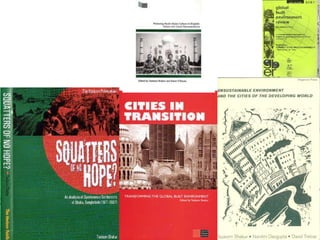
Theorizing Sustainable Design through Human Geographies Key Note Paper 12 th  August 2009 Dr Tasleem Shakur Email:  [email_address]   e-journals:  www.edgehill.ac.uk/gber   www.edgehill.ac.uk/icdes/sacs
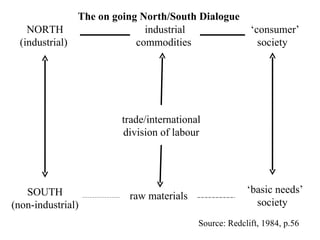
NORTH (industrial)  SOUTH (non-industrial) industrial commodities  ‘ consumer’ society  raw materials  ‘ basic needs’ society  trade/international division of labour Source: Redclift, 1984, p.56 The on going North/South Dialogue
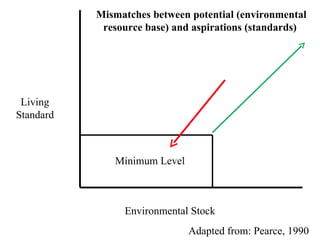
Living  Standard  Environmental Stock Minimum Level Adapted from: Pearce, 1990  Mismatches between potential (environmental resource base) and aspirations (standards)
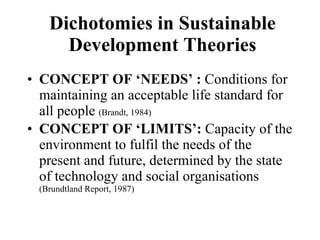
Dichotomies in Sustainable Development Theories CONCEPT OF ‘NEEDS’ :  Conditions for maintaining an acceptable life standard for all people  (Brandt, 1984)  CONCEPT OF ‘LIMITS’:  Capacity of the environment to fulfil the needs of the present and future, determined by the state of technology and social organisations  (Brundtland Report, 1987)
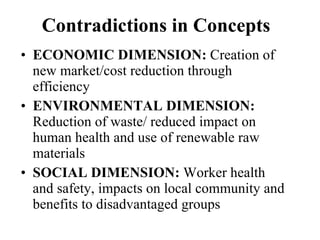
Contradictions in Concepts ECONOMIC DIMENSION:  Creation of new market/cost reduction through efficiency  ENVIRONMENTAL DIMENSION:  Reduction of waste/ reduced impact on human health and use of renewable raw materials SOCIAL DIMENSION:  Worker health and safety, impacts on local community and benefits to disadvantaged groups
Contemporary Emerging Principles Understanding Place Connecting with Nature Understanding Natural Processes Understanding Environmental Impact Embracing co-creative design: importance to listen to every voice, voices of the community Understanding People THIS IS WHERE HUMAN GEOGRAPHIES COMES INTO ACTION!
Sustainable Architecture Concept would nowadays include a Combination of Values  Sustainability Durability Longevity Appropriate materials Sense of place The challenge is to find the balance between environmental considerations and economic constraints. Many suggest consideration must be given to the need of our  communities  and the  eco-system.
Ideal Context to Sustainable Design  CULTURAL CONTEXT IN:  Architecture history, theory SUSTAINABLE TECHNOLOGY:  Building design is responsible for consuming more than half the energy consumed in the US
Social and Environmental Aims  Locally and environmentally sensitive Re-thinking design methodology for sustainable social development  Climate as design generation To sustain cultural identity in the face of rapid global technological change Short term gains versus long term failures End of 1980s and the beginning of the 1990s  began the era of sustainability with economy and environmental care
Environmental Design and Cultural Identity: A Challenge to ‘modernity’? Le Corbusier’s ‘Only one house for all cultures’ or ‘global common place’ (failure of Bijlmermeer design of the 1960s in Amsterdam)  (Shakur, 2005)  Louis Kahn in defence of poor rain protection in his massive national assembly building in Bangladesh ‘why the hell does it rain so much in Bangladesh?’ (Shakur, 2008)  Nehru while commissioning Le Corbusier for the planning and design of Chandigarh ‘let a city be born free from the past prejudices of India?’  (Shakur, 2003)
Some Concluding Thoughts Shifting roles, performance and limitations of the designers, builders and constructors  (Shakur,  et al , 2001)  (preoccupation with micro scale interactions) What are the implications for design education in the future? Not to treat design and design professions as independent variables  Relationships between individuals, built environment, design professions and society  (Knox, 2004, p.94)
Some Concluding Thoughts Sustainable design education versus postmodern societies Challenge for the future – design professionals are becoming more and more irrelevant, a passenger on a rudderless postmodern ship  (Newman and Kenworthy, 2003)
 

Theorizing Sustainable Design through Human Geographies

  • 1.
    Theorizing Sustainable Designthrough Human Geographies Key Note Paper 12 th August 2009 Dr Tasleem Shakur Email: [email_address] e-journals: www.edgehill.ac.uk/gber www.edgehill.ac.uk/icdes/sacs
  • 2.
    NORTH (industrial) SOUTH (non-industrial) industrial commodities ‘ consumer’ society raw materials ‘ basic needs’ society trade/international division of labour Source: Redclift, 1984, p.56 The on going North/South Dialogue
  • 3.
    Living Standard Environmental Stock Minimum Level Adapted from: Pearce, 1990 Mismatches between potential (environmental resource base) and aspirations (standards)
  • 4.
    Dichotomies in SustainableDevelopment Theories CONCEPT OF ‘NEEDS’ : Conditions for maintaining an acceptable life standard for all people (Brandt, 1984) CONCEPT OF ‘LIMITS’: Capacity of the environment to fulfil the needs of the present and future, determined by the state of technology and social organisations (Brundtland Report, 1987)
  • 5.
    Contradictions in ConceptsECONOMIC DIMENSION: Creation of new market/cost reduction through efficiency ENVIRONMENTAL DIMENSION: Reduction of waste/ reduced impact on human health and use of renewable raw materials SOCIAL DIMENSION: Worker health and safety, impacts on local community and benefits to disadvantaged groups
  • 6.
    Contemporary Emerging PrinciplesUnderstanding Place Connecting with Nature Understanding Natural Processes Understanding Environmental Impact Embracing co-creative design: importance to listen to every voice, voices of the community Understanding People THIS IS WHERE HUMAN GEOGRAPHIES COMES INTO ACTION!
  • 7.
    Sustainable Architecture Conceptwould nowadays include a Combination of Values Sustainability Durability Longevity Appropriate materials Sense of place The challenge is to find the balance between environmental considerations and economic constraints. Many suggest consideration must be given to the need of our communities and the eco-system.
  • 8.
    Ideal Context toSustainable Design CULTURAL CONTEXT IN: Architecture history, theory SUSTAINABLE TECHNOLOGY: Building design is responsible for consuming more than half the energy consumed in the US
  • 9.
    Social and EnvironmentalAims Locally and environmentally sensitive Re-thinking design methodology for sustainable social development Climate as design generation To sustain cultural identity in the face of rapid global technological change Short term gains versus long term failures End of 1980s and the beginning of the 1990s began the era of sustainability with economy and environmental care
  • 10.
    Environmental Design andCultural Identity: A Challenge to ‘modernity’? Le Corbusier’s ‘Only one house for all cultures’ or ‘global common place’ (failure of Bijlmermeer design of the 1960s in Amsterdam) (Shakur, 2005) Louis Kahn in defence of poor rain protection in his massive national assembly building in Bangladesh ‘why the hell does it rain so much in Bangladesh?’ (Shakur, 2008) Nehru while commissioning Le Corbusier for the planning and design of Chandigarh ‘let a city be born free from the past prejudices of India?’ (Shakur, 2003)
  • 11.
    Some Concluding ThoughtsShifting roles, performance and limitations of the designers, builders and constructors (Shakur, et al , 2001) (preoccupation with micro scale interactions) What are the implications for design education in the future? Not to treat design and design professions as independent variables Relationships between individuals, built environment, design professions and society (Knox, 2004, p.94)
  • 12.
    Some Concluding ThoughtsSustainable design education versus postmodern societies Challenge for the future – design professionals are becoming more and more irrelevant, a passenger on a rudderless postmodern ship (Newman and Kenworthy, 2003)
  • 13.