Electric Forces and
                                                               Electric Fields
CHAPTER OUTLINE
19.1    Historical Overview
19.2    Properties of Electric
        Charges                                      ANSWERS TO QUESTIONS
19.3    Insulators and
        Conductors
19.4    Coulomb’s Law               Q19.1   A neutral atom is one that has no net charge. This means that it has
19.5    Electric Fields                     the same number of electrons orbiting the nucleus as it has protons
19.6    Electric Field Lines
19.7    Motion of Charged                   in the nucleus. A negatively charged atom has one or more excess
        Particles in a Uniform              electrons.
        Electric Field
19.8    Electric Flux
19.9    Gauss’s Law                 Q19.2   The clothes dryer rubs dissimilar materials together as it tumbles the
19.10   Application of Gauss’s              clothes. Electrons are transferred from one kind of molecule to
        Law to Symmetric Charge
                                            another. The charges on pieces of cloth, or on nearby objects charged
        Distributions
19.11   Conductors in                       by induction, can produce strong electric fields that promote the
        Electrostatic Equilibrium           ionization process in the surrounding air that is necessary for a spark
19.12   Context ConnectionThe              to occur. Then you hear or see the sparks.
        Atmospheric Electric
        Field


Q19.3      To avoid making a spark. Rubber-soled shoes acquire a charge by friction with the floor and could
           discharge with a spark, possibly causing an explosion of any flammable material in the oxygen-
           enriched atmosphere.

Q19.4      Similarities: A force of gravity is proportional to the product of the intrinsic properties (masses) of
           two particles, and inversely proportional to the square of the separation distance. An electrical force
           exhibits the same proportionalities, with charge as the intrinsic property.
                 Differences: The electrical force can either attract or repel, while the gravitational force as
           described by Newton’s law can only attract. The electrical force between elementary particles is
           vastly stronger than the gravitational force.

Q19.5      No. The balloon induces polarization of the molecules in the wall, so that a layer of positive charge
           exists near the balloon. This is just like the situation in Figure 19.5a, except that the signs of the
           charges are reversed. The attraction between these charges and the negative charges on the balloon
           is stronger than the repulsion between the negative charges on the balloon and the negative charges
           in the polarized molecules (because they are farther from the balloon), so that there is a net attractive
           force toward the wall. Ionization processes in the air surrounding the balloon provide ions to which
           excess electrons in the balloon can transfer, reducing the charge on the balloon and eventually
           causing the attractive force to be insufficient to support the weight of the balloon.


                                                        519
520     Electric Forces and Electric Fields

Q19.6      An electric field once established by a positive or negative charge extends in all directions from the
           charge. Thus, it can exist in empty space if that is what surrounds the charge. There is no material at
           point A in Figure 19.18(a), so there is no charge, nor is there a force. There would be a force if a
           charge were present at point A, however. A field does exist at point A.

Q19.7      If a charge distribution is small compared to the distance of a field point from it, the charge
           distribution can be modeled as a single particle with charge equal to the net charge of the
           distribution. Further, if a charge distribution is spherically symmetric, it will create a field at exterior
           points just as if all of its charge were a point charge at its center.
                                             r        r
Q19.8      Both figures are drawn correctly. E1 and E 2 are the electric fields separately created by the point
                                                                                          r      r              r
           charges q and −q in Figure 19.11. The net electric field is the vector sum of E1 and E 2 , shown as E .
           Figure 19.16 shows only one electric field line at each point away from the charge. At the point
           location of an object modeled as a point charge, the direction of the field is undefined, and so is its
           magnitude.

Q19.9      No. Life would be no different if electrons were + charged and protons were – charged. Opposite
           charges would still attract, and like charges would repel. The naming of + and – charge is merely a
           convention.

Q19.10     At a point exactly midway between the two charges.

Q19.11     In special orientations the force between two dipoles can be zero or a force of repulsion. In general
           each dipole will exert a torque on the other, tending to align its axis with the field created by the first
           dipole. After this alignment, each dipole exerts a force of attraction on the other.

Q19.12     The negative charge will be drawn to the center of the positively charged ring. Since it will then
           have velocity, it will continue on, to an equidistant point on the opposite side of the ring. It will then
           start moving back and arrive again at point P . This periodic motion will continue. If x is much less
           than a, the motion can be shown from the solution for the electric field to be simple harmonic.

Q19.13     The surface must enclose a positive total charge.

Q19.14     The net flux through any gaussian surface is zero. We can argue it two ways. Any surface contains
           zero charge so Gauss’s law says the total flux is zero. The field is uniform, so the field lines entering
           one side of the closed surface come out the other side and the net flux is zero.

Q19.15     Gauss’s law cannot tell the different values of the electric field at different points on the surface.
                                                                 z              z                   b
           When E is an unknown number, then we can say E cos θ dA = E cos θ dA . When E x , y , z is an
           unknown function, then there is no such simplification.
                                                                                                            g
Q19.16     Inject some charge at arbitrary places within a conducting object. Every bit of the charge repels
           every other bit, so each bit runs away as far as it can, stopping only when it reaches the outer surface
           of the conductor.

Q19.17     If the person is uncharged, the electric field inside the sphere is zero. The interior wall of the shell
           carries no charge. The person is not harmed by touching this wall. If the person carries a (small)
           charge q, the electric field inside the sphere is no longer zero. Charge –q is induced on the inner wall
           of the sphere. The person will get a (small) shock when touching the sphere, as all the charge on his
           body jumps to the metal.
Chapter 19521
                                                                                                            r
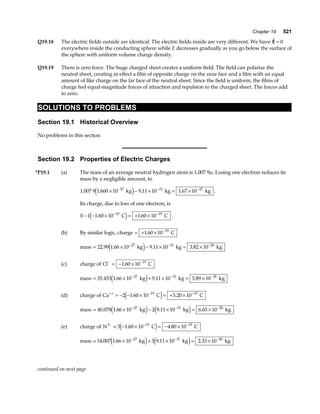
Q19.18    The electric fields outside are identical. The electric fields inside are very different. We have E = 0
          everywhere inside the conducting sphere while E decreases gradually as you go below the surface of
          the sphere with uniform volume charge density.

Q19.19    There is zero force. The huge charged sheet creates a uniform field. The field can polarize the
          neutral sheet, creating in effect a film of opposite charge on the near face and a film with an equal
          amount of like charge on the far face of the neutral sheet. Since the field is uniform, the films of
          charge feel equal-magnitude forces of attraction and repulsion to the charged sheet. The forces add
          to zero.

 SOLUTIONS TO PROBLEMS
Section 19.1 Historical Overview

No problems in this section


Section 19.2 Properties of Electric Charges

*P19.1    (a)      The mass of an average neutral hydrogen atom is 1.007 9u. Losing one electron reduces its
                   mass by a negligible amount, to

                             e                   j
                   1.007 9 1.660 × 10 −27 kg − 9.11 × 10 −31 kg = 1.67 × 10 −27 kg .

                   Its charge, due to loss of one electron, is

                         e                   j
                   0 − 1 −1.60 × 10 −19 C = +1.60 × 10 −19 C .


          (b)      By similar logic, charge = +1.60 × 10 −19 C

                                 e                     j
                   mass = 22.99 1.66 × 10 −27 kg − 9.11 × 10 −31 kg = 3.82 × 10 −26 kg


          (c)      charge of Cl − = −1.60 × 10 −19 C

                                     e                     j
                   mass = 35.453 1.66 × 10 −27 kg + 9.11 × 10 −31 kg = 5.89 × 10 −26 kg


          (d)                                e                   j
                   charge of Ca ++ = −2 −1.60 × 10 −19 C = +3.20 × 10 −19 C

                                     e                     j e                    j
                   mass = 40.078 1.66 × 10 −27 kg − 2 9.11 × 10 −31 kg = 6.65 × 10 −26 kg


          (e)                            e                    j
                   charge of N 3 − = 3 −1.60 × 10 −19 C = −4.80 × 10 −19 C

                                     e
                   mass = 14.007 1.66 × 10 −27       kg j + 3e9.11 × 10   −31
                                                                                  j
                                                                                kg = 2.33 × 10 −26 kg


continued on next page
522     Electric Forces and Electric Fields


           (f)                                           e
                     charge of N 4+ = 4 1.60 × 10 −19 C = +6.40 × 10 −19 C          j
                                             e                                j e
                     mass = 14.007 1.66 × 10 −27 kg − 4 9.11 × 10 −31 kg = 2.32 × 10 −26 kg              j
           (g)       We think of a nitrogen nucleus as a seven-times ionized nitrogen atom.

                                         e
                     charge = 7 1.60 × 10 −19 C = 1.12 × 10 −18 C       j
                                             e                                j e
                     mass = 14.007 1.66 × 10 −27 kg − 7 9.11 × 10 −31 kg = 2.32 × 10 −26 kg              j
           (h)       charge = −1.60 × 10 −19 C

                                     b               g
                     mass = 2 1.007 9 + 15.999 1.66 × 10 −27 kg + 9.11 × 10 −31 kg = 2.99 × 10 −26 kg


                            F 10.0 grams I FG 6.02 × 10                                      atoms   IJ FG 47 electrons IJ =
P19.2      (a)       N=     GH 107.87 grams mol JK H                                    23
                                                                                              mol     K H atom K                2.62 × 10 24


                                                                  Q       1.00 × 10 −3 C
           (b)       # electrons added =                            =                        = 6.25 × 10 15
                                                                  e 1.60 × 10 −19 C electron

                     or           2.38 electrons for every 10 9 already present .


Section 19.3 Insulators and Conductors

No problems in this section


Section 19.4 Coulomb’s Law

P19.3      If each person has a mass of ≈ 70 kg and is (almost) composed of water, then each person contains

                 F 70 000 grams I FG 6.02 × 10                              molecules    IJ FG 10 protons IJ = 2.3 × 10
            N=   GH 18 grams mol JK H                              23
                                                                              mol         K H molecule K
                                                                                                                           28
                                                                                                                                protons .


           With an excess of 1% electrons over protons, each person has a charge

                             e                               je
                   q = 0.01 1.6 × 10 −19 C 2.3 × 10 28 = 3.7 × 10 7 C .        j
           So      F = ke
                            q1 q 2
                                     = e9 × 10 j
                                                 e3.7 × 10 j
                                                         9
                                                                              7 2
                                                                                    N = 4 × 10 25 N ~ 10 26 N .
                             r2                                     0.6 2
           This force is almost enough to lift a weight equal to that of the Earth:

                                                 e
                   Mg = 6 × 10 24 kg 9.8 m s 2 = 6 × 10 25 N ~ 10 26 N .j
Chapter 19   523
                                    r k q q
P19.4    The force on one proton is F = e 1 2 away from the other proton. Its magnitude is
                                         r2


                                           jFGH 12.6××10           I
                                                            −19           2
                                                       10         C
         e   8.99 × 10 9 N ⋅ m C 2                        −15      J
                                                                  mK
                                                                               = 57.5 N .


P19.5    F1 = k e
                    q1 q 2
                             =
                                 e8.99 × 10    9
                                                                          je
                                                       N ⋅ m 2 C 2 7.00 × 10 −6 C 2.00 × 10 −6 C je                     j = 0.503 N
                     r   2
                                                                   a0.500 mf            2


         F2 = k e
                    q1 q 2
                             =
                               e8.99 × 10      9
                                                       N ⋅ m2     C je7.00 × 10 C je 4.00 × 10 C j
                                                                      2                     −6
                                                                                                   = 1.01 N
                                                                                                            −6


                     r2                                            a0.500 mf            2


                                                                                                                                                     r
         Fx = 0.503 cos 60.0°+1.01 cos 60.0° = 0.755 N                                                                                               F1
         Fy = 0.503 sin 60.0°−1.01 sin 60.0° = −0.436 N
         r                                                                                                                                      r
               a             f a                   f
         F = 0.755 N $ − 0.436 N $ = 0.872 N at an angle of 330°
                       i             j                                                                                                          F2


                                                                                                                                              FIG. P19.5

                                 r            k e q A qB $
*P19.6   In the first situation, FA on B ,1 =            i . In the second situation, q A and qB are the same.
                                                   r12

                                                            r              r         k e q A qB $
                                                            FB on A ,2 = − FA on B =
                                                                                          r22
                                                                                                −i         e j
                                                            F2 k e q A qB      r12
                                                               =
                                                            F1      r22   k e q A qB
                                                                   F1 r12                        FG 13.7 mmIJ   2
                                                            F2 =
                                                                      r22
                                                                                   = 2.62 µN
                                                                                                  H 17.7 mmK        = 1.57 µN

              r
         Then FB on A ,2 = 1.57 µN to the left .


P19.7    (a)         The force is one of attraction . The distance r in Coulomb’s law is the distance between
                     centers. The magnitude of the force is


                     F=
                             k e q1 q 2
                                           e
                                          = 8.99 × 10 N ⋅ m 9                  2
                                                                                   C j
                                                                                    2  e12.0 × 10 Cje18.0 × 10 Cj =
                                                                                                      −9                  −9
                                                                                                                                      2.16 × 10 −5 N .
                                 r2                                                              a0.300 mf          2


         (b)         The net charge of −6.00 × 10 −9 C will be equally split between the two spheres, or
                     −3.00 × 10 −9 C on each. The force is one of repulsion , and its magnitude is


                     F=
                             k e q1 q 2
                                           e
                                          = 8.99 × 10 N ⋅ m 9                  2
                                                                                   C j
                                                                                    2  e3.00 × 10 Cje3.00 × 10 Cj =
                                                                                                      −9                   −9
                                                                                                                                      8.99 × 10 −7 N .
                                 r2                                                              a0.300 mf          2
524      Electric Forces and Electric Fields

*P19.8      Let the third bead have charge Q and be located distance x from the left end of the rod. This bead
            will experience a net force given by

             F=
                    b g
             r ke 3q Q        bg e j
                       $ + ke q Q −$ .
                       i           i
                  x 2
                             a f
                           d−x
                                 2


                                                  3     1                                   x
            The net force will be zero if            =                   , or d − x =            .
                                                  x2    a
                                                       d−x       f   2
                                                                                             3

            This gives an equilibrium position of the third bead of x = 0.634d .

            The equilibrium is stable if the third bead has positive charge .


                                                                     j e0.529 × 10               j
                                                                                     −19             2
                         k e2                                            1.60 × 10           C
P19.9       (a)                   e
                      F = e 2 = 8.99 × 10 9 N ⋅ m 2 C 2                                                      = 8.22 × 10 −8 N
                          r
                                                                      e                −10
                                                                                                m    j   2


                                       mv 2
            (b)      We have F =            from which
                                        r


                                         v=
                                                  Fr
                                                     =
                                                                                 e
                                                              8.22 × 10 −8 N 0.529 × 10 −10 m                     j=    2.19 × 10 6 m s .
                                                                                       −31
                                                  m                        9.11 × 10            kg


Section 19.5 Electric Fields
                                      r      r
P19.10      For equilibrium,          Fe = − Fg
                                       r
            or                                    e j
                                      qE = − mg − $ .
                                                  j

                                      r mg
            Thus,                     E=   $.
                                           j
                                         q


            (a)
                      r mg
                      E=   $=
                           j
                                  e
                              9.11 × 10 −31 kg 9.80 m s 2je                  j
                                                          $ = − 5.58 × 10 −11 N C $
                                                          j                       j     e                               j
                         q                e
                                     −1.60 × 10 −19
                                                    C                j
            (b)
                      r mg
                      E=   $=
                           j
                                  e
                              1.67 × 10 −27 kg 9.80 m s 2je
                                                          $=
                                                          j
                                                                             j       e1.02 × 10              −7
                                                                                                                    j
                                                                                                                  NC$
                                                                                                                    j
                         q                 e
                                     1.60 × 10 −19 C             j
Chapter 19     525
 P19.11    The point is designated in the sketch. The magnitudes of the electric fields,                                              r        r
                                                                                                                                      E2       E1
           E1 , (due to the −2.50 × 10 −6 C charge) and E 2 (due to the 6.00 × 10 −6 C
           charge) are


           E1 =
                  ke q
                           =
                             e8.99 × 10    9
                                                               je
                                               N ⋅ m 2 C 2 2.50 × 10 −6 C                j                                      (1)
                                                                                                                                           FIG. P19.11
                       2                                  2
                   r                                  d


           E2 =
                  keq
                            =
                              e8.99 × 10   9
                                                         je
                                               N ⋅ m 2 C 2 6.00 × 10 −6 C                 j                                     (2)
                   r   2
                                               ad + 1.00 mf         2


           Equate the right sides of (1) and (2)

                   to get                      ad + 1.00 mf         2
                                                                        = 2.40d 2

                   or                          d + 1.00 m = ±1.55d

                   which yields                d = 1.82 m

                   or                          d = −0.392 m .

           The negative value for d is unsatisfactory because that locates a point between the charges where
           both fields are in the same direction.

           Thus,                               d = 1.82 m to the left of the − 2.50 µC charge .

                                                                                  k eQ                                    +Q x = 0                       q
* P19.12   The first charge creates at the origin field                             2
                                                                                          to the right.
                                                         a                                                                                                    x
           Suppose the total field at the origin is to the right. Then q must
           be negative:                                                                                                               FIG. P19.12
           k eQ $ k e q      2k Q
            a 2
                i+
                   3a
                       2
                          i
                           a fe j
                         −$ = e $
                              a2
                                  i                                              q = −9Q .


           In the alternative, the total field at the origin is to the left:

           k eQ $ k e q $ 2 k eQ $
            a2
                i + 2 −i = 2 −i
                   9a       a
                               e j              e j                              q = +27Q .


                                         e j e                          je                   j e− $jj = −e2.70 × 10
                           r   k e q1   8.99 × 10 9 3.00 × 10 −9
 P19.13    (a)             E1 = 2 − $ =
                                 r1
                                      j
                                                0.100
                                                       2
                                                               a             f
                                                                                                                      3
                                                                                                                            j
                                                                                                                          NC$
                                                                                                                            j
                                                                                                                                           r
                                                                                                                                           E2
                                                                                                                                                    r
                                                                                                                                           r        E1
                                         e j e                          je                   je j e
                                                                    9                   −9
                           r     ke q2         8.99 × 10 6.00 × 10                                                                         E
                           E2 = 2 −$ =
                                   r2
                                          i
                                                        0.300
                                                              2
                                                               a       − $ = − 5.99 × 10 2 N C $
                                                                         i
                                                                             f                 i                            j
                           r r        r
                                            e                                    j e
                           E = E 2 + E 1 = − 5.99 × 10 2 N C $ − 2.70 × 10 3 N C $
                                                                i                 j                        j                                    FIG. P19.13

                           r    r
           (b)                       e                    je
                           F = qE = 5.00 × 10 −9 C −599 $ − 2 700 $ N C
                                                        i         j                     j
                           r
                              e
                           F = −3.00 × 10 −6 $ − 13.5 × 10 −6 $ N =
                                             i                j              j          e−3.00 $i − 13.5 $jj µN
526      Electric Forces and Electric Fields


P19.14      (a)             E=
                                    keq
                                             =
                                                 e8.99 × 10 je2.00 × 10 j = 14 400 N C
                                                                    9                      −6                                                      r
                                                                                                                                                   E
                                                                                                                                                                   r
                                                                                                                                                                   E
                                        r2                a1.12f             2


                            Ex = 0                    and       E = 2b14 400g sin 26.6° = 1.29 × 10
                                                                                 y
                                                                                                                                         4
                                                                                                                                             NC
                                                                              r                                                                            FIG. P19.14
                                                        so                    E = 1.29 × 10 4 $ N C .
                                                                                              j

                            r    r
            (b)                              e                          je
                            F = qE = −3.00 × 10 −6 1.29 × 10 4 $ = −3.86 × 10 −2 $ N
                                                               j                 j         j
                                                                                         k b 2 q g $ k b3 q g $
                                                                                                             ei cos 45.0°+ $j sin 45.0°j + k b4qg $j
                            r k q         k q        k q                                        e                   e                                  e
P19.15      (a)             E = e 2 1 r1 + e 2 2 r2 + e 2 3 r3
                                      $          $          $                          =           i+
                                r1         r2         r3                                            a2              2a 2                                   a2
                            r       k q         k q         k q
                            E = 3.06 e2 $ + 5.06 e2 $ = 5.91 e2 at 58.8°
                                        i           j
                                     a           a           a

                            r    r       k q2
            (b)             F = qE = 5.91 e 2 at 58.8°
                                          a

P19.16      The electric field at any point x is

             E=
                       ke q
                                    −
                                         a f     ke q
                                                            =
                                                                     k e q 4ax
                                                                                       .
                  ax − af cx − a− afh ex − a j
                                2                       2               2        2 2


            When x is much, much greater than a, we find E ≈
                                                                                                                           b g
                                                                                                                        4a k e q
                                                                                                                                     .
                                                                                                                           x3


P19.17       E=
                   k e λl b g
                          =
                                  e
                            ke Q l l
                                     =
                                         k eQ
                                              =
                                                8.99 × 10 9 22.0 × 10 −6                                  je                    j
                      a f a f a f a
                  d l+d     d l+d      d l+d     0.290 0.140 + 0.290                                 fa                     f
             r
             E = 1.59 × 10 6 N C , directed toward the rod.
                                                                                                                                                                FIG. P19.17


P19.18       E=   z   k e dq
                       x2
                                , where dq = λ 0 dx


                            z
                            ∞
                               dx            1      FG IJ       ∞
                                                                             keλ 0
                                                                                                                   The direction is − $ or left for λ 0 > 0
             E = keλ 0
                            x0 x
                                 2
                                   = keλ 0 −
                                             x       H K        x0
                                                                        =
                                                                              x0
                                                                                                                                      i


P19.19       E=
                           k e xQ
                                             =
                                                 e8.99 × 10 je75.0 × 10 jx = 6.74 × 10 x
                                                                    9                      −6                               5


                  ex   2
                           + a2     j   32
                                                      ex + 0.100 j
                                                            2
                                                                            ex + 0.010 0j
                                                                                 2 32                          2                32


                                                                             r
            (a)            At x = 0.010 0 m ,                                E = 6.64 × 10 6 $ N C = 6.64$ MN C
                                                                                             i           i

                                                                             r
            (b)            At x = 0.050 0 m ,                                E = 2.41 × 10 7 $ N C = 24.1$ MN C
                                                                                             i           i
continued on next page
Chapter 19   527
                                                                               r
          (c)             At x = 0.300 m ,                                     E = 6.40 × 10 6 $ N C = 6.40 $ MN C
                                                                                               i            i

                                                                               r
          (d)             At x = 1.00 m ,                                      E = 6.64 × 10 5 $ N C = 0.664$ MN C
                                                                                               i            i

                         k e Qx
*P19.20   E=
                ex   2
                         + a2   j   32


                                             dE
                                                                  LM               1                          3x 2
                                                                                                                   OP
          For a maximum,
                                             dx
                                                = Qk e
                                                                   MM ex                   j   32
                                                                                                    −
                                                                                                        ex + a j PQP
                                                                                                                      =0
                                                                                                                    2 52
                                                                    N
                                                                           2
                                                                               + a2                       2


                                                              a
          x 2 + a 2 − 3 x 2 = 0 or x =                             .
                                                              2
          Substituting into the expression for E gives

                         k eQa                   k eQ                      2 k eQ                       Q
          E=                             =                    =                                =                .
                  2      e aj
                          3
                          2
                              2 32           3   2
                                                  3
                                                      a   2            3 3a            2
                                                                                                    6 3π ∈0 a 2


 P19.21   Due to symmetry                                              z
                                                      Ey = dE y = 0 , and Ex = dE sin θ = k e                       z                        z   dq sin θ
                                                                                                                                                    r2
          where                                       dq = λds = λrdθ ,


          so that,                                    Ex =
                                                                       keλ π
                                                                        r 0        z  k λ
                                                                             sin θdθ = e − cos θ
                                                                                       r
                                                                                                                a              f   π
                                                                                                                                   0
                                                                                                                                       =
                                                                                                                                           2k e λ
                                                                                                                                            r
                                                                                                                                                                       FIG. P19.21
                                                                   q        L
          where                                       λ=             and r = .
                                                                   L        π

          Thus,                                       Ex =
                                                                       2 k e qπ
                                                                                       =
                                                                                                e                               je
                                                                                               2 8.99 × 10 9 N ⋅ m 2 C 2 7.50 × 10 −6 C π                   j   .
                                                                           L   2
                                                                                                                        a0.140 mf           2


          Solving,                                    Ex = 2.16 × 10 7 N C .
                                               r
          Since the rod has a negative charge, E = −2.16 × 10 7 $ N C = −21.6 $ MN C .
                                                                i             i                     e                      j
528       Electric Forces and Electric Fields
                                                                                                                              r
 P19.22      (a)       The electric field at point P due to each element of length dx, is                                    dE
                              k dq
                       dE = 2 e 2 and is directed along the line joining the element to
                            x +y
                       point P. By symmetry,

                            z
                       Ex = dE x = 0                        and since                 dq = λdx ,


                                z        z
                       E = Ey = dEy = dE cos θ              where                     cos θ =
                                                                                                      y
                                                                                                  x2 + y2
                                                                                                             .
                                                                                                                            FIG. P19.22


                                                      ze
                                                      l2
                                                                dx                  2 k e λ sin θ 0
                       Therefore,      E = 2 k e λy                         =                       .
                                                      0
                                                            2
                                                           x +y       j
                                                                     2 32                   y


                                                                                                             2k e λ
             (b)      For a bar of infinite length,             θ 0 = 90°               and           Ey =          .
                                                                                                              y


P19.23       (a)      The whole surface area of the cylinder is A = 2π r 2 + 2π rL = 2π r r + L .                a f
                                 e                         j b                  g
                       Q = σA = 15.0 × 10 −9 C m 2 2π 0.025 0 m 0.025 0 m + 0.060 0 m = 2.00 × 10 −10 C


             (b)      For the curved lateral surface only, A = 2π rL .

                                 e                         j b                  ga
                       Q = σA = 15.0 × 10 −9 C m 2 2π 0.025 0 m 0.060 0 m = 1.41 × 10 −10 C       f
             (c)                             e
                       Q = ρV = ρπ r 2 L = 500 × 10 −9 C m 3 π 0.025 0 m  j b               g b0.060 0 mg =
                                                                                              2
                                                                                                                   5.89 × 10 −11 C


Section 19.6 Electric Field Lines

                       q1 −6      1
*P19.24      (a)          =   = −
                       q 2 18     3

             (b)        q1 is negative, q 2 is positive


 P19.25


                         FIG. P19.25
Chapter 19   529
P19.26   (a)   The electric field has the general appearance shown. It is zero
                at the center , where (by symmetry) one can see that the
               three charges individually produce fields that cancel out.
                      In addition to the center of the triangle, the electric field
               lines in the second figure to the right indicate three other
               points near the middle of each leg of the triangle where E = 0 ,
               but they are more difficult to find mathematically.

         (b)   You may need to review vector addition in Chapter One. The
               electric field at point P can be found by adding the electric field
                                                                     r r       r
               vectors due to each of the two lower point charges: E = E1 + E 2 .
                                                         r       q
               The electric field from a point charge is E = k e 2 r .
                                                                   $                                           r        r
                                                                r                                              E2       E1
               As shown in the solution figure at right,
               r        q
               E1 = k e 2 to the right and upward at 60°
                       a
               r         q
               E 2 = k e 2 to the left and upward at 60°
                        a                                                                                      FIG. P19.26
               r r      r          q                                                      q
                                  a
                                           ei           j     j e     i           j
                                                                                         a
                                                                                             j
               E = E1 + E 2 = k e 2 cos 60° $ + sin 60° $ + − cos 60° $ + sin 60° $ = k e 2 2 sin 60° $
                                                                                                      j    e           j
                             q
                 = 1.73 k e 2 $ j
                            a


Section 19.7 Motion of Charged Particles in a Uniform Electric Field

P19.27   (a)   a=
                    qE 1.60 × 10 −19 640
                      =
                                           a f
                                         = 6.13 × 10 10 m s 2
                                    −27
                    m     1.67 × 10

         (b)   v f = vi + at                                        e
                                                  1.20 × 10 6 = 6.13 × 10 10 t        j             t = 1.95 × 10 −5 s

                            1                                1
         (c)   x f − xi =
                            2
                               d       i
                              vi + v f t              xf =
                                                             2
                                                              e                 je           j
                                                               1.20 × 10 6 1.95 × 10 −5 = 11.7 m


                    1       1
         (d)   K=
                    2       2
                                   e             je
                      mv 2 = 1.67 × 10 −27 kg 1.20 × 10 6 m s           j   2
                                                                                = 1.20 × 10 −15 J
530      Electric Forces and Electric Fields

P19.28      The required electric field will be in the direction of motion .

            Work done = ∆K
                                                 1
            so,                          − Fd = − mvi2 (since the final velocity = 0 )
                                                 2
            which becomes                eEd = K

                                                  K
            and                          E=          .
                                                  ed

                            x    0.050 0
P19.29      (a)       t=      =            = 1.11 × 10 −7 s = 111 ns
                           v x 4.50 × 10 5


            (b)       ay =
                           qE 1.602 × 10
                             =
                                         e
                                         −19
                                              9.60 × 10 3    je            j
                                                          = 9.21 × 10 11 m s 2
                           m         1.67 × 10 −27e               j
                                                 1                                 1
                      y f − yi = v yi t +
                                                 2
                                                   ayt 2 :            yf =
                                                                                   2
                                                                                    e                  je
                                                                                     9.21 × 10 11 1.11 × 10 −7        j   2
                                                                                                                              = 5.68 × 10 −3 m = 5.68 mm


            (c)       v x = 4.50 × 10 5 m s                                                        e             je                 j
                                                                      v yf = v yi + a y t = 9.21 × 10 11 1.11 × 10 −7 = 1.02 × 10 5 m s


Section 19.8 Electric Flux

P19.30                           e                           je        j
             Φ E = EA cos θ = 2.00 × 10 4 N C 18.0 m 2 cos 10.0° = 355 kN ⋅ m 2 C


P19.31       Φ E = EA cos θ                                                    a
                                                             A = π r 2 = π 0.200        f   2
                                                                                                = 0.126 m 2

                            a
             5.20 × 10 5 = E 0.126 cos 0°    f               E = 4.14 × 10 6 N C = 4.14 MN C


Section 19.9 Gauss’s Law


P19.32      (a)       E=
                           k eQ
                                     :                                                          8.90 × 10 2 =
                                                                                                                e8.99 × 10 jQ  9


                            r2                                                                                     a0.750f      2

                                             r
                     But Q is negative since E points inward.                                   Q = −5.57 × 10 −8 C = −55.7 nC


            (b)      The negative charge has a spherically symmetric charge distribution, concentric with
                     the spherical shell.
Chapter 19   531
P19.33   (a)      With δ very small, all points on the hemisphere are nearly at
                  a distance R from the charge, so the field everywhere on the                                               Q
                                     kQ                                                                             δ →0
                  curved surface is e 2 radially outward (normal to the
                                      R
                  surface). Therefore, the flux is this field strength times the
                  area of half a sphere:

                               z
                              r r
                  Φ curved = E ⋅ dA = Elocal A hemisphere
                               FG       Q    IJ FG 1 4π R IJ = 1 Qa2π f =
                                                             2                        +Q
                  Φ curved = k e
                                H       R2    K H 2 K 4π ∈                 0          2 ∈0                            FIG. P19.33

         (b)      The closed surface encloses zero charge so Gauss’s law gives

                                                                                             −Q
                  Φ curved + Φ flat = 0                 or           Φ flat = − Φ curved =        .
                                                                                             2 ∈0

                qin      170 × 10 −6 C
P19.34   ΦE =       =                        = 1.92 × 10 7 N ⋅ m 2 C
                ∈0 8.85 × 10 −12 C 2 N ⋅ m 2


                                               1.92 × 10 7 N ⋅ m 2 C
         (a)      bΦ g
                     E one face     =
                                        1
                                        6
                                          ΦE =
                                                          6
                                                                                                  bΦ gE one face   = 3.20 MN ⋅ m 2 C


         (b)      Φ E = 19.2 MN ⋅ m 2 C

         (c)       The answer to (a) would change because the flux through each face of the cube would
                   not be equal with an asymmetric charge distribution. The sides of the cube nearer the
                   charge would have more flux and the ones further away would have less. The answer
                   to (b) would remain the same, since the overall flux would remain the same.


Section 19.10 Application of Gauss’s Law to Symmetric Charge Distributions
                       k eQr
P19.35   (a)      E=           = 0
                         a3


         (b)      E=
                       k eQr
                               =
                                    e8.99 × 10 je26.0 × 10 ja0.100f =
                                                    9                 −6
                                                                                     365 kN C
                         a3                     a0.400f          3


         (c)      E=
                       k eQ
                              =
                                e8.99 × 10 je26.0 × 10 j =
                                                9                    −6
                                                                               1. 46 MN C
                       r2                a0.400f             2


         (d)      E=
                       k eQ
                              =
                                e8.99 × 10 je26.0 × 10 j =
                                                9                    −6
                                                                               649 kN C
                       r2                a0.600f             2


                  The direction for each electric field is radially outward .
532       Electric Forces and Electric Fields


*P19.36
                         F σ IJ = qFG Q A IJ
              mg = qE = qG
                                                              Q 2 ∈0 mg 2 8.85 × 10
                                                                =      =
                                                                                      e
                                                                                    −12
                                                                                        0.01 9.8          ja fa f
                                                                                                 = −2.48 µC m 2
                         H2∈ K H 2∈ K
                                  0           0               A    q           −0.7 × 10 −6


P19.37       (a)
                         2k λ
                       E= e                                     4
                                                      3.60 × 10 =
                                                                      e              jb
                                                                     2 8.99 × 10 9 Q 2.40           g
                          r                                                     0.190

                       Q = +9.13 × 10 −7 C = +913 nC

                       r
             (b)       E= 0

                       r
P19.38       (a)       E= 0


             (b)       E=
                            k eQ
                                      =
                                        e8.99 × 10 je32.0 × 10 j = 7.19 MN C
                                                  9           −6
                                                                                                        r
                                                                                                        E = 7.19 MN C radially outward
                             r2                  a0.200f
                                                       2


 P19.39      If ρ is positive, the field must be radially outward. Choose as the
             gaussian surface a cylinder of length L and radius r, contained inside
             the charged rod. Its volume is π r 2 L and it encloses charge ρπ r 2 L .
             Because the charge distribution is long, no electric flux passes
                                               r r
             through the r rcircular end caps; E ⋅ dA = EdA cos 90.0° = 0 . The curved
             surface has E ⋅ dA = EdA cos 0° , and E must be the same strength
             everywhere over the curved surface.                                                                     FIG. P19.39

                          r r
                             z
             Gauss’s law, E ⋅ dA =
                                    q
                                   ∈0
                                      ,               becomes        E    z
                                                                      Curved
                                                                              dA =
                                                                                     ρπ r 2 L
                                                                                       ∈0
                                                                                                .
                                                                      Surface


             Now the lateral surface area of the cylinder is 2π rL :

                           ρπ r 2 L                                  r        ρr
               b g
              E 2π r L =
                             ∈0
                                       .              Thus,          E=
                                                                              2 ∈0
                                                                                     radially away from the cylinder axis .


                                                                    4 3                       3Q
*P19.40      The charge density is determined by Q =                  πa ρ              ρ=
                                                                    3                        4π a 3

             (a)      The flux is that created by the enclosed charge within radius r:

                                 qin 4π r 3 ρ    4π r 3 3Q    Qr 3
                       ΦE =         =         =             =
                                 ∈0   3 ∈0      3 ∈0 4π a 3   ∈0 a 3

                                  Q
             (b)       ΦE =          . Note that the answers to parts (a) and (b) agree at r = a .
                                  ∈0


continued on next page
Chapter 19   533
         (c)                          ΦE

                                 Q
                                 ∈0


                                  0                                      r
                                      0            a

                                             FIG. P19.40(c)

P19.41   The distance between centers is 2 × 5.90 × 10 −15 m . Each produces a field as if it were a point charge
         at its center, and each feels a force as if all its charge were a point at its center.
.


               k e q1 q 2                                   a46f e1.60 × 10 Cj
                                                                    2                  −19       2

         F=                  e
                            = 8.99 × 10 N ⋅ m9      2
                                                        C j
                                                          2
                                                                                                      = 3.50 × 10 3 N = 3.50 kN
                  r2
                                                             e2 × 5.90 × 10 mj        −15        2


Section 19.11 Conductors in Electrostatic Equilibrium


         z
                                                          qin
                                       qin                                   λ
P19.42                 b g
             EdA = E 2π rl =
                                       ∈0
                                                  E=       l
                                                        2π ∈0 r
                                                                   =
                                                                        2π ∈0 r
                                                  r
         (a)           r = 3.00 cm                E= 0

                                                  r             30.0 × 10 −9
         (b)           r = 10.0 cm                E=                                                 5 400 N C , outward
                                                          e
                                                        2π 8.85 × 10 −12 0.100   ja         f=
                                                  r             30.0 × 10 −9
         (c)           r = 100 cm                 E=                                  =          540 N C , outward
                                                          e
                                                        2π 8.85 × 10 −12 1.00    ja f
                                                                              σ conductor
P19.43   The fields are equal. The Equation 19.25 E =                                            for the field outside the aluminum looks
                                                                                      ∈0
                                                           σ insulator
         different from Equation 19.24 E =                                   for the field around glass. But its charge will spread out
                                                                2 ∈0
                                                                                                                   Q
         to cover both sides of the aluminum plate, so the density is σ conductor =                                   . The glass carries charge
                                                                                                                   2A
                                         Q                         Q
         only on area A, with σ insulator = . The two fields are        the same in magnitude, and both are
                                          A                      2 A ∈0
         perpendicular to the plates, vertically upward if Q is positive.
534      Electric Forces and Electric Fields

                            σ
P19.44      (a)        E=
                            ∈0
                                                      e                je                 j
                                             σ = 8.00 × 10 4 8.85 × 10 −12 = 7.08 × 10 −7 C m 2


                       σ = 708 nC m 2 , positive on one face and negative on the other.


            (b)        σ=
                            Q
                            A
                                                               e
                                             Q = σA = 7.08 × 10 −7 0.500        ja        f   2
                                                                                                  C

                       Q = 1.77 × 10 −7 C = 177 nC , positive on one face and negative on the other.

                       r
P19.45      (a)        E= 0


            (b)
                         k eQ
                       E= 2 =
                                     e
                              8.99 × 10 9 8.00 × 10 −6    je
                                                       = 7.99 × 10 7 N C
                                                                            j                             r
                                                                                                          E = 79.9 MN C radially outward
                          r           0.030 0
                                              2
                                                  b                g
                       r
            (c)        E= 0


            (d)
                         k eQ
                       E= 2 =
                                     e
                              8.99 × 10 9 4.00 × 10 −6    je
                                                       = 7.34 × 10 6 N C
                                                                            j                             r
                                                                                                          E = 7.34 MN C radially outward
                          r           0.070 0
                                              2
                                                  b                g
P19.46      The electric field on the surface of a conductor varies inversely with the radius of curvature of the
            surface. Thus, the field is most intense where the radius of curvature is smallest and vice-versa. The
            local charge density and the electric field intensity are related by
                  σ
             E=                 or           σ =∈0 E .
                  ∈0

            (a)        Where the radius of curvature is the greatest,

                                         e                                       je
                       σ =∈0 Emin = 8.85 × 10 −12 C 2 N ⋅ m 2 2.80 × 10 4 N C = 248 nC m 2 .          j
            (b)        Where the radius of curvature is the smallest,

                                         e                                           je
                       σ =∈0 Emax = 8.85 × 10 −12 C 2 N ⋅ m 2 5.60 × 10 4 N C = 496 nC m 2 .          j
P19.47      (a)        Inside surface: consider a cylindrical surface within the metal. Since E inside the conducting
                       shell is zero, the total charge inside the gaussian surface must be zero, so the inside
                       charge/length = − λ .
                                                                                                                 qin
                       0 = λl + qin                       so                                                         = −λ
                                                                                                                  l
                       Outside surface:                   The total charge on the metal cylinder is              2λl = qin + qout

                       qout = 2λl + λl                    so the outside charge/length is                         3λ .


            (b)        E=
                                 b g = 6k λ =
                            2 k e 3λ           e                 3λ
                                                                       radially outward
                                 r            r                2π ∈0 r
Chapter 19   535
*P19.48   (a)        Consider a gaussian surface in the shape of a rectangular
                     box with two faces perpendicular to the direction of the
                                                                                                                    +         +
                     field. It encloses some charge, so the net flux out of the box
                     is nonzero. The field must be stronger on one side than on                                      +
                     the other. It cannot be uniform in magnitude.                                                +           +
                                                                                                                      +
          (b)        Now the volume contains no charge. The net flux out of the                                           +
                     box is zero. The flux entering is equal to the flux exiting.
                     The field magnitude is uniform.
                                                                                                                   FIG. P19.48(a)

P19.49    (a)        The charge density on each of the surfaces (upper and lower) of the plate is:


                     σ=
                          1 q  FG IJ        e
                                           −8
                                1 4.00 × 10 C                   j
                                              = 8.00 × 10 −8 C m 2 = 80.0 nC m 2 .
                          2 A
                              =
                                H K
                                2 0.500 m 2     a           f
                     r    FG IJ F
                        σ $      8.00 × 10 −8 C m 2                       I      b9.04 kN Cgk
                           H K GH                                         JK
          (b)        E=    k=                           $
                                                        k=                                  $
                        ∈0    8.85 × 10 −12 C 2 N ⋅ m 2

                     r
          (c)        E=       b−9.04 kN Cgk
                                          $


                                
Section 19.12 Context ConnectionThe Atmospheric Electric Field
                     r σ
P19.50    (a)        E=    toward a negative charge.
                        ∈0

                                   b                 ge                           j
                     σ = E ∈0 = 120 N C 8.85 × 10 −12 C 2 N ⋅ m 2 = 1.06 × 10 −9 C m 2


          (b)                          e            j e
                     Q = σ A = σ 4π R 2 = −1.06 × 10 −9 C m 2 4π 6.37 × 10 6 m jLNM e              j OQP =
                                                                                                    2
                                                                                                             −5.42 × 10 5 C


                     −5.42 × 10 5 C
                                           FG 1 electron IJ =       3.38 × 10 24 excess electrons
                                            H −1.6 × 10 C K
                                                          −19


P19.51    Consider as a gaussian surface a box with horizontal area A, lying between 500 and 600 m elevation.


          z   r r
              E ⋅ dA =
                        q
                       ∈0
                          :            b+120 N CgA + b−100 N CgA = ρAa100 mf
                                                                      ∈                 0


                                       ρ=
                                          b20 N Cge8.85 × 10        −12
                                                                          C 2 N ⋅ m2    j=   1.77 × 10 −12 C m3
                                                                100 m

          The charge is positive , to produce the net outward flux of electric field.
536       Electric Forces and Electric Fields

P19.52       (a)               The Moon would feel a force away from Earth of magnitude


                                                                                                   F e−5 × 10 Cje−1.37 × 10
                                                                                                             5                    5
                                                                                                                                          j IJ =
                                                                                                 jGG
                                            k e q1 q 2                                                                                C
                                       F=                     e
                                                             = 8.99 × 10 9 N ⋅ m 2 C 2
                                                                                                                                             JK    4.18 × 10 3 N .
                                               r2
                                                                                                   H e3.84 × 10 mj    8       2


             (b)               The gravitational force is


                                               F=
                                                     Gm1 m 2
                                                                      =
                                                                          e6.67 × 10   −11
                                                                                                             je                   je
                                                                                             N ⋅ m 2 kg 2 5.98 × 10 24 kg 7.36 × 10 22 kg                 j
                                                              r   2
                                                                                                         e3.84 × 10 mj
                                                                                                                  8       2


                                               F = 1.99 × 10 20 N toward Earth.

                               Thus,                 the electric force is weaker by

                                                    1.99 × 10 20 N
                                                                   = 4.77 × 10 16 times and in the opposite direction .
                                                     4.18 × 10 3 N

Additional Problems

*P19.53      The two given charges exert equal-size forces of attraction                                                                x=0             15 cm
                                                                                                                                  d
             on each other. If a third charge, positive or negative, were                                                                 –               +    x
             placed between them they could not be in equilibrium. If                                                         q        –12 µC           45 µ C
             the third charge were at a point x > 15 cm , it would exert a
             stronger force on the 45 µ C than on the −12 µ C , and                                                                    FIG. P19.53
             could not produce equilibrium for both. Thus the third
             charge must be at x = − d < 0 . Its equilibrium requires

                   b
              k e q 12 µ C       g = k qb45 µ Cg
                                       e                                  FG 15 cm + d IJ    2
                                                                                                     45
                       d   2
                                     a15 cm + df         2                 H d K                 =
                                                                                                     12
                                                                                                        = 3.75


              15 cm + d = 1.94d                                           d = 16.0 cm .

             The third charge is at x = −16.0 cm . The equilibrium of the −12 µ C requires

                   b    g = k b45 µ Cg12 µ C
              k e q 12 µ C             e
                                                                            q = 51.3 µ C .
              a16.0 cmf         a15 cmf
                                2                        2


             All six individual forces are now equal in magnitude, so we have equilibrium as required, and this is
             the only solution.
Chapter 19     537
P19.54   From the free-body diagram shown,

         ∑ Fy = 0 :                                    T cos 15.0° = 1.96 × 10 −2 N .                                r
                                                                                                                     T
         So                                            T = 2.03 × 10 −2 N .                                                      r
                                                                                                                                qE
         From    ∑ Fx = 0 , we have                    qE = T sin 15.0°
                                                                                                                    r
                              T sin 15.0° e 2.03 × 10                 j
                                                                −2                                                  Fg = 0.019 6 N
                                                                     N sin 15.0°
         or                q=            =                                         = 5.25 × 10 −6 C = 5.25 µC .
                                       E                1.00 × 10 3 N C
                                                                                                                    FIG. P19.54

              k e q1 q 2                       15.0
P19.55   F=          2
                           :        tan θ =              θ = 14.0°
                 r                             60.0


         F =
             e8.99 × 10 je10.0 × 10 j
                                9              −6 2
                                                       = 40.0 N
                                                                                                r
                                                                                                F3
          1
                      a0.150f          2                                                         r
                                                                                                 F2

         F =
             e8.99 × 10 je10.0 × 10 j
                                9               −6 2

                                                       = 2.50 N
                                                                                                 r    r
                                                                                                 Fnet F1
          3
                      a0.600f          2


         F =
             e8.99 × 10 je10.0 × 10 j
                                9               −6 2
                                                       = 2.35 N
                                                                                                           FIG. P19.55
          2
                      a0.619f              2

         Fx = − F3 − F2 cos 14.0° = −2.50 − 2.35 cos 14.0° = −4.78 N
         Fy = − F1 − F2 sin 14.0° = −40.0 − 2.35 sin 14.0° = −40.6 N

         Fnet = Fx2 + Fy2 =            a4.78f + a40.6f
                                               2            2
                                                                = 40.9 N
                     Fy        −40.6
         tan φ =           =
                     Fx        −4.78
         φ = 263°
538      Electric Forces and Electric Fields

P19.56      FIG. P19.56(a):                           d cos 30.0° = 15.0 cm,
                                                               15.0 cm
                     or                               d=
                                                               cos 30.0°

                                                      θ = sin −1
                                                                      FG d IJ
            FIG. P19.56(b):
                                                                       H 50.0 cm K
                                                                       F 15.0 cm I = 20.3°
                                                      θ = sin −1       GH 50.0 cmacos 30.0°f JK                               FIG. P19.56(a)

                                                          Fq
                                                               = tan θ
                                                          mg

                     or                               Fq = mg tan 20.3°                                            (1)        r
                                                                                                                              Fq
                                                                                                                                    r     r
            FIG. P19.56(c):                           Fq = 2 F cos 30.0°                                                            Fg = mg


                                                      Fq = 2
                                                                 LM k q   e
                                                                                  2       OP cos 30.0°             (2)        FIG. P19.56(b)
                                                                  MN a0.300 mf        2
                                                                                           PQ
            Combining equations (1) and (2),


                                                      2
                                                          LM k q OP cos 30.0° = mg tan 20.3°
                                                                  e
                                                                      2


                                                           NM a0.300 mf QP    2
                                                                                                                         r
                                                                                                                         F

             q2 =
                         a
                    mg 0.300 m tan 20.3°      f   2
                                                                                                                         r
                                                                                                                         Fq
                                                                                                                               r
                                                                                                                               F
                         2 k e cos 30.0°

             q2 =
                    e2.00 × 10 kg je9.80 m s ja0.300 mf tan 20.3°
                                         −3                       2                       2
                                                                                                                              FIG. P19.56(c)
                            2e8.99 × 10 N ⋅ m C j cos 30.0°
                                                      9           2       2


             q = 4.20 × 10 −14 C 2 = 2.05 × 10 −7 C = 0.205 µC

                         Q
P19.57      Charge         resides on each block, which repel as point charges:
                         2


             F=
                   e je j = kbL − L g
                    ke
                         Q
                         2
                                 Q
                                 2
                             2                        i
                    L

             Q = 2L
                     k bL − L g
                                = 2a0.400 mf
                                          i   b100 N mga0.100 mf =                                           26.7 µC
                         k           e       e8.99 × 10 N ⋅ m C j                         9        2     2
Chapter 19         539


P19.58    Charge
                 Q
                   resides on each block, which repel as point charges:                          F=
                                                                                                       ke    e je j = kbL − L g .
                                                                                                              Q
                                                                                                              2
                                                                                                                      Q
                                                                                                                      2
                                                                                                                  2                                 i
                 2                                                                                            L


          Solving for Q,                                                                         Q = 2L
                                                                                                                       b
                                                                                                                      k L − Li           g     .
                                                                                                                               ke

          Observing the spring extension gives a way of measuring the charge. If L is large compared to Li , the
                                            3
          charge is proportional to L to the power. The charge is proportional to the spring constant to the
                                            2
          1
            power. We demonstrate dimensional correctness by evaluating the units of the right hand side:
          2

                                                                                                  F N ⋅ m⋅C I
                                                                                                 mG
                                                                                                                        2           12


                                                                                                  H m ⋅ N ⋅ m JK           2
                                                                                                                                             = C.


P19.59    (a)      From the 2Q charge we have              Fe − T2 sin θ 2 = 0 and mg − T2 cos θ 2 = 0 .

                                                           Fe  T sin θ 2
                   Combining these we find                    = 2        = tan θ 2 .
                                                           mg T2 cos θ 2

                   From the Q charge we have               Fe = T1 sin θ 1 = 0 and mg − T1 cos θ 1 = 0 .

                                                           Fe  T sin θ 1
                   Combining these we find                    = 1        = tan θ 1 or θ 2 = θ 1 .                                             FIG. P19.59
                                                           mg T1 cos θ 1


                          k e 2QQ       2 k eQ 2
          (b)      Fe =             =
                             r2           r2
                                                                     r 2
                   If we assume θ is small then            tan θ ≈       .
                                                                      l
                   Substitute expressions for Fe and tan θ into either equation found in part (a) and solve for r.

                   Fe             2k Q 2 1    r    F I                         4k eQ 2 l                F                      I    13


                   mg
                      = tan θ then e 2
                                    r    mg
                                            ≈
                                              2l   GH JK
                                                 and solving for r we find r ≈
                                                                                 mg                     GH                     JK        .


P19.60    At an equilibrium position, the net force on the charge Q is zero. The equilibrium position can be
          located by determining the angle θ corresponding to equilibrium.
                                        1
          In terms of lengths s,          a 3 , and r, shown in Figure P19.60, the charge at the origin exerts an
                                        2
          attractive force

                                                                             k eQq

                                                                      es +   1
                                                                             2   a 3   j   2


                                                                                               k eQq
          The other two charges exert equal repulsive forces of magnitude                              . The horizontal components
                                                                                                r2
          of the two repulsive forces add, balancing the attractive force,
continued on next page
540      Electric Forces and Electric Fields

                                                                                                    LM 2 cos θ                             1
                                                                                                                                                  OP
                                                                             Fnet            = k Qq Me         −                                   P=0
                                                                                                     NM  r
                                                                                                                 es +
                                                                                                                  2
                                                                                                                                       1
                                                                                                                                       2   a   3j P
                                                                                                                                                  2
                                                                                                                                                   Q
                                                                                             1   a
                                                                                             2                                                 1
            From Figure P19.60                                               r=                                                        s=        a cot θ
                                                                                         sin θ                                                 2


                                                                                               FG 4 IJ k QqFG 2 cos θ sin θ −              2                 1
                                                                                                                                                                     I
                                                                                                                                                                     JJ = 0 .
            The equilibrium condition, in terms of θ, is                     Fnet            =
                                                                                                H a K GH 2   e
                                                                                                                              e                          3 + cot θ j K
                                                                                                                                                                    2


            Thus the equilibrium value of θ satisfies                        2 cos θ sin 2 θ                 e   3 + cot θ     j   2
                                                                                                                                       =1.

            One method for solving for θ is to tabulate the left side. To three significant figures a value of θ
            corresponding to equilibrium is 81.7°.
            The distance from the vertical side of the triangle to the equilibrium position is
                                                                                         1
                                                                             s=            a cot 81.7° = 0.072 9 a .
                                                                                         2


                                                                                     θ               2 cos θ sin 2 θ     e   3 + cot θ           j   2


                                                                                  60°                                    4
                                                                                  70°                                  2.654
                                                                                  80°                                  1.226
                                                                                  90°                                    0
                                                                                  81°                                  1.091
                          FIG. P19.60
                                                                                 81.5°                                 1.024
                                                                                 81.7°                                 0.997

            A second zero-field point is on the negative side of the x-axis, where θ = −9.16° and s = −3.10 a .

P19.61      (a)       Zero contribution from the same face due to symmetry,
                      opposite face contributes

                       FG k q sin φIJ where
                           e                        FG s IJ + FG s IJ
                                                              2              2
                                                                                 + s 2 = 1.5 s = 1.22s
                      4
                        Hr K2
                                               r=
                                                     H 2K H 2K
                                s                    k e qs              4           keq                         keq
                      sin φ =                  E=4                =                              = 2.18
                                r                     r   3
                                                                      a1.22f     3
                                                                                         s   2
                                                                                                                 s2                                      FIG. P19.61

            (b)                             $
                       The direction is the k direction.
Chapter 19   541
P19.62   Consider the field due to a single sheet and let E+ and E−
         represent the fields due to the positive and negative sheets. The
         field at any distance from each sheet has a magnitude given by
         Equation 19.24:
                       σ
          E+ = E− =          .
                      2 ∈0

         (a)     To the left of the positive sheet, E+ is directed toward the
                 left and E− toward the right and the net field over this
                           r
                 region is E = 0 .

         (b)     In the region between the sheets, E+ and E− are both                r       r             r
                 directed toward the right and the net field is
                 r  σ
                 E=    to the right .
                    ∈0
                                                                                          FIG. P19.62
                                                                                                 r
         (c)     To the right of the negative sheet, E+ and E− are again oppositely directed and E = 0 .

P19.63   The magnitude of the field due to the each sheet given by
         Equation 19.24 is
                                  σ
                           E=           directed perpendicular to the sheet.         r           r         r
                                 2 ∈0

         (a)     In the region to the left of the pair of sheets, both fields are
                 directed toward the left and the net field is                            FIG. P19.63
                           r  σ
                           E=    to the left .
                              ∈0

         (b)     In the region between the sheets, the fields due to the individual sheets are oppositely
                 directed and the net field is
                        r
                        E= 0 .

         (c)     In the region to the right of the pair of sheets, both fields are directed toward the right and
                 the net field is
                           r  σ
                           E=    to the right .
                              ∈0
542      Electric Forces and Electric Fields

                                          F                  − xi + 0.150 m$
                                                                $           I k λe− xi$ + 0.150 m$jjdx                                   r
                                                                                                                                        dE
P19.64
              r
             dE =
                                 k dq
                                    e     G                                j
                                                                            J=                e

                              + a0.150 mf G
                                          H               x + a0.150 mf J   K x + a0.150 mf
                        2                        2                                                                2 32
                    x                                            2                   2             2


                                                         e− x$i + 0.150 m$jjdx
                        z                        z
             r               r         0. 400 m
             E=             dE = k e λ
                                                         x + a0.150 mf
                                                              2                      2 3 2
                  all charge                 x =0
                                                                                                                                                      FIG. P19.64

             r
                        LM                   $
                                            +i
                                                                     0. 400 m
                                                             a0.150 mf$jx                OP                                0. 400 m

             E = keλ     MM
                         x + a0.150 mf
                                   2
                                                +
                                                   a0.150 mf x + a0.150 mf
                                                             2                            PP  2        2               2

             r
                          N                                          0                     Q                               0

             E = e8.99 × 10 N ⋅ m C je35.0 × 10 C mj i
                                        9            2       2 $a 2.34 − 6.67 f m + $a6.24 − 0f m
                                                                                −9
                                                                                    j                              −1                            −1

             r
             E = e −1.36 i + 1.96 $j × 10 N C = e −1.36 i + 1.96 $ j kN C
                         $        j                     $3
                                                                 j


P19.65      (a)               z   r r
                                                 e   q
                                  E ⋅ dA = E 4π r 2 = in
                                                     ∈0
                                                                 j
                                                                                                   FG 4 π r IJ
                                                                                                           3
                              For r < a ,                                                qin = ρ
                                                                                                    H3 K
                                                                                                   ρr
                              so                                                         E=            .
                                                                                                  3 ∈0

                              For a < r < b and c < r ,                                  qin = Q .                                                    FIG. P19.65

                                                                                                     Q
                              So                                                         E=                 .
                                                                                                  4π r 2 ∈0

                              For b ≤ r ≤ c ,                                            E = 0 , since E = 0 inside a conductor.


            (b)               Let q1 = induced charge on the inner surface of the hollow sphere. Since E = 0 inside the
                              conductor, the total charge enclosed by a spherical surface of radius b ≤ r ≤ c must be zero.

                                                                                                                                       q1              −Q
                              Therefore,                                                 q1 + Q = 0              and           σ1 =          2
                                                                                                                                                 =           .
                                                                                                                                      4π b            4π b 2

                              Let q 2 = induced charge on the outside surface of the hollow sphere. Since the hollow
                              sphere is uncharged, we require

                                                                                                                                       q1              Q
                                                                                          q1 + q 2 = 0           and           σ2 =          2
                                                                                                                                                 =           .
                                                                                                                                      4π c            4π c 2
Chapter 19                  543
                                                                                                                        k e xQ
P19.66   The field on the axis of the ring is calculated in Example 19.5,                       E = Ex =
                                                                                                        ex + a j    2        2 3 2


                                                                                                          LM x                            OP
         The force experienced by a charge −q placed along the axis of the ring is             F = − k Qq
                                                                                                       e   MM ex + a j            2 3 2    PP
                                                                                                            N                               Q
                                                                                                                         2


                                                                                                    F k Qq IJ x
                                                                                               F = −G      e
         and when x << a , this becomes
                                                                                                    Ha K       3


         This expression for the force is in the form of Hooke’s law, with an

                                                                                                     k eQq
         effective spring constant of                                                           k=
                                                                                                      a3

                                 k                                                                     1           k eQq
         Since ω = 2π f =          , we have                                                    f=                            .
                                 m                                                                    2π            ma 3

P19.67   The resultant field within the cavity is the superposition of two
                     r
         fields, one E + due to a uniform sphere of positive charge of                                         r
                                   r                                                                           r1
         radius 2a, and the other E − due to a sphere of negative charge of
         radius a centered within the cavity.                                                          r            r
                                                                                                       a            r

             F
         4 π r 3ρ      I                         r     ρr      ρr
                                                                 r

         3 ∈0GH        JK
                  = 4π r 2 E+              so    E+ =
                                                      3 ∈0
                                                           r=
                                                           $
                                                              3 ∈0

                  F
             4 π r13 ρ      I                    r    ρ r1
                                                            b g    −ρ r
         −
             3 ∈0 GH        JK
                       = 4π r12 E−         so    E− =
                                                      3 ∈0
                                                           − r1 =
                                                             $
                                                                  3 ∈0
                                                                       r1 .
                                                                                                     FIG. P19.67
               r r r
         Since r = a + r1 ,
                                                 r
                                                 E− =
                                                          b g
                                                           r r
                                                        −ρ r − a
                                                       3 ∈0
                                 r r      r       r     r    r    r
                                                ρr    ρr    ρa   ρa         ρa $
                                 E = E+ + E− =      −     +    =    = 0$ +
                                                                       i        j.
                                               3 ∈0 3 ∈0 3 ∈0 3 ∈0         3 ∈0

         Thus,                    Ex = 0

                                         ρa
         and                      Ey =          at all points within the cavity.
                                         3 ∈0


ANSWERS TO EVEN PROBLEMS
P19.2    (a) 2.62 × 10 24 electrons;                               P19.6      1.57 µN to the left
         (b) 2.38 electrons for every
         10 9 already present                                      P19.8      0.634d , stable if the third bead has positive
                                                                              charge
P19.4    57.5 N away from the other proton
544      Electric Forces and Electric Fields

P19.10                e
            (a) − 5.58 × 10 −11 N C $ ;
                                    j   j                       P19.42   (a) 0; (b) 5 400 N/C, outward;
                                                                         (c) 540 N/C, outward
                  e
            (b) 1.02 × 10 −7 N C $
                                 j  j
                                                                P19.44   (a) 708 nC m 2 and −708 nC m 2 ;
P19.12       −9Q and +27Q                                                (b) 177 nC and −177 nC
                r
P19.14      (a) E = 1.29 × 10 4 $ N C ;
                                j                               P19.46   (a) 248 nC m 2 ; (b) 496 nC m 2
                           −2 $
            (b) −3.86 × 10 j N
                                                                P19.48   (a) If the volume charge density is
P19.16      see the solution                                             nonzero, the field cannot be uniform in
                                                                         magnitude.
             keλ 0                                                       (b) The field must be uniform in
P19.18             , The direction is − $ or left for λ 0 > 0
                                        i                                magnitude.
              x0

P19.20      see the solution                                    P19.50   (a) negative, 1.06 × 10 −9 C m 2 ;
                                                                         (b) −5.42 × 10 5 C , 3.38 × 10 24 excess
P19.22      (a) see the solution; (b) see the solution                   electrons

                 1                                              P19.52   (a) away from Earth, 4.18 × 10 3 N ;
P19.24      (a) − ; (b) q1 is negative and q 2 is positive
                 3                                                       (b) the electric force is weaker by
                                                                         4.77 × 10 16 times and in the opposite
                                            q                            direction
P19.26      (a) at the center; (b) 1.73 k e 2 $
                                              j
                                           a
                                                                P19.54   5. 25 µC
                                        K
P19.28      in the direction of motion,
                                        ed                      P19.56   0. 205 µC

P19.30       355 kN ⋅ m 2 C
                                                                P19.58   2L
                                                                               b
                                                                              k L − Li      g
P19.32      (a) −55.7 nC ; (b) negative, spherically                               ke
            symmetric, and concentric with the shell
                                                                P19.60   0.072 9 a
                               2                       2
P19.34      (a) 3.20 MN ⋅ m C ; (b) 19.2 MN ⋅ m C ;
            (c) see the solution                                                        σ
                                                                P19.62   (a) 0; (b)         to the right; (c) 0
                                                                                      ∈0
P19.36       −2.48 µC m 2

P19.38      (a) 0; (b) 7.19 MN C radially outward
                                                                P19.64   e−1.36$i + 1.96$jj kN C
                  Qr 3         Q                                P19.66   see the solution
P19.40      (a)          ; (b)    ; (c) see the solution
                  ∈0 a 3       ∈0

Sm chapter19

  • 1.
    Electric Forces and Electric Fields CHAPTER OUTLINE 19.1 Historical Overview 19.2 Properties of Electric Charges ANSWERS TO QUESTIONS 19.3 Insulators and Conductors 19.4 Coulomb’s Law Q19.1 A neutral atom is one that has no net charge. This means that it has 19.5 Electric Fields the same number of electrons orbiting the nucleus as it has protons 19.6 Electric Field Lines 19.7 Motion of Charged in the nucleus. A negatively charged atom has one or more excess Particles in a Uniform electrons. Electric Field 19.8 Electric Flux 19.9 Gauss’s Law Q19.2 The clothes dryer rubs dissimilar materials together as it tumbles the 19.10 Application of Gauss’s clothes. Electrons are transferred from one kind of molecule to Law to Symmetric Charge another. The charges on pieces of cloth, or on nearby objects charged Distributions 19.11 Conductors in by induction, can produce strong electric fields that promote the Electrostatic Equilibrium ionization process in the surrounding air that is necessary for a spark 19.12 Context ConnectionThe to occur. Then you hear or see the sparks. Atmospheric Electric Field Q19.3 To avoid making a spark. Rubber-soled shoes acquire a charge by friction with the floor and could discharge with a spark, possibly causing an explosion of any flammable material in the oxygen- enriched atmosphere. Q19.4 Similarities: A force of gravity is proportional to the product of the intrinsic properties (masses) of two particles, and inversely proportional to the square of the separation distance. An electrical force exhibits the same proportionalities, with charge as the intrinsic property. Differences: The electrical force can either attract or repel, while the gravitational force as described by Newton’s law can only attract. The electrical force between elementary particles is vastly stronger than the gravitational force. Q19.5 No. The balloon induces polarization of the molecules in the wall, so that a layer of positive charge exists near the balloon. This is just like the situation in Figure 19.5a, except that the signs of the charges are reversed. The attraction between these charges and the negative charges on the balloon is stronger than the repulsion between the negative charges on the balloon and the negative charges in the polarized molecules (because they are farther from the balloon), so that there is a net attractive force toward the wall. Ionization processes in the air surrounding the balloon provide ions to which excess electrons in the balloon can transfer, reducing the charge on the balloon and eventually causing the attractive force to be insufficient to support the weight of the balloon. 519
  • 2.
    520 Electric Forces and Electric Fields Q19.6 An electric field once established by a positive or negative charge extends in all directions from the charge. Thus, it can exist in empty space if that is what surrounds the charge. There is no material at point A in Figure 19.18(a), so there is no charge, nor is there a force. There would be a force if a charge were present at point A, however. A field does exist at point A. Q19.7 If a charge distribution is small compared to the distance of a field point from it, the charge distribution can be modeled as a single particle with charge equal to the net charge of the distribution. Further, if a charge distribution is spherically symmetric, it will create a field at exterior points just as if all of its charge were a point charge at its center. r r Q19.8 Both figures are drawn correctly. E1 and E 2 are the electric fields separately created by the point r r r charges q and −q in Figure 19.11. The net electric field is the vector sum of E1 and E 2 , shown as E . Figure 19.16 shows only one electric field line at each point away from the charge. At the point location of an object modeled as a point charge, the direction of the field is undefined, and so is its magnitude. Q19.9 No. Life would be no different if electrons were + charged and protons were – charged. Opposite charges would still attract, and like charges would repel. The naming of + and – charge is merely a convention. Q19.10 At a point exactly midway between the two charges. Q19.11 In special orientations the force between two dipoles can be zero or a force of repulsion. In general each dipole will exert a torque on the other, tending to align its axis with the field created by the first dipole. After this alignment, each dipole exerts a force of attraction on the other. Q19.12 The negative charge will be drawn to the center of the positively charged ring. Since it will then have velocity, it will continue on, to an equidistant point on the opposite side of the ring. It will then start moving back and arrive again at point P . This periodic motion will continue. If x is much less than a, the motion can be shown from the solution for the electric field to be simple harmonic. Q19.13 The surface must enclose a positive total charge. Q19.14 The net flux through any gaussian surface is zero. We can argue it two ways. Any surface contains zero charge so Gauss’s law says the total flux is zero. The field is uniform, so the field lines entering one side of the closed surface come out the other side and the net flux is zero. Q19.15 Gauss’s law cannot tell the different values of the electric field at different points on the surface. z z b When E is an unknown number, then we can say E cos θ dA = E cos θ dA . When E x , y , z is an unknown function, then there is no such simplification. g Q19.16 Inject some charge at arbitrary places within a conducting object. Every bit of the charge repels every other bit, so each bit runs away as far as it can, stopping only when it reaches the outer surface of the conductor. Q19.17 If the person is uncharged, the electric field inside the sphere is zero. The interior wall of the shell carries no charge. The person is not harmed by touching this wall. If the person carries a (small) charge q, the electric field inside the sphere is no longer zero. Charge –q is induced on the inner wall of the sphere. The person will get a (small) shock when touching the sphere, as all the charge on his body jumps to the metal.
  • 3.
    Chapter 19521 r Q19.18 The electric fields outside are identical. The electric fields inside are very different. We have E = 0 everywhere inside the conducting sphere while E decreases gradually as you go below the surface of the sphere with uniform volume charge density. Q19.19 There is zero force. The huge charged sheet creates a uniform field. The field can polarize the neutral sheet, creating in effect a film of opposite charge on the near face and a film with an equal amount of like charge on the far face of the neutral sheet. Since the field is uniform, the films of charge feel equal-magnitude forces of attraction and repulsion to the charged sheet. The forces add to zero. SOLUTIONS TO PROBLEMS Section 19.1 Historical Overview No problems in this section Section 19.2 Properties of Electric Charges *P19.1 (a) The mass of an average neutral hydrogen atom is 1.007 9u. Losing one electron reduces its mass by a negligible amount, to e j 1.007 9 1.660 × 10 −27 kg − 9.11 × 10 −31 kg = 1.67 × 10 −27 kg . Its charge, due to loss of one electron, is e j 0 − 1 −1.60 × 10 −19 C = +1.60 × 10 −19 C . (b) By similar logic, charge = +1.60 × 10 −19 C e j mass = 22.99 1.66 × 10 −27 kg − 9.11 × 10 −31 kg = 3.82 × 10 −26 kg (c) charge of Cl − = −1.60 × 10 −19 C e j mass = 35.453 1.66 × 10 −27 kg + 9.11 × 10 −31 kg = 5.89 × 10 −26 kg (d) e j charge of Ca ++ = −2 −1.60 × 10 −19 C = +3.20 × 10 −19 C e j e j mass = 40.078 1.66 × 10 −27 kg − 2 9.11 × 10 −31 kg = 6.65 × 10 −26 kg (e) e j charge of N 3 − = 3 −1.60 × 10 −19 C = −4.80 × 10 −19 C e mass = 14.007 1.66 × 10 −27 kg j + 3e9.11 × 10 −31 j kg = 2.33 × 10 −26 kg continued on next page
  • 4.
    522 Electric Forces and Electric Fields (f) e charge of N 4+ = 4 1.60 × 10 −19 C = +6.40 × 10 −19 C j e j e mass = 14.007 1.66 × 10 −27 kg − 4 9.11 × 10 −31 kg = 2.32 × 10 −26 kg j (g) We think of a nitrogen nucleus as a seven-times ionized nitrogen atom. e charge = 7 1.60 × 10 −19 C = 1.12 × 10 −18 C j e j e mass = 14.007 1.66 × 10 −27 kg − 7 9.11 × 10 −31 kg = 2.32 × 10 −26 kg j (h) charge = −1.60 × 10 −19 C b g mass = 2 1.007 9 + 15.999 1.66 × 10 −27 kg + 9.11 × 10 −31 kg = 2.99 × 10 −26 kg F 10.0 grams I FG 6.02 × 10 atoms IJ FG 47 electrons IJ = P19.2 (a) N= GH 107.87 grams mol JK H 23 mol K H atom K 2.62 × 10 24 Q 1.00 × 10 −3 C (b) # electrons added = = = 6.25 × 10 15 e 1.60 × 10 −19 C electron or 2.38 electrons for every 10 9 already present . Section 19.3 Insulators and Conductors No problems in this section Section 19.4 Coulomb’s Law P19.3 If each person has a mass of ≈ 70 kg and is (almost) composed of water, then each person contains F 70 000 grams I FG 6.02 × 10 molecules IJ FG 10 protons IJ = 2.3 × 10 N= GH 18 grams mol JK H 23 mol K H molecule K 28 protons . With an excess of 1% electrons over protons, each person has a charge e je q = 0.01 1.6 × 10 −19 C 2.3 × 10 28 = 3.7 × 10 7 C . j So F = ke q1 q 2 = e9 × 10 j e3.7 × 10 j 9 7 2 N = 4 × 10 25 N ~ 10 26 N . r2 0.6 2 This force is almost enough to lift a weight equal to that of the Earth: e Mg = 6 × 10 24 kg 9.8 m s 2 = 6 × 10 25 N ~ 10 26 N .j
  • 5.
    Chapter 19 523 r k q q P19.4 The force on one proton is F = e 1 2 away from the other proton. Its magnitude is r2 jFGH 12.6××10 I −19 2 10 C e 8.99 × 10 9 N ⋅ m C 2 −15 J mK = 57.5 N . P19.5 F1 = k e q1 q 2 = e8.99 × 10 9 je N ⋅ m 2 C 2 7.00 × 10 −6 C 2.00 × 10 −6 C je j = 0.503 N r 2 a0.500 mf 2 F2 = k e q1 q 2 = e8.99 × 10 9 N ⋅ m2 C je7.00 × 10 C je 4.00 × 10 C j 2 −6 = 1.01 N −6 r2 a0.500 mf 2 r Fx = 0.503 cos 60.0°+1.01 cos 60.0° = 0.755 N F1 Fy = 0.503 sin 60.0°−1.01 sin 60.0° = −0.436 N r r a f a f F = 0.755 N $ − 0.436 N $ = 0.872 N at an angle of 330° i j F2 FIG. P19.5 r k e q A qB $ *P19.6 In the first situation, FA on B ,1 = i . In the second situation, q A and qB are the same. r12 r r k e q A qB $ FB on A ,2 = − FA on B = r22 −i e j F2 k e q A qB r12 = F1 r22 k e q A qB F1 r12 FG 13.7 mmIJ 2 F2 = r22 = 2.62 µN H 17.7 mmK = 1.57 µN r Then FB on A ,2 = 1.57 µN to the left . P19.7 (a) The force is one of attraction . The distance r in Coulomb’s law is the distance between centers. The magnitude of the force is F= k e q1 q 2 e = 8.99 × 10 N ⋅ m 9 2 C j 2 e12.0 × 10 Cje18.0 × 10 Cj = −9 −9 2.16 × 10 −5 N . r2 a0.300 mf 2 (b) The net charge of −6.00 × 10 −9 C will be equally split between the two spheres, or −3.00 × 10 −9 C on each. The force is one of repulsion , and its magnitude is F= k e q1 q 2 e = 8.99 × 10 N ⋅ m 9 2 C j 2 e3.00 × 10 Cje3.00 × 10 Cj = −9 −9 8.99 × 10 −7 N . r2 a0.300 mf 2
  • 6.
    524 Electric Forces and Electric Fields *P19.8 Let the third bead have charge Q and be located distance x from the left end of the rod. This bead will experience a net force given by F= b g r ke 3q Q bg e j $ + ke q Q −$ . i i x 2 a f d−x 2 3 1 x The net force will be zero if = , or d − x = . x2 a d−x f 2 3 This gives an equilibrium position of the third bead of x = 0.634d . The equilibrium is stable if the third bead has positive charge . j e0.529 × 10 j −19 2 k e2 1.60 × 10 C P19.9 (a) e F = e 2 = 8.99 × 10 9 N ⋅ m 2 C 2 = 8.22 × 10 −8 N r e −10 m j 2 mv 2 (b) We have F = from which r v= Fr = e 8.22 × 10 −8 N 0.529 × 10 −10 m j= 2.19 × 10 6 m s . −31 m 9.11 × 10 kg Section 19.5 Electric Fields r r P19.10 For equilibrium, Fe = − Fg r or e j qE = − mg − $ . j r mg Thus, E= $. j q (a) r mg E= $= j e 9.11 × 10 −31 kg 9.80 m s 2je j $ = − 5.58 × 10 −11 N C $ j j e j q e −1.60 × 10 −19 C j (b) r mg E= $= j e 1.67 × 10 −27 kg 9.80 m s 2je $= j j e1.02 × 10 −7 j NC$ j q e 1.60 × 10 −19 C j
  • 7.
    Chapter 19 525 P19.11 The point is designated in the sketch. The magnitudes of the electric fields, r r E2 E1 E1 , (due to the −2.50 × 10 −6 C charge) and E 2 (due to the 6.00 × 10 −6 C charge) are E1 = ke q = e8.99 × 10 9 je N ⋅ m 2 C 2 2.50 × 10 −6 C j (1) FIG. P19.11 2 2 r d E2 = keq = e8.99 × 10 9 je N ⋅ m 2 C 2 6.00 × 10 −6 C j (2) r 2 ad + 1.00 mf 2 Equate the right sides of (1) and (2) to get ad + 1.00 mf 2 = 2.40d 2 or d + 1.00 m = ±1.55d which yields d = 1.82 m or d = −0.392 m . The negative value for d is unsatisfactory because that locates a point between the charges where both fields are in the same direction. Thus, d = 1.82 m to the left of the − 2.50 µC charge . k eQ +Q x = 0 q * P19.12 The first charge creates at the origin field 2 to the right. a x Suppose the total field at the origin is to the right. Then q must be negative: FIG. P19.12 k eQ $ k e q 2k Q a 2 i+ 3a 2 i a fe j −$ = e $ a2 i q = −9Q . In the alternative, the total field at the origin is to the left: k eQ $ k e q $ 2 k eQ $ a2 i + 2 −i = 2 −i 9a a e j e j q = +27Q . e j e je j e− $jj = −e2.70 × 10 r k e q1 8.99 × 10 9 3.00 × 10 −9 P19.13 (a) E1 = 2 − $ = r1 j 0.100 2 a f 3 j NC$ j r E2 r r E1 e j e je je j e 9 −9 r ke q2 8.99 × 10 6.00 × 10 E E2 = 2 −$ = r2 i 0.300 2 a − $ = − 5.99 × 10 2 N C $ i f i j r r r e j e E = E 2 + E 1 = − 5.99 × 10 2 N C $ − 2.70 × 10 3 N C $ i j j FIG. P19.13 r r (b) e je F = qE = 5.00 × 10 −9 C −599 $ − 2 700 $ N C i j j r e F = −3.00 × 10 −6 $ − 13.5 × 10 −6 $ N = i j j e−3.00 $i − 13.5 $jj µN
  • 8.
    526 Electric Forces and Electric Fields P19.14 (a) E= keq = e8.99 × 10 je2.00 × 10 j = 14 400 N C 9 −6 r E r E r2 a1.12f 2 Ex = 0 and E = 2b14 400g sin 26.6° = 1.29 × 10 y 4 NC r FIG. P19.14 so E = 1.29 × 10 4 $ N C . j r r (b) e je F = qE = −3.00 × 10 −6 1.29 × 10 4 $ = −3.86 × 10 −2 $ N j j j k b 2 q g $ k b3 q g $ ei cos 45.0°+ $j sin 45.0°j + k b4qg $j r k q k q k q e e e P19.15 (a) E = e 2 1 r1 + e 2 2 r2 + e 2 3 r3 $ $ $ = i+ r1 r2 r3 a2 2a 2 a2 r k q k q k q E = 3.06 e2 $ + 5.06 e2 $ = 5.91 e2 at 58.8° i j a a a r r k q2 (b) F = qE = 5.91 e 2 at 58.8° a P19.16 The electric field at any point x is E= ke q − a f ke q = k e q 4ax . ax − af cx − a− afh ex − a j 2 2 2 2 2 When x is much, much greater than a, we find E ≈ b g 4a k e q . x3 P19.17 E= k e λl b g = e ke Q l l = k eQ = 8.99 × 10 9 22.0 × 10 −6 je j a f a f a f a d l+d d l+d d l+d 0.290 0.140 + 0.290 fa f r E = 1.59 × 10 6 N C , directed toward the rod. FIG. P19.17 P19.18 E= z k e dq x2 , where dq = λ 0 dx z ∞ dx 1 FG IJ ∞ keλ 0 The direction is − $ or left for λ 0 > 0 E = keλ 0 x0 x 2 = keλ 0 − x H K x0 = x0 i P19.19 E= k e xQ = e8.99 × 10 je75.0 × 10 jx = 6.74 × 10 x 9 −6 5 ex 2 + a2 j 32 ex + 0.100 j 2 ex + 0.010 0j 2 32 2 32 r (a) At x = 0.010 0 m , E = 6.64 × 10 6 $ N C = 6.64$ MN C i i r (b) At x = 0.050 0 m , E = 2.41 × 10 7 $ N C = 24.1$ MN C i i continued on next page
  • 9.
    Chapter 19 527 r (c) At x = 0.300 m , E = 6.40 × 10 6 $ N C = 6.40 $ MN C i i r (d) At x = 1.00 m , E = 6.64 × 10 5 $ N C = 0.664$ MN C i i k e Qx *P19.20 E= ex 2 + a2 j 32 dE LM 1 3x 2 OP For a maximum, dx = Qk e MM ex j 32 − ex + a j PQP =0 2 52 N 2 + a2 2 a x 2 + a 2 − 3 x 2 = 0 or x = . 2 Substituting into the expression for E gives k eQa k eQ 2 k eQ Q E= = = = . 2 e aj 3 2 2 32 3 2 3 a 2 3 3a 2 6 3π ∈0 a 2 P19.21 Due to symmetry z Ey = dE y = 0 , and Ex = dE sin θ = k e z z dq sin θ r2 where dq = λds = λrdθ , so that, Ex = keλ π r 0 z k λ sin θdθ = e − cos θ r a f π 0 = 2k e λ r FIG. P19.21 q L where λ= and r = . L π Thus, Ex = 2 k e qπ = e je 2 8.99 × 10 9 N ⋅ m 2 C 2 7.50 × 10 −6 C π j . L 2 a0.140 mf 2 Solving, Ex = 2.16 × 10 7 N C . r Since the rod has a negative charge, E = −2.16 × 10 7 $ N C = −21.6 $ MN C . i i e j
  • 10.
    528 Electric Forces and Electric Fields r P19.22 (a) The electric field at point P due to each element of length dx, is dE k dq dE = 2 e 2 and is directed along the line joining the element to x +y point P. By symmetry, z Ex = dE x = 0 and since dq = λdx , z z E = Ey = dEy = dE cos θ where cos θ = y x2 + y2 . FIG. P19.22 ze l2 dx 2 k e λ sin θ 0 Therefore, E = 2 k e λy = . 0 2 x +y j 2 32 y 2k e λ (b) For a bar of infinite length, θ 0 = 90° and Ey = . y P19.23 (a) The whole surface area of the cylinder is A = 2π r 2 + 2π rL = 2π r r + L . a f e j b g Q = σA = 15.0 × 10 −9 C m 2 2π 0.025 0 m 0.025 0 m + 0.060 0 m = 2.00 × 10 −10 C (b) For the curved lateral surface only, A = 2π rL . e j b ga Q = σA = 15.0 × 10 −9 C m 2 2π 0.025 0 m 0.060 0 m = 1.41 × 10 −10 C f (c) e Q = ρV = ρπ r 2 L = 500 × 10 −9 C m 3 π 0.025 0 m j b g b0.060 0 mg = 2 5.89 × 10 −11 C Section 19.6 Electric Field Lines q1 −6 1 *P19.24 (a) = = − q 2 18 3 (b) q1 is negative, q 2 is positive P19.25 FIG. P19.25
  • 11.
    Chapter 19 529 P19.26 (a) The electric field has the general appearance shown. It is zero at the center , where (by symmetry) one can see that the three charges individually produce fields that cancel out. In addition to the center of the triangle, the electric field lines in the second figure to the right indicate three other points near the middle of each leg of the triangle where E = 0 , but they are more difficult to find mathematically. (b) You may need to review vector addition in Chapter One. The electric field at point P can be found by adding the electric field r r r vectors due to each of the two lower point charges: E = E1 + E 2 . r q The electric field from a point charge is E = k e 2 r . $ r r r E2 E1 As shown in the solution figure at right, r q E1 = k e 2 to the right and upward at 60° a r q E 2 = k e 2 to the left and upward at 60° a FIG. P19.26 r r r q q a ei j j e i j a j E = E1 + E 2 = k e 2 cos 60° $ + sin 60° $ + − cos 60° $ + sin 60° $ = k e 2 2 sin 60° $ j e j q = 1.73 k e 2 $ j a Section 19.7 Motion of Charged Particles in a Uniform Electric Field P19.27 (a) a= qE 1.60 × 10 −19 640 = a f = 6.13 × 10 10 m s 2 −27 m 1.67 × 10 (b) v f = vi + at e 1.20 × 10 6 = 6.13 × 10 10 t j t = 1.95 × 10 −5 s 1 1 (c) x f − xi = 2 d i vi + v f t xf = 2 e je j 1.20 × 10 6 1.95 × 10 −5 = 11.7 m 1 1 (d) K= 2 2 e je mv 2 = 1.67 × 10 −27 kg 1.20 × 10 6 m s j 2 = 1.20 × 10 −15 J
  • 12.
    530 Electric Forces and Electric Fields P19.28 The required electric field will be in the direction of motion . Work done = ∆K 1 so, − Fd = − mvi2 (since the final velocity = 0 ) 2 which becomes eEd = K K and E= . ed x 0.050 0 P19.29 (a) t= = = 1.11 × 10 −7 s = 111 ns v x 4.50 × 10 5 (b) ay = qE 1.602 × 10 = e −19 9.60 × 10 3 je j = 9.21 × 10 11 m s 2 m 1.67 × 10 −27e j 1 1 y f − yi = v yi t + 2 ayt 2 : yf = 2 e je 9.21 × 10 11 1.11 × 10 −7 j 2 = 5.68 × 10 −3 m = 5.68 mm (c) v x = 4.50 × 10 5 m s e je j v yf = v yi + a y t = 9.21 × 10 11 1.11 × 10 −7 = 1.02 × 10 5 m s Section 19.8 Electric Flux P19.30 e je j Φ E = EA cos θ = 2.00 × 10 4 N C 18.0 m 2 cos 10.0° = 355 kN ⋅ m 2 C P19.31 Φ E = EA cos θ a A = π r 2 = π 0.200 f 2 = 0.126 m 2 a 5.20 × 10 5 = E 0.126 cos 0° f E = 4.14 × 10 6 N C = 4.14 MN C Section 19.9 Gauss’s Law P19.32 (a) E= k eQ : 8.90 × 10 2 = e8.99 × 10 jQ 9 r2 a0.750f 2 r But Q is negative since E points inward. Q = −5.57 × 10 −8 C = −55.7 nC (b) The negative charge has a spherically symmetric charge distribution, concentric with the spherical shell.
  • 13.
    Chapter 19 531 P19.33 (a) With δ very small, all points on the hemisphere are nearly at a distance R from the charge, so the field everywhere on the Q kQ δ →0 curved surface is e 2 radially outward (normal to the R surface). Therefore, the flux is this field strength times the area of half a sphere: z r r Φ curved = E ⋅ dA = Elocal A hemisphere FG Q IJ FG 1 4π R IJ = 1 Qa2π f = 2 +Q Φ curved = k e H R2 K H 2 K 4π ∈ 0 2 ∈0 FIG. P19.33 (b) The closed surface encloses zero charge so Gauss’s law gives −Q Φ curved + Φ flat = 0 or Φ flat = − Φ curved = . 2 ∈0 qin 170 × 10 −6 C P19.34 ΦE = = = 1.92 × 10 7 N ⋅ m 2 C ∈0 8.85 × 10 −12 C 2 N ⋅ m 2 1.92 × 10 7 N ⋅ m 2 C (a) bΦ g E one face = 1 6 ΦE = 6 bΦ gE one face = 3.20 MN ⋅ m 2 C (b) Φ E = 19.2 MN ⋅ m 2 C (c) The answer to (a) would change because the flux through each face of the cube would not be equal with an asymmetric charge distribution. The sides of the cube nearer the charge would have more flux and the ones further away would have less. The answer to (b) would remain the same, since the overall flux would remain the same. Section 19.10 Application of Gauss’s Law to Symmetric Charge Distributions k eQr P19.35 (a) E= = 0 a3 (b) E= k eQr = e8.99 × 10 je26.0 × 10 ja0.100f = 9 −6 365 kN C a3 a0.400f 3 (c) E= k eQ = e8.99 × 10 je26.0 × 10 j = 9 −6 1. 46 MN C r2 a0.400f 2 (d) E= k eQ = e8.99 × 10 je26.0 × 10 j = 9 −6 649 kN C r2 a0.600f 2 The direction for each electric field is radially outward .
  • 14.
    532 Electric Forces and Electric Fields *P19.36 F σ IJ = qFG Q A IJ mg = qE = qG Q 2 ∈0 mg 2 8.85 × 10 = = e −12 0.01 9.8 ja fa f = −2.48 µC m 2 H2∈ K H 2∈ K 0 0 A q −0.7 × 10 −6 P19.37 (a) 2k λ E= e 4 3.60 × 10 = e jb 2 8.99 × 10 9 Q 2.40 g r 0.190 Q = +9.13 × 10 −7 C = +913 nC r (b) E= 0 r P19.38 (a) E= 0 (b) E= k eQ = e8.99 × 10 je32.0 × 10 j = 7.19 MN C 9 −6 r E = 7.19 MN C radially outward r2 a0.200f 2 P19.39 If ρ is positive, the field must be radially outward. Choose as the gaussian surface a cylinder of length L and radius r, contained inside the charged rod. Its volume is π r 2 L and it encloses charge ρπ r 2 L . Because the charge distribution is long, no electric flux passes r r through the r rcircular end caps; E ⋅ dA = EdA cos 90.0° = 0 . The curved surface has E ⋅ dA = EdA cos 0° , and E must be the same strength everywhere over the curved surface. FIG. P19.39 r r z Gauss’s law, E ⋅ dA = q ∈0 , becomes E z Curved dA = ρπ r 2 L ∈0 . Surface Now the lateral surface area of the cylinder is 2π rL : ρπ r 2 L r ρr b g E 2π r L = ∈0 . Thus, E= 2 ∈0 radially away from the cylinder axis . 4 3 3Q *P19.40 The charge density is determined by Q = πa ρ ρ= 3 4π a 3 (a) The flux is that created by the enclosed charge within radius r: qin 4π r 3 ρ 4π r 3 3Q Qr 3 ΦE = = = = ∈0 3 ∈0 3 ∈0 4π a 3 ∈0 a 3 Q (b) ΦE = . Note that the answers to parts (a) and (b) agree at r = a . ∈0 continued on next page
  • 15.
    Chapter 19 533 (c) ΦE Q ∈0 0 r 0 a FIG. P19.40(c) P19.41 The distance between centers is 2 × 5.90 × 10 −15 m . Each produces a field as if it were a point charge at its center, and each feels a force as if all its charge were a point at its center. . k e q1 q 2 a46f e1.60 × 10 Cj 2 −19 2 F= e = 8.99 × 10 N ⋅ m9 2 C j 2 = 3.50 × 10 3 N = 3.50 kN r2 e2 × 5.90 × 10 mj −15 2 Section 19.11 Conductors in Electrostatic Equilibrium z qin qin λ P19.42 b g EdA = E 2π rl = ∈0 E= l 2π ∈0 r = 2π ∈0 r r (a) r = 3.00 cm E= 0 r 30.0 × 10 −9 (b) r = 10.0 cm E= 5 400 N C , outward e 2π 8.85 × 10 −12 0.100 ja f= r 30.0 × 10 −9 (c) r = 100 cm E= = 540 N C , outward e 2π 8.85 × 10 −12 1.00 ja f σ conductor P19.43 The fields are equal. The Equation 19.25 E = for the field outside the aluminum looks ∈0 σ insulator different from Equation 19.24 E = for the field around glass. But its charge will spread out 2 ∈0 Q to cover both sides of the aluminum plate, so the density is σ conductor = . The glass carries charge 2A Q Q only on area A, with σ insulator = . The two fields are the same in magnitude, and both are A 2 A ∈0 perpendicular to the plates, vertically upward if Q is positive.
  • 16.
    534 Electric Forces and Electric Fields σ P19.44 (a) E= ∈0 e je j σ = 8.00 × 10 4 8.85 × 10 −12 = 7.08 × 10 −7 C m 2 σ = 708 nC m 2 , positive on one face and negative on the other. (b) σ= Q A e Q = σA = 7.08 × 10 −7 0.500 ja f 2 C Q = 1.77 × 10 −7 C = 177 nC , positive on one face and negative on the other. r P19.45 (a) E= 0 (b) k eQ E= 2 = e 8.99 × 10 9 8.00 × 10 −6 je = 7.99 × 10 7 N C j r E = 79.9 MN C radially outward r 0.030 0 2 b g r (c) E= 0 (d) k eQ E= 2 = e 8.99 × 10 9 4.00 × 10 −6 je = 7.34 × 10 6 N C j r E = 7.34 MN C radially outward r 0.070 0 2 b g P19.46 The electric field on the surface of a conductor varies inversely with the radius of curvature of the surface. Thus, the field is most intense where the radius of curvature is smallest and vice-versa. The local charge density and the electric field intensity are related by σ E= or σ =∈0 E . ∈0 (a) Where the radius of curvature is the greatest, e je σ =∈0 Emin = 8.85 × 10 −12 C 2 N ⋅ m 2 2.80 × 10 4 N C = 248 nC m 2 . j (b) Where the radius of curvature is the smallest, e je σ =∈0 Emax = 8.85 × 10 −12 C 2 N ⋅ m 2 5.60 × 10 4 N C = 496 nC m 2 . j P19.47 (a) Inside surface: consider a cylindrical surface within the metal. Since E inside the conducting shell is zero, the total charge inside the gaussian surface must be zero, so the inside charge/length = − λ . qin 0 = λl + qin so = −λ l Outside surface: The total charge on the metal cylinder is 2λl = qin + qout qout = 2λl + λl so the outside charge/length is 3λ . (b) E= b g = 6k λ = 2 k e 3λ e 3λ radially outward r r 2π ∈0 r
  • 17.
    Chapter 19 535 *P19.48 (a) Consider a gaussian surface in the shape of a rectangular box with two faces perpendicular to the direction of the + + field. It encloses some charge, so the net flux out of the box is nonzero. The field must be stronger on one side than on + the other. It cannot be uniform in magnitude. + + + (b) Now the volume contains no charge. The net flux out of the + box is zero. The flux entering is equal to the flux exiting. The field magnitude is uniform. FIG. P19.48(a) P19.49 (a) The charge density on each of the surfaces (upper and lower) of the plate is: σ= 1 q FG IJ e −8 1 4.00 × 10 C j = 8.00 × 10 −8 C m 2 = 80.0 nC m 2 . 2 A = H K 2 0.500 m 2 a f r FG IJ F σ $ 8.00 × 10 −8 C m 2 I b9.04 kN Cgk H K GH JK (b) E= k= $ k= $ ∈0 8.85 × 10 −12 C 2 N ⋅ m 2 r (c) E= b−9.04 kN Cgk $  Section 19.12 Context ConnectionThe Atmospheric Electric Field r σ P19.50 (a) E= toward a negative charge. ∈0 b ge j σ = E ∈0 = 120 N C 8.85 × 10 −12 C 2 N ⋅ m 2 = 1.06 × 10 −9 C m 2 (b) e j e Q = σ A = σ 4π R 2 = −1.06 × 10 −9 C m 2 4π 6.37 × 10 6 m jLNM e j OQP = 2 −5.42 × 10 5 C −5.42 × 10 5 C FG 1 electron IJ = 3.38 × 10 24 excess electrons H −1.6 × 10 C K −19 P19.51 Consider as a gaussian surface a box with horizontal area A, lying between 500 and 600 m elevation. z r r E ⋅ dA = q ∈0 : b+120 N CgA + b−100 N CgA = ρAa100 mf ∈ 0 ρ= b20 N Cge8.85 × 10 −12 C 2 N ⋅ m2 j= 1.77 × 10 −12 C m3 100 m The charge is positive , to produce the net outward flux of electric field.
  • 18.
    536 Electric Forces and Electric Fields P19.52 (a) The Moon would feel a force away from Earth of magnitude F e−5 × 10 Cje−1.37 × 10 5 5 j IJ = jGG k e q1 q 2 C F= e = 8.99 × 10 9 N ⋅ m 2 C 2 JK 4.18 × 10 3 N . r2 H e3.84 × 10 mj 8 2 (b) The gravitational force is F= Gm1 m 2 = e6.67 × 10 −11 je je N ⋅ m 2 kg 2 5.98 × 10 24 kg 7.36 × 10 22 kg j r 2 e3.84 × 10 mj 8 2 F = 1.99 × 10 20 N toward Earth. Thus, the electric force is weaker by 1.99 × 10 20 N = 4.77 × 10 16 times and in the opposite direction . 4.18 × 10 3 N Additional Problems *P19.53 The two given charges exert equal-size forces of attraction x=0 15 cm d on each other. If a third charge, positive or negative, were – + x placed between them they could not be in equilibrium. If q –12 µC 45 µ C the third charge were at a point x > 15 cm , it would exert a stronger force on the 45 µ C than on the −12 µ C , and FIG. P19.53 could not produce equilibrium for both. Thus the third charge must be at x = − d < 0 . Its equilibrium requires b k e q 12 µ C g = k qb45 µ Cg e FG 15 cm + d IJ 2 45 d 2 a15 cm + df 2 H d K = 12 = 3.75 15 cm + d = 1.94d d = 16.0 cm . The third charge is at x = −16.0 cm . The equilibrium of the −12 µ C requires b g = k b45 µ Cg12 µ C k e q 12 µ C e q = 51.3 µ C . a16.0 cmf a15 cmf 2 2 All six individual forces are now equal in magnitude, so we have equilibrium as required, and this is the only solution.
  • 19.
    Chapter 19 537 P19.54 From the free-body diagram shown, ∑ Fy = 0 : T cos 15.0° = 1.96 × 10 −2 N . r T So T = 2.03 × 10 −2 N . r qE From ∑ Fx = 0 , we have qE = T sin 15.0° r T sin 15.0° e 2.03 × 10 j −2 Fg = 0.019 6 N N sin 15.0° or q= = = 5.25 × 10 −6 C = 5.25 µC . E 1.00 × 10 3 N C FIG. P19.54 k e q1 q 2 15.0 P19.55 F= 2 : tan θ = θ = 14.0° r 60.0 F = e8.99 × 10 je10.0 × 10 j 9 −6 2 = 40.0 N r F3 1 a0.150f 2 r F2 F = e8.99 × 10 je10.0 × 10 j 9 −6 2 = 2.50 N r r Fnet F1 3 a0.600f 2 F = e8.99 × 10 je10.0 × 10 j 9 −6 2 = 2.35 N FIG. P19.55 2 a0.619f 2 Fx = − F3 − F2 cos 14.0° = −2.50 − 2.35 cos 14.0° = −4.78 N Fy = − F1 − F2 sin 14.0° = −40.0 − 2.35 sin 14.0° = −40.6 N Fnet = Fx2 + Fy2 = a4.78f + a40.6f 2 2 = 40.9 N Fy −40.6 tan φ = = Fx −4.78 φ = 263°
  • 20.
    538 Electric Forces and Electric Fields P19.56 FIG. P19.56(a): d cos 30.0° = 15.0 cm, 15.0 cm or d= cos 30.0° θ = sin −1 FG d IJ FIG. P19.56(b): H 50.0 cm K F 15.0 cm I = 20.3° θ = sin −1 GH 50.0 cmacos 30.0°f JK FIG. P19.56(a) Fq = tan θ mg or Fq = mg tan 20.3° (1) r Fq r r FIG. P19.56(c): Fq = 2 F cos 30.0° Fg = mg Fq = 2 LM k q e 2 OP cos 30.0° (2) FIG. P19.56(b) MN a0.300 mf 2 PQ Combining equations (1) and (2), 2 LM k q OP cos 30.0° = mg tan 20.3° e 2 NM a0.300 mf QP 2 r F q2 = a mg 0.300 m tan 20.3° f 2 r Fq r F 2 k e cos 30.0° q2 = e2.00 × 10 kg je9.80 m s ja0.300 mf tan 20.3° −3 2 2 FIG. P19.56(c) 2e8.99 × 10 N ⋅ m C j cos 30.0° 9 2 2 q = 4.20 × 10 −14 C 2 = 2.05 × 10 −7 C = 0.205 µC Q P19.57 Charge resides on each block, which repel as point charges: 2 F= e je j = kbL − L g ke Q 2 Q 2 2 i L Q = 2L k bL − L g = 2a0.400 mf i b100 N mga0.100 mf = 26.7 µC k e e8.99 × 10 N ⋅ m C j 9 2 2
  • 21.
    Chapter 19 539 P19.58 Charge Q resides on each block, which repel as point charges: F= ke e je j = kbL − L g . Q 2 Q 2 2 i 2 L Solving for Q, Q = 2L b k L − Li g . ke Observing the spring extension gives a way of measuring the charge. If L is large compared to Li , the 3 charge is proportional to L to the power. The charge is proportional to the spring constant to the 2 1 power. We demonstrate dimensional correctness by evaluating the units of the right hand side: 2 F N ⋅ m⋅C I mG 2 12 H m ⋅ N ⋅ m JK 2 = C. P19.59 (a) From the 2Q charge we have Fe − T2 sin θ 2 = 0 and mg − T2 cos θ 2 = 0 . Fe T sin θ 2 Combining these we find = 2 = tan θ 2 . mg T2 cos θ 2 From the Q charge we have Fe = T1 sin θ 1 = 0 and mg − T1 cos θ 1 = 0 . Fe T sin θ 1 Combining these we find = 1 = tan θ 1 or θ 2 = θ 1 . FIG. P19.59 mg T1 cos θ 1 k e 2QQ 2 k eQ 2 (b) Fe = = r2 r2 r 2 If we assume θ is small then tan θ ≈ . l Substitute expressions for Fe and tan θ into either equation found in part (a) and solve for r. Fe 2k Q 2 1 r F I 4k eQ 2 l F I 13 mg = tan θ then e 2 r mg ≈ 2l GH JK and solving for r we find r ≈ mg GH JK . P19.60 At an equilibrium position, the net force on the charge Q is zero. The equilibrium position can be located by determining the angle θ corresponding to equilibrium. 1 In terms of lengths s, a 3 , and r, shown in Figure P19.60, the charge at the origin exerts an 2 attractive force k eQq es + 1 2 a 3 j 2 k eQq The other two charges exert equal repulsive forces of magnitude . The horizontal components r2 of the two repulsive forces add, balancing the attractive force, continued on next page
  • 22.
    540 Electric Forces and Electric Fields LM 2 cos θ 1 OP Fnet = k Qq Me − P=0 NM r es + 2 1 2 a 3j P 2 Q 1 a 2 1 From Figure P19.60 r= s= a cot θ sin θ 2 FG 4 IJ k QqFG 2 cos θ sin θ − 2 1 I JJ = 0 . The equilibrium condition, in terms of θ, is Fnet = H a K GH 2 e e 3 + cot θ j K 2 Thus the equilibrium value of θ satisfies 2 cos θ sin 2 θ e 3 + cot θ j 2 =1. One method for solving for θ is to tabulate the left side. To three significant figures a value of θ corresponding to equilibrium is 81.7°. The distance from the vertical side of the triangle to the equilibrium position is 1 s= a cot 81.7° = 0.072 9 a . 2 θ 2 cos θ sin 2 θ e 3 + cot θ j 2 60° 4 70° 2.654 80° 1.226 90° 0 81° 1.091 FIG. P19.60 81.5° 1.024 81.7° 0.997 A second zero-field point is on the negative side of the x-axis, where θ = −9.16° and s = −3.10 a . P19.61 (a) Zero contribution from the same face due to symmetry, opposite face contributes FG k q sin φIJ where e FG s IJ + FG s IJ 2 2 + s 2 = 1.5 s = 1.22s 4 Hr K2 r= H 2K H 2K s k e qs 4 keq keq sin φ = E=4 = = 2.18 r r 3 a1.22f 3 s 2 s2 FIG. P19.61 (b) $ The direction is the k direction.
  • 23.
    Chapter 19 541 P19.62 Consider the field due to a single sheet and let E+ and E− represent the fields due to the positive and negative sheets. The field at any distance from each sheet has a magnitude given by Equation 19.24: σ E+ = E− = . 2 ∈0 (a) To the left of the positive sheet, E+ is directed toward the left and E− toward the right and the net field over this r region is E = 0 . (b) In the region between the sheets, E+ and E− are both r r r directed toward the right and the net field is r σ E= to the right . ∈0 FIG. P19.62 r (c) To the right of the negative sheet, E+ and E− are again oppositely directed and E = 0 . P19.63 The magnitude of the field due to the each sheet given by Equation 19.24 is σ E= directed perpendicular to the sheet. r r r 2 ∈0 (a) In the region to the left of the pair of sheets, both fields are directed toward the left and the net field is FIG. P19.63 r σ E= to the left . ∈0 (b) In the region between the sheets, the fields due to the individual sheets are oppositely directed and the net field is r E= 0 . (c) In the region to the right of the pair of sheets, both fields are directed toward the right and the net field is r σ E= to the right . ∈0
  • 24.
    542 Electric Forces and Electric Fields F − xi + 0.150 m$ $ I k λe− xi$ + 0.150 m$jjdx r dE P19.64 r dE = k dq e G j J= e + a0.150 mf G H x + a0.150 mf J K x + a0.150 mf 2 2 2 32 x 2 2 2 e− x$i + 0.150 m$jjdx z z r r 0. 400 m E= dE = k e λ x + a0.150 mf 2 2 3 2 all charge x =0 FIG. P19.64 r LM $ +i 0. 400 m a0.150 mf$jx OP 0. 400 m E = keλ MM x + a0.150 mf 2 + a0.150 mf x + a0.150 mf 2 PP 2 2 2 r N 0 Q 0 E = e8.99 × 10 N ⋅ m C je35.0 × 10 C mj i 9 2 2 $a 2.34 − 6.67 f m + $a6.24 − 0f m −9 j −1 −1 r E = e −1.36 i + 1.96 $j × 10 N C = e −1.36 i + 1.96 $ j kN C $ j $3 j P19.65 (a) z r r e q E ⋅ dA = E 4π r 2 = in ∈0 j FG 4 π r IJ 3 For r < a , qin = ρ H3 K ρr so E= . 3 ∈0 For a < r < b and c < r , qin = Q . FIG. P19.65 Q So E= . 4π r 2 ∈0 For b ≤ r ≤ c , E = 0 , since E = 0 inside a conductor. (b) Let q1 = induced charge on the inner surface of the hollow sphere. Since E = 0 inside the conductor, the total charge enclosed by a spherical surface of radius b ≤ r ≤ c must be zero. q1 −Q Therefore, q1 + Q = 0 and σ1 = 2 = . 4π b 4π b 2 Let q 2 = induced charge on the outside surface of the hollow sphere. Since the hollow sphere is uncharged, we require q1 Q q1 + q 2 = 0 and σ2 = 2 = . 4π c 4π c 2
  • 25.
    Chapter 19 543 k e xQ P19.66 The field on the axis of the ring is calculated in Example 19.5, E = Ex = ex + a j 2 2 3 2 LM x OP The force experienced by a charge −q placed along the axis of the ring is F = − k Qq e MM ex + a j 2 3 2 PP N Q 2 F k Qq IJ x F = −G e and when x << a , this becomes Ha K 3 This expression for the force is in the form of Hooke’s law, with an k eQq effective spring constant of k= a3 k 1 k eQq Since ω = 2π f = , we have f= . m 2π ma 3 P19.67 The resultant field within the cavity is the superposition of two r fields, one E + due to a uniform sphere of positive charge of r r r1 radius 2a, and the other E − due to a sphere of negative charge of radius a centered within the cavity. r r a r F 4 π r 3ρ I r ρr ρr r 3 ∈0GH JK = 4π r 2 E+ so E+ = 3 ∈0 r= $ 3 ∈0 F 4 π r13 ρ I r ρ r1 b g −ρ r − 3 ∈0 GH JK = 4π r12 E− so E− = 3 ∈0 − r1 = $ 3 ∈0 r1 . FIG. P19.67 r r r Since r = a + r1 , r E− = b g r r −ρ r − a 3 ∈0 r r r r r r r ρr ρr ρa ρa ρa $ E = E+ + E− = − + = = 0$ + i j. 3 ∈0 3 ∈0 3 ∈0 3 ∈0 3 ∈0 Thus, Ex = 0 ρa and Ey = at all points within the cavity. 3 ∈0 ANSWERS TO EVEN PROBLEMS P19.2 (a) 2.62 × 10 24 electrons; P19.6 1.57 µN to the left (b) 2.38 electrons for every 10 9 already present P19.8 0.634d , stable if the third bead has positive charge P19.4 57.5 N away from the other proton
  • 26.
    544 Electric Forces and Electric Fields P19.10 e (a) − 5.58 × 10 −11 N C $ ; j j P19.42 (a) 0; (b) 5 400 N/C, outward; (c) 540 N/C, outward e (b) 1.02 × 10 −7 N C $ j j P19.44 (a) 708 nC m 2 and −708 nC m 2 ; P19.12 −9Q and +27Q (b) 177 nC and −177 nC r P19.14 (a) E = 1.29 × 10 4 $ N C ; j P19.46 (a) 248 nC m 2 ; (b) 496 nC m 2 −2 $ (b) −3.86 × 10 j N P19.48 (a) If the volume charge density is P19.16 see the solution nonzero, the field cannot be uniform in magnitude. keλ 0 (b) The field must be uniform in P19.18 , The direction is − $ or left for λ 0 > 0 i magnitude. x0 P19.20 see the solution P19.50 (a) negative, 1.06 × 10 −9 C m 2 ; (b) −5.42 × 10 5 C , 3.38 × 10 24 excess P19.22 (a) see the solution; (b) see the solution electrons 1 P19.52 (a) away from Earth, 4.18 × 10 3 N ; P19.24 (a) − ; (b) q1 is negative and q 2 is positive 3 (b) the electric force is weaker by 4.77 × 10 16 times and in the opposite q direction P19.26 (a) at the center; (b) 1.73 k e 2 $ j a P19.54 5. 25 µC K P19.28 in the direction of motion, ed P19.56 0. 205 µC P19.30 355 kN ⋅ m 2 C P19.58 2L b k L − Li g P19.32 (a) −55.7 nC ; (b) negative, spherically ke symmetric, and concentric with the shell P19.60 0.072 9 a 2 2 P19.34 (a) 3.20 MN ⋅ m C ; (b) 19.2 MN ⋅ m C ; (c) see the solution σ P19.62 (a) 0; (b) to the right; (c) 0 ∈0 P19.36 −2.48 µC m 2 P19.38 (a) 0; (b) 7.19 MN C radially outward P19.64 e−1.36$i + 1.96$jj kN C Qr 3 Q P19.66 see the solution P19.40 (a) ; (b) ; (c) see the solution ∈0 a 3 ∈0