Electric Charge
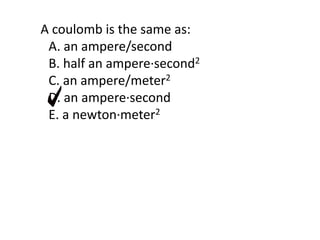
A coulomb is the same as:
A. an ampere/second
B. half an ampere·second2
C. an ampere/meter2
D. an ampere·second
E. a newton·meter2
A kiloampere·hour is a unit of:
A. current
B. charge per time
C. power
D. charge
E. energy
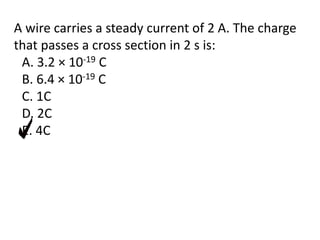
A wire carries a steady current of 2 A. The charge
that passes a cross section in 2 s is:
A. 3.2 × 10⁻¹⁹ C
B. 6.4 × 10⁻¹⁹ C
C. 1C
D. 2C
E. 4C
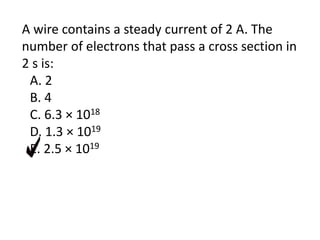
A wire contains a steady current of 2 A. The
number of electrons that pass a cross section in
2 s is:
A. 2
B. 4
C. 6.3 × 10¹⁸
D. 1.3 × 10¹⁹
E. 2.5 × 10¹⁹
The charge on a glass rod that has been rubbed
with silk is called positive:
A. by arbitrary convention
B. so that the proton charge will be positive
C. to conform to the conventions adopted for G
and m in Newton’s law of gravitation
D. because like charges repel
E. because glass is an insulator
To make an uncharged object have a positive
charge:
A. remove some neutrons
B. add some neutrons
C. add some electrons
D. remove some electrons
E. heat it to cause a change of phase
When a hard rubber rod is given a negative
charge by rubbing it with wool:
A. positive charges are transferred from rod to
wool
B. negative charges are transferred from rod to
wool
C. positive charges are transferred from wool to
rod
D. negative charges are transferred from wool to
rod
E. negative charges are created and stored on the
rod
An electrical insulator is a material:
A. containing no electrons
B. through which electrons do not flow easily
C. that has more electrons than protons on its
surface
D. cannot be a pure chemical element
E. must be a crystal
The diagram shows two pairs of heavily charged
plastic cubes. Cubes 1 and 2 attract each other and
cubes 1 and 3 repel each other.
Which of the following illustrates the forces of
cube 2 on cube 3 and cube 3 on cube 2?
The diagram shows a pair of heavily charged plastic
cubes that attract each other.
Cube 3 is a conductor and is uncharged. Which of
the following illustrates the forces between cubes 1
and 3 and between cubes 2 and 3?
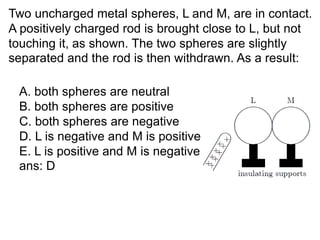
Two uncharged metal spheres, L and M, are in contact.
A positively charged rod is brought close to L, but not
touching it, as shown. The two spheres are slightly
separated and the rod is then withdrawn. As a result:
A. both spheres are neutral
B. both spheres are positive
C. both spheres are negative
D. L is negative and M is positive
E. L is positive and M is negative
ans: D
A neutral metal ball is suspended by a string. A
positively charged insulating rod is placed
near the ball, which is observed to be attracted to
the rod. This is because:
A. the ball becomes positively charged by induction
B. the ball becomes negatively charged by
induction
C. the number of electrons in the ball is more than
the number in the rod
D. the string is not a perfect insulator
E. there is a rearrangement of the electrons in the
ball
Two small charged objects attract each other with a
force F when separated by a distance d. If the
charge on each object is reduced to one-fourth of its
original value and the distance between them is
reduced to d/2 the force becomes:
A. F/16
B. F/8
C. F/4
D. F/2
E. F
Two identical conducting spheres A and B carry
equal charge. They are separated by a distance
much larger than their diameters. A third identical
conducting sphere C is uncharged. Sphere
C is first touched to A, then to B, and finally
removed. As a result, the electrostatic force
between A and B, which was originally F, becomes:
A. F/2
B. F/4
C. 3F/8
D. F/16
E. 0
Two particles, X and Y, are 4m apart. X has a charge
of 2Q and Y has a charge of Q. The
force of X on Y:
A. has twice the magnitude of the force of Y on X
B. has half the magnitude of the force of Y on X
C. has four times the magnitude of the force of Y
on X
D. has one-fourth the magnitude of the force of Y
on X
E. has the same magnitude as the force of Y on X
A 5.0-C charge is 10m from a −2.0-C charge. The
electrostatic force on the positive charge is:
A. 9.0 × 10⁸ N toward the negative charge
B. 9.0 × 10⁸ N away from the negative charge
C. 9.0 × 10⁹ N toward the negative charge
D. 9.0 × 10⁹ N away from the negative charge
E. none of these
Two identical charges, 2.0m apart, exert forces of
magnitude 4.0N on each other. The value of either
charge is:
A. 1.8 × 10⁻⁹ C
B. 2.1 × 10⁻⁵ C
C. 4.2 × 10⁻⁵ C
D. 1.9 × 10⁵ C
E. 3.8 × 10⁵ C
Two electrons (e1 and e2) and a proton (p) lie on a
straight line, as shown. The directions of
the force of e2 on e1, the force of p on e1, and the
total force on e1, respectively, are:
A. →, ←, →
B. ←, →, →
C. →, ←, ←
D. ←, →, ←
E. ←, ←, ←
Particles 1, with charge q1, and 2, with charge q2, are
on the x axis, with particle 1 at x = a
and particle 2 at x = −2a. For the net force on a third
charged particle, at the origin, to be
zero, q 1 and q2 must be related by q2 =:
A. 2q1
B. 4q1
C. −2q1
D. −4q1
E. −q1/4
Two particles A and B have identical charge Q. For a
net force of zero to be exerted on a third
charged particle it must be placed:
A. midway between A and B
B. on the perpendicular bisector of the line joining
A and B but away from the line
C. on the line joining A and B, not between the
particles
D. on the line joining A and B, closer to one of them
than the other
E. at none of these places (there is no place)
A particle with charge 2-μC is placed at the origin,
an identical particle, with the same charge,
is placed 2m from the origin on the x axis, and a
third identical particle, with the same charge,
is placed 2m from the origin on the y axis. The
magnitude of the force on the particle at the
origin is:
A. 9.0 × 10⁻³ N
B. 6.4 × 10⁻³ N
C. 1.3 × 10⁻² N
D. 1.8 × 10⁻² N
E. 3.6 × 10⁻² N
Two particles, each with charge Q, and a third
particle, with charge q, are placed at the vertices
of an equilateral triangle as shown. The total force on
the particle with charge q is:
A. parallel to the left side of the triangle
B. parallel to the right side of the triangle
C. parallel to the bottom side of the triangle
D. perpendicular to the bottom side of the triangle
E. perpendicular to the left side of the triangle
Electric Field
An electric field is most directly related to:
A. the momentum of a test charge
B. the kinetic energy of a test charge
C. the potential energy of a test charge
D. the force acting on a test charge
E. the charge carried by a test charge
As used in the definition of electric field, a “test
charge”:
A. has zero charge
B. has charge of magnitude 1C
C. has charge of magnitude 1.6 × 10⁻¹⁹ C
D. must be an electron
E. none of the above
Experimenter A uses a test charge q0 and
experimenter B uses a test charge −2q0 to measure
an electric field produced by stationary charges. A
finds a field that is:
A. the same in both magnitude and direction as
the field found by B
B. greater in magnitude than the field found by B
C. less in magnitude than the field found by B
D. opposite in direction to the field found by B
E. either greater or less than the field found by B,
depending on the accelerations of the test
charges
The units of the electric field are:
A. J/(C·m)
B. J/C
C. J·C
D. J/m
E. none of these
Two thin spherical shells, one with radius R and the
other with radius 2R, surround an isolated
charged point particle. The ratio of the number of
field lines through the larger sphere to the
number through the smaller is:
A. 1
B. 2
C. 4
D. 1/2
E. 1/4
Choose the correct statement concerning electric
field lines:
A. field lines may cross
B. field lines are close together where the field is
large
C. field lines point away from a negatively
charged particle
D. a charged point particle released from rest
moves along a field line
E. none of these are correct
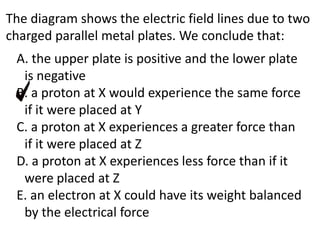
The diagram shows the electric field lines due to two
charged parallel metal plates. We conclude that:
A. the upper plate is positive and the lower plate
is negative
B. a proton at X would experience the same force
if it were placed at Y
C. a proton at X experiences a greater force than
if it were placed at Z
D. a proton at X experiences less force than if it
were placed at Z
E. an electron at X could have its weight balanced
by the electrical force
Let k denote 1/4πε0. The magnitude of the electric
field at a distance r from an isolated point
particle with charge q is:
A. kq/r
B. kr/q
C. kq/r3
D. kq/r2
E. kq2/r2
The diagram shows the electric field lines in a region
of space containing two small charged spheres (Y
and Z). Then:
A. Y is negative and Z is positive
B. the magnitude of the electric field is the same
everywhere
C. the electric field is strongest midway between Y
and Z
D. the electric field is not zero anywhere (except
infinitely far from the spheres)
E. Y and Z must have the same sign
The electric field at a distance of 10 cm from an
isolated point particle with a charge of 2×10⁻⁹ C is:
A. 1.8N/C
B. 180N/C
C. 18N/C
D. 1800N/C
E. none of these
An isolated charged point particle produces an
electric field with magnitude E at a point 2m away.
At a point 1m from the particle the magnitude of
the field is:
A. E
B. 2E
C. 4E
D. E/2
E. E/4
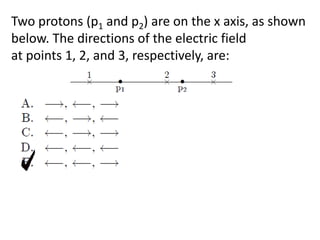
Two protons (p1 and p2) are on the x axis, as shown
below. The directions of the electric field
at points 1, 2, and 3, respectively, are:
Two point particles, with a charges of q1 and q2,
are placed a distance r apart. The electric field is
zero at a point P between the particles on the line
segment connecting them. We conclude that:
A. q1 and q2 must have the same magnitude and
sign
B. P must be midway between the particles
C. q1 and q2 must have the same sign but may
have different magnitudes
D. q1 and q2 must have equal magnitudes and
opposite signs
E. q1 and q2 must have opposite signs and may
have different magnitudes
The diagrams below depict four different charge
distributions. The charge particles are all the
same distance from the origin. The electric field at
the origin:
A. is greatest for situation 1
B. is greatest for situation 3
C. is zero for situation 4
D. is downward for situation 1
E. is downward for situation 3
The diagram shows a particle with positive charge Q
and a particle with negative charge −Q. The electric
field at point P on the perpendicular bisector of the
line joining them is:
A. ↑
B. ↓
C. →
D. ← E. zero
Two point particles, one with charge +8 × 10⁻⁹ C and
the other with charge −2 × 10⁻⁹ C, are
separated by 4m. The electric field in N/C midway
between them is:
A. 9 × 10⁹
B. 13, 500
C. 135, 000
D. 36 × 10−9
E. 22.5
Positive charge Q is uniformly distributed on a
semicircular rod. What is the direction of the
electric field at point P, the center of the semicircle?
The electric field due to a uniform distribution of
charge on a spherical shell is zero:
A. everywhere
B. nowhere
C. only at the center of the shell
D. only inside the shell
E. only outside the shell
The magnitude of the force of a 400-N/C electric
field on a 0.02-C point charge is:
A. 8.0N
B. 8 × 10⁻⁵ N
C. 8 × 10⁻³ N
D. 0.08N
E. 2 × 10¹¹ N
A 200-N/C electric field is in the positive x
direction. The force on an electron in this field is:
A. 200N in the positive x direction
B. 200N in the negative x direction
C. 3.2 × 10⁻¹⁷ N in the positive x direction
D. 3.2 × 10⁻¹⁷ N in the negative x direction
E. 0
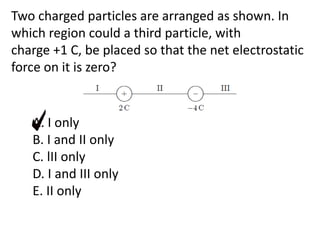
Two charged particles are arranged as shown. In
which region could a third particle, with
charge +1 C, be placed so that the net electrostatic
force on it is zero?
A. I only
B. I and II only
C. lII only
D. I and III only
E. II only
GAUSS’ LAW
A total charge of 6.3×10⁻⁸ C is distributed uniformly
throughout a 2.7-cm radius sphere. The volume
charge density is:
A. 3.7 × 10⁻⁷ C/m3
B. 6.9 × 10⁻⁶ C/m3
C. 6.9 × 10⁻⁶ C/m2
D. 2.5 × 10⁻⁴ C/m3
E. 7.6 × 10⁻⁴ C/m3
A spherical shell has an inner radius of 3.7 cm and
an outer radius of 4.5 cm. If charge is distributed
uniformly throughout the shell with a volume
density of 6.1×10⁻⁴ C/m3 the total charge is:
A. 1.0 × 10⁻⁷ C
B. 1.3 × 10⁻⁷ C
C. 2.0 × 10⁻⁷ C
D. 2.3 × 10⁻⁷ C
E. 4.0 × 10⁻⁷ C
The flux of the electric field (24N/C)ˆi + (30N/C)ˆj +
(16N/C)ˆk through a 2.0m2 portion of the yz plane
is:
A. 32N · m2 /C
B. 34N · m2 /C
C. 42N · m2 /C
D. 48N · m2 /C
E. 60N · m2 /C
A charged point particle is placed at the center of a
spherical Gaussian surface. The electric
flux ΦE is changed if:
A. the sphere is replaced by a cube of the same
volume
B. the sphere is replaced by a cube of one-tenth
the volume
C. the point charge is moved off center (but still
inside the original sphere)
D. the point charge is moved to just outside the
sphere
E. a second point charge is placed just outside the
sphere
Choose the INCORRECT statement:
A. Gauss’ law can be derived from Coulomb’s law
B. Gauss’ law states that the net number of lines
crossing any closed surface in an outward
direction is proportional to the net charge
enclosed within the surface
C. Coulomb’s law can be derived from Gauss’ law
and symmetry
D. Gauss’ law applies to a closed surface of any
shape
E. According to Gauss’ law, if a closed surface
encloses no charge, then the electric field must
vanish everywhere on the surface
The outer surface of the cardboard center of a paper
towel roll:
A. is a possible Gaussian surface
B. cannot be a Gaussian surface because it encloses
no charge
C. cannot be a Gaussian surface since it is an
insulator
D. cannot be a Gaussian surface because it is not a
closed surface
E. none of the above
ans: D
A physics instructor in an anteroom charges an
electrostatic generator to 25 μC, then carries
it into the lecture hall. The net electric flux in N ·
m2/C through the lecture hall walls is:
A. 0
B. 25 × 10−6
C. 2.2 × 10⁵
D. 2.8 × 10⁶
E. can not tell unless the lecture hall dimensions
are given
A solid insulating sphere of radius R contains positive
charge that is distributed with a volume charge density
that does not depend on angle but does increase with
distance from the sphere center. Which of the graphs
below might give the magnitude E of the electric field
as a function of the distance r from the center of the
sphere?
ans: D
Which of the following graphs represents the
magnitude of the electric field as a function of the
distance from the center of a solid charged conducting
sphere of radius R?
ans: E
Reason

De1 p6 32n review

  • 1.
  • 2.
    A coulomb isthe same as: A. an ampere/second B. half an ampere·second2 C. an ampere/meter2 D. an ampere·second E. a newton·meter2
  • 3.
    A kiloampere·hour isa unit of: A. current B. charge per time C. power D. charge E. energy
  • 4.
    A wire carriesa steady current of 2 A. The charge that passes a cross section in 2 s is: A. 3.2 × 10⁻¹⁹ C B. 6.4 × 10⁻¹⁹ C C. 1C D. 2C E. 4C
  • 5.
    A wire containsa steady current of 2 A. The number of electrons that pass a cross section in 2 s is: A. 2 B. 4 C. 6.3 × 10¹⁸ D. 1.3 × 10¹⁹ E. 2.5 × 10¹⁹
  • 6.
    The charge ona glass rod that has been rubbed with silk is called positive: A. by arbitrary convention B. so that the proton charge will be positive C. to conform to the conventions adopted for G and m in Newton’s law of gravitation D. because like charges repel E. because glass is an insulator
  • 7.
    To make anuncharged object have a positive charge: A. remove some neutrons B. add some neutrons C. add some electrons D. remove some electrons E. heat it to cause a change of phase
  • 8.
    When a hardrubber rod is given a negative charge by rubbing it with wool: A. positive charges are transferred from rod to wool B. negative charges are transferred from rod to wool C. positive charges are transferred from wool to rod D. negative charges are transferred from wool to rod E. negative charges are created and stored on the rod
  • 9.
    An electrical insulatoris a material: A. containing no electrons B. through which electrons do not flow easily C. that has more electrons than protons on its surface D. cannot be a pure chemical element E. must be a crystal
  • 10.
    The diagram showstwo pairs of heavily charged plastic cubes. Cubes 1 and 2 attract each other and cubes 1 and 3 repel each other. Which of the following illustrates the forces of cube 2 on cube 3 and cube 3 on cube 2?
  • 11.
    The diagram showsa pair of heavily charged plastic cubes that attract each other. Cube 3 is a conductor and is uncharged. Which of the following illustrates the forces between cubes 1 and 3 and between cubes 2 and 3?
  • 12.
    Two uncharged metalspheres, L and M, are in contact. A positively charged rod is brought close to L, but not touching it, as shown. The two spheres are slightly separated and the rod is then withdrawn. As a result: A. both spheres are neutral B. both spheres are positive C. both spheres are negative D. L is negative and M is positive E. L is positive and M is negative ans: D
  • 13.
    A neutral metalball is suspended by a string. A positively charged insulating rod is placed near the ball, which is observed to be attracted to the rod. This is because: A. the ball becomes positively charged by induction B. the ball becomes negatively charged by induction C. the number of electrons in the ball is more than the number in the rod D. the string is not a perfect insulator E. there is a rearrangement of the electrons in the ball
  • 14.
    Two small chargedobjects attract each other with a force F when separated by a distance d. If the charge on each object is reduced to one-fourth of its original value and the distance between them is reduced to d/2 the force becomes: A. F/16 B. F/8 C. F/4 D. F/2 E. F
  • 15.
    Two identical conductingspheres A and B carry equal charge. They are separated by a distance much larger than their diameters. A third identical conducting sphere C is uncharged. Sphere C is first touched to A, then to B, and finally removed. As a result, the electrostatic force between A and B, which was originally F, becomes: A. F/2 B. F/4 C. 3F/8 D. F/16 E. 0
  • 16.
    Two particles, Xand Y, are 4m apart. X has a charge of 2Q and Y has a charge of Q. The force of X on Y: A. has twice the magnitude of the force of Y on X B. has half the magnitude of the force of Y on X C. has four times the magnitude of the force of Y on X D. has one-fourth the magnitude of the force of Y on X E. has the same magnitude as the force of Y on X
  • 17.
    A 5.0-C chargeis 10m from a −2.0-C charge. The electrostatic force on the positive charge is: A. 9.0 × 10⁸ N toward the negative charge B. 9.0 × 10⁸ N away from the negative charge C. 9.0 × 10⁹ N toward the negative charge D. 9.0 × 10⁹ N away from the negative charge E. none of these
  • 18.
    Two identical charges,2.0m apart, exert forces of magnitude 4.0N on each other. The value of either charge is: A. 1.8 × 10⁻⁹ C B. 2.1 × 10⁻⁵ C C. 4.2 × 10⁻⁵ C D. 1.9 × 10⁵ C E. 3.8 × 10⁵ C
  • 19.
    Two electrons (e1and e2) and a proton (p) lie on a straight line, as shown. The directions of the force of e2 on e1, the force of p on e1, and the total force on e1, respectively, are: A. →, ←, → B. ←, →, → C. →, ←, ← D. ←, →, ← E. ←, ←, ←
  • 20.
    Particles 1, withcharge q1, and 2, with charge q2, are on the x axis, with particle 1 at x = a and particle 2 at x = −2a. For the net force on a third charged particle, at the origin, to be zero, q 1 and q2 must be related by q2 =: A. 2q1 B. 4q1 C. −2q1 D. −4q1 E. −q1/4
  • 21.
    Two particles Aand B have identical charge Q. For a net force of zero to be exerted on a third charged particle it must be placed: A. midway between A and B B. on the perpendicular bisector of the line joining A and B but away from the line C. on the line joining A and B, not between the particles D. on the line joining A and B, closer to one of them than the other E. at none of these places (there is no place)
  • 22.
    A particle withcharge 2-μC is placed at the origin, an identical particle, with the same charge, is placed 2m from the origin on the x axis, and a third identical particle, with the same charge, is placed 2m from the origin on the y axis. The magnitude of the force on the particle at the origin is: A. 9.0 × 10⁻³ N B. 6.4 × 10⁻³ N C. 1.3 × 10⁻² N D. 1.8 × 10⁻² N E. 3.6 × 10⁻² N
  • 23.
    Two particles, eachwith charge Q, and a third particle, with charge q, are placed at the vertices of an equilateral triangle as shown. The total force on the particle with charge q is: A. parallel to the left side of the triangle B. parallel to the right side of the triangle C. parallel to the bottom side of the triangle D. perpendicular to the bottom side of the triangle E. perpendicular to the left side of the triangle
  • 24.
  • 25.
    An electric fieldis most directly related to: A. the momentum of a test charge B. the kinetic energy of a test charge C. the potential energy of a test charge D. the force acting on a test charge E. the charge carried by a test charge
  • 26.
    As used inthe definition of electric field, a “test charge”: A. has zero charge B. has charge of magnitude 1C C. has charge of magnitude 1.6 × 10⁻¹⁹ C D. must be an electron E. none of the above
  • 27.
    Experimenter A usesa test charge q0 and experimenter B uses a test charge −2q0 to measure an electric field produced by stationary charges. A finds a field that is: A. the same in both magnitude and direction as the field found by B B. greater in magnitude than the field found by B C. less in magnitude than the field found by B D. opposite in direction to the field found by B E. either greater or less than the field found by B, depending on the accelerations of the test charges
  • 28.
    The units ofthe electric field are: A. J/(C·m) B. J/C C. J·C D. J/m E. none of these
  • 29.
    Two thin sphericalshells, one with radius R and the other with radius 2R, surround an isolated charged point particle. The ratio of the number of field lines through the larger sphere to the number through the smaller is: A. 1 B. 2 C. 4 D. 1/2 E. 1/4
  • 30.
    Choose the correctstatement concerning electric field lines: A. field lines may cross B. field lines are close together where the field is large C. field lines point away from a negatively charged particle D. a charged point particle released from rest moves along a field line E. none of these are correct
  • 31.
    The diagram showsthe electric field lines due to two charged parallel metal plates. We conclude that: A. the upper plate is positive and the lower plate is negative B. a proton at X would experience the same force if it were placed at Y C. a proton at X experiences a greater force than if it were placed at Z D. a proton at X experiences less force than if it were placed at Z E. an electron at X could have its weight balanced by the electrical force
  • 32.
    Let k denote1/4πε0. The magnitude of the electric field at a distance r from an isolated point particle with charge q is: A. kq/r B. kr/q C. kq/r3 D. kq/r2 E. kq2/r2
  • 33.
    The diagram showsthe electric field lines in a region of space containing two small charged spheres (Y and Z). Then: A. Y is negative and Z is positive B. the magnitude of the electric field is the same everywhere C. the electric field is strongest midway between Y and Z D. the electric field is not zero anywhere (except infinitely far from the spheres) E. Y and Z must have the same sign
  • 34.
    The electric fieldat a distance of 10 cm from an isolated point particle with a charge of 2×10⁻⁹ C is: A. 1.8N/C B. 180N/C C. 18N/C D. 1800N/C E. none of these
  • 35.
    An isolated chargedpoint particle produces an electric field with magnitude E at a point 2m away. At a point 1m from the particle the magnitude of the field is: A. E B. 2E C. 4E D. E/2 E. E/4
  • 36.
    Two protons (p1and p2) are on the x axis, as shown below. The directions of the electric field at points 1, 2, and 3, respectively, are:
  • 37.
    Two point particles,with a charges of q1 and q2, are placed a distance r apart. The electric field is zero at a point P between the particles on the line segment connecting them. We conclude that: A. q1 and q2 must have the same magnitude and sign B. P must be midway between the particles C. q1 and q2 must have the same sign but may have different magnitudes D. q1 and q2 must have equal magnitudes and opposite signs E. q1 and q2 must have opposite signs and may have different magnitudes
  • 38.
    The diagrams belowdepict four different charge distributions. The charge particles are all the same distance from the origin. The electric field at the origin: A. is greatest for situation 1 B. is greatest for situation 3 C. is zero for situation 4 D. is downward for situation 1 E. is downward for situation 3
  • 39.
    The diagram showsa particle with positive charge Q and a particle with negative charge −Q. The electric field at point P on the perpendicular bisector of the line joining them is: A. ↑ B. ↓ C. → D. ← E. zero
  • 40.
    Two point particles,one with charge +8 × 10⁻⁹ C and the other with charge −2 × 10⁻⁹ C, are separated by 4m. The electric field in N/C midway between them is: A. 9 × 10⁹ B. 13, 500 C. 135, 000 D. 36 × 10−9 E. 22.5
  • 41.
    Positive charge Qis uniformly distributed on a semicircular rod. What is the direction of the electric field at point P, the center of the semicircle?
  • 42.
    The electric fielddue to a uniform distribution of charge on a spherical shell is zero: A. everywhere B. nowhere C. only at the center of the shell D. only inside the shell E. only outside the shell
  • 43.
    The magnitude ofthe force of a 400-N/C electric field on a 0.02-C point charge is: A. 8.0N B. 8 × 10⁻⁵ N C. 8 × 10⁻³ N D. 0.08N E. 2 × 10¹¹ N
  • 44.
    A 200-N/C electricfield is in the positive x direction. The force on an electron in this field is: A. 200N in the positive x direction B. 200N in the negative x direction C. 3.2 × 10⁻¹⁷ N in the positive x direction D. 3.2 × 10⁻¹⁷ N in the negative x direction E. 0
  • 45.
    Two charged particlesare arranged as shown. In which region could a third particle, with charge +1 C, be placed so that the net electrostatic force on it is zero? A. I only B. I and II only C. lII only D. I and III only E. II only
  • 46.
  • 47.
    A total chargeof 6.3×10⁻⁸ C is distributed uniformly throughout a 2.7-cm radius sphere. The volume charge density is: A. 3.7 × 10⁻⁷ C/m3 B. 6.9 × 10⁻⁶ C/m3 C. 6.9 × 10⁻⁶ C/m2 D. 2.5 × 10⁻⁴ C/m3 E. 7.6 × 10⁻⁴ C/m3
  • 48.
    A spherical shellhas an inner radius of 3.7 cm and an outer radius of 4.5 cm. If charge is distributed uniformly throughout the shell with a volume density of 6.1×10⁻⁴ C/m3 the total charge is: A. 1.0 × 10⁻⁷ C B. 1.3 × 10⁻⁷ C C. 2.0 × 10⁻⁷ C D. 2.3 × 10⁻⁷ C E. 4.0 × 10⁻⁷ C
  • 49.
    The flux ofthe electric field (24N/C)ˆi + (30N/C)ˆj + (16N/C)ˆk through a 2.0m2 portion of the yz plane is: A. 32N · m2 /C B. 34N · m2 /C C. 42N · m2 /C D. 48N · m2 /C E. 60N · m2 /C
  • 51.
    A charged pointparticle is placed at the center of a spherical Gaussian surface. The electric flux ΦE is changed if: A. the sphere is replaced by a cube of the same volume B. the sphere is replaced by a cube of one-tenth the volume C. the point charge is moved off center (but still inside the original sphere) D. the point charge is moved to just outside the sphere E. a second point charge is placed just outside the sphere
  • 52.
    Choose the INCORRECTstatement: A. Gauss’ law can be derived from Coulomb’s law B. Gauss’ law states that the net number of lines crossing any closed surface in an outward direction is proportional to the net charge enclosed within the surface C. Coulomb’s law can be derived from Gauss’ law and symmetry D. Gauss’ law applies to a closed surface of any shape E. According to Gauss’ law, if a closed surface encloses no charge, then the electric field must vanish everywhere on the surface
  • 53.
    The outer surfaceof the cardboard center of a paper towel roll: A. is a possible Gaussian surface B. cannot be a Gaussian surface because it encloses no charge C. cannot be a Gaussian surface since it is an insulator D. cannot be a Gaussian surface because it is not a closed surface E. none of the above ans: D
  • 54.
    A physics instructorin an anteroom charges an electrostatic generator to 25 μC, then carries it into the lecture hall. The net electric flux in N · m2/C through the lecture hall walls is: A. 0 B. 25 × 10−6 C. 2.2 × 10⁵ D. 2.8 × 10⁶ E. can not tell unless the lecture hall dimensions are given
  • 55.
    A solid insulatingsphere of radius R contains positive charge that is distributed with a volume charge density that does not depend on angle but does increase with distance from the sphere center. Which of the graphs below might give the magnitude E of the electric field as a function of the distance r from the center of the sphere? ans: D
  • 57.
    Which of thefollowing graphs represents the magnitude of the electric field as a function of the distance from the center of a solid charged conducting sphere of radius R? ans: E
  • 58.