SLTC Conference 2017
Lecture Capture, the good, the bad and the ugly:
perception of multiple stakeholders.
Dr Tosin Lagoke, Dr Godwin Okafor and Stephen Brown
Friday 23 June 2017
Lecture Capture- Introduction and background
• Lecture Capture Technology is a system that provides an umbrella for
recording lecture sessions using an IT Software.
• Nowadays, online capture of lectures have become more prominent
in universities and other HEIs (Rui et al., 2004; Zhu and Bergom, 2010)
yielding outstanding results although this has not been with several
other issues which this study focuses on.
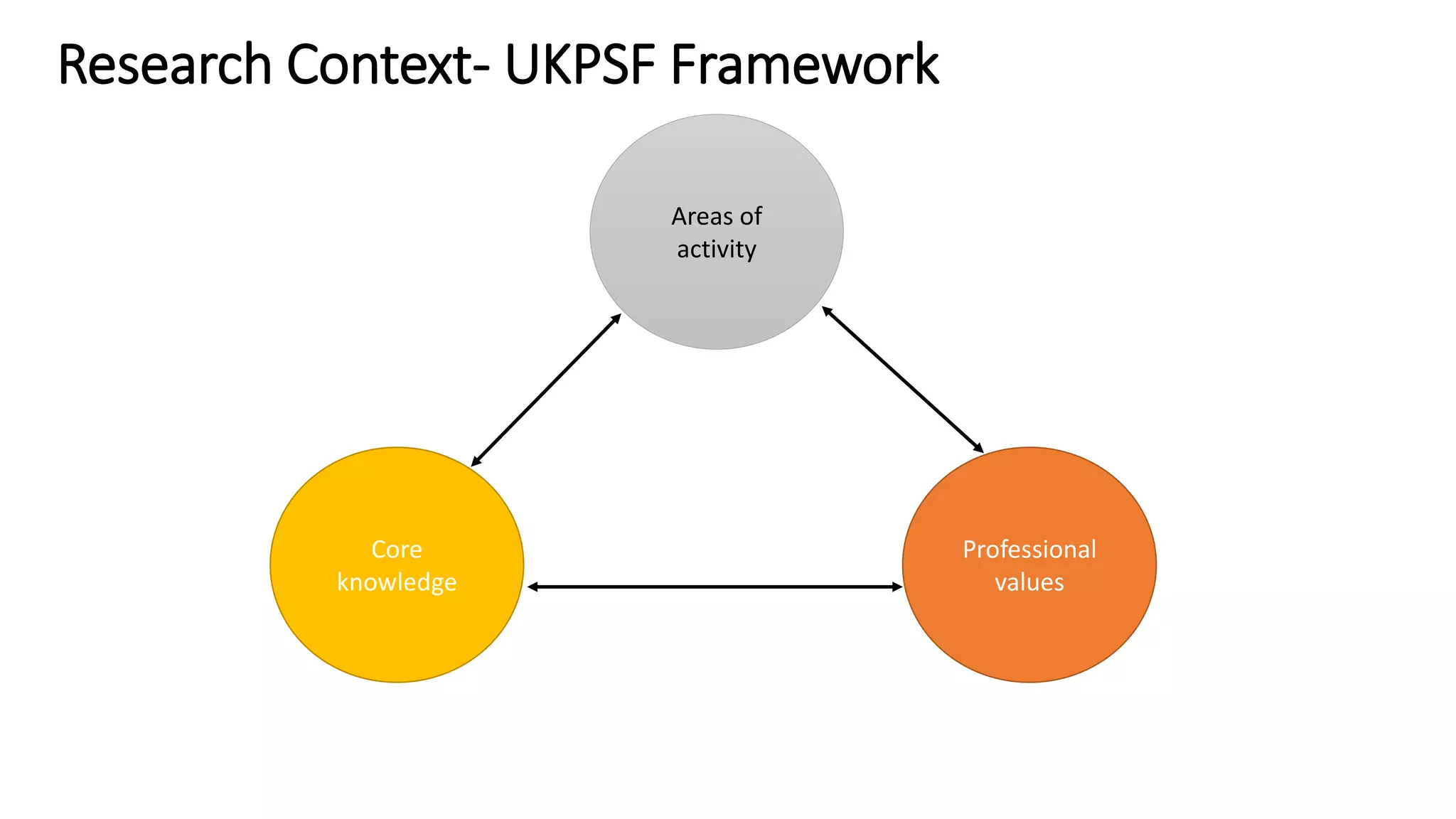
Research Context- UKPSF Framework
Areas of
activity
Core
knowledge
Professional
values
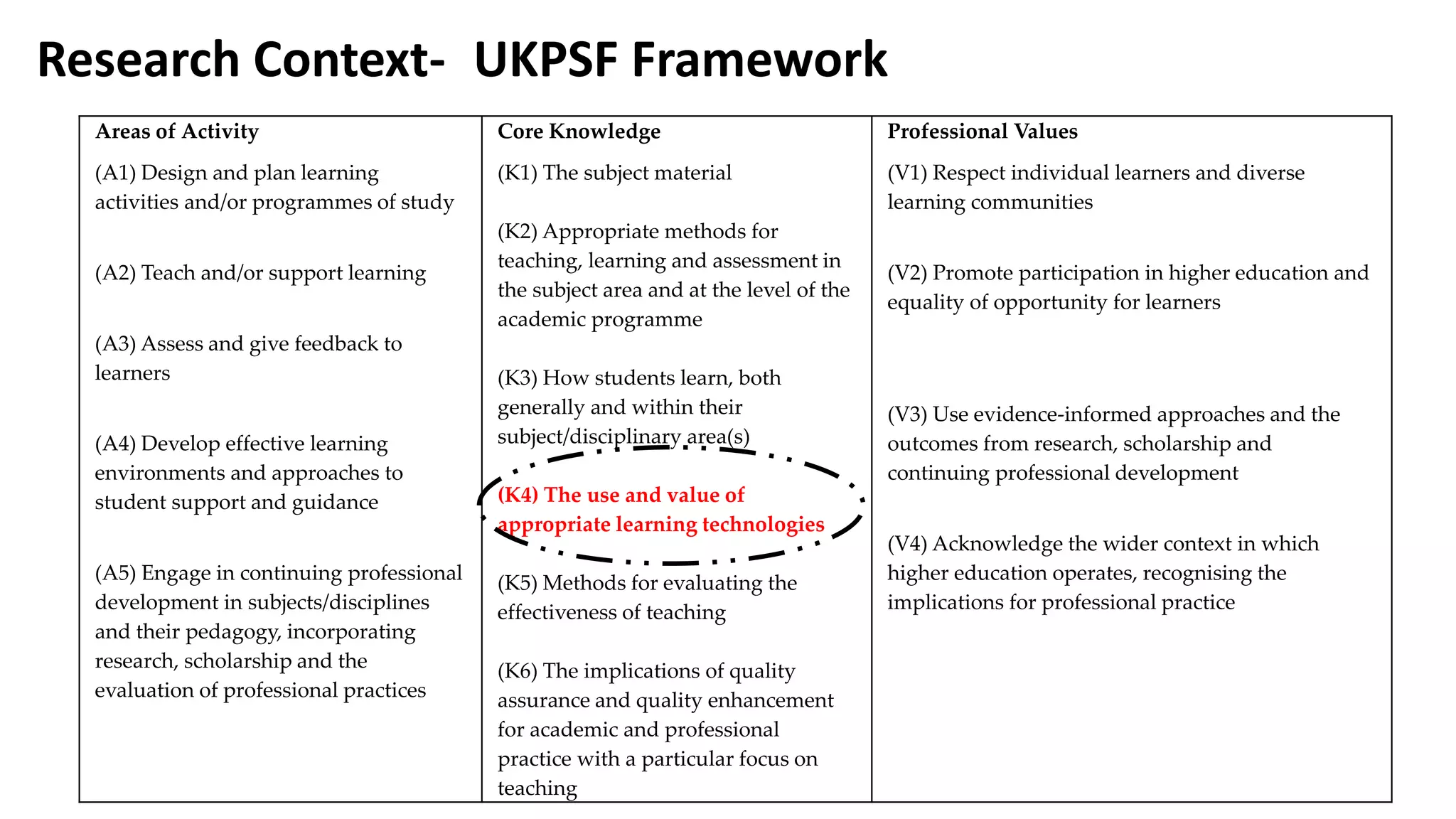
Research Context- UKPSF Framework
Areas of Activity
(A1) Design and plan learning
activities and/or programmes of study
(A2) Teach and/or support learning
(A3) Assess and give feedback to
learners
(A4) Develop effective learning
environments and approaches to
student support and guidance
(A5) Engage in continuing professional
development in subjects/disciplines
and their pedagogy, incorporating
research, scholarship and the
evaluation of professional practices
Core Knowledge
(K1) The subject material
(K2) Appropriate methods for
teaching, learning and assessment in
the subject area and at the level of the
academic programme
(K3) How students learn, both
generally and within their
subject/disciplinary area(s)
(K4) The use and value of
appropriate learning technologies
(K5) Methods for evaluating the
effectiveness of teaching
(K6) The implications of quality
assurance and quality enhancement
for academic and professional
practice with a particular focus on
teaching
Professional Values
(V1) Respect individual learners and diverse
learning communities
(V2) Promote participation in higher education and
equality of opportunity for learners
(V3) Use evidence-informed approaches and the
outcomes from research, scholarship and
continuing professional development
(V4) Acknowledge the wider context in which
higher education operates, recognising the
implications for professional practice
Research Framework
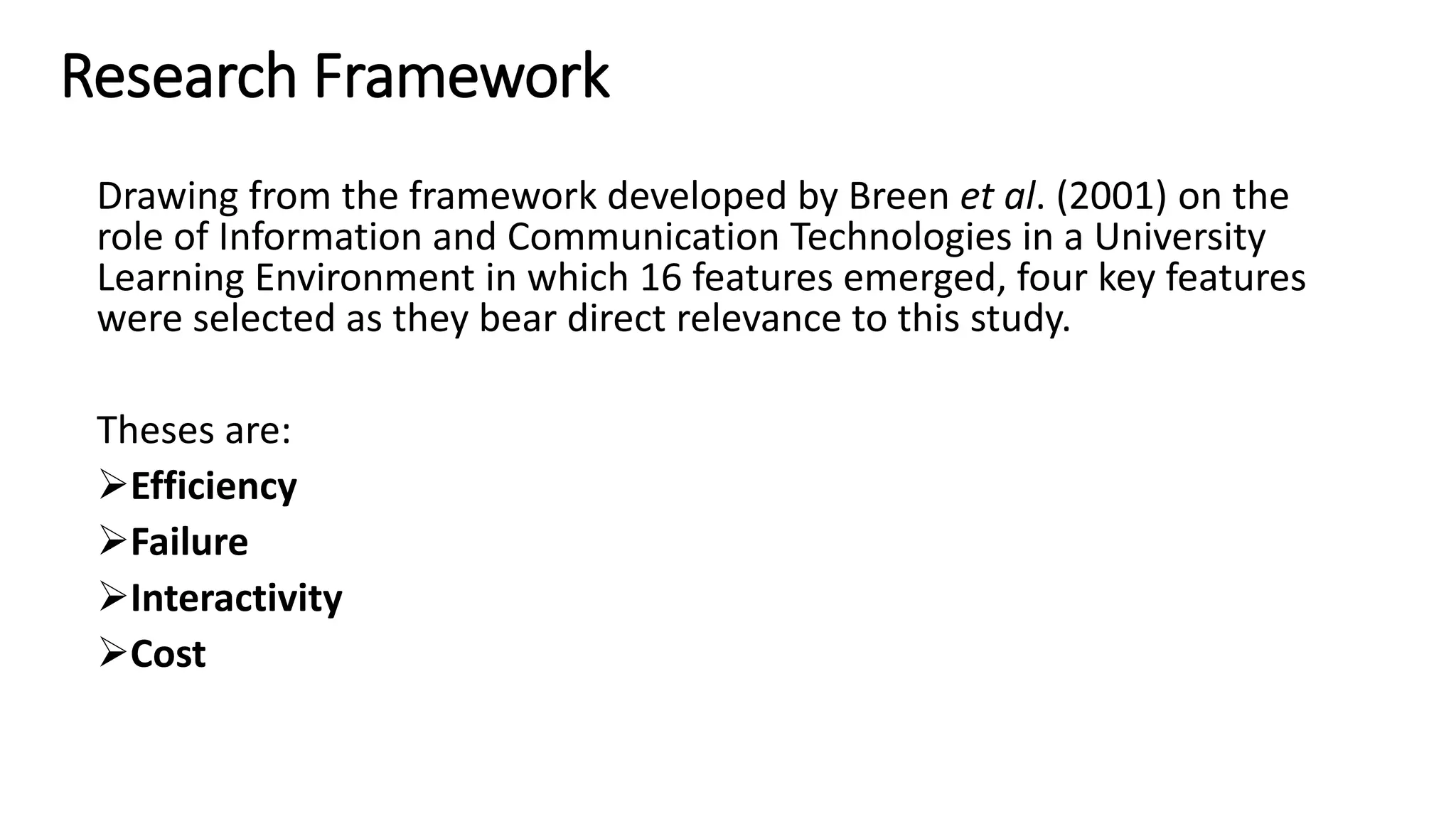
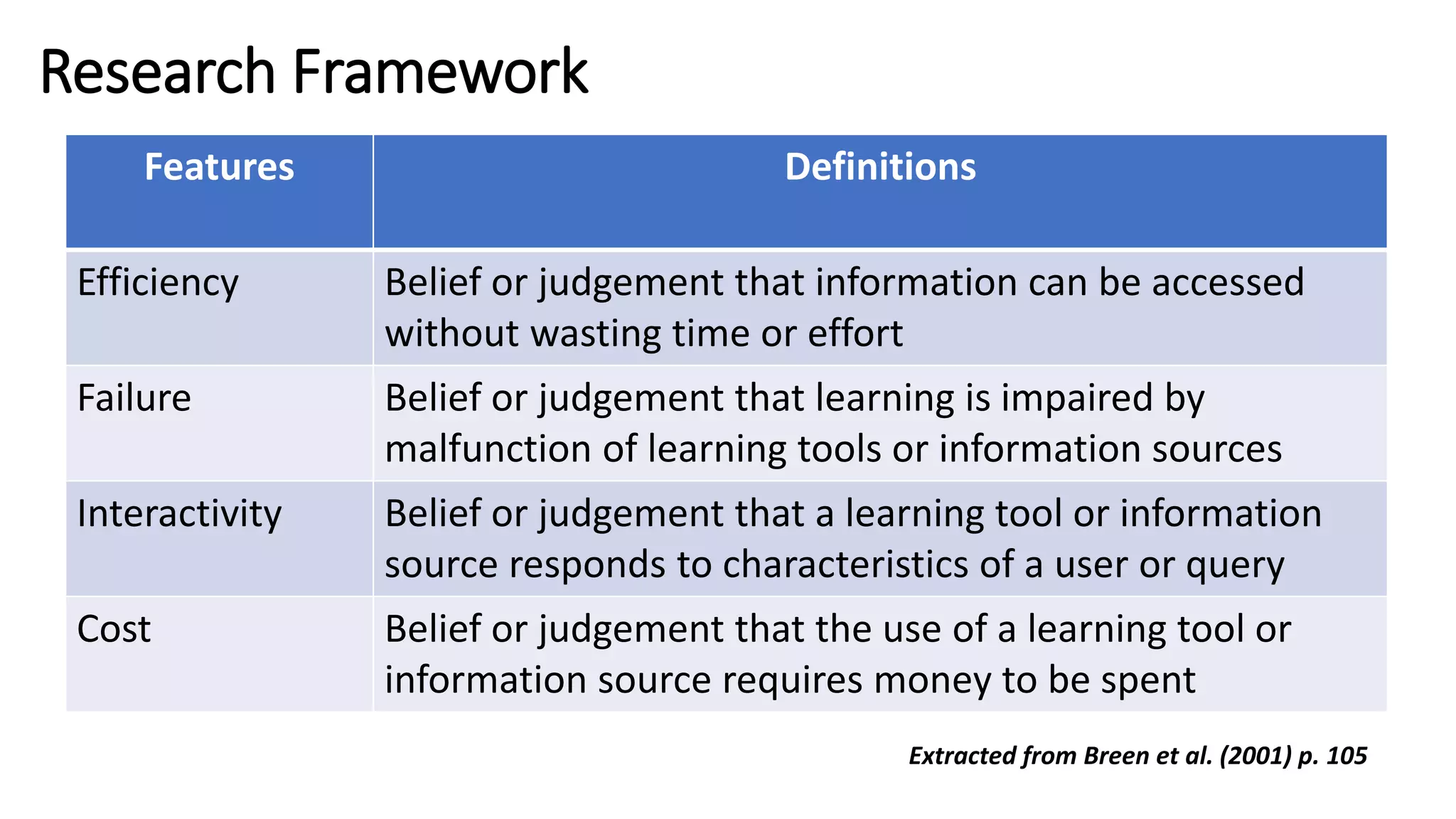
Drawing from the framework developed by Breen et al. (2001) on the
role of Information and Communication Technologies in a University
Learning Environment in which 16 features emerged, four key features
were selected as they bear direct relevance to this study.
Theses are:
Efficiency
Failure
Interactivity
Cost
Research Framework
Features Definitions
Efficiency Belief or judgement that information can be accessed
without wasting time or effort
Failure Belief or judgement that learning is impaired by
malfunction of learning tools or information sources
Interactivity Belief or judgement that a learning tool or information
source responds to characteristics of a user or query
Cost Belief or judgement that the use of a learning tool or
information source requires money to be spent
Extracted from Breen et al. (2001) p. 105
Methodology- Participants’ selection
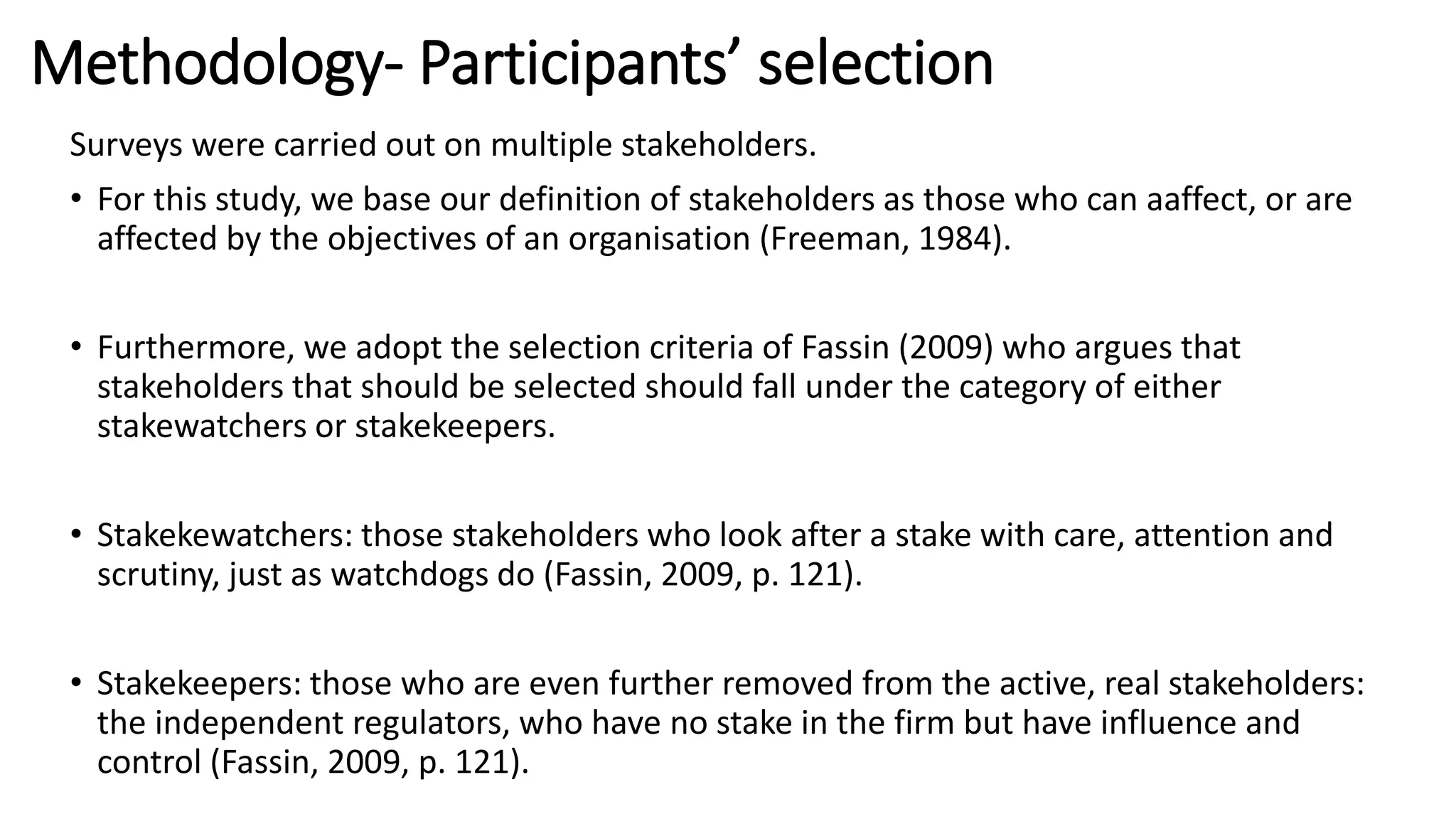
Surveys were carried out on multiple stakeholders.
• For this study, we base our definition of stakeholders as those who can aaffect, or are
affected by the objectives of an organisation (Freeman, 1984).
• Furthermore, we adopt the selection criteria of Fassin (2009) who argues that
stakeholders that should be selected should fall under the category of either
stakewatchers or stakekeepers.
• Stakekewatchers: those stakeholders who look after a stake with care, attention and
scrutiny, just as watchdogs do (Fassin, 2009, p. 121).
• Stakekeepers: those who are even further removed from the active, real stakeholders:
the independent regulators, who have no stake in the firm but have influence and
control (Fassin, 2009, p. 121).
Methodology- sampling and survey
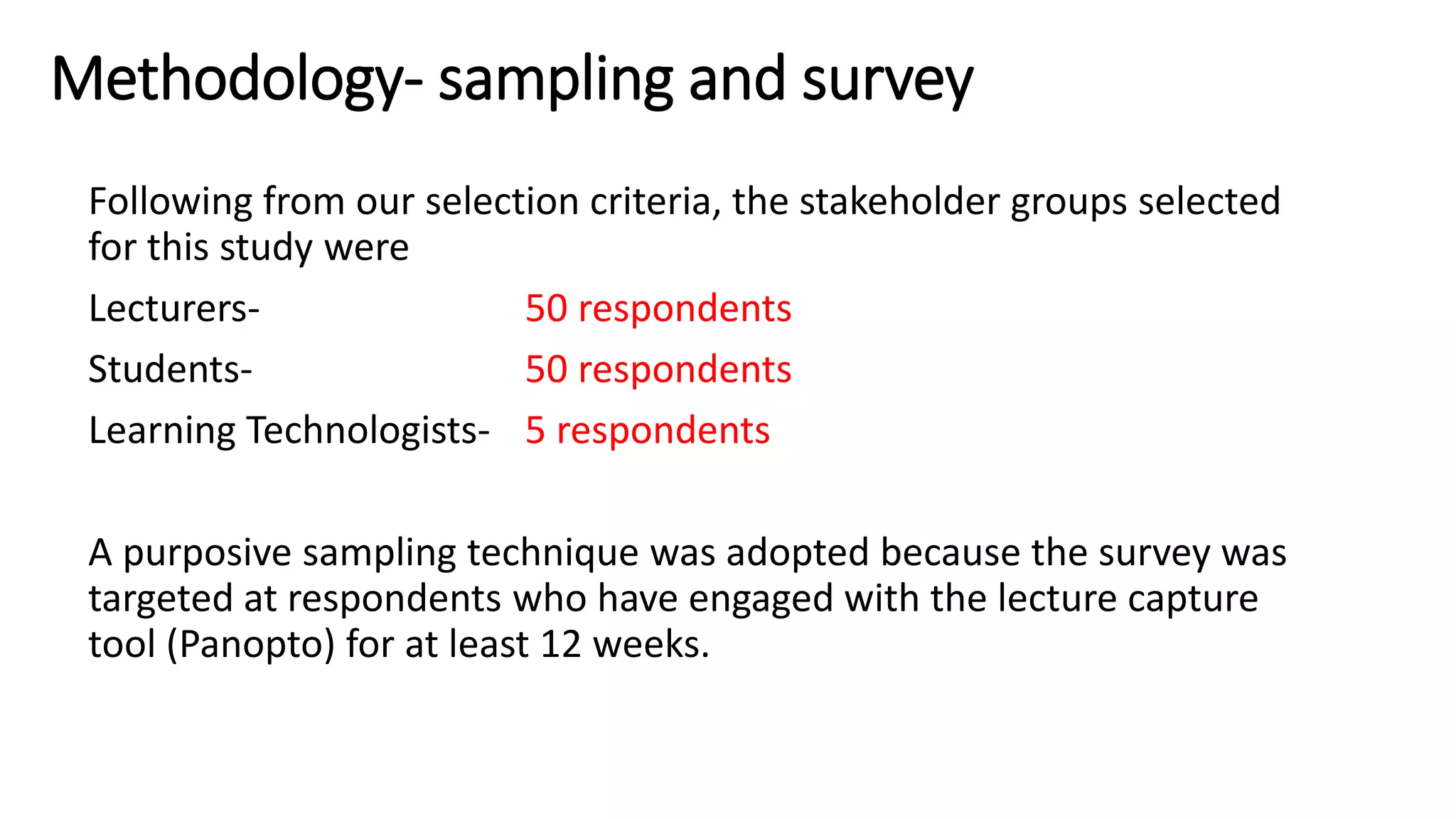
Following from our selection criteria, the stakeholder groups selected
for this study were
Lecturers- 50 respondents
Students- 50 respondents
Learning Technologists- 5 respondents
A purposive sampling technique was adopted because the survey was
targeted at respondents who have engaged with the lecture capture
tool (Panopto) for at least 12 weeks.
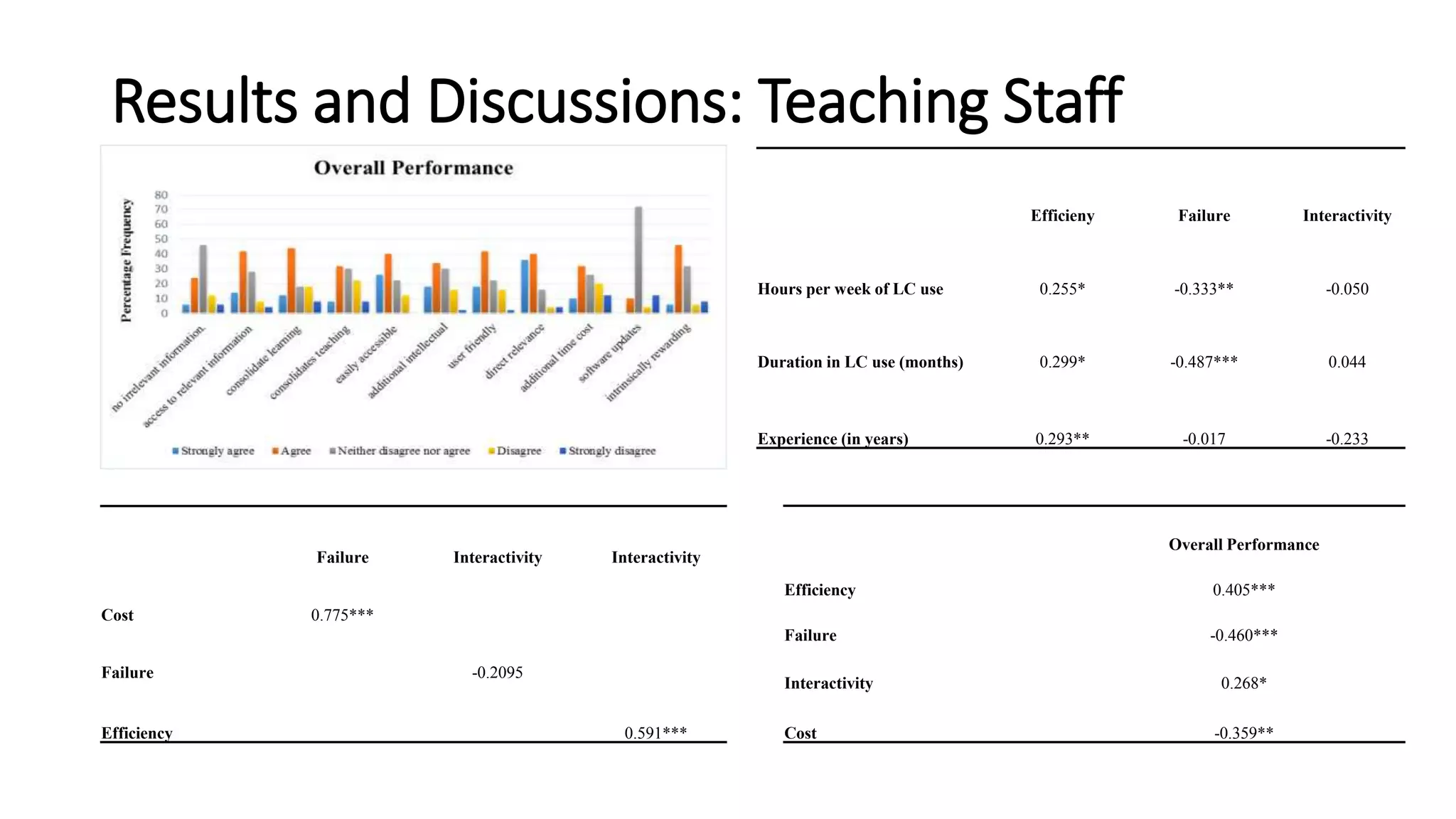
Results and Discussions: Teaching Staff
Efficieny Failure Interactivity
Hours per week of LC use 0.255* -0.333** -0.050
Duration in LC use (months) 0.299* -0.487*** 0.044
Experience (in years) 0.293** -0.017 -0.233
Failure Interactivity Interactivity
Cost 0.775***
Failure -0.2095
Efficiency 0.591***
Overall Performance
Efficiency 0.405***
Failure -0.460***
Interactivity 0.268*
Cost -0.359**
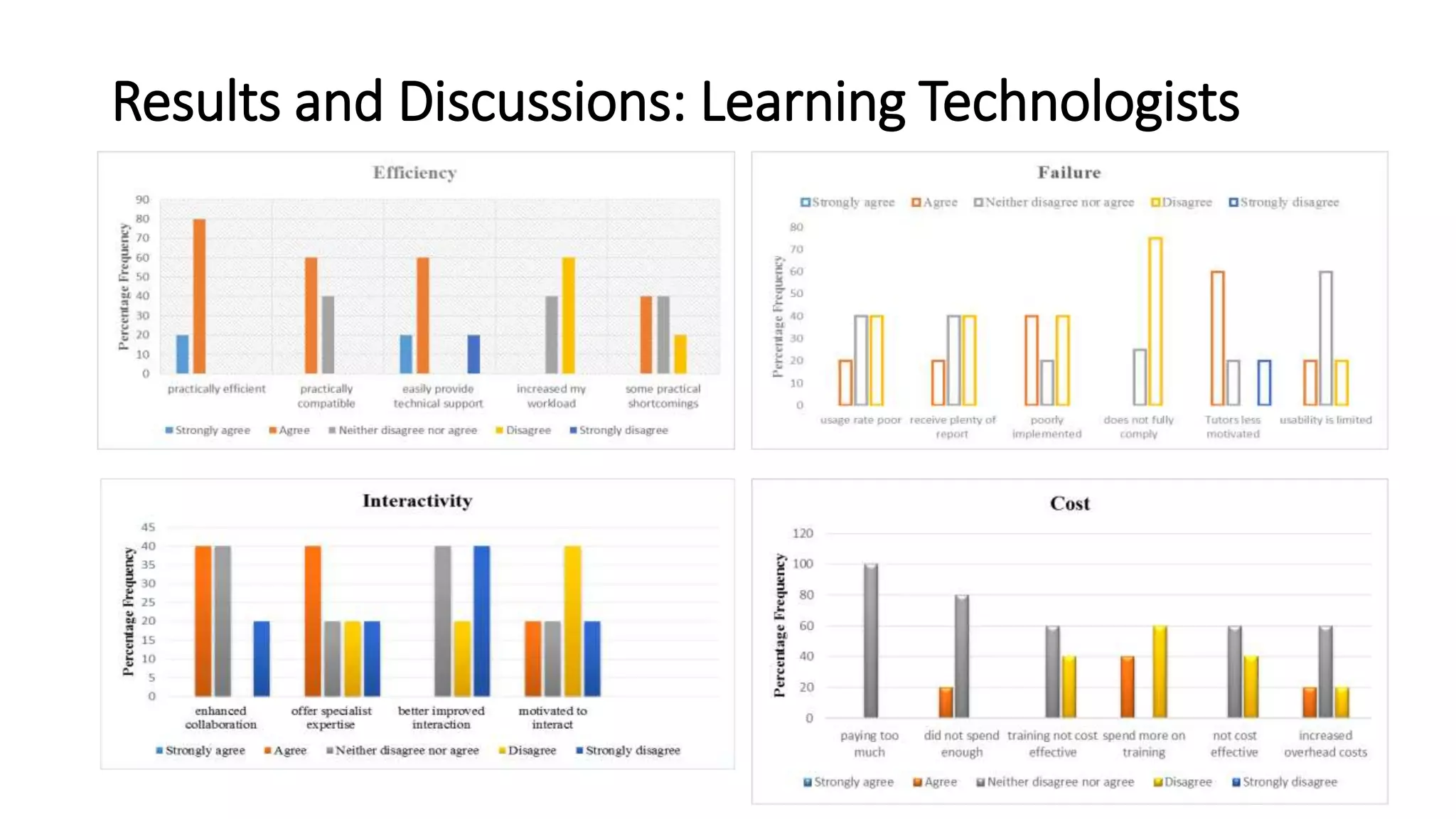
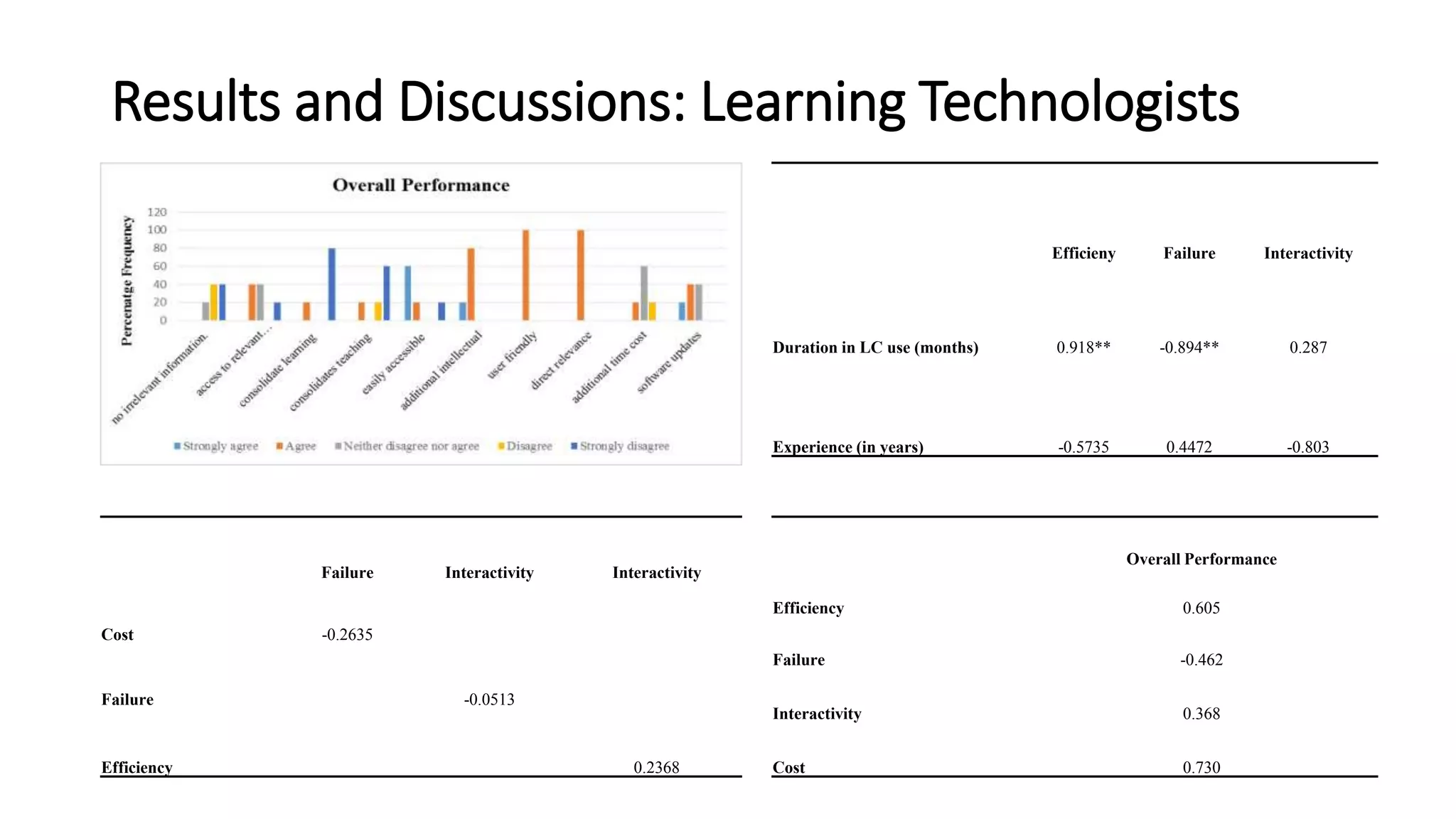
Results and Discussions: Learning Technologists
Efficieny Failure Interactivity
Duration in LC use (months) 0.918** -0.894** 0.287
Experience (in years) -0.5735 0.4472 -0.803
Failure Interactivity Interactivity
Cost -0.2635
Failure -0.0513
Efficiency 0.2368
Overall Performance
Efficiency 0.605
Failure -0.462
Interactivity 0.368
Cost 0.730
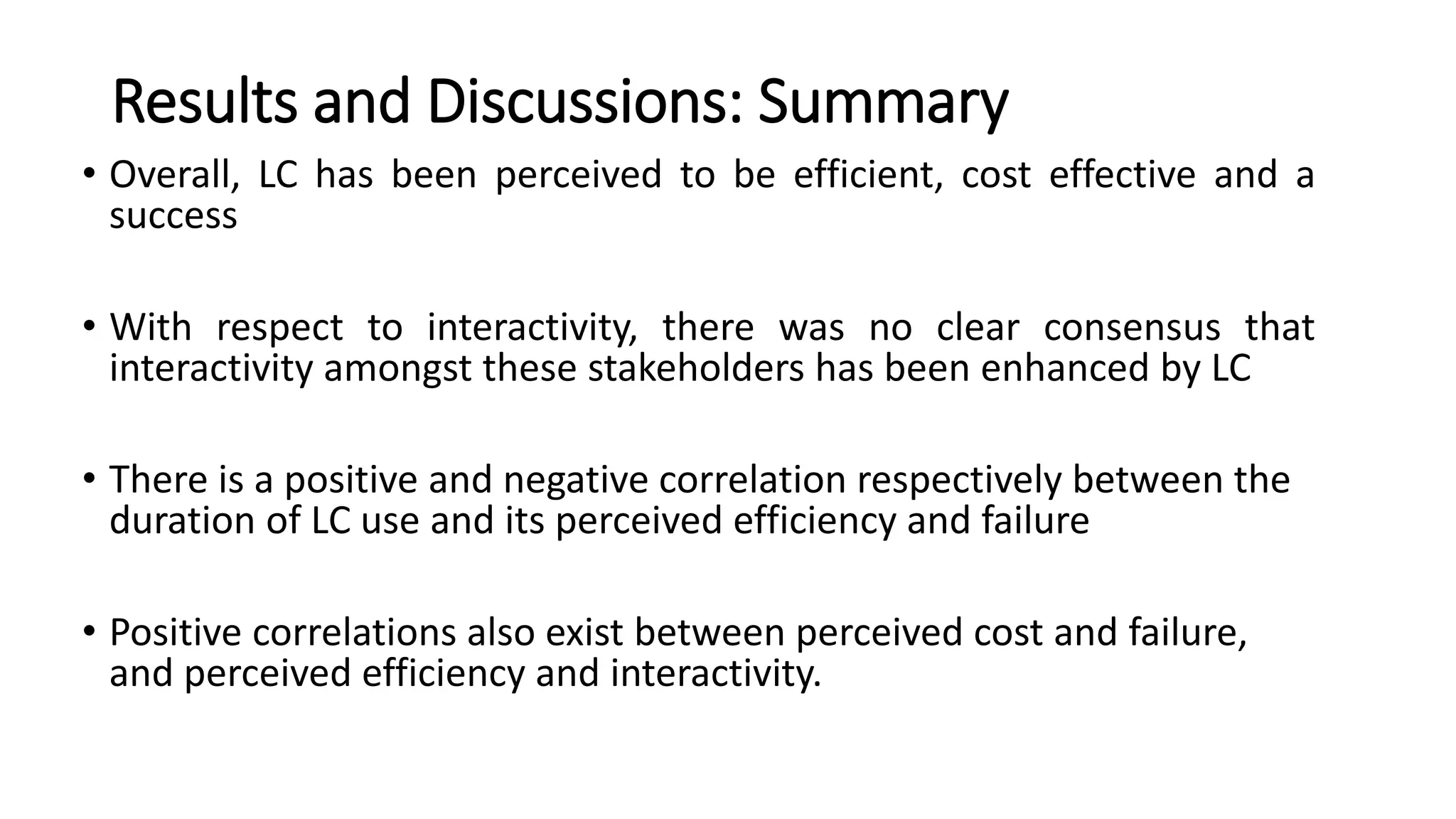
Results and Discussions: Summary
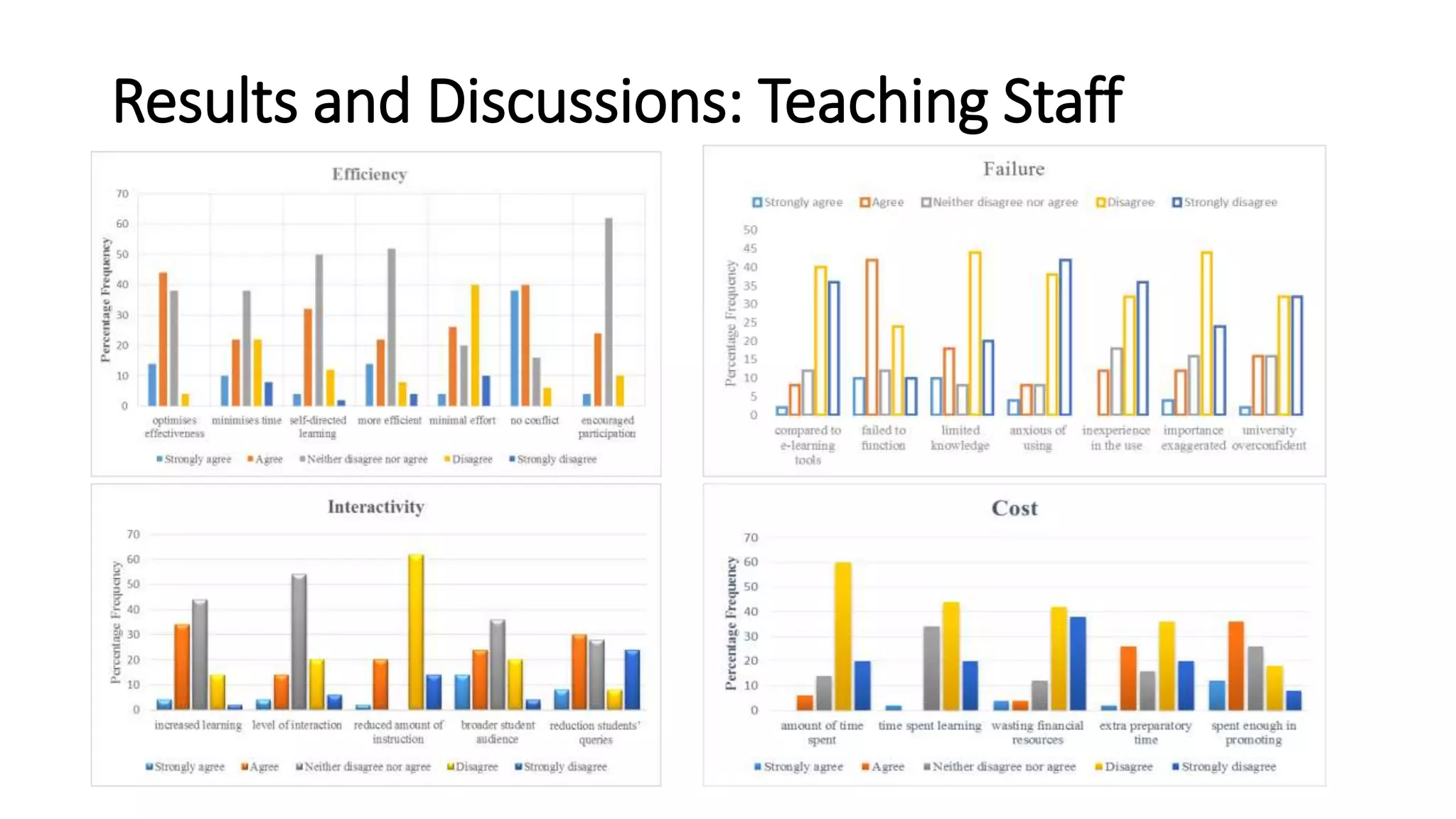
• Overall, LC has been perceived to be efficient, cost effective and a
success
• With respect to interactivity, there was no clear consensus that
interactivity amongst these stakeholders has been enhanced by LC
• There is a positive and negative correlation respectively between the
duration of LC use and its perceived efficiency and failure
• Positive correlations also exist between perceived cost and failure,
and perceived efficiency and interactivity.
Limitations and implications for further research
Limitation
Accessibility to wider respondents within the stakeholder groups
selected
Further Research
The research is still on going and based on our selection criteria, we
plan to carry out in depth semi structured interviews with at least two
more stakeholder groups- Solent Senior Management (VCG) and
Panopto Software developers.
References
BREEN, R., LINDSAY, R., JENKINS, A. AND SMITH, P., 2001. The role of information and
communication technologies in a university learning environment. Studies in Higher
Education, 26(1), pp.95-114.
FASSIN, Y., 2009. The stakeholder model refined. Journal of business ethics, 84(1),
pp.113-135.
FREEMAN, R.E., 1984. Strategic Management: A Stakeholder Approach. New York, NY,
USA: Basic Books.
RUI, Y., GUPTA, A., GRUDIN, J. AND HE, L., 2004. Automating lecture capture and
broadcast: technology and videography. Multimedia Systems, 10(1), pp.3-15.
ZHU, E. AND BERGOM, I., 2010. Lecture capture: A guide for effective use. University of
Michigan CRLT Occasional Papers (27).

SLTCC2017 Lecture Capture: The good, the bad and the ugly (Tosin Lagoke)

  • 1.
    SLTC Conference 2017 LectureCapture, the good, the bad and the ugly: perception of multiple stakeholders. Dr Tosin Lagoke, Dr Godwin Okafor and Stephen Brown Friday 23 June 2017
  • 2.
    Lecture Capture- Introductionand background • Lecture Capture Technology is a system that provides an umbrella for recording lecture sessions using an IT Software. • Nowadays, online capture of lectures have become more prominent in universities and other HEIs (Rui et al., 2004; Zhu and Bergom, 2010) yielding outstanding results although this has not been with several other issues which this study focuses on.
  • 3.
    Research Context- UKPSFFramework Areas of activity Core knowledge Professional values
  • 4.
    Research Context- UKPSFFramework Areas of Activity (A1) Design and plan learning activities and/or programmes of study (A2) Teach and/or support learning (A3) Assess and give feedback to learners (A4) Develop effective learning environments and approaches to student support and guidance (A5) Engage in continuing professional development in subjects/disciplines and their pedagogy, incorporating research, scholarship and the evaluation of professional practices Core Knowledge (K1) The subject material (K2) Appropriate methods for teaching, learning and assessment in the subject area and at the level of the academic programme (K3) How students learn, both generally and within their subject/disciplinary area(s) (K4) The use and value of appropriate learning technologies (K5) Methods for evaluating the effectiveness of teaching (K6) The implications of quality assurance and quality enhancement for academic and professional practice with a particular focus on teaching Professional Values (V1) Respect individual learners and diverse learning communities (V2) Promote participation in higher education and equality of opportunity for learners (V3) Use evidence-informed approaches and the outcomes from research, scholarship and continuing professional development (V4) Acknowledge the wider context in which higher education operates, recognising the implications for professional practice
  • 5.
    Research Framework Drawing fromthe framework developed by Breen et al. (2001) on the role of Information and Communication Technologies in a University Learning Environment in which 16 features emerged, four key features were selected as they bear direct relevance to this study. Theses are: Efficiency Failure Interactivity Cost
  • 6.
    Research Framework Features Definitions EfficiencyBelief or judgement that information can be accessed without wasting time or effort Failure Belief or judgement that learning is impaired by malfunction of learning tools or information sources Interactivity Belief or judgement that a learning tool or information source responds to characteristics of a user or query Cost Belief or judgement that the use of a learning tool or information source requires money to be spent Extracted from Breen et al. (2001) p. 105
  • 7.
    Methodology- Participants’ selection Surveyswere carried out on multiple stakeholders. • For this study, we base our definition of stakeholders as those who can aaffect, or are affected by the objectives of an organisation (Freeman, 1984). • Furthermore, we adopt the selection criteria of Fassin (2009) who argues that stakeholders that should be selected should fall under the category of either stakewatchers or stakekeepers. • Stakekewatchers: those stakeholders who look after a stake with care, attention and scrutiny, just as watchdogs do (Fassin, 2009, p. 121). • Stakekeepers: those who are even further removed from the active, real stakeholders: the independent regulators, who have no stake in the firm but have influence and control (Fassin, 2009, p. 121).
  • 8.
    Methodology- sampling andsurvey Following from our selection criteria, the stakeholder groups selected for this study were Lecturers- 50 respondents Students- 50 respondents Learning Technologists- 5 respondents A purposive sampling technique was adopted because the survey was targeted at respondents who have engaged with the lecture capture tool (Panopto) for at least 12 weeks.
  • 9.
  • 10.
    Results and Discussions:Teaching Staff Efficieny Failure Interactivity Hours per week of LC use 0.255* -0.333** -0.050 Duration in LC use (months) 0.299* -0.487*** 0.044 Experience (in years) 0.293** -0.017 -0.233 Failure Interactivity Interactivity Cost 0.775*** Failure -0.2095 Efficiency 0.591*** Overall Performance Efficiency 0.405*** Failure -0.460*** Interactivity 0.268* Cost -0.359**
  • 11.
    Results and Discussions:Learning Technologists
  • 12.
    Results and Discussions:Learning Technologists Efficieny Failure Interactivity Duration in LC use (months) 0.918** -0.894** 0.287 Experience (in years) -0.5735 0.4472 -0.803 Failure Interactivity Interactivity Cost -0.2635 Failure -0.0513 Efficiency 0.2368 Overall Performance Efficiency 0.605 Failure -0.462 Interactivity 0.368 Cost 0.730
  • 13.
    Results and Discussions:Summary • Overall, LC has been perceived to be efficient, cost effective and a success • With respect to interactivity, there was no clear consensus that interactivity amongst these stakeholders has been enhanced by LC • There is a positive and negative correlation respectively between the duration of LC use and its perceived efficiency and failure • Positive correlations also exist between perceived cost and failure, and perceived efficiency and interactivity.
  • 14.
    Limitations and implicationsfor further research Limitation Accessibility to wider respondents within the stakeholder groups selected Further Research The research is still on going and based on our selection criteria, we plan to carry out in depth semi structured interviews with at least two more stakeholder groups- Solent Senior Management (VCG) and Panopto Software developers.
  • 15.
    References BREEN, R., LINDSAY,R., JENKINS, A. AND SMITH, P., 2001. The role of information and communication technologies in a university learning environment. Studies in Higher Education, 26(1), pp.95-114. FASSIN, Y., 2009. The stakeholder model refined. Journal of business ethics, 84(1), pp.113-135. FREEMAN, R.E., 1984. Strategic Management: A Stakeholder Approach. New York, NY, USA: Basic Books. RUI, Y., GUPTA, A., GRUDIN, J. AND HE, L., 2004. Automating lecture capture and broadcast: technology and videography. Multimedia Systems, 10(1), pp.3-15. ZHU, E. AND BERGOM, I., 2010. Lecture capture: A guide for effective use. University of Michigan CRLT Occasional Papers (27).