An Analysis of Perceptions of Learning Outcome Competencies
of College Graduates in ABET and non-ABET Accredited
Occupational Safety and Health Programs
Darryl C. Hill, Ph.D., CSP
Oakland University
April 28, 2011
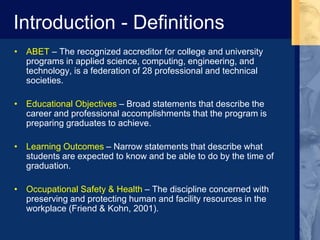
Introduction - Definitions
• ABET – The recognized accreditor for college and university
programs in applied science, computing, engineering, and
technology, is a federation of 28 professional and technical
societies.
• Educational Objectives – Broad statements that describe the
career and professional accomplishments that the program is
preparing graduates to achieve.
• Learning Outcomes – Narrow statements that describe what
students are expected to know and be able to do by the time of
graduation.
• Occupational Safety & Health – The discipline concerned with
preserving and protecting human and facility resources in the
workplace (Friend & Kohn, 2001).
Introduction – Background
• There has been a shift in higher education institutional culture from an
emphasis on assessing teaching methodology to assessing student
learning (Allen, 2006) as a way of measuring educational quality.
• This change of paradigm will also make it difficult to assess the quality
because it will be necessary to assess not only the quality of teaching,
but also the quality of learning, which means assessing the performance
of graduates in the world of work. (Hirsch & Weber, 1999, p. 9)
• True assessment of student competence must come from not only the
student’s performance in the undergraduate academic setting; but it
must also come from the program graduates extended experiences
after leaving the undergraduate program. (Palomba & Banta, 2001, p.
156)
Study Hypothesis
• Premise that the skills, knowledge, and behaviors
acquired by graduates from ABET accredited
occupational safety and health (OSH) programs
contribute to a higher degree of learning outcome
perceptions than graduates from non-ABET
accredited OSH programs.
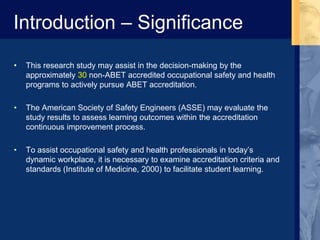
Introduction – Significance
• This research study may assist in the decision-making by the
approximately 30 non-ABET accredited occupational safety and health
programs to actively pursue ABET accreditation.
• The American Society of Safety Engineers (ASSE) may evaluate the
study results to assess learning outcomes within the accreditation
continuous improvement process.
• To assist occupational safety and health professionals in today’s
dynamic workplace, it is necessary to examine accreditation criteria and
standards (Institute of Medicine, 2000) to facilitate student learning.
Literature Review
• Several recently completed studies have addressed assessment of
higher education learning outcomes (Anastasio, 2004; Ferrara, 2007;
Turansky, 2003; Waite, 2004). These studies addressed the success of
student learning outcomes in specific institutions.
• Additional literature exists related to accountability, assessment, and the
impact of accreditation on student learning (Banta & Associates, 2002;
Burke & Associates, 2005; Palomba & Banta, 2001; Tanner, 2005).
These studies focused on the effect of the accreditation process on the
learning parameters of the students in educational institutions.
Literature Review – Theoretical Bases of
Curriculum and Learning Outcomes
• Curriculum theory is the interdisciplinary study of educational
experience.
• Curriculum theory seeks to provide meaning to the overall educational
significance of the curriculum (Pinar, 2004).
• Catherine Cornbleth (1990) sees curriculum as a particular type of
process. Curriculum is what happens in the classrooms, which is further
defined by Cornbleth as “an ongoing social process comprised of the
interactions of students, teachers, and knowledge” (p. 5).
• To better understand curriculum theory and its application to
accreditation, one must understand curriculum ideologies. Schiro (2008)
identifies four curricular ideologies: Social Efficiency, Scholar Academic,
Learner Centered, and Social Reconstruction
Literature Review – Theoretical Bases of
Curriculum and Learning Outcomes
• Social Efficiency ideology promotes the belief that the purpose of
schooling is to efficiently meet the needs of society of training students
to function as future contributing members of the society (Schiro, 2008).
• Scholar Academic ideology believes that history has acquired
knowledge for all cultures which is conveniently organized into
academic disciplines and found at colleges and universities (Schiro,
2008).
• Learner Centered ideology focuses not on the needs of the academic
disciplines or society, but on the needs and concerns of individuals
(Schiro, 2008)
• Social Reconstruction ideology brings awareness to the problems of
society and the injustices done to its citizens, such as those originating
from gender, racial, social, and economic inequalities (Schiro, 2008).
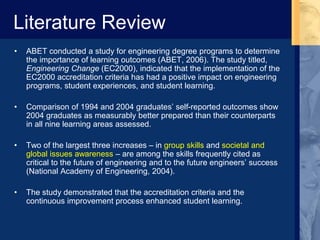
Literature Review
• ABET conducted a study for engineering degree programs to determine
the importance of learning outcomes (ABET, 2006). The study titled,
Engineering Change (EC2000), indicated that the implementation of the
EC2000 accreditation criteria has had a positive impact on engineering
programs, student experiences, and student learning.
• Comparison of 1994 and 2004 graduates’ self-reported outcomes show
2004 graduates as measurably better prepared than their counterparts
in all nine learning areas assessed.
• Two of the largest three increases – in group skills and societal and
global issues awareness – are among the skills frequently cited as
critical to the future of engineering and to the future engineers’ success
(National Academy of Engineering, 2004).
• The study demonstrated that the accreditation criteria and the
continuous improvement process enhanced student learning.
Literature Review: Occupational Safety &
Health Education
• Rapid growth in the number of safety curricula, as well as various
influences on them, has caused diversity in curriculum content (Brauer,
1992).
• This diversity creates concern among educators and practitioners
regarding the quality of safety education (Simon & Simon, 1995).
• Safety educators face a dilemma of balancing the scope of curriculum
content with the constraints of a four-year baccalaureate degree
program, especially when one considers that the safety professional’s
role has expanded into areas such as risk management, ergonomics,
and environmental safety (Academic Accreditation Council, 1991).
• To perform their professional functions, the safety professional must
have education, training and experience in a common body of
knowledge. Safety professionals need to have fundamental knowledge
of physics, chemistry, biology, physiology, statistics, mathematics,
industrial processes, business, communication and psychology.
(Adams, 2001, p. 27)
Research Questions
• Question 1: Is there a difference in perceptions of learning outcomes?
• Question 2: Is there a difference in feedback about the programs?
• Question 3: Is there a difference in advice to other students?
• Question 4: Is there a difference with regard to professional
development as determined by the questionnaire survey?
• Question 5: Is there a difference in the perceptions of curriculum theory
used in their programs of study?
Methodology – Approach and Design
• This study used a combined research method, mixing quantitative and
qualitative approaches. This approach is recommended by Coll and
Chapman (2000). A combined quantitative and qualitative research
method would complement each other.
• A survey questionnaire online link was sent to occupational safety and
health program directors who agreed to participate in the study.
• Thirteen colleges and universities agreed to participate in the study (5
ABET accredited and 8 non-ABET accredited). A total of 323 survey
questionnaires (169 – ABET, 154 – non-ABET) were received from the
804 sent by the May 31, 2009 deadline.
• The total surveys returned included 52.3% ABET accredited graduates
and 47.7% non-ABET accredited graduates.
Methodology – Population and Sample
• There are 13 undergraduate and graduate occupational safety and
health programs accredited by ABET. There are 30 non-ABET
accredited occupational safety and health programs.
• Each of the schools in this study is a public university with an average
student population of 15,000. There is an average of 60 students
currently studying in the occupational safety and health programs for the
schools participating in this study.
• Approximately, 2750 students have graduated from the occupational
safety and health programs participating in this study.
Methodology – Instrument Used
• The research instrument used in this study was a 37-item questionnaire
and divided into 5 parts.
• Parts 1-4 of the survey questionnaire were constructed using a four-
point Likert-type scale. The range of the scale is “completely untrue”
represented by 1 to “completely true” represented by 4.
• Part 5 included four open-ended questions to allow respondents to
communicate opinions and engage in personal reflection.
Methodology – Data Collection
• A Survey Monkey link, along with introductory letter, consent form, and
IRB approval, was sent to occupational safety and health program
directors.
• All data was collected in a 6-week timeframe. To prevent multiple
survey submissions, the IP address was identified.
• The response rate for this survey research study was 40.2% based
upon 804 surveys distributed and 323 surveys collected.
• Graduates from an ABET accredited occupational safety and health
program had a mean of 5.52 years experience, while graduates from a
non-ABET accredited program had a mean of 11.06 years experience.
The years of experience difference was statistically significant
(***p<.001).
Research Question 1
• Is there a difference in perceptions of
learning outcomes?
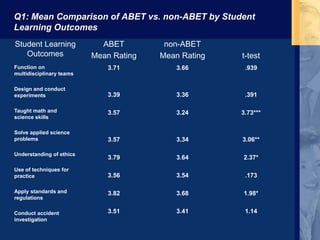
Q1: Mean Comparison of ABET vs. non-ABET by Student
Learning Outcomes
Student Learning
Outcomes
ABET
Mean Rating
non-ABET
Mean Rating t-test
Function on
multidisciplinary teams
Design and conduct
experiments
Taught math and
science skills
Solve applied science
problems
Understanding of ethics
Use of techniques for
practice
Apply standards and
regulations
Conduct accident
investigation
3.71
3.39
3.57
3.57
3.79
3.56
3.82
3.51
3.66
3.36
3.24
3.34
3.64
3.54
3.68
3.41
.939
.391
3.73***
3.06**
2.37*
.173
1.98*
1.14
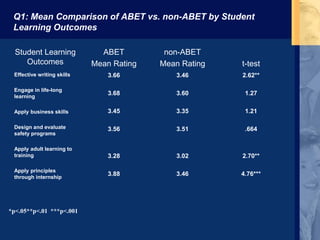
Q1: Mean Comparison of ABET vs. non-ABET by Student
Learning Outcomes
Student Learning
Outcomes
ABET
Mean Rating
non-ABET
Mean Rating t-test
Effective writing skills
Engage in life-long
learning
Apply business skills
Design and evaluate
safety programs
Apply adult learning to
training
Apply principles
through internship
3.66
3.68
3.45
3.56
3.28
3.88
3.46
3.60
3.35
3.51
3.02
3.46
2.62**
1.27
1.21
.664
2.70**
4.76***
*p<.05**p<.01 ***p<.001
Q1: ANOVA Analysis of ABET Program by Student Learning
Outcomes
Learning Outcomes F
Function on multidisciplinary teams .204
Design and conduct experiments .183
Taught math and science skills 10.887**
Solve applied science problems 5.642*
Understanding of ethics 2.685
Use of techniques for practice .011
Apply standards and regulations
*p<.05**p<.01 ***p<.001
3.041
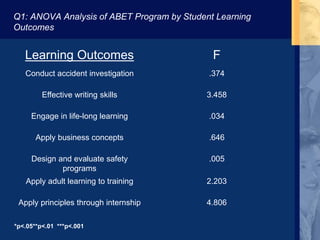
Q1: ANOVA Analysis of ABET Program by Student Learning
Outcomes
Learning Outcomes F
Conduct accident investigation .374
Effective writing skills 3.458
Engage in life-long learning .034
Apply business concepts .646
Design and evaluate safety
programs
.005
Apply adult learning to training 2.203
Apply principles through internship
*p<.05**p<.01 ***p<.001
4.806
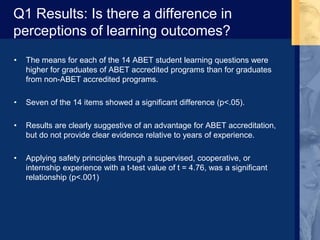
Q1 Results: Is there a difference in
perceptions of learning outcomes?
• The means for each of the 14 ABET student learning questions were
higher for graduates of ABET accredited programs than for graduates
from non-ABET accredited programs.
• Seven of the 14 items showed a significant difference (p<.05).
• Results are clearly suggestive of an advantage for ABET accreditation,
but do not provide clear evidence relative to years of experience.
• Applying safety principles through a supervised, cooperative, or
internship experience with a t-test value of t = 4.76, was a significant
relationship (p<.001)
Research Question 2
• Is there a difference in feedback about
the programs?
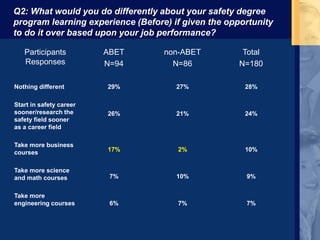
Q2: What would you do differently about your safety degree
program learning experience (Before) if given the opportunity
to do it over based upon your job performance?
Participants
Responses
ABET
N=94
non-ABET
N=86
Total
N=180
Nothing different
Start in safety career
sooner/research the
safety field sooner
as a career field
Take more business
courses
Take more science
and math courses
Take more
engineering courses
29%
26%
17%
7%
6%
27%
21%
2%
10%
7%
28%
24%
10%
9%
7%
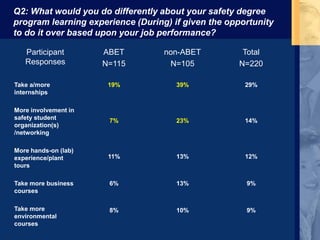
Q2: What would you do differently about your safety degree
program learning experience (During) if given the opportunity
to do it over based upon your job performance?
Participant
Responses
ABET
N=115
non-ABET
N=105
Total
N=220
Take a/more
internships
More involvement in
safety student
organization(s)
/networking
More hands-on (lab)
experience/plant
tours
Take more business
courses
Take more
environmental
courses
19%
7%
11%
6%
8%
39%
23%
13%
13%
10%
29%
14%
12%
9%
9%
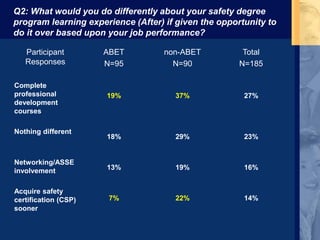
Q2: What would you do differently about your safety degree
program learning experience (After) if given the opportunity to
do it over based upon your job performance?
Participant
Responses
ABET
N=95
non-ABET
N=90
Total
N=185
Complete
professional
development
courses
Nothing different
Networking/ASSE
involvement
Acquire safety
certification (CSP)
sooner
19%
18%
13%
7%
37%
29%
19%
22%
27%
23%
16%
14%
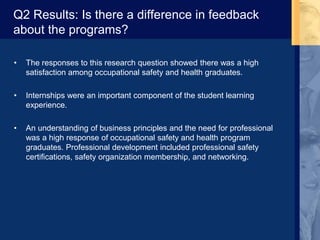
Q2 Results: Is there a difference in feedback
about the programs?
• The responses to this research question showed there was a high
satisfaction among occupational safety and health graduates.
• Internships were an important component of the student learning
experience.
• An understanding of business principles and the need for professional
was a high response of occupational safety and health program
graduates. Professional development included professional safety
certifications, safety organization membership, and networking.
Research Question 3
• Is there a difference in advice to other
students?
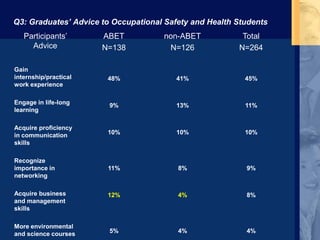
Q3: Graduates’ Advice to Occupational Safety and Health Students
Participants’
Advice
ABET
N=138
non-ABET
N=126
Total
N=264
Gain
internship/practical
work experience
Engage in life-long
learning
Acquire proficiency
in communication
skills
Recognize
importance in
networking
Acquire business
and management
skills
More environmental
and science courses
48%
9%
10%
11%
12%
5%
41%
13%
10%
8%
4%
4%
45%
11%
10%
9%
8%
4%
Q3 Results: Is there a difference in advice to other
students?
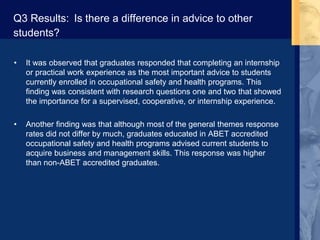
• It was observed that graduates responded that completing an internship
or practical work experience as the most important advice to students
currently enrolled in occupational safety and health programs. This
finding was consistent with research questions one and two that showed
the importance for a supervised, cooperative, or internship experience.
• Another finding was that although most of the general themes response
rates did not differ by much, graduates educated in ABET accredited
occupational safety and health programs advised current students to
acquire business and management skills. This response was higher
than non-ABET accredited graduates.
Research Question 4
• Is there a difference with regard to
professional development as determined
by the questionnaire survey?
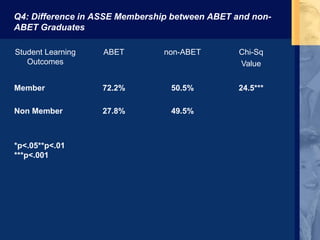
Q4: Difference in ASSE Membership between ABET and non-
ABET Graduates
Student Learning
Outcomes
ABET non-ABET Chi-Sq
Value
Member
Non Member
*p<.05**p<.01
***p<.001
72.2%
27.8%
50.5%
49.5%
24.5***
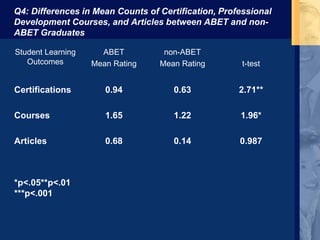
Q4: Differences in Mean Counts of Certification, Professional
Development Courses, and Articles between ABET and non-
ABET Graduates
Student Learning
Outcomes
ABET
Mean Rating
non-ABET
Mean Rating t-test
Certifications
Courses
Articles
*p<.05**p<.01
***p<.001
0.94
1.65
0.68
0.63
1.22
0.14
2.71**
1.96*
0.987
Q4 Results: Is there a difference with regard to
professional development as determined by the
questionnaire survey?
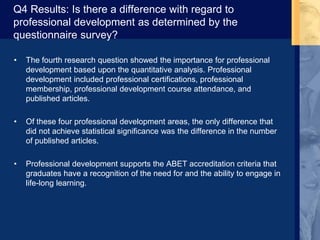
• The fourth research question showed the importance for professional
development based upon the quantitative analysis. Professional
development included professional certifications, professional
membership, professional development course attendance, and
published articles.
• Of these four professional development areas, the only difference that
did not achieve statistical significance was the difference in the number
of published articles.
• Professional development supports the ABET accreditation criteria that
graduates have a recognition of the need for and the ability to engage in
life-long learning.
Research Question 5
• Is there a difference in the perceptions
of curriculum theory used in their
programs of study?
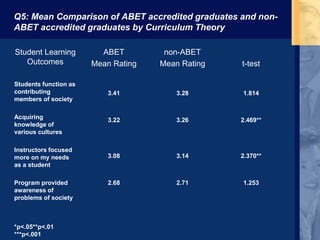
Q5: Mean Comparison of ABET accredited graduates and non-
ABET accredited graduates by Curriculum Theory
Student Learning
Outcomes
ABET
Mean Rating
non-ABET
Mean Rating t-test
Students function as
contributing
members of society
Acquiring
knowledge of
various cultures
Instructors focused
more on my needs
as a student
Program provided
awareness of
problems of society
*p<.05**p<.01
***p<.001
3.41
3.22
3.08
2.68
3.28
3.26
3.14
2.71
1.814
2.469**
2.370**
1.253
Q5 Results: Is there a difference in the perceptions of
curriculum theory used in their programs of study?
• Of the four curriculum theory ideologies – acquiring knowledge of
various cultures and instructors focused on my needs focused on my
needs – were significantly higher among non-ABET accredited
graduates than ABET accredited graduates. These curriculum theory
ideologies included scholar academic and learner centered ideologies.
• This finding is possibly the result of non-ABET accredited occupational
safety and health programs having additional time to focus on
curriculum topics. This finding requires further study.
Findings and Conclusions
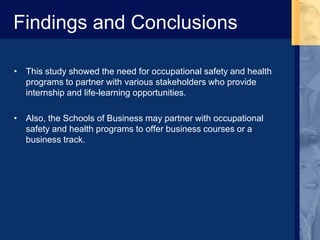
• This study showed the need for occupational safety and health
programs to partner with various stakeholders who provide
internship and life-learning opportunities.
• Also, the Schools of Business may partner with occupational
safety and health programs to offer business courses or a
business track.
Limitations
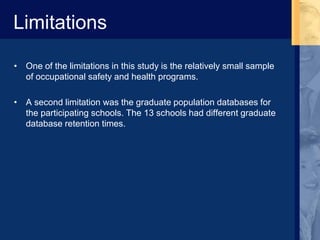
• One of the limitations in this study is the relatively small sample
of occupational safety and health programs.
• A second limitation was the graduate population databases for
the participating schools. The 13 schools had different graduate
database retention times.
Recommendations
• Occupational safety and health programs should encourage students to
understand the importance of professional development. Professional
development includes membership in professional safety organizations, seeking
accredited professional certifications, attendance at professional development
courses, and writing articles for professional safety magazines and journals.
• The American Society of Safety Engineers (ASSE), lead society for ABET
accredited occupational safety and health programs, should ensure faculty
demonstrate competence.
• The findings in this study suggest that there is an opportunity for occupational
safety and health programs to partner with the School of Business and that
faculty offer business courses for occupational safety and health students.
• Occupational safety and health organizations should increase their marketing
campaigns to promote the profession. Targeted marketing and promotions
should include high school students and college and university students who are
undecided for their program of study.
• This study revealed that occupational safety and health programs should
consider ABET accreditation.
Future Studies
• A future study might extend the current study by increasing the number
of schools participating and enlarging the graduate respondents
encompassed by the study.
• A second area might examine the employer’s perceptions of graduate
learning outcomes.
• A third area might examine the analysis of perceptions of educational
objectives of occupational safety and health program graduates and
conduct a similar comparative study.
• A fourth possible study is to conduct a qualitative research at one or
more of the occupational safety and health programs to develop a
greater, in-depth assessment of learning outcomes based upon
graduate perceptions. The qualitative study may include focus groups
and interviews.

ABET Study

  • 1.
    An Analysis ofPerceptions of Learning Outcome Competencies of College Graduates in ABET and non-ABET Accredited Occupational Safety and Health Programs Darryl C. Hill, Ph.D., CSP Oakland University April 28, 2011
  • 2.
    Introduction - Definitions •ABET – The recognized accreditor for college and university programs in applied science, computing, engineering, and technology, is a federation of 28 professional and technical societies. • Educational Objectives – Broad statements that describe the career and professional accomplishments that the program is preparing graduates to achieve. • Learning Outcomes – Narrow statements that describe what students are expected to know and be able to do by the time of graduation. • Occupational Safety & Health – The discipline concerned with preserving and protecting human and facility resources in the workplace (Friend & Kohn, 2001).
  • 3.
    Introduction – Background •There has been a shift in higher education institutional culture from an emphasis on assessing teaching methodology to assessing student learning (Allen, 2006) as a way of measuring educational quality. • This change of paradigm will also make it difficult to assess the quality because it will be necessary to assess not only the quality of teaching, but also the quality of learning, which means assessing the performance of graduates in the world of work. (Hirsch & Weber, 1999, p. 9) • True assessment of student competence must come from not only the student’s performance in the undergraduate academic setting; but it must also come from the program graduates extended experiences after leaving the undergraduate program. (Palomba & Banta, 2001, p. 156)
  • 4.
    Study Hypothesis • Premisethat the skills, knowledge, and behaviors acquired by graduates from ABET accredited occupational safety and health (OSH) programs contribute to a higher degree of learning outcome perceptions than graduates from non-ABET accredited OSH programs.
  • 5.
    Introduction – Significance •This research study may assist in the decision-making by the approximately 30 non-ABET accredited occupational safety and health programs to actively pursue ABET accreditation. • The American Society of Safety Engineers (ASSE) may evaluate the study results to assess learning outcomes within the accreditation continuous improvement process. • To assist occupational safety and health professionals in today’s dynamic workplace, it is necessary to examine accreditation criteria and standards (Institute of Medicine, 2000) to facilitate student learning.
  • 6.
    Literature Review • Severalrecently completed studies have addressed assessment of higher education learning outcomes (Anastasio, 2004; Ferrara, 2007; Turansky, 2003; Waite, 2004). These studies addressed the success of student learning outcomes in specific institutions. • Additional literature exists related to accountability, assessment, and the impact of accreditation on student learning (Banta & Associates, 2002; Burke & Associates, 2005; Palomba & Banta, 2001; Tanner, 2005). These studies focused on the effect of the accreditation process on the learning parameters of the students in educational institutions.
  • 7.
    Literature Review –Theoretical Bases of Curriculum and Learning Outcomes • Curriculum theory is the interdisciplinary study of educational experience. • Curriculum theory seeks to provide meaning to the overall educational significance of the curriculum (Pinar, 2004). • Catherine Cornbleth (1990) sees curriculum as a particular type of process. Curriculum is what happens in the classrooms, which is further defined by Cornbleth as “an ongoing social process comprised of the interactions of students, teachers, and knowledge” (p. 5). • To better understand curriculum theory and its application to accreditation, one must understand curriculum ideologies. Schiro (2008) identifies four curricular ideologies: Social Efficiency, Scholar Academic, Learner Centered, and Social Reconstruction
  • 8.
    Literature Review –Theoretical Bases of Curriculum and Learning Outcomes • Social Efficiency ideology promotes the belief that the purpose of schooling is to efficiently meet the needs of society of training students to function as future contributing members of the society (Schiro, 2008). • Scholar Academic ideology believes that history has acquired knowledge for all cultures which is conveniently organized into academic disciplines and found at colleges and universities (Schiro, 2008). • Learner Centered ideology focuses not on the needs of the academic disciplines or society, but on the needs and concerns of individuals (Schiro, 2008) • Social Reconstruction ideology brings awareness to the problems of society and the injustices done to its citizens, such as those originating from gender, racial, social, and economic inequalities (Schiro, 2008).
  • 9.
    Literature Review • ABETconducted a study for engineering degree programs to determine the importance of learning outcomes (ABET, 2006). The study titled, Engineering Change (EC2000), indicated that the implementation of the EC2000 accreditation criteria has had a positive impact on engineering programs, student experiences, and student learning. • Comparison of 1994 and 2004 graduates’ self-reported outcomes show 2004 graduates as measurably better prepared than their counterparts in all nine learning areas assessed. • Two of the largest three increases – in group skills and societal and global issues awareness – are among the skills frequently cited as critical to the future of engineering and to the future engineers’ success (National Academy of Engineering, 2004). • The study demonstrated that the accreditation criteria and the continuous improvement process enhanced student learning.
  • 10.
    Literature Review: OccupationalSafety & Health Education • Rapid growth in the number of safety curricula, as well as various influences on them, has caused diversity in curriculum content (Brauer, 1992). • This diversity creates concern among educators and practitioners regarding the quality of safety education (Simon & Simon, 1995). • Safety educators face a dilemma of balancing the scope of curriculum content with the constraints of a four-year baccalaureate degree program, especially when one considers that the safety professional’s role has expanded into areas such as risk management, ergonomics, and environmental safety (Academic Accreditation Council, 1991). • To perform their professional functions, the safety professional must have education, training and experience in a common body of knowledge. Safety professionals need to have fundamental knowledge of physics, chemistry, biology, physiology, statistics, mathematics, industrial processes, business, communication and psychology. (Adams, 2001, p. 27)
  • 11.
    Research Questions • Question1: Is there a difference in perceptions of learning outcomes? • Question 2: Is there a difference in feedback about the programs? • Question 3: Is there a difference in advice to other students? • Question 4: Is there a difference with regard to professional development as determined by the questionnaire survey? • Question 5: Is there a difference in the perceptions of curriculum theory used in their programs of study?
  • 12.
    Methodology – Approachand Design • This study used a combined research method, mixing quantitative and qualitative approaches. This approach is recommended by Coll and Chapman (2000). A combined quantitative and qualitative research method would complement each other. • A survey questionnaire online link was sent to occupational safety and health program directors who agreed to participate in the study. • Thirteen colleges and universities agreed to participate in the study (5 ABET accredited and 8 non-ABET accredited). A total of 323 survey questionnaires (169 – ABET, 154 – non-ABET) were received from the 804 sent by the May 31, 2009 deadline. • The total surveys returned included 52.3% ABET accredited graduates and 47.7% non-ABET accredited graduates.
  • 13.
    Methodology – Populationand Sample • There are 13 undergraduate and graduate occupational safety and health programs accredited by ABET. There are 30 non-ABET accredited occupational safety and health programs. • Each of the schools in this study is a public university with an average student population of 15,000. There is an average of 60 students currently studying in the occupational safety and health programs for the schools participating in this study. • Approximately, 2750 students have graduated from the occupational safety and health programs participating in this study.
  • 14.
    Methodology – InstrumentUsed • The research instrument used in this study was a 37-item questionnaire and divided into 5 parts. • Parts 1-4 of the survey questionnaire were constructed using a four- point Likert-type scale. The range of the scale is “completely untrue” represented by 1 to “completely true” represented by 4. • Part 5 included four open-ended questions to allow respondents to communicate opinions and engage in personal reflection.
  • 15.
    Methodology – DataCollection • A Survey Monkey link, along with introductory letter, consent form, and IRB approval, was sent to occupational safety and health program directors. • All data was collected in a 6-week timeframe. To prevent multiple survey submissions, the IP address was identified. • The response rate for this survey research study was 40.2% based upon 804 surveys distributed and 323 surveys collected. • Graduates from an ABET accredited occupational safety and health program had a mean of 5.52 years experience, while graduates from a non-ABET accredited program had a mean of 11.06 years experience. The years of experience difference was statistically significant (***p<.001).
  • 16.
    Research Question 1 •Is there a difference in perceptions of learning outcomes?
  • 17.
    Q1: Mean Comparisonof ABET vs. non-ABET by Student Learning Outcomes Student Learning Outcomes ABET Mean Rating non-ABET Mean Rating t-test Function on multidisciplinary teams Design and conduct experiments Taught math and science skills Solve applied science problems Understanding of ethics Use of techniques for practice Apply standards and regulations Conduct accident investigation 3.71 3.39 3.57 3.57 3.79 3.56 3.82 3.51 3.66 3.36 3.24 3.34 3.64 3.54 3.68 3.41 .939 .391 3.73*** 3.06** 2.37* .173 1.98* 1.14
  • 18.
    Q1: Mean Comparisonof ABET vs. non-ABET by Student Learning Outcomes Student Learning Outcomes ABET Mean Rating non-ABET Mean Rating t-test Effective writing skills Engage in life-long learning Apply business skills Design and evaluate safety programs Apply adult learning to training Apply principles through internship 3.66 3.68 3.45 3.56 3.28 3.88 3.46 3.60 3.35 3.51 3.02 3.46 2.62** 1.27 1.21 .664 2.70** 4.76*** *p<.05**p<.01 ***p<.001
  • 19.
    Q1: ANOVA Analysisof ABET Program by Student Learning Outcomes Learning Outcomes F Function on multidisciplinary teams .204 Design and conduct experiments .183 Taught math and science skills 10.887** Solve applied science problems 5.642* Understanding of ethics 2.685 Use of techniques for practice .011 Apply standards and regulations *p<.05**p<.01 ***p<.001 3.041
  • 20.
    Q1: ANOVA Analysisof ABET Program by Student Learning Outcomes Learning Outcomes F Conduct accident investigation .374 Effective writing skills 3.458 Engage in life-long learning .034 Apply business concepts .646 Design and evaluate safety programs .005 Apply adult learning to training 2.203 Apply principles through internship *p<.05**p<.01 ***p<.001 4.806
  • 21.
    Q1 Results: Isthere a difference in perceptions of learning outcomes? • The means for each of the 14 ABET student learning questions were higher for graduates of ABET accredited programs than for graduates from non-ABET accredited programs. • Seven of the 14 items showed a significant difference (p<.05). • Results are clearly suggestive of an advantage for ABET accreditation, but do not provide clear evidence relative to years of experience. • Applying safety principles through a supervised, cooperative, or internship experience with a t-test value of t = 4.76, was a significant relationship (p<.001)
  • 22.
    Research Question 2 •Is there a difference in feedback about the programs?
  • 23.
    Q2: What wouldyou do differently about your safety degree program learning experience (Before) if given the opportunity to do it over based upon your job performance? Participants Responses ABET N=94 non-ABET N=86 Total N=180 Nothing different Start in safety career sooner/research the safety field sooner as a career field Take more business courses Take more science and math courses Take more engineering courses 29% 26% 17% 7% 6% 27% 21% 2% 10% 7% 28% 24% 10% 9% 7%
  • 24.
    Q2: What wouldyou do differently about your safety degree program learning experience (During) if given the opportunity to do it over based upon your job performance? Participant Responses ABET N=115 non-ABET N=105 Total N=220 Take a/more internships More involvement in safety student organization(s) /networking More hands-on (lab) experience/plant tours Take more business courses Take more environmental courses 19% 7% 11% 6% 8% 39% 23% 13% 13% 10% 29% 14% 12% 9% 9%
  • 25.
    Q2: What wouldyou do differently about your safety degree program learning experience (After) if given the opportunity to do it over based upon your job performance? Participant Responses ABET N=95 non-ABET N=90 Total N=185 Complete professional development courses Nothing different Networking/ASSE involvement Acquire safety certification (CSP) sooner 19% 18% 13% 7% 37% 29% 19% 22% 27% 23% 16% 14%
  • 26.
    Q2 Results: Isthere a difference in feedback about the programs? • The responses to this research question showed there was a high satisfaction among occupational safety and health graduates. • Internships were an important component of the student learning experience. • An understanding of business principles and the need for professional was a high response of occupational safety and health program graduates. Professional development included professional safety certifications, safety organization membership, and networking.
  • 27.
    Research Question 3 •Is there a difference in advice to other students?
  • 28.
    Q3: Graduates’ Adviceto Occupational Safety and Health Students Participants’ Advice ABET N=138 non-ABET N=126 Total N=264 Gain internship/practical work experience Engage in life-long learning Acquire proficiency in communication skills Recognize importance in networking Acquire business and management skills More environmental and science courses 48% 9% 10% 11% 12% 5% 41% 13% 10% 8% 4% 4% 45% 11% 10% 9% 8% 4%
  • 29.
    Q3 Results: Isthere a difference in advice to other students? • It was observed that graduates responded that completing an internship or practical work experience as the most important advice to students currently enrolled in occupational safety and health programs. This finding was consistent with research questions one and two that showed the importance for a supervised, cooperative, or internship experience. • Another finding was that although most of the general themes response rates did not differ by much, graduates educated in ABET accredited occupational safety and health programs advised current students to acquire business and management skills. This response was higher than non-ABET accredited graduates.
  • 30.
    Research Question 4 •Is there a difference with regard to professional development as determined by the questionnaire survey?
  • 31.
    Q4: Difference inASSE Membership between ABET and non- ABET Graduates Student Learning Outcomes ABET non-ABET Chi-Sq Value Member Non Member *p<.05**p<.01 ***p<.001 72.2% 27.8% 50.5% 49.5% 24.5***
  • 32.
    Q4: Differences inMean Counts of Certification, Professional Development Courses, and Articles between ABET and non- ABET Graduates Student Learning Outcomes ABET Mean Rating non-ABET Mean Rating t-test Certifications Courses Articles *p<.05**p<.01 ***p<.001 0.94 1.65 0.68 0.63 1.22 0.14 2.71** 1.96* 0.987
  • 33.
    Q4 Results: Isthere a difference with regard to professional development as determined by the questionnaire survey? • The fourth research question showed the importance for professional development based upon the quantitative analysis. Professional development included professional certifications, professional membership, professional development course attendance, and published articles. • Of these four professional development areas, the only difference that did not achieve statistical significance was the difference in the number of published articles. • Professional development supports the ABET accreditation criteria that graduates have a recognition of the need for and the ability to engage in life-long learning.
  • 34.
    Research Question 5 •Is there a difference in the perceptions of curriculum theory used in their programs of study?
  • 35.
    Q5: Mean Comparisonof ABET accredited graduates and non- ABET accredited graduates by Curriculum Theory Student Learning Outcomes ABET Mean Rating non-ABET Mean Rating t-test Students function as contributing members of society Acquiring knowledge of various cultures Instructors focused more on my needs as a student Program provided awareness of problems of society *p<.05**p<.01 ***p<.001 3.41 3.22 3.08 2.68 3.28 3.26 3.14 2.71 1.814 2.469** 2.370** 1.253
  • 36.
    Q5 Results: Isthere a difference in the perceptions of curriculum theory used in their programs of study? • Of the four curriculum theory ideologies – acquiring knowledge of various cultures and instructors focused on my needs focused on my needs – were significantly higher among non-ABET accredited graduates than ABET accredited graduates. These curriculum theory ideologies included scholar academic and learner centered ideologies. • This finding is possibly the result of non-ABET accredited occupational safety and health programs having additional time to focus on curriculum topics. This finding requires further study.
  • 37.
    Findings and Conclusions •This study showed the need for occupational safety and health programs to partner with various stakeholders who provide internship and life-learning opportunities. • Also, the Schools of Business may partner with occupational safety and health programs to offer business courses or a business track.
  • 38.
    Limitations • One ofthe limitations in this study is the relatively small sample of occupational safety and health programs. • A second limitation was the graduate population databases for the participating schools. The 13 schools had different graduate database retention times.
  • 39.
    Recommendations • Occupational safetyand health programs should encourage students to understand the importance of professional development. Professional development includes membership in professional safety organizations, seeking accredited professional certifications, attendance at professional development courses, and writing articles for professional safety magazines and journals. • The American Society of Safety Engineers (ASSE), lead society for ABET accredited occupational safety and health programs, should ensure faculty demonstrate competence. • The findings in this study suggest that there is an opportunity for occupational safety and health programs to partner with the School of Business and that faculty offer business courses for occupational safety and health students. • Occupational safety and health organizations should increase their marketing campaigns to promote the profession. Targeted marketing and promotions should include high school students and college and university students who are undecided for their program of study. • This study revealed that occupational safety and health programs should consider ABET accreditation.
  • 40.
    Future Studies • Afuture study might extend the current study by increasing the number of schools participating and enlarging the graduate respondents encompassed by the study. • A second area might examine the employer’s perceptions of graduate learning outcomes. • A third area might examine the analysis of perceptions of educational objectives of occupational safety and health program graduates and conduct a similar comparative study. • A fourth possible study is to conduct a qualitative research at one or more of the occupational safety and health programs to develop a greater, in-depth assessment of learning outcomes based upon graduate perceptions. The qualitative study may include focus groups and interviews.