

1
Student: Geserbaatar
Nandin-erdene
Supervisor: Prof. Kenlo
Nishida Nasahara
16th
March, 2022
Estimation of the Above-ground Biomass
and Carbon Stock in Boreal Forest Using
Satellite Data with Machine Learning
Outline
1. Introduction
2. Research objectives
3. Materials and methods
4. Data analysis and results
5. Conclusion
2
1. Introduction
3
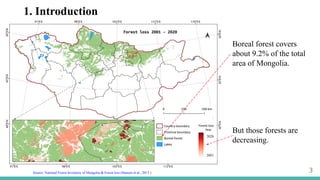
Source: National Forest Inventory of Mongolia & Forest loss (Hansen et al., 2013 )
Boreal forest covers
about 9.2% of the total
area of Mongolia.
But those forests are
decreasing.
2020
2001
Forest area
(1000 ha)
Growing stock
(million m3
)
1990 14352.0 1382.2
2000 14263.9 1373.3
2010 14183.9 1365.4
2015 14178.3 1365.3
2020 14172.7 1364.6
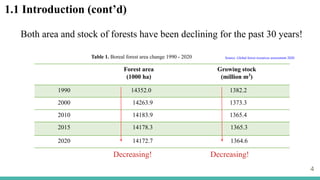
Source: Global forest resources assessment 2020
4
Table 1. Boreal forest area change 1990 - 2020
Both area and stock of forests have been declining for the past 30 years!
Decreasing! Decreasing!
1.1 Introduction (cont’d)
5
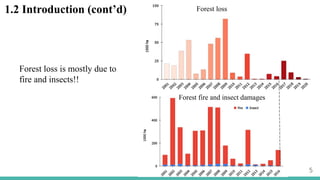
Forest loss is mostly due to
fire and insects!!
1.2 Introduction (cont’d) Forest loss
Forest fire and insect damages
1.3 Introduction (cont’d)
6
Current situation of forest data in Mongolia
--- Have to be updated every 5 years in all forested area
--- Use field measurement and allometric equation
--- Spend more time, challenging to reach some area, and costly
2. Research objectives
Main objective:
To map forest above-ground biomass and carbon stock using satellite data with
machine learning
Goals:
➢ To develop a suitable model
➢ To estimate forest above-ground biomass (AGB)
➢ To evaluate boreal forest carbon stock
7
8
3. Materials and Methods
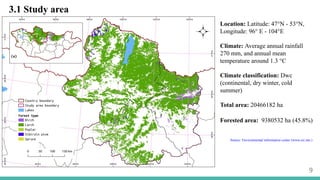
3.1 Study area
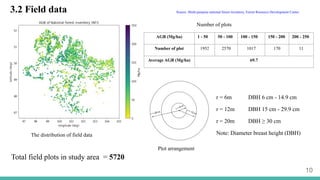
3.2 Field data
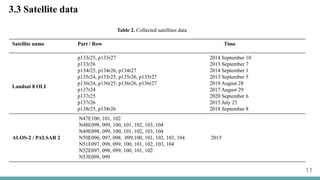
3.3 Satellite data
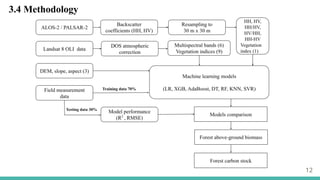
3.4 Methodology
3.1 Study area
9
Location: Latitude: 47°N - 53°N,
Longitude: 96° E - 104°E
Climate: Average annual rainfall
270 mm, and annual mean
temperature around 1.3 °C
Climate classification: Dwc
(continental, dry winter, cold
summer)
Total area: 20466182 ha
Forested area: 9380532 ha (45.8%)
Source: Environmental information center (www.eic.mn )
10
3.2 Field data
The distribution of field data
Plot arrangement
Total field plots in study area = 5720
AGB (Mg/ha) 1 - 50 50 - 100 100 - 150 150 - 200 200 - 250
Number of plot 1952 2570 1017 170 11
Average AGB (Mg/ha) 69.7
Number of plots
r = 6m DBH 6 cm - 14.9 cm
r = 12m DBH 15 cm - 29.9 cm
r = 20m DBH ≥ 30 cm
Note: Diameter breast height (DBH)
Source: Multi-purpose national forest inventory, Forest Resource Development Center
3.3 Satellite data
11
Satellite name Part / Row Time
Landsat 8 OLI
p133r25, p133r27
p133r26
p134r25, p134r26, p134r27
p135r24, p135r25, p135r26, p135r27
p136r24, p136r25, p136r26, p136r27
p137r24
p137r25
p137r26
p138r25, p138r26
2014 September 10
2013 September 7
2014 September 1
2013 September 5
2019 August 28
2017 August 29
2020 September 6
2015 July 23
2018 September 8
ALOS-2 / PALSAR 2
N47E100, 101, 102
N48E098, 099, 100, 101, 102, 103, 104
N49E098, 099, 100, 101, 102, 103, 104
N50E096, 097, 098, 099,100, 101, 102, 103, 104
N51E097, 098, 099, 100, 101, 102, 103, 104
N52E097, 098, 099, 100, 101, 102
N53E098, 099
2015
Table 2. Collected satellites data
12
3.4 Methodology
13
4. Data analysis and results
4.1 Input features for machine learning (ML)
4.2 Accuracy of forest above-ground biomass (AGB) prediction
4.3 Hyperparameter values of ML algorithms
4.4 Feature importance for random forest (RF)
4.5 Predicted map derived from RF model
4.6 Reference data errors
14
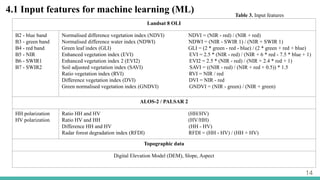
4.1 Input features for machine learning (ML)
Landsat 8 OLI
B2 - blue band
B3 - green band
B4 - red band
B5 - NIR
B6 - SWIR1
B7 - SWIR2
Normalised difference vegetation index (NDVI) NDVI = (NIR - red) / (NIR + red)
Normalised difference water index (NDWI) NDWI = (NIR - SWIR 1) / (NIR + SWIR 1)
Green leaf index (GLI) GLI = (2 * green - red - blue) / (2 * green + red + blue)
Enhanced vegetation index (EVI) EVI = 2.5 * (NIR - red) / (NIR + 6 * red - 7.5 * blue + 1)
Enhanced vegetation index 2 (EVI2) EVI2 = 2.5 * (NIR - red) / (NIR + 2.4 * red + 1)
Soil adjusted vegetation index (SAVI) SAVI = ((NIR - red) / (NIR + red + 0.5)) * 1.5
Ratio vegetation index (RVI) RVI = NIR / red
Difference vegetation index (DVI) DVI = NIR - red
Green normalised vegetation index (GNDVI) GNDVI = (NIR - green) / (NIR + green)
ALOS-2 / PALSAR 2
HH polarization
HV polarization
Ratio HH and HV (HH/HV)
Ratio HV and HH (HV/HH)
Difference HH and HV (HH - HV)
Radar forest degradation index (RFDI) RFDI = (HH - HV) / (HH + HV)
Topographic data
Digital Elevation Model (DEM), Slope, Aspect
Table 3. Input features
15
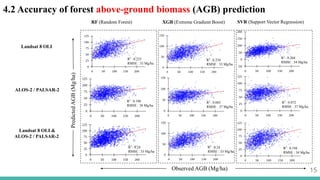
4.2 Accuracy of forest above-ground biomass (AGB) prediction
RF (Random Forest) XGB (Extreme Gradient Boost) SVR (Support Vector Regression)
Landsat 8 OLI
ALOS-2 / PALSAR-2
Landsat 8 OLI &
ALOS-2 / PALSAR-2
Predicted
AGB
(Mg/ha)
Observed AGB (Mg/ha)
R2
: 0.235
RMSE : 33 Mg/ha
R2
: 0.106
RMSE : 36 Mg/ha
R2
: 0.24
RMSE : 33 Mg/ha
R2
: 0.234
RMSE : 33 Mg/ha
R2
: 0.085
RMSE : 37 Mg/ha
R2
: 0.24
RMSE : 33 Mg/ha
R2
: 0.204
RMSE : 34 Mg/ha
R2
: 0.072
RMSE : 37 Mg/ha
R2
: 0.194
RMSE : 34 Mg/ha
16
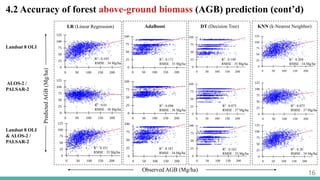
4.2 Accuracy of forest above-ground biomass (AGB) prediction (cont’d)
LR (Linear Regression) AdaBoost DT (Decision Tree) KNN (k-Nearest Neighbor)
Landsat 8 OLI
ALOS-2 /
PALSAR-2
Landsat 8 OLI
& ALOS-2 /
PALSAR-2
Predicted
AGB
(Mg/ha)
Observed AGB (Mg/ha)
R2
: 0.195
RMSE : 34 Mg/ha
R2
: 0.01
RMSE : 38 Mg/ha
R2
: 0.151
RMSE : 35 Mg/ha
R2
: 0.171
RMSE : 35 Mg/ha
R2
: 0.096
RMSE : 36 Mg/ha
R2
: 0.187
RMSE : 34 Mg/ha
R2
: 0.149
RMSE : 35 Mg/ha
R2
: 0.075
RMSE : 37 Mg/ha
R2
: 0.162
RMSE : 35 Mg/ha
R2
: 0.204
RMSE : 34 Mg/ha
R2
: 0.075
RMSE : 37 Mg/ha
R2
: 0.20
RMSE : 34 Mg/ha
17
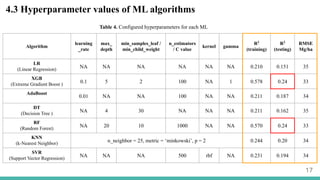
4.3 Hyperparameter values of ML algorithms
Algorithm
learning
_rate
max_
depth
min_samples_leaf /
min_child_weight
n_estimators
/ C value
kernel gamma
R2
(training)
R2
(testing)
RMSE
Mg/ha
LR
(Linear Regression)
NA NA NA NA NA NA 0.210 0.151 35
XGB
(Extreme Gradient Boost )
0.1 5 2 100 NA 1 0.578 0.24 33
AdaBoost
0.01 NA NA 100 NA NA 0.211 0.187 34
DT
(Decision Tree )
NA 4 30 NA NA NA 0.211 0.162 35
RF
(Random Forest)
NA 20 10 1000 NA NA 0.570 0.24 33
KNN
(k-Nearest Neighbor)
n_neighbor = 25, metric = ‘minkowski’, p = 2 0.244 0.20 34
SVR
(Support Vector Regression)
NA NA NA 500 rbf NA 0.231 0.194 34
Table 4. Configured hyperparameters for each ML
18
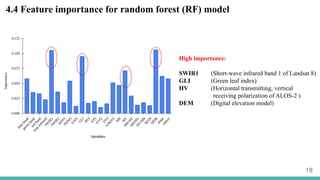
4.4 Feature importance for random forest (RF) model
High importance:
SWIR1 (Short-wave infrared band 1 of Landsat 8)
GLI (Green leaf index)
HV (Horizontal transmitting, vertical
receiving polarization of ALOS-2 )
DEM (Digital elevation model)
19
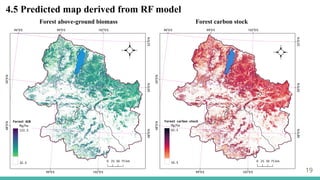
4.5 Predicted map derived from RF model
Forest above-ground biomass Forest carbon stock
20
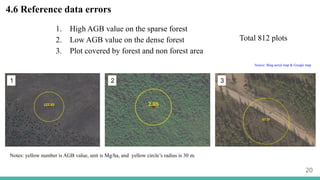
4.6 Reference data errors
1. High AGB value on the sparse forest
2. Low AGB value on the dense forest
3. Plot covered by forest and non forest area
Notes: yellow number is AGB value, unit is Mg/ha, and yellow circle’s radius is 30 m.
1 2 3
Total 812 plots
Source: Bing aerial map & Google map
21
5. Conclusion
* Hyperparameter values were effectively influenced by overfitting error.
* SVR, KNN, and LR models were high R2
in only using Landsat data.
* The best regression model was RF. The coefficient of determination (R2
) was 0.24 and
RMSE was 33 Mg/ha. Forest AGB was estimated 32.5 Mg/ha - 122.5 Mg/ha and forest carbon
stock was estimated 16.5 Mg C/ha - 62.5 Mg C/ha.
* The highest importance variables were SWIR1, GLI, HV and DEM for the RF model.
* After data screening, 812 plots of reference data were errors. From data screening analysis
and my research, forest AGB data of National Forest Inventory in Mongolia was bad quality.
* In the future, reference field data need validation and update.
22
References
Dan, A. (2019). Multipurpose national forest inventory in Mongolia, 2014-2017-A tool to support sustainable forest
management. Geography, Environment, Sustainability, 12(3), 167-183.
Environmental information center. (2020). http://www.eic.mn
FAO. (2020). Global forest resources assessment 2020. FAO. http://www.fao.org/3/cb0031en/cb0031en.pdf
Hansen, M. C., P. V. Potapov, R. Moore, M. Hancher, S. A. Turubanova, A. Tyukavina, D. Thau, S. V. Stehman, S. J.
Goetz, T. R. Loveland, A. Kommareddy, A. Egorov, L. Chini, C. O. Justice, and J. R. G. Townshend. 2013.
“High-Resolution Global Maps of 21st-Century Forest Cover Change.” Science 342 (15 November): 850–53. Data
available online from: http://earthenginepartners.appspot.com/science-2013-global-forest.
FRDC. (2017). Multi-purpose national forest inventory in Mongolia
Nachin, B., & Sukhbaatar, G. (2013). Some results of forest carbon stock calculation in northern Mongolia. UNREDD.
www.unredd.net
Thank you for your attention!
23

Presentation 20220316 nandia

  • 1.
    1 Student: Geserbaatar Nandin-erdene Supervisor: Prof.Kenlo Nishida Nasahara 16th March, 2022 Estimation of the Above-ground Biomass and Carbon Stock in Boreal Forest Using Satellite Data with Machine Learning
  • 2.
    Outline 1. Introduction 2. Researchobjectives 3. Materials and methods 4. Data analysis and results 5. Conclusion 2
  • 3.
    1. Introduction 3 Source: NationalForest Inventory of Mongolia & Forest loss (Hansen et al., 2013 ) Boreal forest covers about 9.2% of the total area of Mongolia. But those forests are decreasing. 2020 2001
  • 4.
    Forest area (1000 ha) Growingstock (million m3 ) 1990 14352.0 1382.2 2000 14263.9 1373.3 2010 14183.9 1365.4 2015 14178.3 1365.3 2020 14172.7 1364.6 Source: Global forest resources assessment 2020 4 Table 1. Boreal forest area change 1990 - 2020 Both area and stock of forests have been declining for the past 30 years! Decreasing! Decreasing! 1.1 Introduction (cont’d)
  • 5.
    5 Forest loss ismostly due to fire and insects!! 1.2 Introduction (cont’d) Forest loss Forest fire and insect damages
  • 6.
    1.3 Introduction (cont’d) 6 Currentsituation of forest data in Mongolia --- Have to be updated every 5 years in all forested area --- Use field measurement and allometric equation --- Spend more time, challenging to reach some area, and costly
  • 7.
    2. Research objectives Mainobjective: To map forest above-ground biomass and carbon stock using satellite data with machine learning Goals: ➢ To develop a suitable model ➢ To estimate forest above-ground biomass (AGB) ➢ To evaluate boreal forest carbon stock 7
  • 8.
    8 3. Materials andMethods 3.1 Study area 3.2 Field data 3.3 Satellite data 3.4 Methodology
  • 9.
    3.1 Study area 9 Location:Latitude: 47°N - 53°N, Longitude: 96° E - 104°E Climate: Average annual rainfall 270 mm, and annual mean temperature around 1.3 °C Climate classification: Dwc (continental, dry winter, cold summer) Total area: 20466182 ha Forested area: 9380532 ha (45.8%) Source: Environmental information center (www.eic.mn )
  • 10.
    10 3.2 Field data Thedistribution of field data Plot arrangement Total field plots in study area = 5720 AGB (Mg/ha) 1 - 50 50 - 100 100 - 150 150 - 200 200 - 250 Number of plot 1952 2570 1017 170 11 Average AGB (Mg/ha) 69.7 Number of plots r = 6m DBH 6 cm - 14.9 cm r = 12m DBH 15 cm - 29.9 cm r = 20m DBH ≥ 30 cm Note: Diameter breast height (DBH) Source: Multi-purpose national forest inventory, Forest Resource Development Center
  • 11.
    3.3 Satellite data 11 Satellitename Part / Row Time Landsat 8 OLI p133r25, p133r27 p133r26 p134r25, p134r26, p134r27 p135r24, p135r25, p135r26, p135r27 p136r24, p136r25, p136r26, p136r27 p137r24 p137r25 p137r26 p138r25, p138r26 2014 September 10 2013 September 7 2014 September 1 2013 September 5 2019 August 28 2017 August 29 2020 September 6 2015 July 23 2018 September 8 ALOS-2 / PALSAR 2 N47E100, 101, 102 N48E098, 099, 100, 101, 102, 103, 104 N49E098, 099, 100, 101, 102, 103, 104 N50E096, 097, 098, 099,100, 101, 102, 103, 104 N51E097, 098, 099, 100, 101, 102, 103, 104 N52E097, 098, 099, 100, 101, 102 N53E098, 099 2015 Table 2. Collected satellites data
  • 12.
  • 13.
    13 4. Data analysisand results 4.1 Input features for machine learning (ML) 4.2 Accuracy of forest above-ground biomass (AGB) prediction 4.3 Hyperparameter values of ML algorithms 4.4 Feature importance for random forest (RF) 4.5 Predicted map derived from RF model 4.6 Reference data errors
  • 14.
    14 4.1 Input featuresfor machine learning (ML) Landsat 8 OLI B2 - blue band B3 - green band B4 - red band B5 - NIR B6 - SWIR1 B7 - SWIR2 Normalised difference vegetation index (NDVI) NDVI = (NIR - red) / (NIR + red) Normalised difference water index (NDWI) NDWI = (NIR - SWIR 1) / (NIR + SWIR 1) Green leaf index (GLI) GLI = (2 * green - red - blue) / (2 * green + red + blue) Enhanced vegetation index (EVI) EVI = 2.5 * (NIR - red) / (NIR + 6 * red - 7.5 * blue + 1) Enhanced vegetation index 2 (EVI2) EVI2 = 2.5 * (NIR - red) / (NIR + 2.4 * red + 1) Soil adjusted vegetation index (SAVI) SAVI = ((NIR - red) / (NIR + red + 0.5)) * 1.5 Ratio vegetation index (RVI) RVI = NIR / red Difference vegetation index (DVI) DVI = NIR - red Green normalised vegetation index (GNDVI) GNDVI = (NIR - green) / (NIR + green) ALOS-2 / PALSAR 2 HH polarization HV polarization Ratio HH and HV (HH/HV) Ratio HV and HH (HV/HH) Difference HH and HV (HH - HV) Radar forest degradation index (RFDI) RFDI = (HH - HV) / (HH + HV) Topographic data Digital Elevation Model (DEM), Slope, Aspect Table 3. Input features
  • 15.
    15 4.2 Accuracy offorest above-ground biomass (AGB) prediction RF (Random Forest) XGB (Extreme Gradient Boost) SVR (Support Vector Regression) Landsat 8 OLI ALOS-2 / PALSAR-2 Landsat 8 OLI & ALOS-2 / PALSAR-2 Predicted AGB (Mg/ha) Observed AGB (Mg/ha) R2 : 0.235 RMSE : 33 Mg/ha R2 : 0.106 RMSE : 36 Mg/ha R2 : 0.24 RMSE : 33 Mg/ha R2 : 0.234 RMSE : 33 Mg/ha R2 : 0.085 RMSE : 37 Mg/ha R2 : 0.24 RMSE : 33 Mg/ha R2 : 0.204 RMSE : 34 Mg/ha R2 : 0.072 RMSE : 37 Mg/ha R2 : 0.194 RMSE : 34 Mg/ha
  • 16.
    16 4.2 Accuracy offorest above-ground biomass (AGB) prediction (cont’d) LR (Linear Regression) AdaBoost DT (Decision Tree) KNN (k-Nearest Neighbor) Landsat 8 OLI ALOS-2 / PALSAR-2 Landsat 8 OLI & ALOS-2 / PALSAR-2 Predicted AGB (Mg/ha) Observed AGB (Mg/ha) R2 : 0.195 RMSE : 34 Mg/ha R2 : 0.01 RMSE : 38 Mg/ha R2 : 0.151 RMSE : 35 Mg/ha R2 : 0.171 RMSE : 35 Mg/ha R2 : 0.096 RMSE : 36 Mg/ha R2 : 0.187 RMSE : 34 Mg/ha R2 : 0.149 RMSE : 35 Mg/ha R2 : 0.075 RMSE : 37 Mg/ha R2 : 0.162 RMSE : 35 Mg/ha R2 : 0.204 RMSE : 34 Mg/ha R2 : 0.075 RMSE : 37 Mg/ha R2 : 0.20 RMSE : 34 Mg/ha
  • 17.
    17 4.3 Hyperparameter valuesof ML algorithms Algorithm learning _rate max_ depth min_samples_leaf / min_child_weight n_estimators / C value kernel gamma R2 (training) R2 (testing) RMSE Mg/ha LR (Linear Regression) NA NA NA NA NA NA 0.210 0.151 35 XGB (Extreme Gradient Boost ) 0.1 5 2 100 NA 1 0.578 0.24 33 AdaBoost 0.01 NA NA 100 NA NA 0.211 0.187 34 DT (Decision Tree ) NA 4 30 NA NA NA 0.211 0.162 35 RF (Random Forest) NA 20 10 1000 NA NA 0.570 0.24 33 KNN (k-Nearest Neighbor) n_neighbor = 25, metric = ‘minkowski’, p = 2 0.244 0.20 34 SVR (Support Vector Regression) NA NA NA 500 rbf NA 0.231 0.194 34 Table 4. Configured hyperparameters for each ML
  • 18.
    18 4.4 Feature importancefor random forest (RF) model High importance: SWIR1 (Short-wave infrared band 1 of Landsat 8) GLI (Green leaf index) HV (Horizontal transmitting, vertical receiving polarization of ALOS-2 ) DEM (Digital elevation model)
  • 19.
    19 4.5 Predicted mapderived from RF model Forest above-ground biomass Forest carbon stock
  • 20.
    20 4.6 Reference dataerrors 1. High AGB value on the sparse forest 2. Low AGB value on the dense forest 3. Plot covered by forest and non forest area Notes: yellow number is AGB value, unit is Mg/ha, and yellow circle’s radius is 30 m. 1 2 3 Total 812 plots Source: Bing aerial map & Google map
  • 21.
    21 5. Conclusion * Hyperparametervalues were effectively influenced by overfitting error. * SVR, KNN, and LR models were high R2 in only using Landsat data. * The best regression model was RF. The coefficient of determination (R2 ) was 0.24 and RMSE was 33 Mg/ha. Forest AGB was estimated 32.5 Mg/ha - 122.5 Mg/ha and forest carbon stock was estimated 16.5 Mg C/ha - 62.5 Mg C/ha. * The highest importance variables were SWIR1, GLI, HV and DEM for the RF model. * After data screening, 812 plots of reference data were errors. From data screening analysis and my research, forest AGB data of National Forest Inventory in Mongolia was bad quality. * In the future, reference field data need validation and update.
  • 22.
    22 References Dan, A. (2019).Multipurpose national forest inventory in Mongolia, 2014-2017-A tool to support sustainable forest management. Geography, Environment, Sustainability, 12(3), 167-183. Environmental information center. (2020). http://www.eic.mn FAO. (2020). Global forest resources assessment 2020. FAO. http://www.fao.org/3/cb0031en/cb0031en.pdf Hansen, M. C., P. V. Potapov, R. Moore, M. Hancher, S. A. Turubanova, A. Tyukavina, D. Thau, S. V. Stehman, S. J. Goetz, T. R. Loveland, A. Kommareddy, A. Egorov, L. Chini, C. O. Justice, and J. R. G. Townshend. 2013. “High-Resolution Global Maps of 21st-Century Forest Cover Change.” Science 342 (15 November): 850–53. Data available online from: http://earthenginepartners.appspot.com/science-2013-global-forest. FRDC. (2017). Multi-purpose national forest inventory in Mongolia Nachin, B., & Sukhbaatar, G. (2013). Some results of forest carbon stock calculation in northern Mongolia. UNREDD. www.unredd.net
  • 23.
    Thank you foryour attention! 23