The lion man 
Germany 
Complex thinking creative 
imagination
Woman from willendorf 
Austria 
Fertility statue
• Stonehenge 
• Most complex from time period 
• Likely ceremonial purposes, stones 
transported to location
Spotted Horses and Human Hands 
Pech-Merle Cave 
Use of negative space
12 votive figures 
Square temple, Iraq 
Images depicted to be gods 
Followed conventions of 
Sumerian art
Head of a man (Akkadian ruler) 
Ninua, Iraq 
Earliest known hollow cast sculpture 
using the lost wax casting process
Ishtar Gate and Throne Room Wall 
Symbolic of Babylonian power 
Crenellations are notched walls 
Notches are caled crenels, built as 
military defense
King Tut Funeral Mask 
• Made of gold 
• Built to honor dead 
• Shows beard, symbol 
of power
Map of Ancient Egypt 
Lower end near top because of how the nile flows (north to south)
Seated Scribe 
Sculptors of Old Kingdom featured everyday people as well as 
royals, scribes had high status in society
Ti Watching a Hippo Hunt 
2450-2350 B.C. 
Saqqara, Egypt (Lower) 
Old Kingdom 
from his mastaba 
painted limestone relief 
success in a hunt meant triumph over 
evil, success in life 
hierarchy of scale with Ti 
represents bounty, wealth and leisure
Funerary Temple of Hatshepsut 
Structure not intended to be tomb (ruler made to be put to rest in the 
valley of the kings), positioned against high cliffs and oriented 
towards the Great temple of Amun at Karnak, a few miles away from 
the nile 
Represents authority, union of nature and architecture, and antiquity
Judgement of Hunefer Before Osiris 
Illustration from a Book of the Dead, 19th Dynasty 
Book of Dead supposed to help those in afterlife, no 2 books the same, contains a 
variety of spells,
Young Girl Gathering 
Saffron Crocus 
Flowers 
Good eye for detail in 
color selection and 
surface detail, shows a 
typical seen of a young 
girl “becoming” a 
woman
Knossos Interior 
-with fresco walls (restored) 
- Minoan columns 
- reconstruction resembles 19th century 
feeling, architectural bias 
- past manipulated to function in the present
Bull’s Head Rhyton 
Common subject of Minoan art, 
No proof that bull was 
worshipped as a God
Berlin Kore 
1st Archaic korai, believed to be 
a priestess or attendant, holds 
a symbol of Persephone 
demonstrates this change in 
clothing style. 
Due to the unique preservation 
of this kore (thought to have 
been wrapped in a sheet of 
lead) traces of paint have been 
found on the stone.
Kritos Boy 
• Relaxed pose 
• Lifelike 
• Contrappasto (weight 
shifted)
Aphrodite of Melos 
• Classical styles 
• Heavier set 
• Shows beauty 
• Intricate detail of 
fabric
Charioteer 
Classical 
bronze, idealized youth 
commemorated a victory by a drive 
in the Pythian Games
Old Woman 
It probably represents an aged 
courtesan on her way to a festival of 
Dionysos, the god of wine. 
Veneration of Dionysos was widespread 
during the Hellenistic period, and 
ancient literary descriptions give an idea 
of the extraordinary processions and 
festivals held in his honor. The flattened 
composition of the figure is typical of 
sculpture created in the late second 
century B.C. The original work may 
have been dedicated in a sanctuary of 
Dionysos. The Roman copy could have 
decorated a garden.
Reclining Couple on a sarcophagus 
Made of terra cotta, evolved from earlier terra cotta cinerary 
Husband and wife featured 
Features earthly comforts for the dead
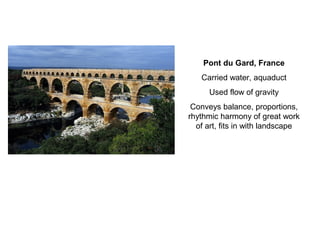
Pont du Gard, France 
Carried water, aquaduct 
Used flow of gravity 
Conveys balance, proportions, 
rhythmic harmony of great work 
of art, fits in with landscape
Pantheon 
Rome 
Designed and constructed during reign of Hadrian, empty space gives 
the feeling that one could rise upward and escape the spherical 
hollow of the building to commune with the gods 
Sophisticated design 
609 AD Pope dedicated it to Saint Mary of the Martyrs, keeping it 
alive in the middle ages
Garden Vista Villa 
• Fresco 
• Rome 
• Peace, calm 
• Shows environment
Wall with Torah Niche 
House-synagoguge, Syria. 244-245 AD 
1st Dura-Europus synagogue 
men and women shared hall, contained residents rooms
Sarcophagus of Junius Bassus 
Junius Bassus was a high-ranking Roman official, who served in 
the Roman senate and held the office of "Praefectus Urbi" for 
Rome, more or less what we would consider as the office of the 
Mayor. As a politician from a prominent family, upon his death, 
he would have had a memorial bust displayed in a prominent 
public place, like in the Forum or along the Appian Way. Instead, 
his elaborately sculpted sarcophagus was his memorial, with 
scenes depicting stories from both the New and Old 
Testaments....
The Good Shepherd 
Significant changes in content and design, conception of Jesus has 
changed 
Young adult, halo, imperial robes 
Stylized elements of landscape

Art History Mid Term

  • 1.
    The lion man Germany Complex thinking creative imagination
  • 2.
    Woman from willendorf Austria Fertility statue
  • 3.
    • Stonehenge •Most complex from time period • Likely ceremonial purposes, stones transported to location
  • 4.
    Spotted Horses andHuman Hands Pech-Merle Cave Use of negative space
  • 5.
    12 votive figures Square temple, Iraq Images depicted to be gods Followed conventions of Sumerian art
  • 6.
    Head of aman (Akkadian ruler) Ninua, Iraq Earliest known hollow cast sculpture using the lost wax casting process
  • 7.
    Ishtar Gate andThrone Room Wall Symbolic of Babylonian power Crenellations are notched walls Notches are caled crenels, built as military defense
  • 8.
    King Tut FuneralMask • Made of gold • Built to honor dead • Shows beard, symbol of power
  • 9.
    Map of AncientEgypt Lower end near top because of how the nile flows (north to south)
  • 10.
    Seated Scribe Sculptorsof Old Kingdom featured everyday people as well as royals, scribes had high status in society
  • 11.
    Ti Watching aHippo Hunt 2450-2350 B.C. Saqqara, Egypt (Lower) Old Kingdom from his mastaba painted limestone relief success in a hunt meant triumph over evil, success in life hierarchy of scale with Ti represents bounty, wealth and leisure
  • 12.
    Funerary Temple ofHatshepsut Structure not intended to be tomb (ruler made to be put to rest in the valley of the kings), positioned against high cliffs and oriented towards the Great temple of Amun at Karnak, a few miles away from the nile Represents authority, union of nature and architecture, and antiquity
  • 13.
    Judgement of HuneferBefore Osiris Illustration from a Book of the Dead, 19th Dynasty Book of Dead supposed to help those in afterlife, no 2 books the same, contains a variety of spells,
  • 14.
    Young Girl Gathering Saffron Crocus Flowers Good eye for detail in color selection and surface detail, shows a typical seen of a young girl “becoming” a woman
  • 15.
    Knossos Interior -withfresco walls (restored) - Minoan columns - reconstruction resembles 19th century feeling, architectural bias - past manipulated to function in the present
  • 16.
    Bull’s Head Rhyton Common subject of Minoan art, No proof that bull was worshipped as a God
  • 17.
    Berlin Kore 1stArchaic korai, believed to be a priestess or attendant, holds a symbol of Persephone demonstrates this change in clothing style. Due to the unique preservation of this kore (thought to have been wrapped in a sheet of lead) traces of paint have been found on the stone.
  • 18.
    Kritos Boy •Relaxed pose • Lifelike • Contrappasto (weight shifted)
  • 19.
    Aphrodite of Melos • Classical styles • Heavier set • Shows beauty • Intricate detail of fabric
  • 20.
    Charioteer Classical bronze,idealized youth commemorated a victory by a drive in the Pythian Games
  • 21.
    Old Woman Itprobably represents an aged courtesan on her way to a festival of Dionysos, the god of wine. Veneration of Dionysos was widespread during the Hellenistic period, and ancient literary descriptions give an idea of the extraordinary processions and festivals held in his honor. The flattened composition of the figure is typical of sculpture created in the late second century B.C. The original work may have been dedicated in a sanctuary of Dionysos. The Roman copy could have decorated a garden.
  • 22.
    Reclining Couple ona sarcophagus Made of terra cotta, evolved from earlier terra cotta cinerary Husband and wife featured Features earthly comforts for the dead
  • 23.
    Pont du Gard,France Carried water, aquaduct Used flow of gravity Conveys balance, proportions, rhythmic harmony of great work of art, fits in with landscape
  • 24.
    Pantheon Rome Designedand constructed during reign of Hadrian, empty space gives the feeling that one could rise upward and escape the spherical hollow of the building to commune with the gods Sophisticated design 609 AD Pope dedicated it to Saint Mary of the Martyrs, keeping it alive in the middle ages
  • 25.
    Garden Vista Villa • Fresco • Rome • Peace, calm • Shows environment
  • 26.
    Wall with TorahNiche House-synagoguge, Syria. 244-245 AD 1st Dura-Europus synagogue men and women shared hall, contained residents rooms
  • 27.
    Sarcophagus of JuniusBassus Junius Bassus was a high-ranking Roman official, who served in the Roman senate and held the office of "Praefectus Urbi" for Rome, more or less what we would consider as the office of the Mayor. As a politician from a prominent family, upon his death, he would have had a memorial bust displayed in a prominent public place, like in the Forum or along the Appian Way. Instead, his elaborately sculpted sarcophagus was his memorial, with scenes depicting stories from both the New and Old Testaments....
  • 28.
    The Good Shepherd Significant changes in content and design, conception of Jesus has changed Young adult, halo, imperial robes Stylized elements of landscape