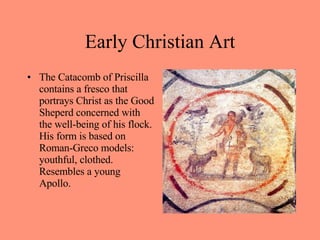
The Catacomb of Priscilla contains a fresco that portrays Christ as the Good Sheperd concerned with the well-being of his flock. His form is based on Roman-Greco models: youthful, clothed. Resembles a young Apollo. Early Christian Art
At the end of the circle, lunettes [semicircles] contain scenes from the Old Testament, like the story of Jonah. To Christians, Jonah is a prefiguration of Christ and therefore important in Christian art. Early Christian Art
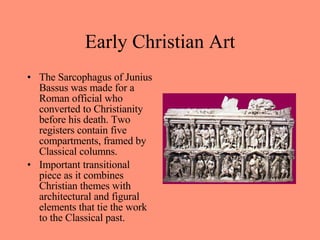
The Sarcophagus of Junius Bassus was made for a Roman official who converted to Christianity before his death. Two registers contain five compartments, framed by Classical columns.  Important transitional piece as it combines Christian themes with architectural and figural elements that tie the work to the Classical past. Early Christian Art
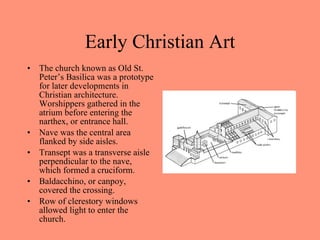
The church known as Old St. Peter’s Basilica was a prototype for later developments in Christian architecture. Worshippers gathered in the atrium before entering the narthex, or entrance hall.  Nave was the central area flanked by side aisles. Transept was a transverse aisle perpendicular to the nave, which formed a cruciform.  Baldacchino, or canpoy, covered the crossing.  Row of clerestory windows allowed light to enter the church. Early Christian Art
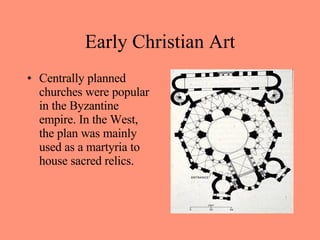
Centrally planned churches were popular in the Byzantine empire. In the West, the plan was mainly used as a martyria to house sacred relics. Early Christian Art
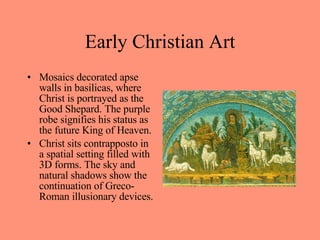
Mosaics decorated apse walls in basilicas, where Christ is portrayed as the Good Shepard. The purple robe signifies his status as the future King of Heaven. Christ sits contrapposto in a spatial setting filled with 3D forms. The sky and natural shadows show the continuation of Greco-Roman illusionary devices. Early Christian Art
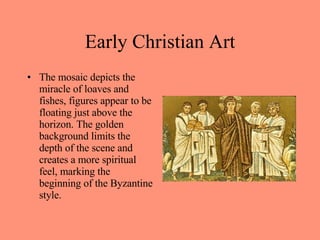
The mosaic depicts the miracle of loaves and fishes, figures appear to be floating just above the horizon. The golden background limits the depth of the scene and creates a more spiritual feel, marking the beginning of the Byzantine style. Early Christian Art
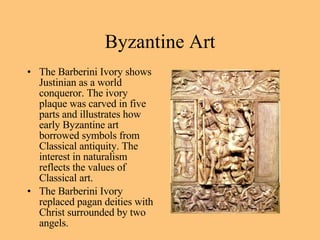
The Barberini Ivory shows Justinian as a world conqueror. The ivory plaque was carved in five parts and illustrates how early Byzantine art borrowed symbols from Classical antiquity. The interest in naturalism reflects the values of Classical art.  The Barberini Ivory replaced pagan deities with Christ surrounded by two angels. Byzantine Art
Hagia Sophia [church of Holy Wisdom] extensively uses pendentives in which the weight of the dome is transferred to the four corner piers: circular dome and rectangular base.  Byzantine Art
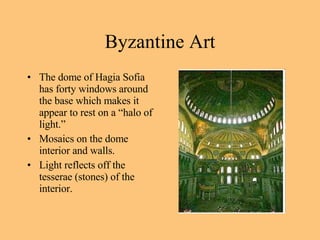
The dome of Hagia Sofia has forty windows around the base which makes it appear to rest on a “halo of light.”  Mosaics on the dome interior and walls. Light reflects off the tesserae (stones) of the interior. Byzantine Art
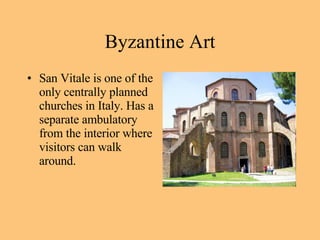
San Vitale is one of the only centrally planned churches in Italy. Has a separate ambulatory from the interior where visitors can walk around.  Byzantine Art
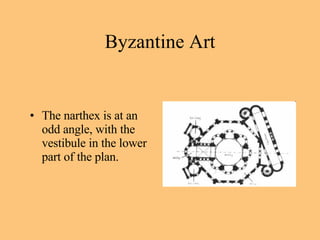
The narthex is at an odd angle, with the vestibule in the lower part of the plan. Byzantine Art
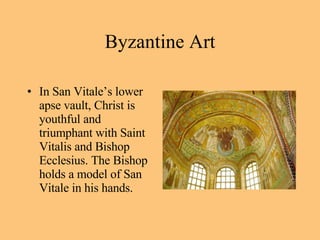
In San Vitale’s lower apse vault, Christ is youthful and triumphant with Saint Vitalis and Bishop Ecclesius. The Bishop holds a model of San Vitale in his hands. Byzantine Art
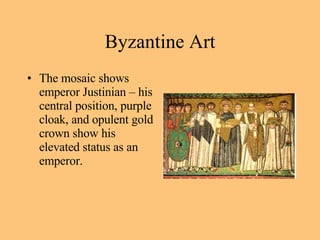
The mosaic shows emperor Justinian – his central position, purple cloak, and opulent gold crown show his elevated status as an emperor.  Byzantine Art
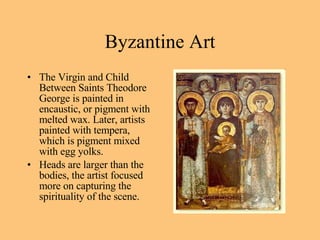
The Virgin and Child Between Saints Theodore George is painted in encaustic, or pigment with melted wax. Later, artists painted with tempera, which is pigment mixed with egg yolks. Heads are larger than the bodies, the artist focused more on capturing the spirituality of the scene. Byzantine Art
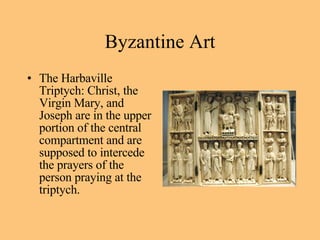
The Harbaville Triptych: Christ, the Virgin Mary, and Joseph are in the upper portion of the central compartment and are supposed to intercede the prayers of the person praying at the triptych. Byzantine Art
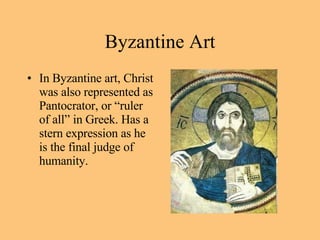
In Byzantine art, Christ was also represented as Pantocrator, or “ruler of all” in Greek. Has a stern expression as he is the final judge of humanity.  Byzantine Art
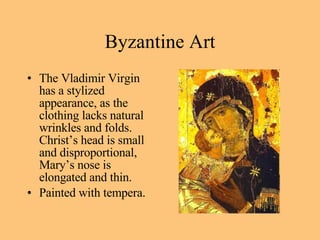
The Vladimir Virgin has a stylized appearance, as the clothing lacks natural wrinkles and folds. Christ’s head is small and disproportional, Mary’s nose is elongated and thin. Painted with tempera. Byzantine Art
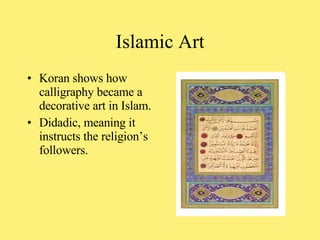
Koran shows how calligraphy became a decorative art in Islam.  Didadic, meaning it instructs the religion’s followers. Islamic Art
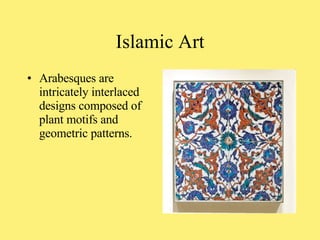
Arabesques are intricately interlaced designs composed of plant motifs and geometric patterns. Islamic Art
The minaret is a tower and an important part of a mosque complex.  Qibla wall of the mosque points the faithful in the direction of the Mecca. Part of the prayer hall, which was often designed as a hypostyle [a row of columns]. The Qibla wall contains a niche called a mihrab. Islamic Art
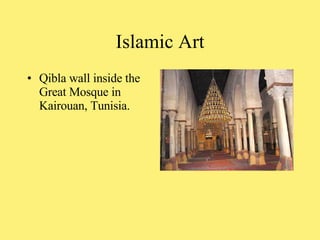
Qibla wall inside the Great Mosque in Kairouan, Tunisia.  Islamic Art
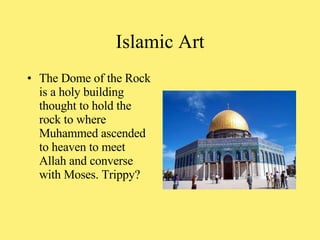
The Dome of the Rock is a holy building thought to hold the rock to where Muhammed ascended to heaven to meet Allah and converse with Moses. Trippy? Islamic Art
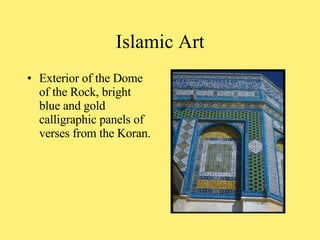
Exterior of the Dome of the Rock, bright blue and gold calligraphic panels of verses from the Koran.  Islamic Art
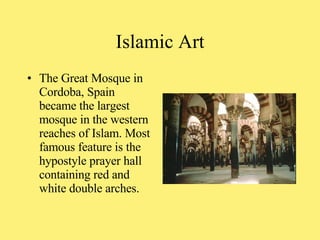
The Great Mosque in Cordoba, Spain became the largest mosque in the western reaches of Islam. Most famous feature is the hypostyle prayer hall containing red and white double arches.  Islamic Art
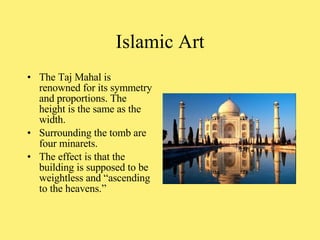
The Taj Mahal is renowned for its symmetry and proportions. The height is the same as the width. Surrounding the tomb are four minarets. The effect is that the building is supposed to be weightless and “ascending to the heavens.”  Islamic Art
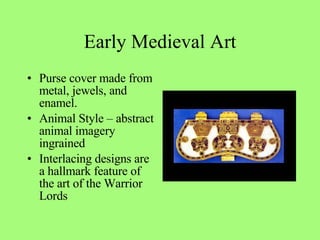
Purse cover made from metal, jewels, and enamel.  Animal Style – abstract animal imagery ingrained  Interlacing designs are a hallmark feature of the art of the Warrior Lords Early Medieval Art
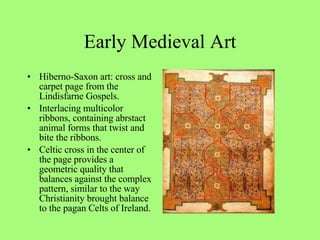
Hiberno-Saxon art: cross and carpet page from the Lindisfarne Gospels. Interlacing multicolor ribbons, containing abrstact animal forms that twist and bite the ribbons.  Celtic cross in the center of the page provides a geometric quality that balances against the complex pattern, similar to the way Christianity brought balance to the pagan Celts of Ireland. Early Medieval Art
Book of Kells is an illuminated manuscript, the chi-rho-iota page based on the Greek letters of Christ [X, P, and I].  Early Medieval Art
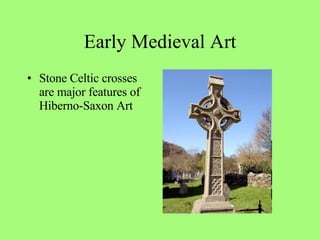
Stone Celtic crosses are major features of Hiberno-Saxon Art Early Medieval Art
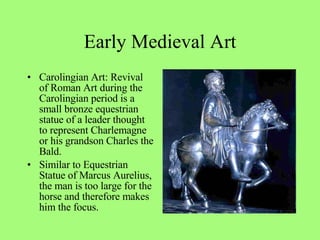
Carolingian Art: Revival of Roman Art during the Carolingian period is a small bronze equestrian statue of a leader thought to represent Charlemagne or his grandson Charles the Bald.  Similar to Equestrian Statue of Marcus Aurelius, the man is too large for the horse and therefore makes him the focus. Early Medieval Art
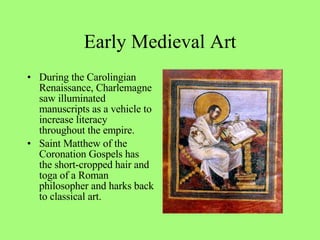
During the Carolingian Renaissance, Charlemagne saw illuminated manuscripts as a vehicle to increase literacy throughout the empire.  Saint Matthew of the Coronation Gospels has the short-cropped hair and toga of a Roman philosopher and harks back to classical art. Early Medieval Art
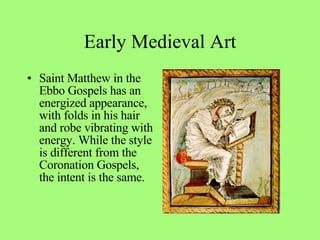
Saint Matthew in the Ebbo Gospels has an energized appearance, with folds in his hair and robe vibrating with energy. While the style is different from the Coronation Gospels, the intent is the same. Early Medieval Art
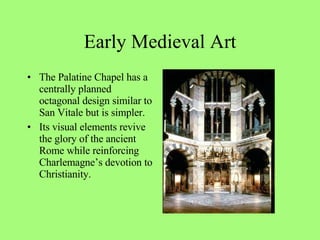
The Palatine Chapel has a centrally planned octagonal design similar to San Vitale but is simpler. Its visual elements revive the glory of the ancient Rome while reinforcing Charlemagne’s devotion to Christianity. Early Medieval Art
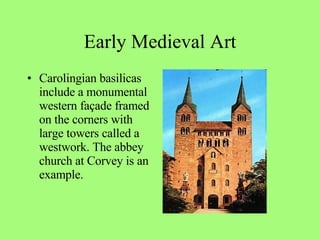
Carolingian basilicas include a monumental western façade framed on the corners with large towers called a westwork. The abbey church at Corvey is an example. Early Medieval Art
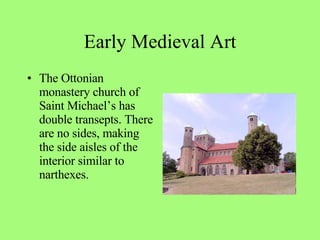
The Ottonian monastery church of Saint Michael’s has double transepts. There are no sides, making the side aisles of the interior similar to narthexes.  Early Medieval Art
Saint Michael’s doors are cast as a single piece from bronze containing eight panels on each door with figures carved in relief. Each panel corresponds with the one across from it – The Old Testament Scenes [left] prefigure the New Testament themes on the right. Early Medieval Art
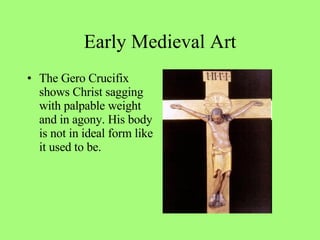
The Gero Crucifix shows Christ sagging with palpable weight and in agony. His body is not in ideal form like it used to be. Early Medieval Art
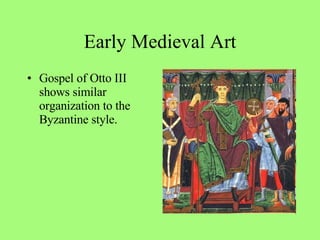
Gospel of Otto III shows similar organization to the Byzantine style.  Early Medieval Art
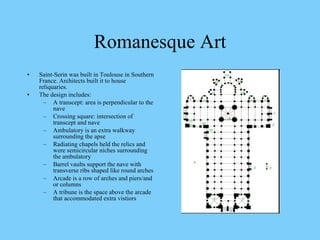
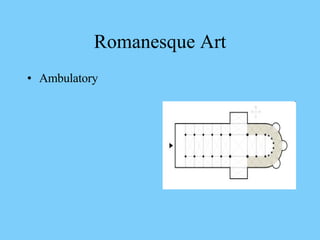
Saint-Serin was built in Toulouse in Southern France. Architects built it to house reliquaries. The design includes: A transcept: area is perpendicular to the nave Crossing square: intersection of transcept and nave Ambulatory is an extra walkway surrounding the apse Radiating chapels held the relics and were semicircular niches surrounding the ambulatory Barrel vaults support the nave with transverse ribs shaped like round arches Arcade is a row of arches and piers/and or columns A tribune is the space above the arcade that accommodated extra vistiors Romanesque Art
Ambulatory Romanesque Art
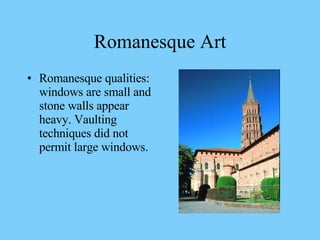
Romanesque qualities: windows are small and stone walls appear heavy. Vaulting techniques did not permit large windows. Romanesque Art
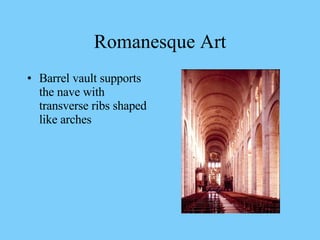
Barrel vault supports the nave with transverse ribs shaped like arches Romanesque Art
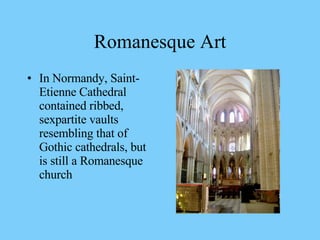
In Normandy, Saint-Etienne Cathedral contained ribbed, sexpartite vaults resembling that of Gothic cathedrals, but is still a Romanesque church Romanesque Art
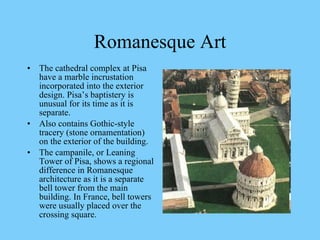
The cathedral complex at Pisa have a marble incrustation incorporated into the exterior design. Pisa’s baptistery is unusual for its time as it is separate. Also contains Gothic-style tracery (stone ornamentation) on the exterior of the building. The campanile, or Leaning Tower of Pisa, shows a regional difference in Romanesque architecture as it is a separate bell tower from the main building. In France, bell towers were usually placed over the crossing square.  Romanesque Art
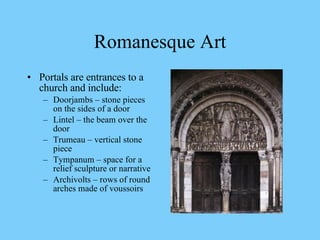
Portals are entrances to a church and include: Doorjambs – stone pieces on the sides of a door Lintel – the beam over the door Trumeau – vertical stone piece Tympanum – space for a relief sculpture or narrative Archivolts – rows of round arches made of voussoirs Romanesque Art
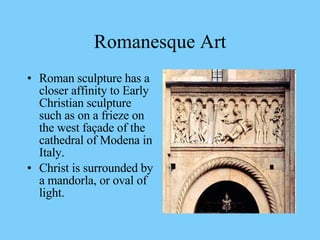
Roman sculpture has a closer affinity to Early Christian sculpture such as on a frieze on the west façade of the cathedral of Modena in Italy. Christ is surrounded by a mandorla, or oval of light. Romanesque Art
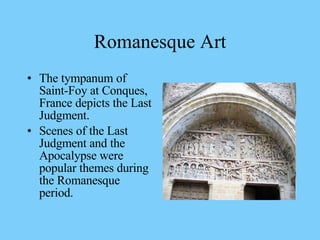
The tympanum of Saint-Foy at Conques, France depicts the Last Judgment.  Scenes of the Last Judgment and the Apocalypse were popular themes during the Romanesque period. Romanesque Art
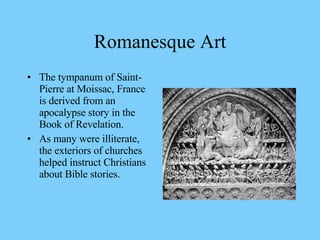
The tympanum of Saint-Pierre at Moissac, France is derived from an apocalypse story in the Book of Revelation. As many were illiterate, the exteriors of churches helped instruct Christians about Bible stories. Romanesque Art
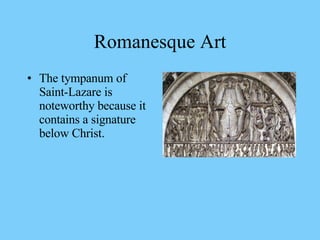
The tympanum of Saint-Lazare is noteworthy because it contains a signature below Christ. Romanesque Art
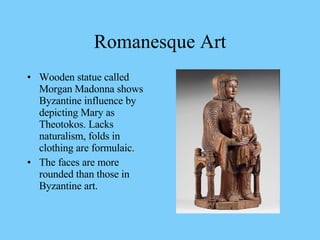
Wooden statue called Morgan Madonna shows Byzantine influence by depicting Mary as Theotokos. Lacks naturalism, folds in clothing are formulaic.  The faces are more rounded than those in Byzantine art. Romanesque Art
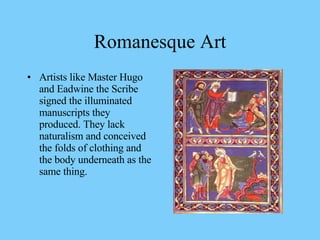
Artists like Master Hugo and Eadwine the Scribe signed the illuminated manuscripts they produced. They lack naturalism and conceived the folds of clothing and the body underneath as the same thing. Romanesque Art
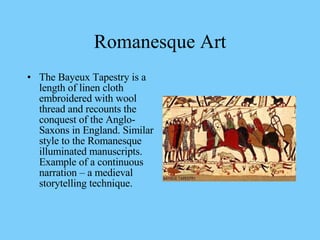
The Bayeux Tapestry is a length of linen cloth embroidered with wool thread and recounts the conquest of the Anglo-Saxons in England. Similar style to the Romanesque illuminated manuscripts. Example of a continuous narration – a medieval storytelling technique.  Romanesque Art
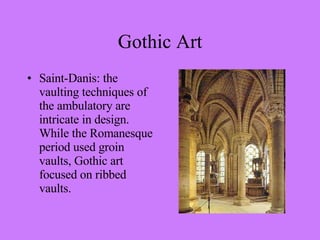
Saint-Danis: the vaulting techniques of the ambulatory are intricate in design. While the Romanesque period used groin vaults, Gothic art focused on ribbed vaults. Gothic Art
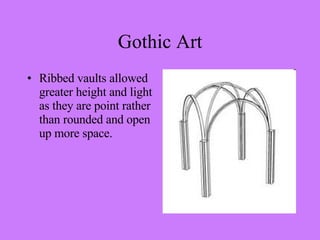
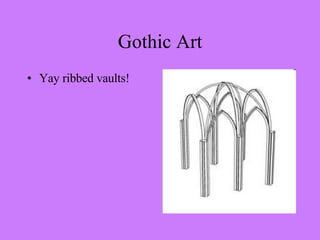
Ribbed vaults allowed greater height and light as they are point rather than rounded and open up more space. Gothic Art
Yay ribbed vaults! Gothic Art
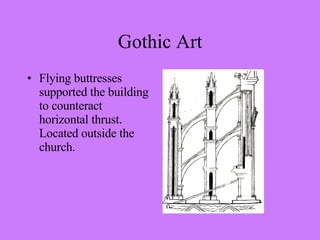
Flying buttresses supported the building to counteract horizontal thrust. Located outside the church. Gothic Art
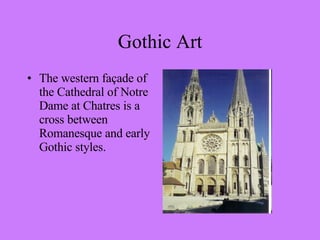
The western façade of the Cathedral of Notre Dame at Chatres is a cross between Romanesque and early Gothic styles. Gothic Art
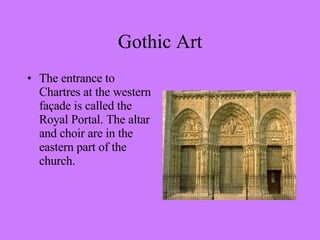
The entrance to Chartres at the western façade is called the Royal Portal. The altar and choir are in the eastern part of the church. Gothic Art
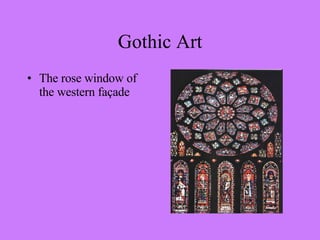
The rose window of the western façade Gothic Art
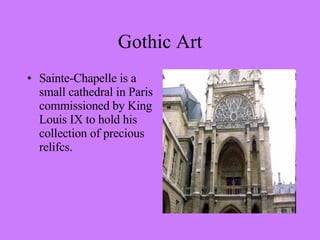
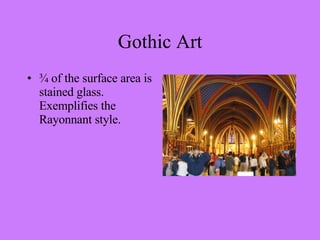
Sainte-Chapelle is a small cathedral in Paris commissioned by King Louis IX to hold his collection of precious relifcs. Gothic Art
¾ of the surface area is stained glass. Exemplifies the Rayonnant style. Gothic Art
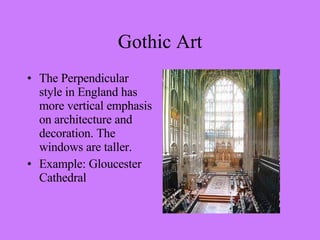
The Perpendicular style in England has more vertical emphasis on architecture and decoration. The windows are taller. Example: Gloucester Cathedral  Gothic Art
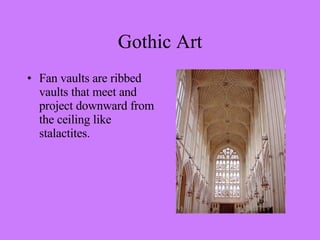
Fan vaults are ribbed vaults that meet and project downward from the ceiling like stalactites. Gothic Art
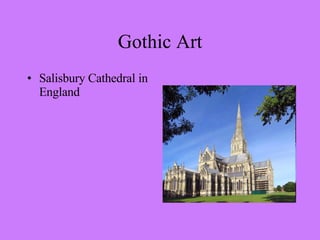
Salisbury Cathedral in England Gothic Art
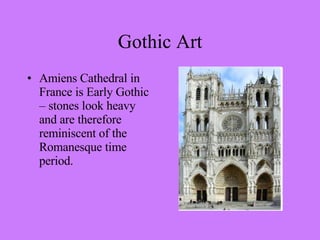
Amiens Cathedral in France is Early Gothic – stones look heavy and are therefore reminiscent of the Romanesque time period. Gothic Art
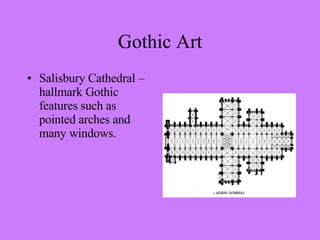
Salisbury Cathedral – hallmark Gothic features such as pointed arches and many windows.  Gothic Art
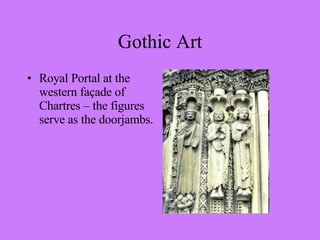
Royal Portal at the western façade of Chartres – the figures serve as the doorjambs.  Gothic Art
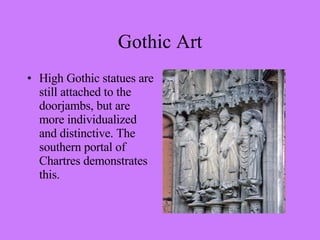
High Gothic statues are still attached to the doorjambs, but are more individualized and distinctive. The southern portal of Chartres demonstrates this. Gothic Art
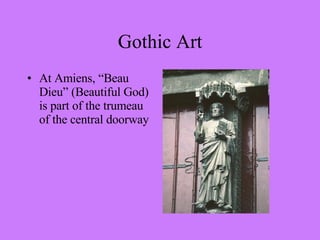
At Amiens, “Beau Dieu” (Beautiful God) is part of the trumeau of the central doorway Gothic Art
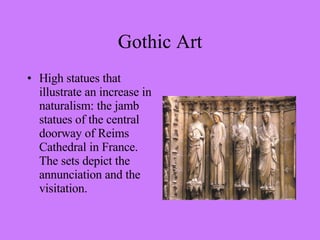
High statues that illustrate an increase in naturalism: the jamb statues of the central doorway of Reims Cathedral in France. The sets depict the annunciation and the visitation. Gothic Art
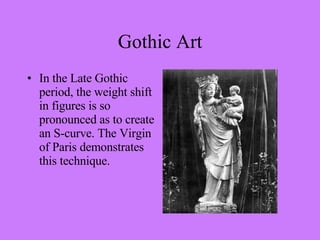
In the Late Gothic period, the weight shift in figures is so pronounced as to create an S-curve. The Virgin of Paris demonstrates this technique. Gothic Art
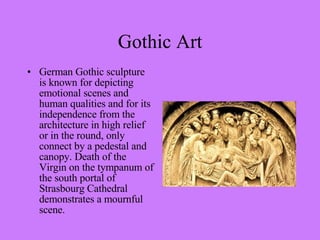
German Gothic sculpture is known for depicting emotional scenes and human qualities and for its independence from the architecture in high relief or in the round, only connect by a pedestal and canopy. Death of the Virgin on the tympanum of the south portal of Strasbourg Cathedral demonstrates a mournful scene.  Gothic Art
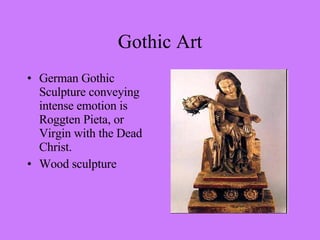
German Gothic Sculpture conveying intense emotion is Roggten Pieta, or Virgin with the Dead Christ. Wood sculpture Gothic Art

Artreview Part2

  • 1.
    The Catacomb ofPriscilla contains a fresco that portrays Christ as the Good Sheperd concerned with the well-being of his flock. His form is based on Roman-Greco models: youthful, clothed. Resembles a young Apollo. Early Christian Art
  • 2.
    At the endof the circle, lunettes [semicircles] contain scenes from the Old Testament, like the story of Jonah. To Christians, Jonah is a prefiguration of Christ and therefore important in Christian art. Early Christian Art
  • 3.
    The Sarcophagus ofJunius Bassus was made for a Roman official who converted to Christianity before his death. Two registers contain five compartments, framed by Classical columns. Important transitional piece as it combines Christian themes with architectural and figural elements that tie the work to the Classical past. Early Christian Art
  • 4.
    The church knownas Old St. Peter’s Basilica was a prototype for later developments in Christian architecture. Worshippers gathered in the atrium before entering the narthex, or entrance hall. Nave was the central area flanked by side aisles. Transept was a transverse aisle perpendicular to the nave, which formed a cruciform. Baldacchino, or canpoy, covered the crossing. Row of clerestory windows allowed light to enter the church. Early Christian Art
  • 5.
    Centrally planned churcheswere popular in the Byzantine empire. In the West, the plan was mainly used as a martyria to house sacred relics. Early Christian Art
  • 6.
    Mosaics decorated apsewalls in basilicas, where Christ is portrayed as the Good Shepard. The purple robe signifies his status as the future King of Heaven. Christ sits contrapposto in a spatial setting filled with 3D forms. The sky and natural shadows show the continuation of Greco-Roman illusionary devices. Early Christian Art
  • 7.
    The mosaic depictsthe miracle of loaves and fishes, figures appear to be floating just above the horizon. The golden background limits the depth of the scene and creates a more spiritual feel, marking the beginning of the Byzantine style. Early Christian Art
  • 8.
    The Barberini Ivoryshows Justinian as a world conqueror. The ivory plaque was carved in five parts and illustrates how early Byzantine art borrowed symbols from Classical antiquity. The interest in naturalism reflects the values of Classical art. The Barberini Ivory replaced pagan deities with Christ surrounded by two angels. Byzantine Art
  • 9.
    Hagia Sophia [churchof Holy Wisdom] extensively uses pendentives in which the weight of the dome is transferred to the four corner piers: circular dome and rectangular base. Byzantine Art
  • 10.
    The dome ofHagia Sofia has forty windows around the base which makes it appear to rest on a “halo of light.” Mosaics on the dome interior and walls. Light reflects off the tesserae (stones) of the interior. Byzantine Art
  • 11.
    San Vitale isone of the only centrally planned churches in Italy. Has a separate ambulatory from the interior where visitors can walk around. Byzantine Art
  • 12.
    The narthex isat an odd angle, with the vestibule in the lower part of the plan. Byzantine Art
  • 13.
    In San Vitale’slower apse vault, Christ is youthful and triumphant with Saint Vitalis and Bishop Ecclesius. The Bishop holds a model of San Vitale in his hands. Byzantine Art
  • 14.
    The mosaic showsemperor Justinian – his central position, purple cloak, and opulent gold crown show his elevated status as an emperor. Byzantine Art
  • 15.
    The Virgin andChild Between Saints Theodore George is painted in encaustic, or pigment with melted wax. Later, artists painted with tempera, which is pigment mixed with egg yolks. Heads are larger than the bodies, the artist focused more on capturing the spirituality of the scene. Byzantine Art
  • 16.
    The Harbaville Triptych:Christ, the Virgin Mary, and Joseph are in the upper portion of the central compartment and are supposed to intercede the prayers of the person praying at the triptych. Byzantine Art
  • 17.
    In Byzantine art,Christ was also represented as Pantocrator, or “ruler of all” in Greek. Has a stern expression as he is the final judge of humanity. Byzantine Art
  • 18.
    The Vladimir Virginhas a stylized appearance, as the clothing lacks natural wrinkles and folds. Christ’s head is small and disproportional, Mary’s nose is elongated and thin. Painted with tempera. Byzantine Art
  • 19.
    Koran shows howcalligraphy became a decorative art in Islam. Didadic, meaning it instructs the religion’s followers. Islamic Art
  • 20.
    Arabesques are intricatelyinterlaced designs composed of plant motifs and geometric patterns. Islamic Art
  • 21.
    The minaret isa tower and an important part of a mosque complex. Qibla wall of the mosque points the faithful in the direction of the Mecca. Part of the prayer hall, which was often designed as a hypostyle [a row of columns]. The Qibla wall contains a niche called a mihrab. Islamic Art
  • 22.
    Qibla wall insidethe Great Mosque in Kairouan, Tunisia. Islamic Art
  • 23.
    The Dome ofthe Rock is a holy building thought to hold the rock to where Muhammed ascended to heaven to meet Allah and converse with Moses. Trippy? Islamic Art
  • 24.
    Exterior of theDome of the Rock, bright blue and gold calligraphic panels of verses from the Koran. Islamic Art
  • 25.
    The Great Mosquein Cordoba, Spain became the largest mosque in the western reaches of Islam. Most famous feature is the hypostyle prayer hall containing red and white double arches. Islamic Art
  • 26.
    The Taj Mahalis renowned for its symmetry and proportions. The height is the same as the width. Surrounding the tomb are four minarets. The effect is that the building is supposed to be weightless and “ascending to the heavens.” Islamic Art
  • 27.
    Purse cover madefrom metal, jewels, and enamel. Animal Style – abstract animal imagery ingrained Interlacing designs are a hallmark feature of the art of the Warrior Lords Early Medieval Art
  • 28.
    Hiberno-Saxon art: crossand carpet page from the Lindisfarne Gospels. Interlacing multicolor ribbons, containing abrstact animal forms that twist and bite the ribbons. Celtic cross in the center of the page provides a geometric quality that balances against the complex pattern, similar to the way Christianity brought balance to the pagan Celts of Ireland. Early Medieval Art
  • 29.
    Book of Kellsis an illuminated manuscript, the chi-rho-iota page based on the Greek letters of Christ [X, P, and I]. Early Medieval Art
  • 30.
    Stone Celtic crossesare major features of Hiberno-Saxon Art Early Medieval Art
  • 31.
    Carolingian Art: Revivalof Roman Art during the Carolingian period is a small bronze equestrian statue of a leader thought to represent Charlemagne or his grandson Charles the Bald. Similar to Equestrian Statue of Marcus Aurelius, the man is too large for the horse and therefore makes him the focus. Early Medieval Art
  • 32.
    During the CarolingianRenaissance, Charlemagne saw illuminated manuscripts as a vehicle to increase literacy throughout the empire. Saint Matthew of the Coronation Gospels has the short-cropped hair and toga of a Roman philosopher and harks back to classical art. Early Medieval Art
  • 33.
    Saint Matthew inthe Ebbo Gospels has an energized appearance, with folds in his hair and robe vibrating with energy. While the style is different from the Coronation Gospels, the intent is the same. Early Medieval Art
  • 34.
    The Palatine Chapelhas a centrally planned octagonal design similar to San Vitale but is simpler. Its visual elements revive the glory of the ancient Rome while reinforcing Charlemagne’s devotion to Christianity. Early Medieval Art
  • 35.
    Carolingian basilicas includea monumental western façade framed on the corners with large towers called a westwork. The abbey church at Corvey is an example. Early Medieval Art
  • 36.
    The Ottonian monasterychurch of Saint Michael’s has double transepts. There are no sides, making the side aisles of the interior similar to narthexes. Early Medieval Art
  • 37.
    Saint Michael’s doorsare cast as a single piece from bronze containing eight panels on each door with figures carved in relief. Each panel corresponds with the one across from it – The Old Testament Scenes [left] prefigure the New Testament themes on the right. Early Medieval Art
  • 38.
    The Gero Crucifixshows Christ sagging with palpable weight and in agony. His body is not in ideal form like it used to be. Early Medieval Art
  • 39.
    Gospel of OttoIII shows similar organization to the Byzantine style. Early Medieval Art
  • 40.
    Saint-Serin was builtin Toulouse in Southern France. Architects built it to house reliquaries. The design includes: A transcept: area is perpendicular to the nave Crossing square: intersection of transcept and nave Ambulatory is an extra walkway surrounding the apse Radiating chapels held the relics and were semicircular niches surrounding the ambulatory Barrel vaults support the nave with transverse ribs shaped like round arches Arcade is a row of arches and piers/and or columns A tribune is the space above the arcade that accommodated extra vistiors Romanesque Art
  • 41.
  • 42.
    Romanesque qualities: windowsare small and stone walls appear heavy. Vaulting techniques did not permit large windows. Romanesque Art
  • 43.
    Barrel vault supportsthe nave with transverse ribs shaped like arches Romanesque Art
  • 44.
    In Normandy, Saint-EtienneCathedral contained ribbed, sexpartite vaults resembling that of Gothic cathedrals, but is still a Romanesque church Romanesque Art
  • 45.
    The cathedral complexat Pisa have a marble incrustation incorporated into the exterior design. Pisa’s baptistery is unusual for its time as it is separate. Also contains Gothic-style tracery (stone ornamentation) on the exterior of the building. The campanile, or Leaning Tower of Pisa, shows a regional difference in Romanesque architecture as it is a separate bell tower from the main building. In France, bell towers were usually placed over the crossing square. Romanesque Art
  • 46.
    Portals are entrancesto a church and include: Doorjambs – stone pieces on the sides of a door Lintel – the beam over the door Trumeau – vertical stone piece Tympanum – space for a relief sculpture or narrative Archivolts – rows of round arches made of voussoirs Romanesque Art
  • 47.
    Roman sculpture hasa closer affinity to Early Christian sculpture such as on a frieze on the west façade of the cathedral of Modena in Italy. Christ is surrounded by a mandorla, or oval of light. Romanesque Art
  • 48.
    The tympanum ofSaint-Foy at Conques, France depicts the Last Judgment. Scenes of the Last Judgment and the Apocalypse were popular themes during the Romanesque period. Romanesque Art
  • 49.
    The tympanum ofSaint-Pierre at Moissac, France is derived from an apocalypse story in the Book of Revelation. As many were illiterate, the exteriors of churches helped instruct Christians about Bible stories. Romanesque Art
  • 50.
    The tympanum ofSaint-Lazare is noteworthy because it contains a signature below Christ. Romanesque Art
  • 51.
    Wooden statue calledMorgan Madonna shows Byzantine influence by depicting Mary as Theotokos. Lacks naturalism, folds in clothing are formulaic. The faces are more rounded than those in Byzantine art. Romanesque Art
  • 52.
    Artists like MasterHugo and Eadwine the Scribe signed the illuminated manuscripts they produced. They lack naturalism and conceived the folds of clothing and the body underneath as the same thing. Romanesque Art
  • 53.
    The Bayeux Tapestryis a length of linen cloth embroidered with wool thread and recounts the conquest of the Anglo-Saxons in England. Similar style to the Romanesque illuminated manuscripts. Example of a continuous narration – a medieval storytelling technique. Romanesque Art
  • 54.
    Saint-Danis: the vaultingtechniques of the ambulatory are intricate in design. While the Romanesque period used groin vaults, Gothic art focused on ribbed vaults. Gothic Art
  • 55.
    Ribbed vaults allowedgreater height and light as they are point rather than rounded and open up more space. Gothic Art
  • 56.
  • 57.
    Flying buttresses supportedthe building to counteract horizontal thrust. Located outside the church. Gothic Art
  • 58.
    The western façadeof the Cathedral of Notre Dame at Chatres is a cross between Romanesque and early Gothic styles. Gothic Art
  • 59.
    The entrance toChartres at the western façade is called the Royal Portal. The altar and choir are in the eastern part of the church. Gothic Art
  • 60.
    The rose windowof the western façade Gothic Art
  • 61.
    Sainte-Chapelle is asmall cathedral in Paris commissioned by King Louis IX to hold his collection of precious relifcs. Gothic Art
  • 62.
    ¾ of thesurface area is stained glass. Exemplifies the Rayonnant style. Gothic Art
  • 63.
    The Perpendicular stylein England has more vertical emphasis on architecture and decoration. The windows are taller. Example: Gloucester Cathedral Gothic Art
  • 64.
    Fan vaults areribbed vaults that meet and project downward from the ceiling like stalactites. Gothic Art
  • 65.
    Salisbury Cathedral inEngland Gothic Art
  • 66.
    Amiens Cathedral inFrance is Early Gothic – stones look heavy and are therefore reminiscent of the Romanesque time period. Gothic Art
  • 67.
    Salisbury Cathedral –hallmark Gothic features such as pointed arches and many windows. Gothic Art
  • 68.
    Royal Portal atthe western façade of Chartres – the figures serve as the doorjambs. Gothic Art
  • 69.
    High Gothic statuesare still attached to the doorjambs, but are more individualized and distinctive. The southern portal of Chartres demonstrates this. Gothic Art
  • 70.
    At Amiens, “BeauDieu” (Beautiful God) is part of the trumeau of the central doorway Gothic Art
  • 71.
    High statues thatillustrate an increase in naturalism: the jamb statues of the central doorway of Reims Cathedral in France. The sets depict the annunciation and the visitation. Gothic Art
  • 72.
    In the LateGothic period, the weight shift in figures is so pronounced as to create an S-curve. The Virgin of Paris demonstrates this technique. Gothic Art
  • 73.
    German Gothic sculptureis known for depicting emotional scenes and human qualities and for its independence from the architecture in high relief or in the round, only connect by a pedestal and canopy. Death of the Virgin on the tympanum of the south portal of Strasbourg Cathedral demonstrates a mournful scene. Gothic Art
  • 74.
    German Gothic Sculptureconveying intense emotion is Roggten Pieta, or Virgin with the Dead Christ. Wood sculpture Gothic Art