A disaster is a sudden, calamitous event that
seriously disrupts the functioning of a
community or society and causes human,
material, and economic or environmental losses
that exceed the community's or society's ability
to cope using its own resources. Though often
caused by nature, disasters can have human
origins
 The goal of disaster nursing is ensuring that the
highest achievable level of care is delivered
through identifying, advocating, and caring for
all impacted populations throughout all phases
of a disaster event, including active
participation in all levels of disaster planning
and preparedness
 D- Detection
 I- Incident command
 S- Safety and security
 A- Assess
 S- Support
 T- Triage and treatment
 E- Evaluation
 R- Recovery
• Prevent the disaster
– Primary prevention
– Secondary prevention
– Tertiary prevention
• Minimize casualties
• Prevent further casualties
• Rescue the victims
• First aid
• Evacuate
• Medical care
• Reconstruction
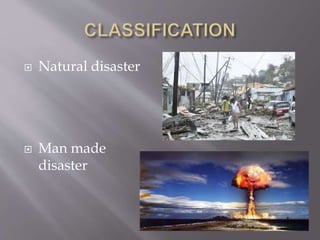
 Natural disaster
 Man made
disaster
1. “First come, first treated” principle will not be followed during emergencies.
2. Triage protocol
3. ABCDE care is provided
– Airway
– Breathing
– Circulation
– Disability limitation
– Exposure / environmental control
4. Trauma team and trauma code
5. Management of cardiopulmonary arrest
6. Emergency medicine records
7. Chain of command in the team and system
8. Alternative chains and flexibility standards
9. Procedures involving medico-legal issues
10. Disaster preparedness
11. Disaster drills
12. Infection control measures
13. Quality management of disaster services
preparedness
management
team
Equipment
Guideline of
disaster plan
Triage
protocol
• Administrative system
• Policies, procedures and protocols
• Physical facilities
• Components & equipments
• Emergency/Disaster medical systems
• Staffing and training
• Resources for disaster drills
• Effective evaluation system
• India
– National disaster management authority of India
– Emergency Management and research Institute
• Worldwide
– International association of emergency managers
– Red cross/red crescent
– United Nations
– World bank
– European union
– International recovery platform
 Pre-incident training
and testing
 Communicating and
incident assessment
 International Emergency Management Society
 International Association of Emergency
Managers
 International Recovery Platform
 The International Red Cross and Red Crescent
Movement
 Baptist Global Response
 United
 Nation
 World Bank
 European Union
 NATIONAL EMERGENCY MANAGEMENT
ROLE OF NURSE-
 • Assess the community
 • Diagnose community disaster threats
 • Community disaster planning
 • Implement disaster plans
 • Shelter management plans
 • Evaluate the effectiveness of disaster plans
LEGAL ASPECTS OF DISASTER
NURSING-
Licensure
Correct identity
Good Samaritan law
Drug maintenance Good rapport
Self discharge of the patient
Standard care
Documentation
Standing order
Protection of patient property
Written consent for operation and procedures
Reporting
IMPACT ON HEALTH
AND AFTER EFFECTS-
 Social reaction
 Communicable diseases
 Population displacements
 Climatic exposure
 Food & Nutrition
 Water supply & sanitation
 Mental health
 Damage to the health infrastructure Post Traumatic Stress Disorder
(PTSD)
 PTSD is a severe anxiety disorder that can develop after exposure to
any event that results in psychological trauma.
 Symptoms: Flashbacks and nightmares Diagnosis of PTSD
 History of exposure to a traumatic event
 Persistent re-experiencing
 Persistence avoidance and emotional numbing
 Persistent symptoms of increased arousal not present before
 Duration of symptoms for more than 1 month
 Significant impairment Management of PTSD
 Provide sense of safety
 Calm the patient
 Improve self efficacy of the patient
 Make social connectedness
 Give hope Rehabilitation after Disaster
 Water supply
 Food supply
 Basic sanitation
 Personal hygiene
 Physical rehabilitation
 Psychosocial rehabilitation
 Financial rehabilitation
 Relocation
SUMMARY
Disaster Management can be defined as the
organization and management of resources and
responsibilities for dealing with all humanitarian
aspects of emergencies, in particular preparedness,
response and recovery in order to lessen the
impact of disasters.
Emergency management is the organization and
management of the resources and responsibilities
for dealing with all humanitarian aspects of
emergencies. The aim is to reduce the harmful
effects of all hazards, including disasters.

Slide disaster managment

  • 2.
    A disaster isa sudden, calamitous event that seriously disrupts the functioning of a community or society and causes human, material, and economic or environmental losses that exceed the community's or society's ability to cope using its own resources. Though often caused by nature, disasters can have human origins
  • 3.
     The goalof disaster nursing is ensuring that the highest achievable level of care is delivered through identifying, advocating, and caring for all impacted populations throughout all phases of a disaster event, including active participation in all levels of disaster planning and preparedness
  • 4.
     D- Detection I- Incident command  S- Safety and security  A- Assess  S- Support  T- Triage and treatment  E- Evaluation  R- Recovery
  • 5.
    • Prevent thedisaster – Primary prevention – Secondary prevention – Tertiary prevention • Minimize casualties • Prevent further casualties • Rescue the victims • First aid • Evacuate • Medical care • Reconstruction
  • 6.
     Natural disaster Man made disaster
  • 7.
    1. “First come,first treated” principle will not be followed during emergencies. 2. Triage protocol 3. ABCDE care is provided – Airway – Breathing – Circulation – Disability limitation – Exposure / environmental control 4. Trauma team and trauma code 5. Management of cardiopulmonary arrest 6. Emergency medicine records 7. Chain of command in the team and system 8. Alternative chains and flexibility standards 9. Procedures involving medico-legal issues 10. Disaster preparedness 11. Disaster drills 12. Infection control measures 13. Quality management of disaster services
  • 8.
  • 10.
    • Administrative system •Policies, procedures and protocols • Physical facilities • Components & equipments • Emergency/Disaster medical systems • Staffing and training • Resources for disaster drills • Effective evaluation system
  • 11.
    • India – Nationaldisaster management authority of India – Emergency Management and research Institute • Worldwide – International association of emergency managers – Red cross/red crescent – United Nations – World bank – European union – International recovery platform
  • 12.
     Pre-incident training andtesting  Communicating and incident assessment
  • 13.
     International EmergencyManagement Society  International Association of Emergency Managers  International Recovery Platform  The International Red Cross and Red Crescent Movement  Baptist Global Response  United  Nation  World Bank  European Union  NATIONAL EMERGENCY MANAGEMENT
  • 14.
    ROLE OF NURSE- • Assess the community  • Diagnose community disaster threats  • Community disaster planning  • Implement disaster plans  • Shelter management plans  • Evaluate the effectiveness of disaster plans
  • 15.
    LEGAL ASPECTS OFDISASTER NURSING- Licensure Correct identity Good Samaritan law Drug maintenance Good rapport Self discharge of the patient Standard care Documentation Standing order Protection of patient property Written consent for operation and procedures Reporting
  • 16.
    IMPACT ON HEALTH ANDAFTER EFFECTS-  Social reaction  Communicable diseases  Population displacements  Climatic exposure  Food & Nutrition  Water supply & sanitation  Mental health  Damage to the health infrastructure Post Traumatic Stress Disorder (PTSD)  PTSD is a severe anxiety disorder that can develop after exposure to any event that results in psychological trauma.  Symptoms: Flashbacks and nightmares Diagnosis of PTSD  History of exposure to a traumatic event  Persistent re-experiencing  Persistence avoidance and emotional numbing  Persistent symptoms of increased arousal not present before
  • 17.
     Duration ofsymptoms for more than 1 month  Significant impairment Management of PTSD  Provide sense of safety  Calm the patient  Improve self efficacy of the patient  Make social connectedness  Give hope Rehabilitation after Disaster  Water supply  Food supply  Basic sanitation  Personal hygiene  Physical rehabilitation  Psychosocial rehabilitation  Financial rehabilitation  Relocation
  • 18.
    SUMMARY Disaster Management canbe defined as the organization and management of resources and responsibilities for dealing with all humanitarian aspects of emergencies, in particular preparedness, response and recovery in order to lessen the impact of disasters. Emergency management is the organization and management of the resources and responsibilities for dealing with all humanitarian aspects of emergencies. The aim is to reduce the harmful effects of all hazards, including disasters.