




Walk UNH Fitness and exercise  can be fun and exhilarating!     Office of Health Education and PromotionHealth Services      www.unh.edu/health-services      603-832-3823      Facebook and Twitter: UNHHealth
Walk UNHDid you know?Walking 70 miles is the width of NHWalking 190 miles is the length of NHWalking 2,000 steps is walking 1 mile*Walking 10,000 steps is walking close to 5 miles**This is an approximation and may differ based on one’s stride
Why Walk? Want to exercisewithout going to a gym?Walking is a great form of exercise that you can do alone, with others, outside or inside.  Health Services has pedometers that you may check-out to track how many steps you take! There are some studies suggesting that walking 10,000 steps a day is the right ball park to be in to assist with stress management and preventing chronic health problems.
Why Walk?Walking is a gentle, low-impact exercise that can ease you into  a higher level of fitness and health. Walking is one of your  body's most natural forms of exercise. It's safe, simple, doesn't require practice, and the health benefits are many: Lower LDL (Bad) and raise HDL (Good) cholesterolLower blood pressureReduce risk of type 2 diabetesManage your weightImprove your moodSource: http://www.mayoclinic.com/health/walking/HQ01612
Guideline: 10,000 Steps a Day How far is 10,000 steps anyway? The average  person's stride length is approximately 2.5 feet  long. That means it  takes  just over 2,000 steps to  walk one  mile, and 10,000 steps  is close to 5 miles.  A sedentary person may only average 1,000 to 3,000 steps a day. A reasonable goal for most people is to increase average daily steps each week by 500 per day  until you can easily average 10,000 per day. There are many ways to  increase your daily steps.  Use  your imagination andcome up with  your own  list:   Walk the long way to class
  Take a walk with a friend
  Use the stairs instead of the elevator
  Park farther from the store  or  walk to the store
  Get up to change the channel
  Window shop
  Plan a walking meeting Continue to track your daily steps and/or mileage; and keep notes on how you feel, how your body is improving, or other changes you are making to improve your health.Source: www.thewalkingsite.com/10000steps.htmlWearing a pedometer is an easy way to track your  steps each day. Start by wearing the pedometer every day for one week. Put it on when you get up in the morning and wear it until bed time. Recordyour  daily steps in a log or notebook. By theend of the week you will know your average daily steps. You  might be surprised how many (or how few) steps  you get in each day.
Pedometers at UNHHealth Services has pedometers that may be checked out by current  UNH students, faculty and staff.Pedometers may be used for 2 weeks at a time to track how many steps you take.Visit Health Services, Room 249 to learn more and check one out!   You can also call (603) 862-3823  or visit www.unh.edu/health-services for more information.
3 Helpful TipsSpend 5 minutes walking slowly to warm-up your muscles.  You can walk in place if you want.  Increase your pace until you feel warm.After warm-up stretch your muscles.Calves, Quadriceps, Hamstrings, and SideCool down to reduce stress on heart and muscles.Walk slowly for 5 minutes and repeat stretcheshttp://www.mayoclinic.com/health/walking/HQ01612/NSECTIONGROUP=2
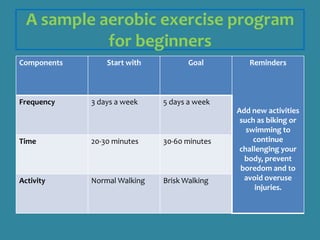
Getting Started: Focus on the BasicsStart slow and easy.  If you’ve been inactive and tire easily it’s best to start slow. Walk as far as you feel comfortable even if it is only for a few minutes and let that be your starting point.  For example, try daily sessions of five to 10 minutes and slowly build up to 15 minutes twice a week.  You can then gradually work your time  way up to 30 to 60 minutes of walking most days each week!
 Use proper technique.  Walking is a great exercise because it’s so simple to do.  But using the correct posture and movements is essential.
 Measure the intensity of your workout.  As you walk measure the intensity of your workout by checking your heart rate.  Knowing your heart rate allows you to increase the intensity to maximize your workout or slow down to avoid overdoing it.Stop to check your pulse manually at your wrist (radial artery) or neck (carotid artery) to find out if you are exercising within the range of your heart rate.  Another option is to wear an electronic device that will display your heart rate.				http://www.mayoclinic.com/health/walking/HQ01612/NSECTIONGROUP=2
Set Goals, Track Progress, Stay Motivated and Improve Your Workout!The good news is that walking-even only a modest amount-provides health benefits!  For maximum benefits, work your way up to 30 to 60 minutes a day within your target heart rate zone, most days of the week.To reach these benefits, it can help to set goals, track progress and take steps to stay healthy and motivated.Set realistic goalsIf your goal is to walk two hours a day 365 days a year, you might be setting yourself up to fail.  Set realistic goals, such as 30  minutes five days a week.No need to do it all at once!   Remember, start slowly and gradually work towards your goal.                                                          	                          http://www.mayoclinic.com/health/walking/HQ01612/NSECTIONGROUP=2
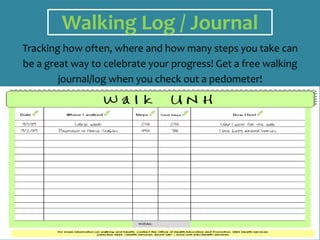
Track ProgressKeeping a record of how many steps you take, the distance you walk, and how long it takes can help you see where you started from and serve as a source of inspiration.  Just think how good you’ll feel when you can see how many miles you’ve walked each week, month, or year! Record these numbers in a walking journal.Stay MotivatedStarting a walking program takes initiative.  Sticking with it takes commitment.  But when you think of the potential health benefits, it’s well worth your effort!If you don’t like walking alone, invite your spouse, partner, friend or neighbor to join you.  You might also join a health club and use a treadmill. http://www.mayoclinic.com/health/walking/HQ01612/NSECTIONGROUP=2
Vary your RoutinePlan several different walking routes but if you’re walking alone, be sure to tell someone which route you are taking.
Walk up and down hills to build strength and stamina. When walking uphill, lean forward slightly-it’s easier on your leg muscles.  Walking downhill can be harder on your body, especially the knees, than walking uphill, and may cause muscle soreness, so slow your pace, keep your knees slightly bent, and take shorter steps.
Try a walking stick or poles.  A walking stick is helpful for balance.  To enhance your upper-body workout, use lightweight, rubber-tipped trekking poles.  Source: Mayo Clinic
Use hand weights, but carefully.They may alter your arm swing and thus lead to muscle soreness or even injury. If you want to use them, start with one-pound weights and increase the weight gradually.  The weights shouldn’t add up to more than 10% of your body weight.
Try backward walking for a change of pace.  It is demanding, since it’s a novel activity for most people. Be careful when going back-wards outdoors: choose a smooth surface and keep far away from traffic, trees, potholes, and other exercisers. To avoid muscle soreness, start slowly. Don't try to walk backward more than a quarter mile the first week. http://www.wellnessletter.com/html/fw/fwFit04Walking.html
Improve Your WorkoutWearing a pedometer is an easy way to track your  steps each day.   Start by wearing the pedometer every day for one week. Put it on when you get up in the  morning and wear it until bed time. Record your steps in a walking journal.
Make an effort to walk as much as possible.Skip elevators and escalators – take the stairs instead! Leave the car at home if you can walk the mile or two of your destination.
If you want to go faster, instead of taking longer steps, take faster steps.  Lengthening your stride can increase strain on your feet and legs.http://www.mayoclinic.com/health/walking/HQ01612/NSECTIONGROUP=2http://www.wellnessletter.com/html/fw/fwFit04Walking.html
Swing your arms.  One good option: bend them at 90⁰ and pump from the shoulder.  Swing them naturally.  Move your arms in opposition to your legs-swing your right arm forward as you step forward with your left leg.  Keep your wrists straight, your hands unclenched, and elbows close to your sides.  This vigorous arm pumping allows for a quicker pace, and provides a good workout of your upper body.

Walk UNH

  • 1.
    Walk UNH Fitnessand exercise can be fun and exhilarating! Office of Health Education and PromotionHealth Services www.unh.edu/health-services 603-832-3823 Facebook and Twitter: UNHHealth
  • 2.
    Walk UNHDid youknow?Walking 70 miles is the width of NHWalking 190 miles is the length of NHWalking 2,000 steps is walking 1 mile*Walking 10,000 steps is walking close to 5 miles**This is an approximation and may differ based on one’s stride
  • 3.
    Why Walk? Wantto exercisewithout going to a gym?Walking is a great form of exercise that you can do alone, with others, outside or inside.  Health Services has pedometers that you may check-out to track how many steps you take! There are some studies suggesting that walking 10,000 steps a day is the right ball park to be in to assist with stress management and preventing chronic health problems.
  • 4.
    Why Walk?Walking isa gentle, low-impact exercise that can ease you into a higher level of fitness and health. Walking is one of your body's most natural forms of exercise. It's safe, simple, doesn't require practice, and the health benefits are many: Lower LDL (Bad) and raise HDL (Good) cholesterolLower blood pressureReduce risk of type 2 diabetesManage your weightImprove your moodSource: http://www.mayoclinic.com/health/walking/HQ01612
  • 5.
    Guideline: 10,000 Stepsa Day How far is 10,000 steps anyway? The average person's stride length is approximately 2.5 feet long. That means it takes just over 2,000 steps to walk one mile, and 10,000 steps is close to 5 miles. A sedentary person may only average 1,000 to 3,000 steps a day. A reasonable goal for most people is to increase average daily steps each week by 500 per day until you can easily average 10,000 per day. There are many ways to increase your daily steps. Use your imagination andcome up with your own list: Walk the long way to class
  • 6.
    Takea walk with a friend
  • 7.
    Usethe stairs instead of the elevator
  • 8.
    Parkfarther from the store or walk to the store
  • 9.
    Getup to change the channel
  • 10.
    Windowshop
  • 11.
    Plana walking meeting Continue to track your daily steps and/or mileage; and keep notes on how you feel, how your body is improving, or other changes you are making to improve your health.Source: www.thewalkingsite.com/10000steps.htmlWearing a pedometer is an easy way to track your steps each day. Start by wearing the pedometer every day for one week. Put it on when you get up in the morning and wear it until bed time. Recordyour daily steps in a log or notebook. By theend of the week you will know your average daily steps. You might be surprised how many (or how few) steps you get in each day.
  • 12.
    Pedometers at UNHHealthServices has pedometers that may be checked out by current UNH students, faculty and staff.Pedometers may be used for 2 weeks at a time to track how many steps you take.Visit Health Services, Room 249 to learn more and check one out! You can also call (603) 862-3823 or visit www.unh.edu/health-services for more information.
  • 13.
    3 Helpful TipsSpend5 minutes walking slowly to warm-up your muscles. You can walk in place if you want. Increase your pace until you feel warm.After warm-up stretch your muscles.Calves, Quadriceps, Hamstrings, and SideCool down to reduce stress on heart and muscles.Walk slowly for 5 minutes and repeat stretcheshttp://www.mayoclinic.com/health/walking/HQ01612/NSECTIONGROUP=2
  • 14.
    Getting Started: Focuson the BasicsStart slow and easy. If you’ve been inactive and tire easily it’s best to start slow. Walk as far as you feel comfortable even if it is only for a few minutes and let that be your starting point. For example, try daily sessions of five to 10 minutes and slowly build up to 15 minutes twice a week. You can then gradually work your time way up to 30 to 60 minutes of walking most days each week!
  • 15.
    Use propertechnique. Walking is a great exercise because it’s so simple to do. But using the correct posture and movements is essential.
  • 16.
    Measure theintensity of your workout. As you walk measure the intensity of your workout by checking your heart rate. Knowing your heart rate allows you to increase the intensity to maximize your workout or slow down to avoid overdoing it.Stop to check your pulse manually at your wrist (radial artery) or neck (carotid artery) to find out if you are exercising within the range of your heart rate. Another option is to wear an electronic device that will display your heart rate. http://www.mayoclinic.com/health/walking/HQ01612/NSECTIONGROUP=2
  • 17.
    Set Goals, TrackProgress, Stay Motivated and Improve Your Workout!The good news is that walking-even only a modest amount-provides health benefits! For maximum benefits, work your way up to 30 to 60 minutes a day within your target heart rate zone, most days of the week.To reach these benefits, it can help to set goals, track progress and take steps to stay healthy and motivated.Set realistic goalsIf your goal is to walk two hours a day 365 days a year, you might be setting yourself up to fail. Set realistic goals, such as 30 minutes five days a week.No need to do it all at once! Remember, start slowly and gradually work towards your goal. http://www.mayoclinic.com/health/walking/HQ01612/NSECTIONGROUP=2
  • 18.
    Track ProgressKeeping arecord of how many steps you take, the distance you walk, and how long it takes can help you see where you started from and serve as a source of inspiration. Just think how good you’ll feel when you can see how many miles you’ve walked each week, month, or year! Record these numbers in a walking journal.Stay MotivatedStarting a walking program takes initiative. Sticking with it takes commitment. But when you think of the potential health benefits, it’s well worth your effort!If you don’t like walking alone, invite your spouse, partner, friend or neighbor to join you. You might also join a health club and use a treadmill. http://www.mayoclinic.com/health/walking/HQ01612/NSECTIONGROUP=2
  • 19.
    Vary your RoutinePlanseveral different walking routes but if you’re walking alone, be sure to tell someone which route you are taking.
  • 20.
    Walk up anddown hills to build strength and stamina. When walking uphill, lean forward slightly-it’s easier on your leg muscles. Walking downhill can be harder on your body, especially the knees, than walking uphill, and may cause muscle soreness, so slow your pace, keep your knees slightly bent, and take shorter steps.
  • 21.
    Try a walkingstick or poles. A walking stick is helpful for balance. To enhance your upper-body workout, use lightweight, rubber-tipped trekking poles. Source: Mayo Clinic
  • 22.
    Use hand weights,but carefully.They may alter your arm swing and thus lead to muscle soreness or even injury. If you want to use them, start with one-pound weights and increase the weight gradually. The weights shouldn’t add up to more than 10% of your body weight.
  • 23.
    Try backward walkingfor a change of pace. It is demanding, since it’s a novel activity for most people. Be careful when going back-wards outdoors: choose a smooth surface and keep far away from traffic, trees, potholes, and other exercisers. To avoid muscle soreness, start slowly. Don't try to walk backward more than a quarter mile the first week. http://www.wellnessletter.com/html/fw/fwFit04Walking.html
  • 24.
    Improve Your WorkoutWearinga pedometer is an easy way to track your steps each day. Start by wearing the pedometer every day for one week. Put it on when you get up in the morning and wear it until bed time. Record your steps in a walking journal.
  • 25.
    Make an effortto walk as much as possible.Skip elevators and escalators – take the stairs instead! Leave the car at home if you can walk the mile or two of your destination.
  • 26.
    If you wantto go faster, instead of taking longer steps, take faster steps. Lengthening your stride can increase strain on your feet and legs.http://www.mayoclinic.com/health/walking/HQ01612/NSECTIONGROUP=2http://www.wellnessletter.com/html/fw/fwFit04Walking.html
  • 27.
    Swing your arms. One good option: bend them at 90⁰ and pump from the shoulder. Swing them naturally. Move your arms in opposition to your legs-swing your right arm forward as you step forward with your left leg. Keep your wrists straight, your hands unclenched, and elbows close to your sides. This vigorous arm pumping allows for a quicker pace, and provides a good workout of your upper body.