The 2012 Revision of
Nevada’s Wildlife Action Plan
State Wildlife Action Plan Workshop – June 5, 2013

Jon C. Sjöberg
Chief of Fisheries
Nevada Department of Wildlife
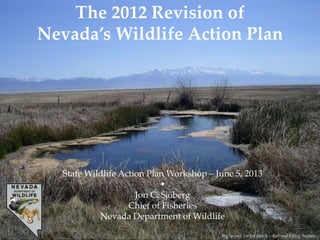
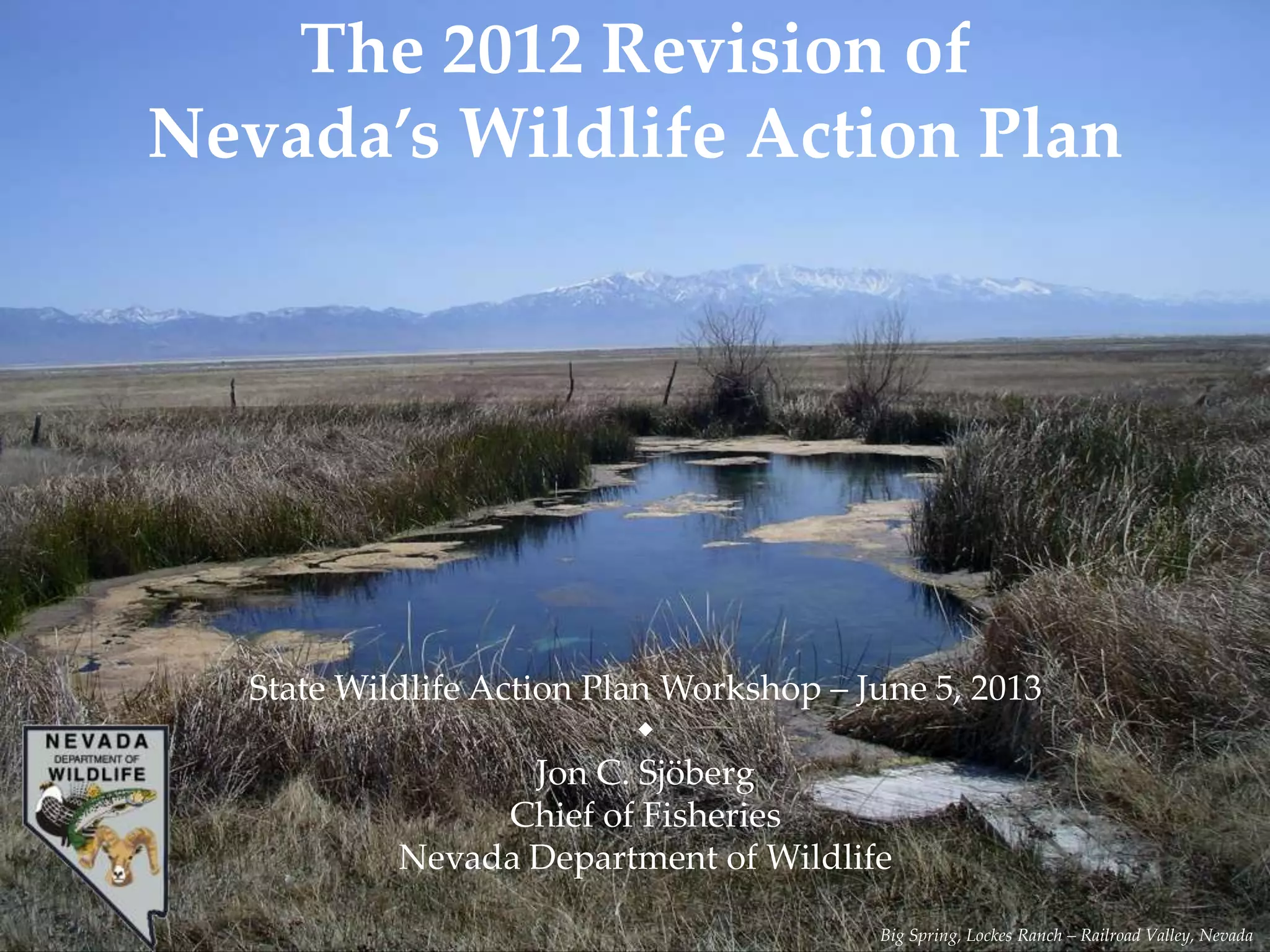
Big Spring, Lockes Ranch – Railroad Valley, Nevada
Overview
• The first Nevada WAP was approved by
USFWS in December 2005
• 264 species of conservation priority (SOCPs)
• Planning approach based on 27 key
terrestrial and aquatic habitats, associated
SOCPs
• Partner based implementation utilizing
existing partnerships and planning efforts to
the extent practical
Overview
• Among the 50 states, Nevada is ranked 11th in overall
biological diversity and 5th in the number of species
extinctions.
• Nevada’s diversity is derived from its geography; many
mountain ranges are effectively isolated by arid and treeless
basins.
• Nevada is uniquely
challenged in part because
of its arid
climate, geography and
limited water
resources, which has
created a unique endemic
biota easily subject to
threats and stressors
including changing climate.
Plan revision
• The conservation partner planning team revised Nevada's Wildlife
Action Plan to incorporate the potential impacts of emerging and
expanding stressors including accelerated energy
development, invasive species, and climate change on Nevada ‘s
fish, wildlife, and habitats.
• By identifying key conservation actions, Nevada is in a stronger
position to ensure ecosystem resiliency across the changing
landscape for key habitats and species.
WAP Revision Partnership
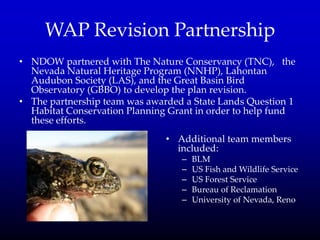
• NDOW partnered with The Nature Conservancy (TNC), the
Nevada Natural Heritage Program (NNHP), Lahontan
Audubon Society (LAS), and the Great Basin Bird
Observatory (GBBO) to develop the plan revision.
• The partnership team was awarded a State Lands Question 1
Habitat Conservation Planning Grant in order to help fund
these efforts.
• Additional team members
included:
– BLM
– US Fish and Wildlife Service
– US Forest Service
– Bureau of Reclamation
– University of Nevada, Reno
Changing Climate in Nevada - Assumptions
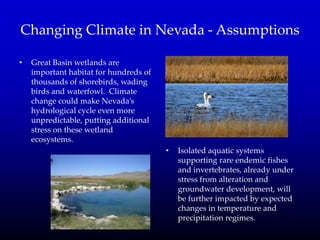
• Great Basin wetlands are
important habitat for hundreds of
thousands of shorebirds, wading
birds and waterfowl. Climate
change could make Nevada’s
hydrological cycle even more
unpredictable, putting additional
stress on these wetland
ecosystems.
• Isolated aquatic systems
supporting rare endemic fishes
and invertebrates, already under
stress from alteration and
groundwater development, will
be further impacted by expected
changes in temperature and
precipitation regimes.
Changing Climate in Nevada - Assumptions
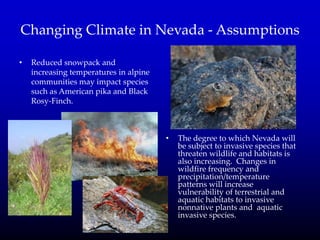
• Reduced snowpack and
increasing temperatures in alpine
communities may impact species
such as American pika and Black
Rosy-Finch.
• The degree to which Nevada will
be subject to invasive species that
threaten wildlife and habitats is
also increasing. Changes in
wildfire frequency and
precipitation/temperature
patterns will increase
vulnerability of terrestrial and
aquatic habitats to invasive
nonnative plants and aquatic
invasive species.
Key steps in the Nevada WAP
Revision
• Climate Change Vulnerability Assessment –
NNHP
• Modeling climate change effects on the future
condition of ecological systems – TNC
• Modeling bird population change in response to
projected habitat changes – GBBO
• Aquatic species and key aquatic habitats analysis
– NDOW
• AFWA/USFWS Wildlife Action Plan Climate
Change Revision guidance provided direction for
plan revisions
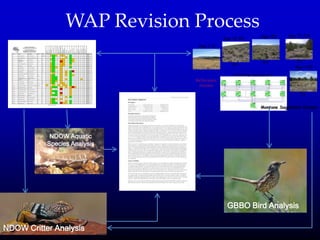
WAP Revision Process
GBBO Bird Analysis
NDOW Critter Analysis
NDOW Aquatic
Species Analysis
Climate Change Vulnerability Assessment
• Climate Change Vulnerability Assessments were
completed for all Species of Conservation Priority
• NatureServe Climate Change Vulnerability Index
(CCVI) methodology
– Predicts whether a species will decline, remain
stable, or increase within the assessment area
– Identifies the factors contributing to vulnerability
• Developed by Nevada Natural Heritage Program
– Initial CCVI assessments completed by NNHP
biologists
– Expert workshops provided feedback to incorporate
into assessments
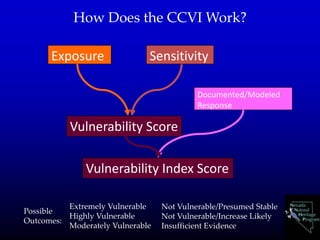
How Does the CCVI Work?
Exposure Sensitivity
Vulnerability Score
Documented/Modeled
Response
Vulnerability Index Score
Extremely Vulnerable
Highly Vulnerable
Moderately Vulnerable
Not Vulnerable/Presumed Stable
Not Vulnerable/Increase Likely
Insufficient Evidence
Possible
Outcomes:
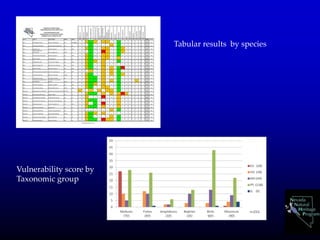
Tabular results by species
Vulnerability score by
Taxonomic group
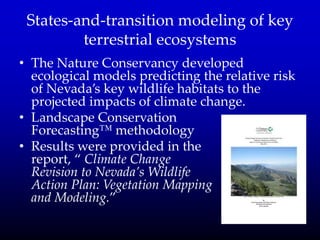
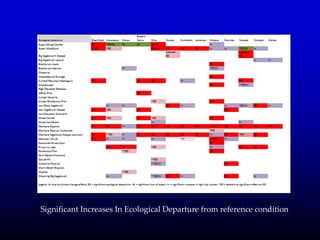
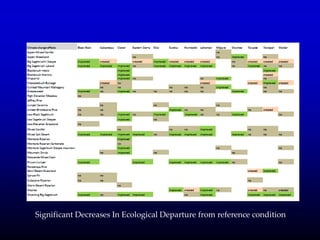
States-and-transition modeling of key
terrestrial ecosystems
• The Nature Conservancy developed
ecological models predicting the relative risk
of Nevada’s key wildlife habitats to the
projected impacts of climate change.
• Landscape Conservation
Forecasting™ methodology
• Results were provided in the
report, ‚ Climate Change
Revision to Nevada’s Wildlife
Action Plan: Vegetation Mapping
and Modeling.‛
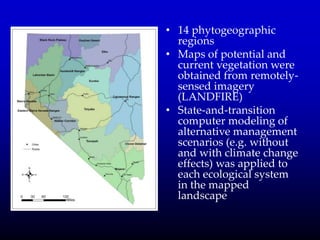
• 14 phytogeographic
regions
• Maps of potential and
current vegetation were
obtained from remotely-
sensed imagery
(LANDFIRE)
• State-and-transition
computer modeling of
alternative management
scenarios (e.g. without
and with climate change
effects) was applied to
each ecological system
in the mapped
landscape
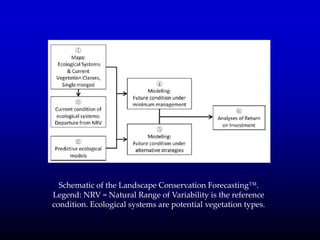
Schematic of the Landscape Conservation Forecasting™.
Legend: NRV = Natural Range of Variability is the reference
condition. Ecological systems are potential vegetation types.
Significant Increases In Ecological Departure from reference condition
Significant Decreases In Ecological Departure from reference condition
Avian climate change response
modeling
• GBBO modeled bird population change in
response to projected habitat changes in Nevada.
• Used point-count data from the Nevada Bird
Count for avian SOCPs
– Statistically-rigorous 10-year database with
georeferencing and coarse-scale habitat association
capability
– Avian SOCP occurrences were geospatially attached
to the LANDFIRE vegetation/habitat mapping
developed by TNC
– Avian species responses were predicted using the
projected changes in key habitats from the TNC state-
and-transition modeling analysis
Avian climate change response
modeling
• Results were
provided in the
report , ‚Bird
Population Responses
to Projected Effects of
Climate Change in
Nevada: An Analysis
for Revision of the
Nevada Wildlife
Action Plan.”
Aquatic species and habitats analysis
• No existing aquatic climate change effects models
could be identified that were:
– Applicable at a useful scale
– Adaptable to the broad spectrum of Nevada’s aquatic
habitats and statewide differences in likely climate
effects
• Heritage CCVI analysis provided useful inputs at
species effect level
• TNC ecosystem modeling identified associated
changes in applicable terrestrial key habitat types
(riparian habitat changes, fire frequency, etc.)
• Available inputs dictated a ‚coarse filter‛ approach
Virgin River near Mesquite, Nevada
Aquatic species and habitats analysis
• Analysis was based on 8-digit HUC watersheds with
presence of aquatic SOCPs
• Climate Wizard tools used to assess predicted change
in temperature and precipitation
– CW did allow assessment of changes in seasonal patterns
at some level
• Findings had to be manually interpreted to
deductively infer predicted effects to aquatic habitats
and species
• For some systems/species recent peer review literature
was available to provide additional guidance on
predicted future effects (e.g. native salmonids)
Revising the Wildlife Action Plan
• Once the analytical products were completed, the Revision
Team identified seven major tasks to complete the WAP
revision:
– Revision of the Species of Conservation Priority List
– Revision of the ecological framework to fit the new vegetative
analysis
– Analysis of how ecological system changes/shifts were likely to
impact conditions and survival potential for priority species
– The construction of conservation strategies to maximize the
preservation of wildlife diversity within state boundaries
– Revision of the Focal Area analysis
– Revision of the Implementation and Adaptive Management
Framework
– Revision of the Wildlife Action Plan itself incorporating
partner/stakeholder participation and review
Species of Conservation Priority
• The 2005 SOCP list was retained but revised using CCVI and
other inputs
• Principle conclusions from the CCVI analysis:
– much greater concern toward isolated endemic aquatic species
with small population sizes, limited mobility and an immitigable
dependency on water in nature
– Terrestrial vertebrates for the most part exhibited relatively
strong adaptability to the nature and degree of climate change
being predicted
• Since very few birds ranked CCVI scores above ‚presumed
stable‛, additions to the list were made based on the severity
of decline as reported by the USGS Breeding Bird Survey, or
where specific management issues were anticipated to direct
agency priority and resources.
Species of Conservation Priority
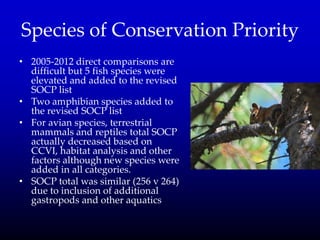
• 2005-2012 direct comparisons are
difficult but 5 fish species were
elevated and added to the revised
SOCP list
• Two amphibian species added to
the revised SOCP list
• For avian species, terrestrial
mammals and reptiles total SOCP
actually decreased based on
CCVI, habitat analysis and other
factors although new species were
added in all categories.
• SOCP total was similar (256 v 264)
due to inclusion of additional
gastropods and other aquatics
Addressing Conservation Strategies
• The
strategies, activities, treatments, prescriptions, progra
ms, and initiatives were often unchanged from the
2005 Plan for SCOP retained on the priority list
• New species sometimes required new creative
thinking, but often could be grouped with a species or
set of species already prioritized by the Plan
Addressing Conservation Strategies
• Where ecological departure of an ecological system was of
major concern and had been quantified for the 50-year period
of analysis, objectives aimed at reversing, stabilizing, or
minimizing the rate of ecological departure of the ecological
system were developed for the immediate 10-year period
following plan revision
Addressing Conservation Strategies
• A general finding of the climate change projections was that
often the first 10-year period (that relevant to this revision)
would witness the least increment of change toward the 50-
year projected outcome.
• Setting up the monitoring framework to measure climate
change effects was often a higher need during this first 10-
year period
Addressing Conservation Strategies
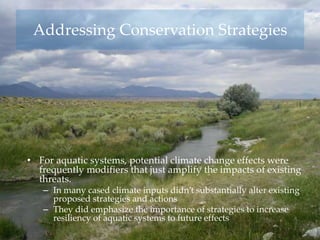
• For aquatic systems, potential climate change effects were
frequently modifiers that just amplify the impacts of existing
threats.
– In many cased climate inputs didn’t substantially alter existing
proposed strategies and actions
– They did emphasize the importance of strategies to increase
resiliency of aquatic systems to future effects
Lessons learned
• Having the same ‚Revision Team‛
partners as the original plan
(TNC, NNHP, Audubon and GGBO)
was very beneficial
– All partners knew the original plan
and purpose well and could hit the
ground running for the plan revision.
• Adding new federal partners that
NDOW works with day to day
(BLM, FS, BOR, FWS) to the Revision
Team was a major benefit
– This greatly helped to incorporate all
Nevada natural resource agency
needs, initiatives and planning efforts
into the plan.
Lessons learned
• Beyond climate change, plan revision allowed
additional focus on other new and emerging stressors
such as accelerated energy development, aquatic and
terrestrial invasive species, wildlife disease, etc.
• As the revision developed, a key strategy across
habitat types became building resiliency for species
and habitats by reducing non-climate stressors.
Lessons learned
• ‚Off the shelf‛ models and assessment
tools to adequately assess climate change
effects on Nevada’s aquatic habitats and
species were simply not available
– This should have been identified earlier in the
revision process so funding and a strategy to
develop these tools could be incorporated.
– Aquatic analysis was an ‚in-house‛ effort
which could be improved
Lessons learned
• Our plan revision was nearly completed when the
‚Best Practices for State Wildlife Action Plans‛ and
the ‚National Fish, Wildlife and Plants Climate
Adaption Strategy‛ were published.
– Availability of earlier drafts of those documents
allowed incorporation of many of the
recommendations into the revised WAP.
Thank you!
http://www.ndow.org/Nevada_Wildlife/Conservation/Nevada_Wildlife_Action_Plan/
Additional information:
lrichards@ndow.org
sjoberg@ndow.org

Sjoberg nv wap for nctc

  • 1.
    The 2012 Revisionof Nevada’s Wildlife Action Plan State Wildlife Action Plan Workshop – June 5, 2013  Jon C. Sjöberg Chief of Fisheries Nevada Department of Wildlife Big Spring, Lockes Ranch – Railroad Valley, Nevada
  • 2.
    Overview • The firstNevada WAP was approved by USFWS in December 2005 • 264 species of conservation priority (SOCPs) • Planning approach based on 27 key terrestrial and aquatic habitats, associated SOCPs • Partner based implementation utilizing existing partnerships and planning efforts to the extent practical
  • 3.
    Overview • Among the50 states, Nevada is ranked 11th in overall biological diversity and 5th in the number of species extinctions. • Nevada’s diversity is derived from its geography; many mountain ranges are effectively isolated by arid and treeless basins. • Nevada is uniquely challenged in part because of its arid climate, geography and limited water resources, which has created a unique endemic biota easily subject to threats and stressors including changing climate.
  • 4.
    Plan revision • Theconservation partner planning team revised Nevada's Wildlife Action Plan to incorporate the potential impacts of emerging and expanding stressors including accelerated energy development, invasive species, and climate change on Nevada ‘s fish, wildlife, and habitats. • By identifying key conservation actions, Nevada is in a stronger position to ensure ecosystem resiliency across the changing landscape for key habitats and species.
  • 5.
    WAP Revision Partnership •NDOW partnered with The Nature Conservancy (TNC), the Nevada Natural Heritage Program (NNHP), Lahontan Audubon Society (LAS), and the Great Basin Bird Observatory (GBBO) to develop the plan revision. • The partnership team was awarded a State Lands Question 1 Habitat Conservation Planning Grant in order to help fund these efforts. • Additional team members included: – BLM – US Fish and Wildlife Service – US Forest Service – Bureau of Reclamation – University of Nevada, Reno
  • 6.
    Changing Climate inNevada - Assumptions • Great Basin wetlands are important habitat for hundreds of thousands of shorebirds, wading birds and waterfowl. Climate change could make Nevada’s hydrological cycle even more unpredictable, putting additional stress on these wetland ecosystems. • Isolated aquatic systems supporting rare endemic fishes and invertebrates, already under stress from alteration and groundwater development, will be further impacted by expected changes in temperature and precipitation regimes.
  • 7.
    Changing Climate inNevada - Assumptions • Reduced snowpack and increasing temperatures in alpine communities may impact species such as American pika and Black Rosy-Finch. • The degree to which Nevada will be subject to invasive species that threaten wildlife and habitats is also increasing. Changes in wildfire frequency and precipitation/temperature patterns will increase vulnerability of terrestrial and aquatic habitats to invasive nonnative plants and aquatic invasive species.
  • 8.
    Key steps inthe Nevada WAP Revision • Climate Change Vulnerability Assessment – NNHP • Modeling climate change effects on the future condition of ecological systems – TNC • Modeling bird population change in response to projected habitat changes – GBBO • Aquatic species and key aquatic habitats analysis – NDOW • AFWA/USFWS Wildlife Action Plan Climate Change Revision guidance provided direction for plan revisions
  • 9.
    WAP Revision Process GBBOBird Analysis NDOW Critter Analysis NDOW Aquatic Species Analysis
  • 10.
    Climate Change VulnerabilityAssessment • Climate Change Vulnerability Assessments were completed for all Species of Conservation Priority • NatureServe Climate Change Vulnerability Index (CCVI) methodology – Predicts whether a species will decline, remain stable, or increase within the assessment area – Identifies the factors contributing to vulnerability • Developed by Nevada Natural Heritage Program – Initial CCVI assessments completed by NNHP biologists – Expert workshops provided feedback to incorporate into assessments
  • 11.
    How Does theCCVI Work? Exposure Sensitivity Vulnerability Score Documented/Modeled Response Vulnerability Index Score Extremely Vulnerable Highly Vulnerable Moderately Vulnerable Not Vulnerable/Presumed Stable Not Vulnerable/Increase Likely Insufficient Evidence Possible Outcomes:
  • 12.
    Tabular results byspecies Vulnerability score by Taxonomic group
  • 13.
    States-and-transition modeling ofkey terrestrial ecosystems • The Nature Conservancy developed ecological models predicting the relative risk of Nevada’s key wildlife habitats to the projected impacts of climate change. • Landscape Conservation Forecasting™ methodology • Results were provided in the report, ‚ Climate Change Revision to Nevada’s Wildlife Action Plan: Vegetation Mapping and Modeling.‛
  • 14.
    • 14 phytogeographic regions •Maps of potential and current vegetation were obtained from remotely- sensed imagery (LANDFIRE) • State-and-transition computer modeling of alternative management scenarios (e.g. without and with climate change effects) was applied to each ecological system in the mapped landscape
  • 15.
    Schematic of theLandscape Conservation Forecasting™. Legend: NRV = Natural Range of Variability is the reference condition. Ecological systems are potential vegetation types.
  • 16.
    Significant Increases InEcological Departure from reference condition
  • 17.
    Significant Decreases InEcological Departure from reference condition
  • 18.
    Avian climate changeresponse modeling • GBBO modeled bird population change in response to projected habitat changes in Nevada. • Used point-count data from the Nevada Bird Count for avian SOCPs – Statistically-rigorous 10-year database with georeferencing and coarse-scale habitat association capability – Avian SOCP occurrences were geospatially attached to the LANDFIRE vegetation/habitat mapping developed by TNC – Avian species responses were predicted using the projected changes in key habitats from the TNC state- and-transition modeling analysis
  • 19.
    Avian climate changeresponse modeling • Results were provided in the report , ‚Bird Population Responses to Projected Effects of Climate Change in Nevada: An Analysis for Revision of the Nevada Wildlife Action Plan.”
  • 20.
    Aquatic species andhabitats analysis • No existing aquatic climate change effects models could be identified that were: – Applicable at a useful scale – Adaptable to the broad spectrum of Nevada’s aquatic habitats and statewide differences in likely climate effects • Heritage CCVI analysis provided useful inputs at species effect level • TNC ecosystem modeling identified associated changes in applicable terrestrial key habitat types (riparian habitat changes, fire frequency, etc.) • Available inputs dictated a ‚coarse filter‛ approach Virgin River near Mesquite, Nevada
  • 21.
    Aquatic species andhabitats analysis • Analysis was based on 8-digit HUC watersheds with presence of aquatic SOCPs • Climate Wizard tools used to assess predicted change in temperature and precipitation – CW did allow assessment of changes in seasonal patterns at some level • Findings had to be manually interpreted to deductively infer predicted effects to aquatic habitats and species • For some systems/species recent peer review literature was available to provide additional guidance on predicted future effects (e.g. native salmonids)
  • 22.
    Revising the WildlifeAction Plan • Once the analytical products were completed, the Revision Team identified seven major tasks to complete the WAP revision: – Revision of the Species of Conservation Priority List – Revision of the ecological framework to fit the new vegetative analysis – Analysis of how ecological system changes/shifts were likely to impact conditions and survival potential for priority species – The construction of conservation strategies to maximize the preservation of wildlife diversity within state boundaries – Revision of the Focal Area analysis – Revision of the Implementation and Adaptive Management Framework – Revision of the Wildlife Action Plan itself incorporating partner/stakeholder participation and review
  • 23.
    Species of ConservationPriority • The 2005 SOCP list was retained but revised using CCVI and other inputs • Principle conclusions from the CCVI analysis: – much greater concern toward isolated endemic aquatic species with small population sizes, limited mobility and an immitigable dependency on water in nature – Terrestrial vertebrates for the most part exhibited relatively strong adaptability to the nature and degree of climate change being predicted • Since very few birds ranked CCVI scores above ‚presumed stable‛, additions to the list were made based on the severity of decline as reported by the USGS Breeding Bird Survey, or where specific management issues were anticipated to direct agency priority and resources.
  • 24.
    Species of ConservationPriority • 2005-2012 direct comparisons are difficult but 5 fish species were elevated and added to the revised SOCP list • Two amphibian species added to the revised SOCP list • For avian species, terrestrial mammals and reptiles total SOCP actually decreased based on CCVI, habitat analysis and other factors although new species were added in all categories. • SOCP total was similar (256 v 264) due to inclusion of additional gastropods and other aquatics
  • 25.
    Addressing Conservation Strategies •The strategies, activities, treatments, prescriptions, progra ms, and initiatives were often unchanged from the 2005 Plan for SCOP retained on the priority list • New species sometimes required new creative thinking, but often could be grouped with a species or set of species already prioritized by the Plan
  • 26.
    Addressing Conservation Strategies •Where ecological departure of an ecological system was of major concern and had been quantified for the 50-year period of analysis, objectives aimed at reversing, stabilizing, or minimizing the rate of ecological departure of the ecological system were developed for the immediate 10-year period following plan revision
  • 27.
    Addressing Conservation Strategies •A general finding of the climate change projections was that often the first 10-year period (that relevant to this revision) would witness the least increment of change toward the 50- year projected outcome. • Setting up the monitoring framework to measure climate change effects was often a higher need during this first 10- year period
  • 28.
    Addressing Conservation Strategies •For aquatic systems, potential climate change effects were frequently modifiers that just amplify the impacts of existing threats. – In many cased climate inputs didn’t substantially alter existing proposed strategies and actions – They did emphasize the importance of strategies to increase resiliency of aquatic systems to future effects
  • 29.
    Lessons learned • Havingthe same ‚Revision Team‛ partners as the original plan (TNC, NNHP, Audubon and GGBO) was very beneficial – All partners knew the original plan and purpose well and could hit the ground running for the plan revision. • Adding new federal partners that NDOW works with day to day (BLM, FS, BOR, FWS) to the Revision Team was a major benefit – This greatly helped to incorporate all Nevada natural resource agency needs, initiatives and planning efforts into the plan.
  • 30.
    Lessons learned • Beyondclimate change, plan revision allowed additional focus on other new and emerging stressors such as accelerated energy development, aquatic and terrestrial invasive species, wildlife disease, etc. • As the revision developed, a key strategy across habitat types became building resiliency for species and habitats by reducing non-climate stressors.
  • 31.
    Lessons learned • ‚Offthe shelf‛ models and assessment tools to adequately assess climate change effects on Nevada’s aquatic habitats and species were simply not available – This should have been identified earlier in the revision process so funding and a strategy to develop these tools could be incorporated. – Aquatic analysis was an ‚in-house‛ effort which could be improved
  • 32.
    Lessons learned • Ourplan revision was nearly completed when the ‚Best Practices for State Wildlife Action Plans‛ and the ‚National Fish, Wildlife and Plants Climate Adaption Strategy‛ were published. – Availability of earlier drafts of those documents allowed incorporation of many of the recommendations into the revised WAP.
  • 33.

Editor's Notes

  • #10 Existing plan formatHabitat TNC developed ecological models that predicted the relative risk of Nevada’s key wildlife habitats to the projected impacts of climate change. CC Vulnerability Index for the Species – Facilitated by NNHPGBBO modeled bird population change in response to projected habitat changes in Nevada.