Climate Adaptation Planning:
from Vulnerability Assessment
to Strategy Identification
-A New York Workshop Case Study-
Chris Hilke
Climate Change Adaptation Program
National Wildlife Federation
hilkec@nwf.org
Identifying Adaptation Strategies:
Utilizing the “New Hampshire
Method”
1. Identify adaptation targets (species-habitats)
2. Summarize the vulnerability of the targets
3. Develop full range of adaptation options
4. Prioritize adaptation options
5. Identify potential implementation partners
6. Group, Filter, and Highlight
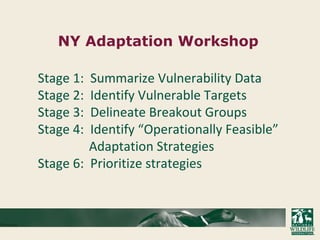
NY Adaptation Workshop
Stage 1: Summarize Vulnerability Data
Stage 2: Identify Vulnerable Targets
Stage 3: Delineate Breakout Groups
Stage 4: Identify “Operationally Feasible”
Adaptation Strategies
Stage 6: Prioritize strategies
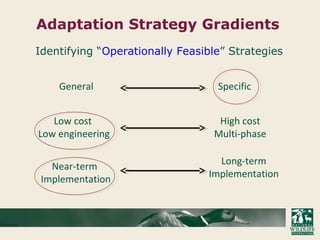
Adaptation Strategy Gradients
General Specific
Low cost
Low engineering
High cost
Multi-phase
Long-term
Implementation
Near-term
Implementation
Identifying “Operationally Feasible” Strategies
Stage 1: Summarize Vulnerability
Data
• New York Habitat Vulnerability Assessment
Galbraith, H. et al. 2012
• Vulnerability of At-risk Species to Climate
Change in New York
Schlesinger, M. et al. 2011
Stage 2: Identify Vulnerable Targets
Freshwater Systems
Species:
• Dwarf Wedge Mussel
• Bog Turtle
• Lake Sturgeon
• Hellbender
Habitats:
• Cold water habitats
• Emergent marsh
• Shrub swamp
• Stratified lakes
Upland Systems
Species:
• Spruce Grouse
• Indiana Bat
• Karner Blue butterfly
• Moose
Habitats:
• Montane Spruce-fir
• N. Hardwood forests
• Tundra
• Boreal bog
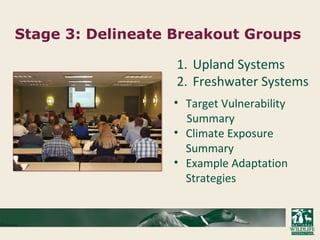
Stage 3: Delineate Breakout Groups
• Target Vulnerability
Summary
• Climate Exposure
Summary
• Example Adaptation
Strategies
1. Upland Systems
2. Freshwater Systems
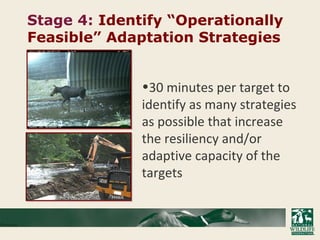
Stage 4: Identify “Operationally
Feasible” Adaptation Strategies
•30 minutes per target to
identify as many strategies
as possible that increase
the resiliency and/or
adaptive capacity of the
targets
FHWA
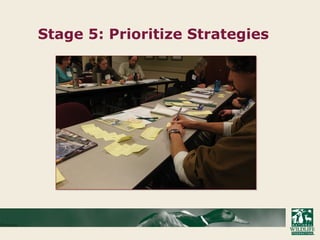
Stage 5: Prioritize Strategies
Group, Filter and Highlight
1.Group strategies by common theme,
category
2.Filter groups based upon feasibility,
cost, implementation potential
3.Highlight a suite of top 5 strategies
for each target
Montane spruce-fir
•Patch clear cut management for fir regeneration
•Expand Catskills to ADK to Canada connectivity
N. Hardwood forests
•Manage for southern spp./promote climate-resilient
assemblages
•Conduct deer management based on vegetation cover metrics
Tundra
•Limit visitation impacts with trail carrying capacity limits
•Monitor tundra pollinators
Boreal bog
•Reduce bog draining and peat harvest on private lands
•Implement existing wetland protection strategies
Upland Systems: Habitats
Upland Systems: Species
Spruce Grouse
•Facilitate range shift through connectivity
•Monitor likely disappearance
•Facilitate translocation for isolated populations
Indiana Bat
•Landowner incentives to maintain snags
•Increased investment in fungal disease research
•Increased hibernacula protection measures
Moose
•Improve connectivity across altitudinal gradients - over-underpass
•Reduce deer population for disease management
Karner Blue butterfly
•Continue/expand prescribed fire for habitat restoration
•Protect/manage islands around core habitat to facilitate meta-
population dynamics
Freshwater Systems: Habitats
Cold water habitats
•Acquire intact “in fee” lands along shores and stream banks
•Stream management programs for local communities
Emergent marsh
•Amend state wetland maps to include > wetlands – utilize previous
wetland map expansions
•Increase staff to implement current program objectives
Shrub swamp
•Remove obsolete impoundments to restore natural hydrology
•Increase capacity-funding for existing water protection program
implementation
Stratified lakes
•Improve sewage facilities for lakeshore residents – stormwater
•Expand watershed management focus for nonpoint discharges
Freshwater Systems: Species
Dwarf Wedge Mussel
•Decrease in-stream disturbance
•Increase aquatic connectivity - dam removal
•Improve water quality
Bog Turtle
•Control sediment runoff
•Acquisition of habitat for key populations
•Develop captive breeding program
Lake Sturgeon
•Reduce length of harvest season
•Minimize water withdrawal impacts - entrainment
Hellbender
•Unblock migration routes – aquatic connectivity
•Population re-establishment in climate-appropriate habitats
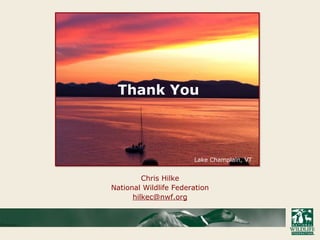
Thank You
Lake Champlain, VT
Chris Hilke
National Wildlife Federation
hilkec@nwf.org

C Hilke NY Climate Change Adaptation workshop

  • 1.
    Climate Adaptation Planning: fromVulnerability Assessment to Strategy Identification -A New York Workshop Case Study- Chris Hilke Climate Change Adaptation Program National Wildlife Federation hilkec@nwf.org
  • 2.
    Identifying Adaptation Strategies: Utilizingthe “New Hampshire Method” 1. Identify adaptation targets (species-habitats) 2. Summarize the vulnerability of the targets 3. Develop full range of adaptation options 4. Prioritize adaptation options 5. Identify potential implementation partners 6. Group, Filter, and Highlight
  • 3.
    NY Adaptation Workshop Stage1: Summarize Vulnerability Data Stage 2: Identify Vulnerable Targets Stage 3: Delineate Breakout Groups Stage 4: Identify “Operationally Feasible” Adaptation Strategies Stage 6: Prioritize strategies
  • 4.
    Adaptation Strategy Gradients GeneralSpecific Low cost Low engineering High cost Multi-phase Long-term Implementation Near-term Implementation Identifying “Operationally Feasible” Strategies
  • 5.
    Stage 1: SummarizeVulnerability Data • New York Habitat Vulnerability Assessment Galbraith, H. et al. 2012 • Vulnerability of At-risk Species to Climate Change in New York Schlesinger, M. et al. 2011
  • 6.
    Stage 2: IdentifyVulnerable Targets Freshwater Systems Species: • Dwarf Wedge Mussel • Bog Turtle • Lake Sturgeon • Hellbender Habitats: • Cold water habitats • Emergent marsh • Shrub swamp • Stratified lakes Upland Systems Species: • Spruce Grouse • Indiana Bat • Karner Blue butterfly • Moose Habitats: • Montane Spruce-fir • N. Hardwood forests • Tundra • Boreal bog
  • 7.
    Stage 3: DelineateBreakout Groups • Target Vulnerability Summary • Climate Exposure Summary • Example Adaptation Strategies 1. Upland Systems 2. Freshwater Systems
  • 8.
    Stage 4: Identify“Operationally Feasible” Adaptation Strategies •30 minutes per target to identify as many strategies as possible that increase the resiliency and/or adaptive capacity of the targets FHWA
  • 9.
  • 10.
    Group, Filter andHighlight 1.Group strategies by common theme, category 2.Filter groups based upon feasibility, cost, implementation potential 3.Highlight a suite of top 5 strategies for each target
  • 11.
    Montane spruce-fir •Patch clearcut management for fir regeneration •Expand Catskills to ADK to Canada connectivity N. Hardwood forests •Manage for southern spp./promote climate-resilient assemblages •Conduct deer management based on vegetation cover metrics Tundra •Limit visitation impacts with trail carrying capacity limits •Monitor tundra pollinators Boreal bog •Reduce bog draining and peat harvest on private lands •Implement existing wetland protection strategies Upland Systems: Habitats
  • 12.
    Upland Systems: Species SpruceGrouse •Facilitate range shift through connectivity •Monitor likely disappearance •Facilitate translocation for isolated populations Indiana Bat •Landowner incentives to maintain snags •Increased investment in fungal disease research •Increased hibernacula protection measures Moose •Improve connectivity across altitudinal gradients - over-underpass •Reduce deer population for disease management Karner Blue butterfly •Continue/expand prescribed fire for habitat restoration •Protect/manage islands around core habitat to facilitate meta- population dynamics
  • 13.
    Freshwater Systems: Habitats Coldwater habitats •Acquire intact “in fee” lands along shores and stream banks •Stream management programs for local communities Emergent marsh •Amend state wetland maps to include > wetlands – utilize previous wetland map expansions •Increase staff to implement current program objectives Shrub swamp •Remove obsolete impoundments to restore natural hydrology •Increase capacity-funding for existing water protection program implementation Stratified lakes •Improve sewage facilities for lakeshore residents – stormwater •Expand watershed management focus for nonpoint discharges
  • 14.
    Freshwater Systems: Species DwarfWedge Mussel •Decrease in-stream disturbance •Increase aquatic connectivity - dam removal •Improve water quality Bog Turtle •Control sediment runoff •Acquisition of habitat for key populations •Develop captive breeding program Lake Sturgeon •Reduce length of harvest season •Minimize water withdrawal impacts - entrainment Hellbender •Unblock migration routes – aquatic connectivity •Population re-establishment in climate-appropriate habitats
  • 15.
    Thank You Lake Champlain,VT Chris Hilke National Wildlife Federation hilkec@nwf.org