Static Guarantees for Macro
Bindings
Mitchell Wand
Presentation for Gnosys site visit
12/14/12
Why study macros?
   macros are a facility for lightweight
    compilers
   translate DSL into host language (Racket),
    then let Racket compiler work
   easy interoperation with host language, etc.
   most translation is on a per-s-expression
    basis
   Racket macro system has features that
    permit interaction between macros,
    optimizations, fancier syntax, etc.
Want: static reasoning about
hygiene
 Does the expansion of a macro obey its
  intended scoping rules?
 Does my-let act like let?
    ◦ Is id0 bound in body?
(define-syntax my-let
  (syntax-rules ()
    [(_ ((id0 val0) (id val) ...) body)
     ((lambda (id ...) body)
      val ...)]))
                              Answer: No
Didn't Dybvig solve this in 1993?
 No notion of "intended scoping rules"
 Dybvig's algorithm works out binding
  relationships dynamically.
 We want static guarantees.
Didn't the nominal logic guys
solve this?
 Nominal logic: Pitts, et al. 2000 or so, et seq.
 Logic for reasoning about names
 Much work about representing terms with
  binding. BUT:
 Aimed at theorem proving, not
  programming
 Generally involves data representations that
  carry their scoping rules with them:
    ◦ lambda-terms, not s-expressions.
    ◦ Macros must translate from s-expressions (or
      something like them) to lambda-terms (or
      something like them)
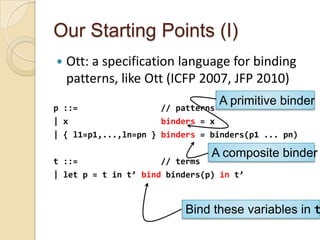
Our Starting Points (I)
   Ott: a specification language for binding
    patterns, like Ott (ICFP 2007, JFP 2010)
p ::=                 // patterns
                                 A primitive binder
| x                   binders = x
| { l1=p1,...,ln=pn } binders = binders(p1 ... pn)

                                A composite binder
t ::=                 // terms
| let p = t in t’ bind binders(p) in t’


                           Bind these variables in t
This doesn't solve the problem
   Ott has back-ends for
    ◦ Latex
    ◦ several theorem provers
   But it's not a general-purpose tool
Our Starting Points (II)
   Dave Herman's thesis (2010)
    ◦ took Ott-like specification language
    ◦ static checking for syntax-rules style macros
 Would reject my-let from slide 1.
 Goal: extend this to procedurally-defined
  macros (e.g. syntax-case)
Our Starting Points (III)
 Pottier's Functional Fresh ML (LICS 2007)
 A programming language based on
  nominal logic.
 His goal: programming with binders.
    ◦ functions map alpha-equivalent objects to
      alpha-equivalent objects
   Attractive semantics
    ◦ no hidden gensym (!)
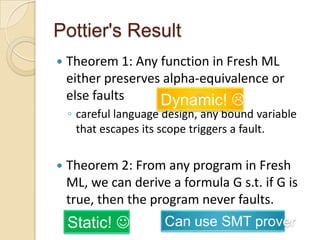
Pottier's Result
   Theorem 1: Any function in Fresh ML
    either preserves alpha-equivalence or
    else faults     Dynamic! 
    ◦ careful language design, any bound variable
      that escapes its scope triggers a fault.

   Theorem 2: From any program in Fresh
    ML, we can derive a formula G s.t. if G is
    true, then the program never faults.
    Static!           Can use SMT prover
Does this solve the problem?
 No: his data still carries around its own
  binding information dynamically
 We need to manipulate plain old s-
  expressions (or something like them)
Our plan
 Adapt Pottier's system to use plain old s-
  expressions.
 Keep the binding information in types
  (static) rather than in the data (dynamic)
Progress [Work by Paul
Stansifer]
 Core language defined
 Static checks defined (extension of
  Pottier's)
 Now working on proofs of theorems
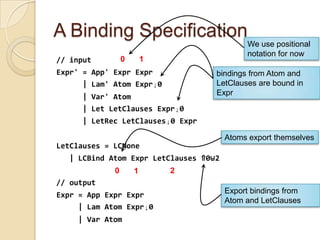
A Binding Specification
                                             We use positional
                                             notation for now
// input         0       1
Expr' = App' Expr Expr             bindings from Atom and
      | Lam' Atom Expr↓0           LetClauses are bound in
                                   Expr
      | Var' Atom
      | Let LetClauses Expr↓0
      | LetRec LetClauses↓0 Expr

                                       Atoms export themselves
LetClauses = LCNone
  | LCBind Atom Expr LetClauses ⇑0⊎2
             0       1       2
// output
Expr = App Expr Expr                   Export bindings from
                                       Atom and LetClauses
     | Lam Atom Expr↓0
    | Var Atom
Next Steps
 Interface to SMT prover (w/ Fabian
  Muehlenboeck)
 What adaptations are necessary to make
  these obligations acceptable to an SMT-
  style prover?
 Actually write some macros in this
  system.

Site visit presentation 2012 12 14

  • 1.
    Static Guarantees forMacro Bindings Mitchell Wand Presentation for Gnosys site visit 12/14/12
  • 2.
    Why study macros?  macros are a facility for lightweight compilers  translate DSL into host language (Racket), then let Racket compiler work  easy interoperation with host language, etc.  most translation is on a per-s-expression basis  Racket macro system has features that permit interaction between macros, optimizations, fancier syntax, etc.
  • 3.
    Want: static reasoningabout hygiene  Does the expansion of a macro obey its intended scoping rules?  Does my-let act like let? ◦ Is id0 bound in body? (define-syntax my-let (syntax-rules () [(_ ((id0 val0) (id val) ...) body) ((lambda (id ...) body) val ...)])) Answer: No
  • 4.
    Didn't Dybvig solvethis in 1993?  No notion of "intended scoping rules"  Dybvig's algorithm works out binding relationships dynamically.  We want static guarantees.
  • 5.
    Didn't the nominallogic guys solve this?  Nominal logic: Pitts, et al. 2000 or so, et seq.  Logic for reasoning about names  Much work about representing terms with binding. BUT:  Aimed at theorem proving, not programming  Generally involves data representations that carry their scoping rules with them: ◦ lambda-terms, not s-expressions. ◦ Macros must translate from s-expressions (or something like them) to lambda-terms (or something like them)
  • 6.
    Our Starting Points(I)  Ott: a specification language for binding patterns, like Ott (ICFP 2007, JFP 2010) p ::= // patterns A primitive binder | x binders = x | { l1=p1,...,ln=pn } binders = binders(p1 ... pn) A composite binder t ::= // terms | let p = t in t’ bind binders(p) in t’ Bind these variables in t
  • 7.
    This doesn't solvethe problem  Ott has back-ends for ◦ Latex ◦ several theorem provers  But it's not a general-purpose tool
  • 8.
    Our Starting Points(II)  Dave Herman's thesis (2010) ◦ took Ott-like specification language ◦ static checking for syntax-rules style macros  Would reject my-let from slide 1.  Goal: extend this to procedurally-defined macros (e.g. syntax-case)
  • 9.
    Our Starting Points(III)  Pottier's Functional Fresh ML (LICS 2007)  A programming language based on nominal logic.  His goal: programming with binders. ◦ functions map alpha-equivalent objects to alpha-equivalent objects  Attractive semantics ◦ no hidden gensym (!)
  • 10.
    Pottier's Result  Theorem 1: Any function in Fresh ML either preserves alpha-equivalence or else faults Dynamic!  ◦ careful language design, any bound variable that escapes its scope triggers a fault.  Theorem 2: From any program in Fresh ML, we can derive a formula G s.t. if G is true, then the program never faults. Static!  Can use SMT prover
  • 11.
    Does this solvethe problem?  No: his data still carries around its own binding information dynamically  We need to manipulate plain old s- expressions (or something like them)
  • 12.
    Our plan  AdaptPottier's system to use plain old s- expressions.  Keep the binding information in types (static) rather than in the data (dynamic)
  • 13.
    Progress [Work byPaul Stansifer]  Core language defined  Static checks defined (extension of Pottier's)  Now working on proofs of theorems
  • 14.
    A Binding Specification We use positional notation for now // input 0 1 Expr' = App' Expr Expr bindings from Atom and | Lam' Atom Expr↓0 LetClauses are bound in Expr | Var' Atom | Let LetClauses Expr↓0 | LetRec LetClauses↓0 Expr Atoms export themselves LetClauses = LCNone | LCBind Atom Expr LetClauses ⇑0⊎2 0 1 2 // output Expr = App Expr Expr Export bindings from Atom and LetClauses | Lam Atom Expr↓0 | Var Atom
  • 15.
    Next Steps  Interfaceto SMT prover (w/ Fabian Muehlenboeck)  What adaptations are necessary to make these obligations acceptable to an SMT- style prover?  Actually write some macros in this system.