Function Argument
Detection And Type
Matching In Radare2
Oddcoder (@anoddcoder)
Xvilka (@akochkov)
R2Con 2016
1
GSoC
● Improving and fixing current types support
● Providing an uniform way to work with local variables
● Providing an uniform way to define argument types
● Very complex task involving a code refactoring
● http://radare.org/gsoc/2016/ideas.html#title_3
Task implications
● It required a change of the way to handle syscalls.
● Changing the ‘t*’ commands syntax and set.
● Changing the ‘af*’ commands syntax and set.
● It was required to simplify fetching types information to radeco.
Future directions
● It’s planned to add integration with signatures mechanisms.
● Supporting object-oriented programming data structures.
● Integration with demangling.
● Integration with DWARF/PDB/etc debug information.
$ whoami
● Computer and communication engineering student.
● Hobbyist system software developer, exploitation, etc..
● Active developer at Radare2 project.
● Participant in Google Summer Of Code 2016.
A word of gratitude
Problems I was trying to solve
● Auto detect formal arguments and local variables.
● Gather type information about them.
Rules of the game
No constraint solvers
No debugging.
Architecture independent
Modular and easy to extend.
Challenges
● A bit of everything is implemented.
● That was my first time to work on large code bases.
● I had to learn a lot on the fly.
Function Arguments/Locals
● Worked on x86 only.
● No 2 variables with same name in the whole binary.
● Only [ebp + stuff] could be manipulated.
● No stack based, or register based args/locals.
● It is arch independent.
● variables are local to their function.
● Adding support for stack based, or register based args/ locals.
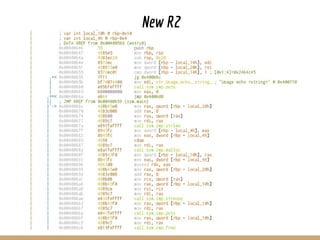
Function Arguments/Locals
Old R2
New R2
How does Automatic detection work ?
It is all strings matching on ESIL.
How does Automatic detection work ?
1. Locate candidate var.
How does Automatic detection work ?
1. Locate candidate var.
NUMBER,SP, +
NUMBER,BP, +
NUMBER,BP, -
How does Automatic detection work ?
1. Locate candidate var.
2. Identify type of candidate var.
How does Automatic detection work ?
1. Locate candidate var.
2. Identify type of candidate var.
NUMBER,BP, + (arg)
NUMBER,BP, - (local)
NUMBER,SP, + (?)
How does Automatic detection work ?
1. Locate candidate var.
2. Identify type of candidate var.
3. Naming and registering var.
How does Automatic detection work ?
1. Locate candidate var.
2. Identify type of candidate var.
3. Naming and registering var.
local_(Number)h [_counter]
var_(Number)h [_counter]
Type Matching
● Implementing type hints for standard function.
● Depends on calling convention of that function.
● Needs emulation to avoid confusion with stack & registers tracing.
What is Calling Convention?
● It is the way functions call another another function.
● How arguments are arranged in the stack ?
● Who cleans the callee stack ?
● Where is the return value placed ?
Cdecl
● Most common calling convention in linux i386.
● Arguments are pushed right to left on the stack.
● Return value is put in eax.
● The caller is the one who cleans the stack.
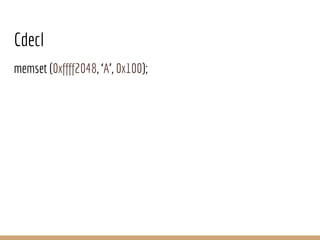
Cdecl
memset (0xffff2048, ‘A’, 0x100);
Cdecl
memset (0xffff2048, ‘A’, 0x100);
push 0x100
push 0x41
push 0xffff2048
call memset
Stdcall
● Popular on i386 windows machines.
● Arguments pushed left to right on the stack.
● Return value is also put in eax.
● Callee cleans its own stack frame.
Stdcall
memset (0xffff2048, ‘A’, 0x100);
Stdcall
memset (0xffff2048, ‘A’, 0x100);
push 0xffff2048
push 0x41
push 0x100
call memset
X64 Windows ABI
● Arguments passed into RCX, RDX, R8, R9, then the remaining arguments are put on
stack right to left.
● Return value is put into rax
And much more
● And there are lots of other calling conventions.
● Calling conventions for each architecture, and for each Operating system.
● Even some programming languages and some compilers got their own calling
conventions (ABI)
Why would we care ?
We already had this.
And we turned it into that
And this is our final goal
Implementation details
1. Read next instruction.
Implementation details
1. Read next instruction.
2. Record that instruction for traceback.
Implementation details
1. Read next instruction.
2. Record that instruction for traceback.
3. Record stack and register accesses.
Implementation details
1. Read next instruction.
2. Record that instruction for traceback.
3. Record stack and register accesses.
4. Go to step 1 .
Implementation details
1. Read next instruction.
2. Record that instruction for traceback.
3. Record stack and register accesses.
4. Go to step 1 .
→ This loop is interrupted when we find a call instruction
Implementation details
Interesting stuff starts when we catch a call instruction.
Implementation details
1- Grab function’s definition from types database.
Implementation details
1- Grab function’s definition from types database.
2- Do the math to calculate the location of all arguments.
Implementation details
1- Grab function’s definition from types database.
2- Do the math to calculate the location of all arguments.
3- Search the trace log for writing to these locations.
Implementation details
Now it is up to us what to do with all that information.
SHOW TIME
Let's add types SDB(s)
See also
GitHub issue https://github.com/radare/radare2/issues/3655
RT (Radare Today) article http://radare.today/posts/GSOC-The-last-commit-213c6f/
Calling convention db docs:
https://github.com/radare/radare2/blob/master/doc/calling-conventions.md
Types db docs: https://github.com/radare/radare2/blob/master/doc/types.md

args_types

  • 1.
    Function Argument Detection AndType Matching In Radare2 Oddcoder (@anoddcoder) Xvilka (@akochkov) R2Con 2016 1
  • 2.
    GSoC ● Improving andfixing current types support ● Providing an uniform way to work with local variables ● Providing an uniform way to define argument types ● Very complex task involving a code refactoring ● http://radare.org/gsoc/2016/ideas.html#title_3
  • 3.
    Task implications ● Itrequired a change of the way to handle syscalls. ● Changing the ‘t*’ commands syntax and set. ● Changing the ‘af*’ commands syntax and set. ● It was required to simplify fetching types information to radeco.
  • 4.
    Future directions ● It’splanned to add integration with signatures mechanisms. ● Supporting object-oriented programming data structures. ● Integration with demangling. ● Integration with DWARF/PDB/etc debug information.
  • 5.
    $ whoami ● Computerand communication engineering student. ● Hobbyist system software developer, exploitation, etc.. ● Active developer at Radare2 project. ● Participant in Google Summer Of Code 2016.
  • 6.
    A word ofgratitude
  • 7.
    Problems I wastrying to solve ● Auto detect formal arguments and local variables. ● Gather type information about them.
  • 8.
    Rules of thegame No constraint solvers No debugging. Architecture independent Modular and easy to extend.
  • 9.
    Challenges ● A bitof everything is implemented. ● That was my first time to work on large code bases. ● I had to learn a lot on the fly.
  • 10.
    Function Arguments/Locals ● Workedon x86 only. ● No 2 variables with same name in the whole binary. ● Only [ebp + stuff] could be manipulated. ● No stack based, or register based args/locals.
  • 11.
    ● It isarch independent. ● variables are local to their function. ● Adding support for stack based, or register based args/ locals. Function Arguments/Locals
  • 12.
  • 13.
  • 14.
    How does Automaticdetection work ? It is all strings matching on ESIL.
  • 15.
    How does Automaticdetection work ? 1. Locate candidate var.
  • 16.
    How does Automaticdetection work ? 1. Locate candidate var. NUMBER,SP, + NUMBER,BP, + NUMBER,BP, -
  • 17.
    How does Automaticdetection work ? 1. Locate candidate var. 2. Identify type of candidate var.
  • 18.
    How does Automaticdetection work ? 1. Locate candidate var. 2. Identify type of candidate var. NUMBER,BP, + (arg) NUMBER,BP, - (local) NUMBER,SP, + (?)
  • 19.
    How does Automaticdetection work ? 1. Locate candidate var. 2. Identify type of candidate var. 3. Naming and registering var.
  • 20.
    How does Automaticdetection work ? 1. Locate candidate var. 2. Identify type of candidate var. 3. Naming and registering var. local_(Number)h [_counter] var_(Number)h [_counter]
  • 21.
    Type Matching ● Implementingtype hints for standard function. ● Depends on calling convention of that function. ● Needs emulation to avoid confusion with stack & registers tracing.
  • 22.
    What is CallingConvention? ● It is the way functions call another another function. ● How arguments are arranged in the stack ? ● Who cleans the callee stack ? ● Where is the return value placed ?
  • 23.
    Cdecl ● Most commoncalling convention in linux i386. ● Arguments are pushed right to left on the stack. ● Return value is put in eax. ● The caller is the one who cleans the stack.
  • 24.
  • 25.
    Cdecl memset (0xffff2048, ‘A’,0x100); push 0x100 push 0x41 push 0xffff2048 call memset
  • 26.
    Stdcall ● Popular oni386 windows machines. ● Arguments pushed left to right on the stack. ● Return value is also put in eax. ● Callee cleans its own stack frame.
  • 27.
  • 28.
    Stdcall memset (0xffff2048, ‘A’,0x100); push 0xffff2048 push 0x41 push 0x100 call memset
  • 29.
    X64 Windows ABI ●Arguments passed into RCX, RDX, R8, R9, then the remaining arguments are put on stack right to left. ● Return value is put into rax
  • 30.
    And much more ●And there are lots of other calling conventions. ● Calling conventions for each architecture, and for each Operating system. ● Even some programming languages and some compilers got their own calling conventions (ABI)
  • 31.
  • 32.
  • 33.
    And we turnedit into that
  • 34.
    And this isour final goal
  • 35.
  • 36.
    Implementation details 1. Readnext instruction. 2. Record that instruction for traceback.
  • 37.
    Implementation details 1. Readnext instruction. 2. Record that instruction for traceback. 3. Record stack and register accesses.
  • 38.
    Implementation details 1. Readnext instruction. 2. Record that instruction for traceback. 3. Record stack and register accesses. 4. Go to step 1 .
  • 39.
    Implementation details 1. Readnext instruction. 2. Record that instruction for traceback. 3. Record stack and register accesses. 4. Go to step 1 . → This loop is interrupted when we find a call instruction
  • 40.
    Implementation details Interesting stuffstarts when we catch a call instruction.
  • 41.
    Implementation details 1- Grabfunction’s definition from types database.
  • 42.
    Implementation details 1- Grabfunction’s definition from types database. 2- Do the math to calculate the location of all arguments.
  • 43.
    Implementation details 1- Grabfunction’s definition from types database. 2- Do the math to calculate the location of all arguments. 3- Search the trace log for writing to these locations.
  • 44.
    Implementation details Now itis up to us what to do with all that information.
  • 45.
  • 46.
  • 47.
    See also GitHub issuehttps://github.com/radare/radare2/issues/3655 RT (Radare Today) article http://radare.today/posts/GSOC-The-last-commit-213c6f/ Calling convention db docs: https://github.com/radare/radare2/blob/master/doc/calling-conventions.md Types db docs: https://github.com/radare/radare2/blob/master/doc/types.md