2
Learning Objectives
To understandthe escalating importance of
logistics and supply-chain management as
crucial tools for competitiveness.
To learn about materials management and
physical distribution.
To learn why international logistics is more
complex than domestic logistics.
To see how the transportation infrastructure in
host countries often dictates the options open to
the manager.
To learn why international inventory management
is crucial for success.
3.
3
International Logistics
International logisticsis the
design and management of a
system that controls the forward
and reverse flow of materials,
services, and information into,
through, and out of the international
corporation.
4.
4
International Logistics (cont.)
Throughthe implementation of international
logistics, the firm can implement cost-saving
programs such as just-in-time (JIT), electronic
data interchange (EDI), and early supplier
involvement (ESI).
The two phases of the movement of materials
include:
materials management, or the timely movement
of materials, parts, and supplies.
physical distribution, or the movement of the
firm’s physical product to its customers.
5.
5
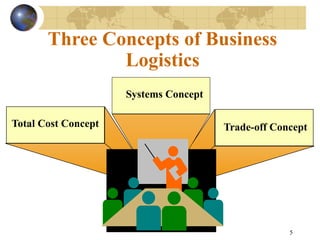
Three Concepts ofBusiness
Logistics
Total Cost Concept Trade-off Concept
Systems Concept
6.
6
Supply-Chain Management
Supply-chain managementis the
integration of business processes from
end user through original suppliers, that
provide products, services, and
information that add value for
customers.
Supply-chain management connects a
company’s supply side with its demand side.
It opens up supplier relationships for
companies outside of the buyer’s domestic
market.
7.
7
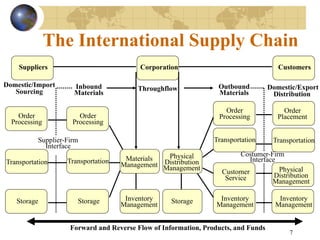
The International SupplyChain
Physical
Distribution
Management
Transportation
Corporation
Suppliers Customers
Domestic/Import
Sourcing
Domestic/Export
Distribution
Throughflow
Inbound
Materials
Outbound
Materials
Forward and Reverse Flow of Information, Products, and Funds
Physical
Distribution
Management
Transportation
Transportation Transportation
Order
Processing
Order
Processing
Order
Processing
Order
Placement
Inventory
Management
Materials
Management
Customer
Service
Storage Storage
Storage Inventory
Management
Inventory
Management
Costumer-Firm
Interface
Supplier-Firm
Interface
8.
8
Transportation Infrastructure
A firm’slogistics platform is determined by a
location’s ease and convenience of market
reach under favorable cost circumstances.
The public sector’s investment priorities, safety
regulations, tax incentives, and transport
policies can have major effects on the logistics
decisions of firms.
The logistics manager must learn about
existing and planned infrastructures abroad
and at home and factor them into the firm’s
strategy.
9.
9
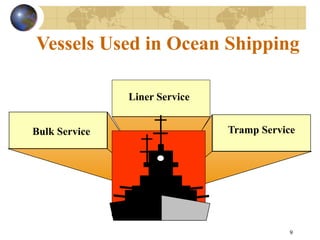
Vessels Used inOcean Shipping
Liner Service
Bulk Service Tramp Service
10.
10
Airfreight
Airfreight is availableto and from most
countries, including the developing world.
International airfreight is expected to grow to
190 billion tons in 2005, compared to only 70
billion tons in 1995.
Forty percent of the world’s manufactured
travel by air.
Items that are high-value or high in density
tend to travel by air.
12
Export Documentation
A billof lading is a contract between the exporter
and the carrier indicating that the carrier has
accepted responsibility for the goods and will
provide transportation in return for payment.
A commercial invoice is a bill for the goods
stating basic information about the transaction,
including a description of the merchandise, total
cost of the goods sold, addresses of the shipper
and seller, and delivery and payment terms.
A freight forwarder specializes in handling export
documentation.
13.
13
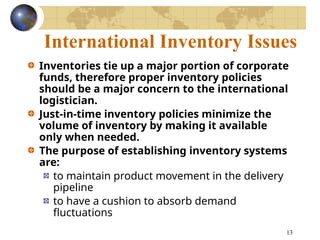
International Inventory Issues
Inventoriestie up a major portion of corporate
funds, therefore proper inventory policies
should be a major concern to the international
logistician.
Just-in-time inventory policies minimize the
volume of inventory by making it available
only when needed.
The purpose of establishing inventory systems
are:
to maintain product movement in the delivery
pipeline
to have a cushion to absorb demand
fluctuations
14.
14
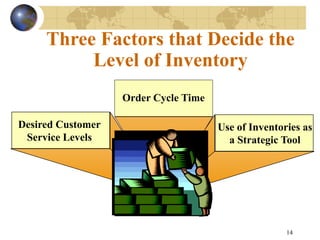
Three Factors thatDecide the
Level of Inventory
Order Cycle Time
Desired Customer
Service Levels
Use of Inventories as
a Strategic Tool
15.
15
International Packaging Issues
Packagingis instrumental in getting the
merchandise to the destination in a safe,
presentable condition.
Because of the added stress of international
shipping, packaging that is adequate for domestic
shipping may be inadequate for international
shipping.
Packaging considerations that should be taken
into account are environmental conditions and
weight.
One solution to the packaging problem has been
the development of inter-modal containers.
Cost attention must be paid to international
16.
16
Storage Facilities
A stationaryperiod is involved when
merchandise becomes inventory stored in
warehouses.
The location decision addresses how many
distribution centers to have and where to locate
them.
Storage facilities abroad can differ in availability
and quality.
The logistician should analyze international
product sales and then rank order products
according to warehousing needs.
17.
17
Special Trade Zones
Foreigntrade zones are areas
where foreign goods may be held
or processed and then re-exported
without incurring duties.
Trade zones can be useful as
transshipment points to reduce
logistics cost and redesign
marketing approaches.
Governments and firms benefit
from foreign trade zones.
18.
18
Export Processing Zonesand
Economic Zones
In export processing zones, special rules apply
that are different in other regions of the country.
These zones usually provide tax-free and duty-free
treatment for production facilities whose output is
destined abroad.
The maquiladoras of Mexico are one example of
a program that permits firms to take advantage of
sharp differentials in labor costs.
Through the creation of special economic zones,
the Chinese government has attracted many
foreign investors bringing in millions of dollars.
19.
19
Centralized Logistics
Management
In internationallogistics, the existence of a
headquarters staff that retains decision-
making power over logistics is important.
To avoid internal problems, both headquarters
staff and local management should report to
one person.
This individual can contribute an objective
view when inevitable conflicts arise in
international logistics coordination.
20.
20
Decentralized Logistics
Management
When afirm serves many diverse international
markets, total centralization might leave the
firm unresponsive to local adaptation needs.
If each subsidiary is made a profit center in
itself, each one carries the full responsibility
for its performance.
Once products are within a specific market,
increased input from local logistics operations
should be expected and encouraged.
21.
21
Outsourcing Logistics Services
Thesystematic outsourcing of
logistics capabilities is a third
option.
By collaborating with
transportation firms, private
warehouses, or other specialists,
corporate resources can be
concentrated on the firm’s core
product.
One-stop logistics allows shippers
to buy all the transportation
modes and functional services
from a single carrier.
22.
22
The Supply Chainand the
Internet
Because of the internet, firms are able to
conduct many more global comparisons among
suppliers and select from a wider variety of
choices.
When customers have the ability to access a
company through the internet, the company
must be prepared for 24-hour order-taking and
customer service.
For all countries, but particularly in developing
nations, the issue of universal access to the
internet is crucial.
23.
23
Logistics and Security
Afterthe terrorist attacks of 2001, companies
have to deal with the fact that the pace of
international transactions has slowed down
and that formerly routine steps will now take
longer.
Logistics systems and modern transportation
systems are often the targets of attacks.
The need to institute new safeguards for
international shipments will affect the ability
of firms to efficiently plan their international
shipments.
24.
24
Logistics and theEnvironment
Since environmental laws and regulations
differ across the globe, the firm’s efforts need
to be responsive to a wide variety of
requirements.
Reverse distribution systems are instrumental
in ensuring that the firm not only delivers the
product to the market, but also can retrieve it
from the market for subsequent use,
recycling, or disposal.
Companies need to learn how to
simultaneously achieve environmental and
economic goals.