Sinus Bradicardia On Grade II Dengue Hemorragic Fever
1
By:
dr. Irfandy Chairi Sulaiman Lubis
NPM: 2107601020018
INTERNAL MEDICINE RECIDENCY PROGRAM
FACULTY OF MEDICINE UNIVERSITY OF SYIAH KUALA BANDA ACEH
2023
•
3rd Case Report
2
• Dengue is one of the most common tropical diseases affecting humans
causing significant morbidity and mortality in tropical countries
• Human become infected with dengue through the bite of DENV-carrying
female Aedes mosquitoes, including Aedes albopictus and Aedes aegypti
• World Health Organization (WHO) estimates that around 2.5-3 billion people
are presently living in dengue transmitted zones.
• In Indonesia, the number of its cases have fluctuated anually, and it tends to
experience an increase and expansion in the distribution of the affected areas
• In 2019 morbidity rate (incidence rate) has increased in compared to 2018,
from 24.75 to 51.48 per 100,000 population.
INTRODUCTION
3
• Dengue fever is now known to involve the heart by inducing myocardial
inflammation, arrhythmias, and, in rare cases, fulminant myocarditis, up to
13% in severe dengue
• Conduction abnormalities can range from benign sinus bradycardia to
fulminant tachyarrhythmias and atrioventricular blocks
• Bradycardia is the most common electrical disturbance seen in dengue
• This case report emphasize on the diagnostic and therapeutic aspects, and the
correlation of how dengue hemorrhagic fever can caused bradycardia
INTRODUCTION
CASE REPORT
 Name : Mr. T.A.
 Age : 37 years old
 Occupation : Teacher
 Marriage status : Married
 Address : Banda Aceh
 Last Education : Bachelor Deegre
 Religion : Islam
 No. MR : 1-33-12-29
Chief complaint:
Fever since 5 days before admission to the hospital
CASE REPORT
 Anamnesis (Medical History)
• The patient complained of having a fever since 5 days before the admission to the
hospital.
• The fever goes up and down, and currently, patient have no fever.
• No complaints of maculopapular rash on the body
• Nosebleed (-)
• Bleeding gums (-)
• Black stool (-)
• Hematemesis (+) 2 times
• Diarrhea (+) since 2 days ago, but currently the patient haven't had a poop for 2 days.
• The patient didn’t complain of having a headaches, pain behind the eyeballs
(retrobulbar pain), and muscle pain.
CASE REPORT
Past Medical History:
• History of past illness in the form of dengue was denied.
• History of travelling to dengue endemic area was denied.
 Family Medical History:
• There was no one in the family who suffers an illness like the patient.
CASE REPORT
Physical Examination
 General Condition : Weak, nutritional status adequate
 Consciousness : E4M6V5 (Compos mentis)
 BP : 117/82 mmHg
 HR : 80 x/min, regular
 RR : 20 x/min
 T : 36,7 °C
 SpO2 : 98% room air
CASE REPORT
Physical Examination
Head and Neck
• CA (-/-), SI (-/-)
• No enlarged lymph nodes
Thoracal:
• Symmetrical, vesicular breath sounds, crackles (-/-), wheezing (-/-)
• S1-2 reguler, cardiomegaly (-)
Abdominal:
• Distention (-)
• Normal bowel sounds
• Hepatomegaly (-)
• Splenomegaly (-)
Extremities
• No edema, warm acral, CRT < 2 seconds
Pemeriksaan 06/02/2023 08/02/2023 09/11/22 Nilai Normal Satuan
Hemoglobin 14,0 15,7 16,1 14,0 - 17,0 g/dL
Hematokrit 38,4 42,7 43,9 45 - 55 %
Eritrosit 4,0 4,5 4,6 4,7 – 6,1 106/mm
Trombosit 138 58 20 150 - 450 103/mm
Leukosit 6,1 4,4 8,4 4,5 - 10,5 103/mm
MCV 93 94 93 80 - 100 fl
MCH 34 34 94 27 - 31 pg
MCHC 36 36 36 32 – 36 %
Eosinofil 0 0 0 0 - 6 %
Basofil 0 0 0 0 - 2 %
Netrofil Batang 1 1 1 2 - 6 %
Netrofil Segmen 77 50 53 50 - 70 %
Limfosit 12 28 26 20 - 40 %
Monosit 10 21 20 2 - 8 %
CASE REPORT
Laboratory Test from Malahayati Bireuen Hospital
Pemeriksaan 10/02/2023 11/02/2023 Nilai Normal Satuan
Hemoglobin 16,4 16,0 14,0 - 17,0 g/dL
Hematokrit 41 42 45 - 55 %
Eritrosit 4,7 4,6 4,7 – 6,1 106/mm
Trombosit 29 55 150 - 450 103/mm
Leukosit 11,96 10,4 4,5 - 10,5 103/mm
MCV 89 91 80 - 100 fl
MCH 35 35 27 - 31 pg
MCHC 40 39 32 – 36 %
Eosinofil 1 2 0 - 6 %
Basofil 1 1 0 - 2 %
Netrofil Batang 0 0 2 - 6 %
Netrofil Segmen 23 18 50 - 70 %
Limfosit 49 54 20 - 40 %
Monosit 26 25 2 - 8 %
CASE REPORT
Laboratory Test
Pemeriksaan 10/02/2023 Nilai Normal Satuan
Imunoserology
Ig M Anti Dengue Positif Negatif
Ig G Anti Dengue Positif Negatif
SGOT 173 <35 U/L
SGPT 103 <45 U/L
GDS 81 <200 mg/dl
Albumin 3,40 3,5 – 5,2 g/dl
Ureum 25 13 – 43 mg/dl
Cretinin 0,70 0,67 – 1, 17 mg/dl
Natrium 134 132 – 145 mmol/L
Kalium 4,10 3,7 – 5,4 mmol/L
Clorida 108 98 - 106 mmol/L
CASE REPORT
Laboratory Test
CASE REPORT
X-ray Examination
• Conclusion :
• Normal cor
• Pleural effusion of the left lung.
CASE REPORT
Elektrocardiography
• Conclusion :
• Sinus Bradicardia, Hr: 45 beats/min, regular, normoaxis
CASE REPORT
Elektrocardiography
• Conclusion :
• Sinus Rhytme, Hr: 83 beats/min, regular, normoaxis
CASE REPORT
Diagnosis
1. Grade II dengue hemorrhagic
fever
2. Sinus bradycardia ec dd viral
infection or pericardial effusion
Treatment
• Bed rest
• IVFD RL 30 drops/min
• IV ondansetron 1 amp/8 h
• IV lansoprazole 30 mg/24 h
• Paracetamol tab 500 mg/8 h
• Salbutamol tab 2 mg/12 h
• N-acetylcystein tab 200 mg/8 h
• Curcuma 1 tablet/12 h.
DISCUSSION
• The classic clinical manifestations of a person with
dengue usually present with fever, arthralgia,
myalgias, retro-orbital pain, and a red rash.
• Clinical manifestations of dengue hemorrhagic
fever, include :
• Acute onset, high and continuous, lasting two
to seven days in most cases.
• Any of the following haemorrhagic
manifestations including a positive tourniquet
test (the most common), petechiae, purpura
(at venepuncture sites), ecchymosis,
epistaxis, gum bleeding, and haematemesis
and/or melena.
• Enlargement of the liver (hepatomegaly) is
observed at some stage of the illness
LITERATURE
• The patient came with a main complaint of fever
• No complaints of maculopapular rash on the body
• Nosebleed (-),
• Bleeding gums (-)
• Black stool (-)
• Hematemesis (+) 2 times, diarrhea (+) since 2
days ago, but currently the patient haven't had a
poop for 2 days.
• The patient didn’t complain of having a
headaches, pain behind the eyeballs (retrobulbar
pain), and muscle pain.
• Examination of the abdominal region revealed
liver and lien are not palpable (no hepatomegaly
or splenomegaly).
CASE
Clinical Manifestation and Physical Examination
DISCUSSION
Laboratory Examination
• The results of routine blood laboratory tests in
Malahayati Bireuen Hospital on February 6th 
Hb 14,0 g/dL; Hct 38,4%; platelet 138.000/mm3;
leucocyte count 6.100/mm3; Lymphocyte 12%;
• The results of routine blood laboratory tests in dr.
Zainal Abidin Regional Hospital on February 10th
 Hb 16,4 g/dL; Hct 41%; platelet 29.000/mm3;
leucocyte count 11.960/mm3; Lymphocyte 49%;
AST/SGOT 173 U/L; ALT/SGPT 103 U/L;
albumin 3,40 g/dL; Na 134 mmol/L
CASE
• The white blood cell (WBC) count may be normal
or with predominant neutrophils in the early
febrile phase.
• A relative lymphocytosis with increased atypical
lymphocytes is commonly observed by the end of
the febrile phase and into convalescence.
• A sudden drop in platelet count to below 100.000
occurs by the end of the febrile phase before the
onset of shock or subsidence of fever.
LITERATURE
DISCUSSION
Laboratory Examination
• The results of routine blood laboratory tests in
Malahayati Bireuen Hospital on February 6th  Hb
14,0 g/dL; Hct 38,4%; platelet 138.000/mm3;
leucocyte count 6.100/mm3; Lymphocyte 12%;
• The results of routine blood laboratory tests in dr.
Zainal Abidin Regional Hospital on February 10th 
Hb 16,4 g/dL; Hct 41%; platelet 29.000/mm3;
leucocyte count 11.960/mm3; Lymphocyte 49%;
AST/SGOT 173 U/L; ALT/SGPT 103 U/L; albumin
3,40 g/dL; Na 134 mmol/L
CASE
• Haemoconcentration or rising haematocrit by 20% from the
baseline
• Thrombocytopenia and haemoconcentration are constant
findings in DHF
• Other common findings are hypoproteinemia or
albuminaemia
• Hyponatremia, and mildly elevated serum aspartate
aminotransferase levels
• A transient mild albuminuria is sometimes observed.
• Occult blood is often found in the stool.
LITERATURE
DISCUSSION
Diagnosis Criteria
The first two clinical criteria, plus
thrombocytopenia and
haemoconcentration or a rising
haematocrit, are sufficient to
establish a clinical diagnosis of DHF
DISCUSSION
Radiology Examination
• Normal cor
• Pleural effusion of the left lung.
CASE
• The presence of pleural effusion (chest X-ray or
ultrasound) is the most objective evidence of plasma
leakage
LITERATURE
DISCUSSION
Serology Examination
• Immunoserology of anti-dengue IgG and IgM
showed positive results
CASE
LITERATURE
IgM IgG Interpretation
(+) (-) Primary infection
(+) (+) Secondary infection
(-) (+) Had been infected before
(-) (-) Never been infected
DISCUSSION
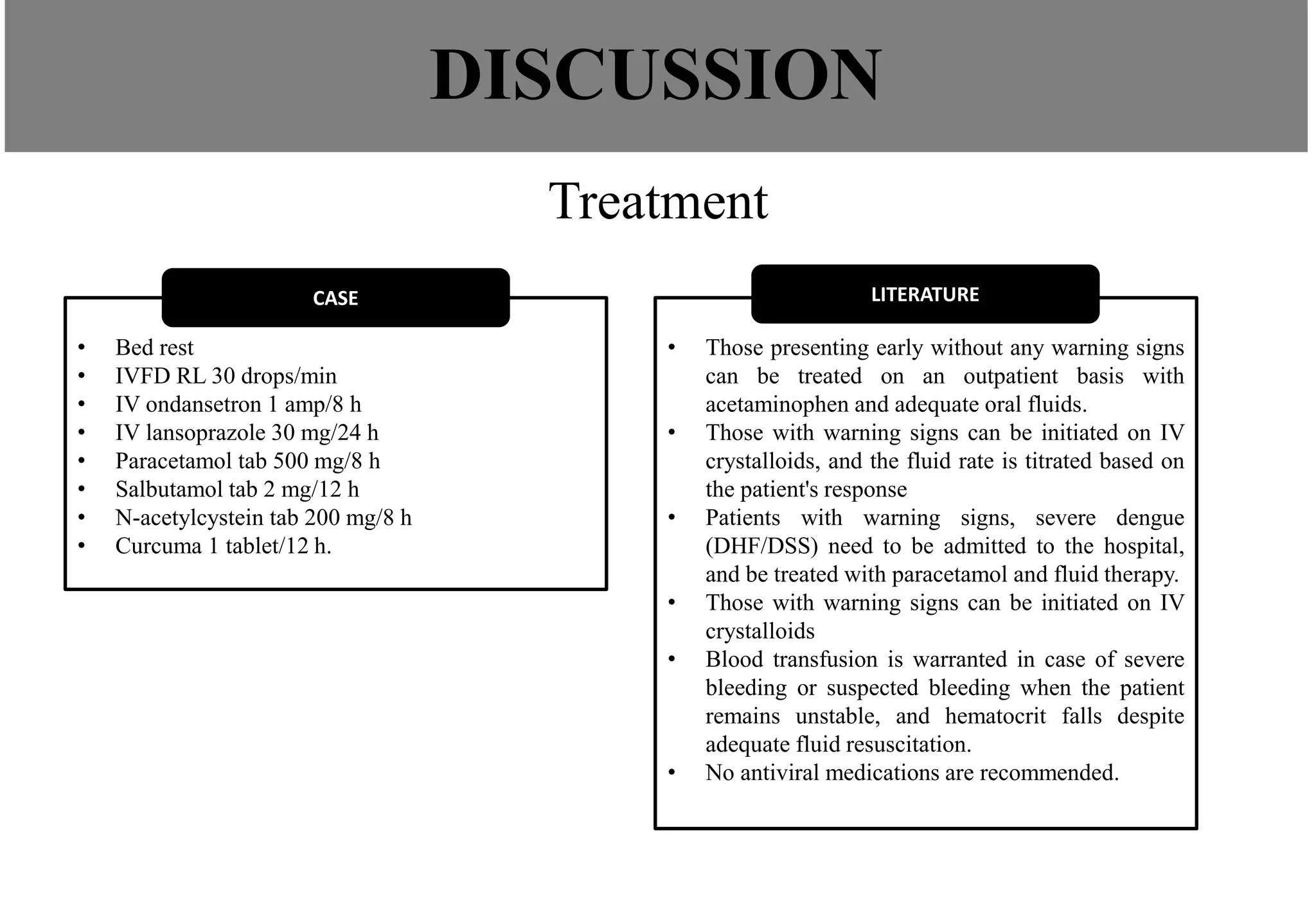
Treatment
• Bed rest
• IVFD RL 30 drops/min
• IV ondansetron 1 amp/8 h
• IV lansoprazole 30 mg/24 h
• Paracetamol tab 500 mg/8 h
• Salbutamol tab 2 mg/12 h
• N-acetylcystein tab 200 mg/8 h
• Curcuma 1 tablet/12 h.
CASE
• Those presenting early without any warning signs
can be treated on an outpatient basis with
acetaminophen and adequate oral fluids.
• Those with warning signs can be initiated on IV
crystalloids, and the fluid rate is titrated based on
the patient's response
• Patients with warning signs, severe dengue
(DHF/DSS) need to be admitted to the hospital,
and be treated with paracetamol and fluid therapy.
• Those with warning signs can be initiated on IV
crystalloids
• Blood transfusion is warranted in case of severe
bleeding or suspected bleeding when the patient
remains unstable, and hematocrit falls despite
adequate fluid resuscitation.
• No antiviral medications are recommended.
LITERATURE
DISCUSSION
Pathogenesis of conduction abnormalities in dengue infection
CONCLUSION
Electrocardiography (ECG) and echocardiography abnormalities are common during dengue
infection. One of those abnormalities is bradycardia. Bradycardia is the most common
electrical disturbance seen in dengue.
Thank You

Sinus Bradicardia on grade II dengue hemorragic fever.pptx

  • 1.
    Sinus Bradicardia OnGrade II Dengue Hemorragic Fever 1 By: dr. Irfandy Chairi Sulaiman Lubis NPM: 2107601020018 INTERNAL MEDICINE RECIDENCY PROGRAM FACULTY OF MEDICINE UNIVERSITY OF SYIAH KUALA BANDA ACEH 2023 • 3rd Case Report
  • 2.
    2 • Dengue isone of the most common tropical diseases affecting humans causing significant morbidity and mortality in tropical countries • Human become infected with dengue through the bite of DENV-carrying female Aedes mosquitoes, including Aedes albopictus and Aedes aegypti • World Health Organization (WHO) estimates that around 2.5-3 billion people are presently living in dengue transmitted zones. • In Indonesia, the number of its cases have fluctuated anually, and it tends to experience an increase and expansion in the distribution of the affected areas • In 2019 morbidity rate (incidence rate) has increased in compared to 2018, from 24.75 to 51.48 per 100,000 population. INTRODUCTION
  • 3.
    3 • Dengue feveris now known to involve the heart by inducing myocardial inflammation, arrhythmias, and, in rare cases, fulminant myocarditis, up to 13% in severe dengue • Conduction abnormalities can range from benign sinus bradycardia to fulminant tachyarrhythmias and atrioventricular blocks • Bradycardia is the most common electrical disturbance seen in dengue • This case report emphasize on the diagnostic and therapeutic aspects, and the correlation of how dengue hemorrhagic fever can caused bradycardia INTRODUCTION
  • 4.
    CASE REPORT  Name: Mr. T.A.  Age : 37 years old  Occupation : Teacher  Marriage status : Married  Address : Banda Aceh  Last Education : Bachelor Deegre  Religion : Islam  No. MR : 1-33-12-29 Chief complaint: Fever since 5 days before admission to the hospital
  • 5.
    CASE REPORT  Anamnesis(Medical History) • The patient complained of having a fever since 5 days before the admission to the hospital. • The fever goes up and down, and currently, patient have no fever. • No complaints of maculopapular rash on the body • Nosebleed (-) • Bleeding gums (-) • Black stool (-) • Hematemesis (+) 2 times • Diarrhea (+) since 2 days ago, but currently the patient haven't had a poop for 2 days. • The patient didn’t complain of having a headaches, pain behind the eyeballs (retrobulbar pain), and muscle pain.
  • 6.
    CASE REPORT Past MedicalHistory: • History of past illness in the form of dengue was denied. • History of travelling to dengue endemic area was denied.  Family Medical History: • There was no one in the family who suffers an illness like the patient.
  • 7.
    CASE REPORT Physical Examination General Condition : Weak, nutritional status adequate  Consciousness : E4M6V5 (Compos mentis)  BP : 117/82 mmHg  HR : 80 x/min, regular  RR : 20 x/min  T : 36,7 °C  SpO2 : 98% room air
  • 8.
    CASE REPORT Physical Examination Headand Neck • CA (-/-), SI (-/-) • No enlarged lymph nodes Thoracal: • Symmetrical, vesicular breath sounds, crackles (-/-), wheezing (-/-) • S1-2 reguler, cardiomegaly (-) Abdominal: • Distention (-) • Normal bowel sounds • Hepatomegaly (-) • Splenomegaly (-) Extremities • No edema, warm acral, CRT < 2 seconds
  • 9.
    Pemeriksaan 06/02/2023 08/02/202309/11/22 Nilai Normal Satuan Hemoglobin 14,0 15,7 16,1 14,0 - 17,0 g/dL Hematokrit 38,4 42,7 43,9 45 - 55 % Eritrosit 4,0 4,5 4,6 4,7 – 6,1 106/mm Trombosit 138 58 20 150 - 450 103/mm Leukosit 6,1 4,4 8,4 4,5 - 10,5 103/mm MCV 93 94 93 80 - 100 fl MCH 34 34 94 27 - 31 pg MCHC 36 36 36 32 – 36 % Eosinofil 0 0 0 0 - 6 % Basofil 0 0 0 0 - 2 % Netrofil Batang 1 1 1 2 - 6 % Netrofil Segmen 77 50 53 50 - 70 % Limfosit 12 28 26 20 - 40 % Monosit 10 21 20 2 - 8 % CASE REPORT Laboratory Test from Malahayati Bireuen Hospital
  • 10.
    Pemeriksaan 10/02/2023 11/02/2023Nilai Normal Satuan Hemoglobin 16,4 16,0 14,0 - 17,0 g/dL Hematokrit 41 42 45 - 55 % Eritrosit 4,7 4,6 4,7 – 6,1 106/mm Trombosit 29 55 150 - 450 103/mm Leukosit 11,96 10,4 4,5 - 10,5 103/mm MCV 89 91 80 - 100 fl MCH 35 35 27 - 31 pg MCHC 40 39 32 – 36 % Eosinofil 1 2 0 - 6 % Basofil 1 1 0 - 2 % Netrofil Batang 0 0 2 - 6 % Netrofil Segmen 23 18 50 - 70 % Limfosit 49 54 20 - 40 % Monosit 26 25 2 - 8 % CASE REPORT Laboratory Test
  • 11.
    Pemeriksaan 10/02/2023 NilaiNormal Satuan Imunoserology Ig M Anti Dengue Positif Negatif Ig G Anti Dengue Positif Negatif SGOT 173 <35 U/L SGPT 103 <45 U/L GDS 81 <200 mg/dl Albumin 3,40 3,5 – 5,2 g/dl Ureum 25 13 – 43 mg/dl Cretinin 0,70 0,67 – 1, 17 mg/dl Natrium 134 132 – 145 mmol/L Kalium 4,10 3,7 – 5,4 mmol/L Clorida 108 98 - 106 mmol/L CASE REPORT Laboratory Test
  • 12.
    CASE REPORT X-ray Examination •Conclusion : • Normal cor • Pleural effusion of the left lung.
  • 13.
    CASE REPORT Elektrocardiography • Conclusion: • Sinus Bradicardia, Hr: 45 beats/min, regular, normoaxis
  • 14.
    CASE REPORT Elektrocardiography • Conclusion: • Sinus Rhytme, Hr: 83 beats/min, regular, normoaxis
  • 15.
    CASE REPORT Diagnosis 1. GradeII dengue hemorrhagic fever 2. Sinus bradycardia ec dd viral infection or pericardial effusion Treatment • Bed rest • IVFD RL 30 drops/min • IV ondansetron 1 amp/8 h • IV lansoprazole 30 mg/24 h • Paracetamol tab 500 mg/8 h • Salbutamol tab 2 mg/12 h • N-acetylcystein tab 200 mg/8 h • Curcuma 1 tablet/12 h.
  • 16.
    DISCUSSION • The classicclinical manifestations of a person with dengue usually present with fever, arthralgia, myalgias, retro-orbital pain, and a red rash. • Clinical manifestations of dengue hemorrhagic fever, include : • Acute onset, high and continuous, lasting two to seven days in most cases. • Any of the following haemorrhagic manifestations including a positive tourniquet test (the most common), petechiae, purpura (at venepuncture sites), ecchymosis, epistaxis, gum bleeding, and haematemesis and/or melena. • Enlargement of the liver (hepatomegaly) is observed at some stage of the illness LITERATURE • The patient came with a main complaint of fever • No complaints of maculopapular rash on the body • Nosebleed (-), • Bleeding gums (-) • Black stool (-) • Hematemesis (+) 2 times, diarrhea (+) since 2 days ago, but currently the patient haven't had a poop for 2 days. • The patient didn’t complain of having a headaches, pain behind the eyeballs (retrobulbar pain), and muscle pain. • Examination of the abdominal region revealed liver and lien are not palpable (no hepatomegaly or splenomegaly). CASE Clinical Manifestation and Physical Examination
  • 17.
    DISCUSSION Laboratory Examination • Theresults of routine blood laboratory tests in Malahayati Bireuen Hospital on February 6th  Hb 14,0 g/dL; Hct 38,4%; platelet 138.000/mm3; leucocyte count 6.100/mm3; Lymphocyte 12%; • The results of routine blood laboratory tests in dr. Zainal Abidin Regional Hospital on February 10th  Hb 16,4 g/dL; Hct 41%; platelet 29.000/mm3; leucocyte count 11.960/mm3; Lymphocyte 49%; AST/SGOT 173 U/L; ALT/SGPT 103 U/L; albumin 3,40 g/dL; Na 134 mmol/L CASE • The white blood cell (WBC) count may be normal or with predominant neutrophils in the early febrile phase. • A relative lymphocytosis with increased atypical lymphocytes is commonly observed by the end of the febrile phase and into convalescence. • A sudden drop in platelet count to below 100.000 occurs by the end of the febrile phase before the onset of shock or subsidence of fever. LITERATURE
  • 18.
    DISCUSSION Laboratory Examination • Theresults of routine blood laboratory tests in Malahayati Bireuen Hospital on February 6th  Hb 14,0 g/dL; Hct 38,4%; platelet 138.000/mm3; leucocyte count 6.100/mm3; Lymphocyte 12%; • The results of routine blood laboratory tests in dr. Zainal Abidin Regional Hospital on February 10th  Hb 16,4 g/dL; Hct 41%; platelet 29.000/mm3; leucocyte count 11.960/mm3; Lymphocyte 49%; AST/SGOT 173 U/L; ALT/SGPT 103 U/L; albumin 3,40 g/dL; Na 134 mmol/L CASE • Haemoconcentration or rising haematocrit by 20% from the baseline • Thrombocytopenia and haemoconcentration are constant findings in DHF • Other common findings are hypoproteinemia or albuminaemia • Hyponatremia, and mildly elevated serum aspartate aminotransferase levels • A transient mild albuminuria is sometimes observed. • Occult blood is often found in the stool. LITERATURE
  • 19.
    DISCUSSION Diagnosis Criteria The firsttwo clinical criteria, plus thrombocytopenia and haemoconcentration or a rising haematocrit, are sufficient to establish a clinical diagnosis of DHF
  • 20.
    DISCUSSION Radiology Examination • Normalcor • Pleural effusion of the left lung. CASE • The presence of pleural effusion (chest X-ray or ultrasound) is the most objective evidence of plasma leakage LITERATURE
  • 21.
    DISCUSSION Serology Examination • Immunoserologyof anti-dengue IgG and IgM showed positive results CASE LITERATURE IgM IgG Interpretation (+) (-) Primary infection (+) (+) Secondary infection (-) (+) Had been infected before (-) (-) Never been infected
  • 22.
    DISCUSSION Treatment • Bed rest •IVFD RL 30 drops/min • IV ondansetron 1 amp/8 h • IV lansoprazole 30 mg/24 h • Paracetamol tab 500 mg/8 h • Salbutamol tab 2 mg/12 h • N-acetylcystein tab 200 mg/8 h • Curcuma 1 tablet/12 h. CASE • Those presenting early without any warning signs can be treated on an outpatient basis with acetaminophen and adequate oral fluids. • Those with warning signs can be initiated on IV crystalloids, and the fluid rate is titrated based on the patient's response • Patients with warning signs, severe dengue (DHF/DSS) need to be admitted to the hospital, and be treated with paracetamol and fluid therapy. • Those with warning signs can be initiated on IV crystalloids • Blood transfusion is warranted in case of severe bleeding or suspected bleeding when the patient remains unstable, and hematocrit falls despite adequate fluid resuscitation. • No antiviral medications are recommended. LITERATURE
  • 23.
    DISCUSSION Pathogenesis of conductionabnormalities in dengue infection
  • 24.
    CONCLUSION Electrocardiography (ECG) andechocardiography abnormalities are common during dengue infection. One of those abnormalities is bradycardia. Bradycardia is the most common electrical disturbance seen in dengue.
  • 25.