SIMPUTER
D.ABHISHEK
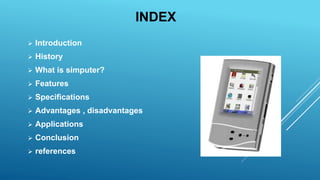
INDEX
 Introduction
 History
 What is simputer?
 Features
 Specifications
 Advantages , disadvantages
 Applications
 Conclusion
 references
INTRODUCTIO
N
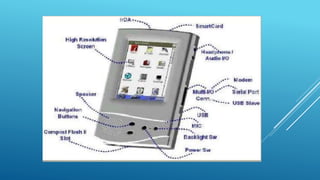
 The Simputer was a self-contained, open hardware Linux-based handheld computer first released in 2002.
 Developed in, and primarily distributed within India, the product was envisioned as a low-cost alternative to personal
computers. With initial goals of selling 50,000 Simputers, the project had sold only about 4,000 units by 2005, and has
been called a failure by news sources.
 The unique feature of this device is a smart card interface which allows a single Simputer to be used by many users.
User's private data might be kept on a cheap smart-card.
 This device was constructed by Indian company- Simputer Trust. The name stands for "Simple computer".
HISTORY
 The Simputer project was invented during the organization of the Global Village, an International Seminar on
Information Technology for Developing Countries.
 It was conducted in October 1998. The discussion was about big need for a low-cost mass access device which will
bring local-language IT to the masses.
 During inventing a name for new established original device, the purpose was to find complex acronym to fit the name
Simputer. Thus Simputer is a Simple, Inexpensive, Multi-lingual computer. Later it was expanded to Simple,
Inexpensive Multi-lingual People's computer.
WHAT IS A “SIMPUTER”
 A simputer is a multilingual mass access ,low cost , portable alternative to PC’s by which the benefits of IT can reach
the common man
 It has a social role in the third world because it is ensure that illiteracy is no longer barrier in handling computer
 The simputer meets these demands through a browser for the information markup language(IML)
 IML has been created to provide a uniform experience to users to allow rapid development of solution on any platform
WHAT MAKES SIMPUTER
DIFFERENT FROM REGULAR
PC’S
 Simputer is not a personal computer. It could however be a pocket computer.
 It is much more powerful than a Palm, with screen size 320 x 240 and memory capability (32MB RAM).
 The Wintel (Windows + Intel) architecture of the de facto standard PC is quite unsuitable for deployment on the low
cost mass market.
 It runs on an intel strong-arm chip . The chip is known for it’s a low power consumption.
 The Simputer mean while is centered around Linux which is freely available, open and modular
SPECIFICATION
HARDWARE
• CPU 32 bit
• 64gb OF DRAM
• 24MB flash for permanent storage
• 32*240 monochrome LCD display pane.
INTERFACES
• Touch panel overlay on LCD display used with plastic stylus
• Speaker , microphone , MIC jacks
• RJ-II telephone jack
• USB connector
DIMENSIONS
•Approx 8cm*13cm*2cm
•Powersupply 3AAA sized battery
ADVANTAGES
 simputer is a small , cheap device , similar to personal digital assistant
 USB port
 Designed to be shared(smart card personalizer)
 Audio
 Infrared data access
 Soft modem
 Rich in interfaces
DISADVANTAGES
• Data inaccuracy
• Require training of maintenance staff
• Information overload
• Software unreliability
APPLICATIONS
 It is an ideal device for e-governance , officer.
 Smart card enabled citizen services(voter ID’s , ration card….etc)
 Micro banking
 Health –portable ultrasound , telemedicine
 Education –digital library
CONCLUSION
 Simputer holds promise for bringing low cost computing to poor countries.
 Given the high illiteracy rates in developing countries , the devices uses image and sound as primary outputs and
touches as its primary input
 Developers said the simputer is somewhere between a personal assistant and a pc given its power , storage capacity ,
display size and smart card based connectivity
 The production began in march 2001 the final product was available on the market on the end of 2002
REFERENCES
 https://en.wikipedia.org/wiki/Simputer
 https://economictimes.indiatimes.com/news/science/why-did-the-simputer-flop/articleshow/48180974.cms
 www.simputer.org
Thank you

Simputer

  • 1.
  • 2.
    INDEX  Introduction  History What is simputer?  Features  Specifications  Advantages , disadvantages  Applications  Conclusion  references
  • 3.
    INTRODUCTIO N  The Simputerwas a self-contained, open hardware Linux-based handheld computer first released in 2002.  Developed in, and primarily distributed within India, the product was envisioned as a low-cost alternative to personal computers. With initial goals of selling 50,000 Simputers, the project had sold only about 4,000 units by 2005, and has been called a failure by news sources.  The unique feature of this device is a smart card interface which allows a single Simputer to be used by many users. User's private data might be kept on a cheap smart-card.  This device was constructed by Indian company- Simputer Trust. The name stands for "Simple computer".
  • 4.
    HISTORY  The Simputerproject was invented during the organization of the Global Village, an International Seminar on Information Technology for Developing Countries.  It was conducted in October 1998. The discussion was about big need for a low-cost mass access device which will bring local-language IT to the masses.  During inventing a name for new established original device, the purpose was to find complex acronym to fit the name Simputer. Thus Simputer is a Simple, Inexpensive, Multi-lingual computer. Later it was expanded to Simple, Inexpensive Multi-lingual People's computer.
  • 5.
    WHAT IS A“SIMPUTER”  A simputer is a multilingual mass access ,low cost , portable alternative to PC’s by which the benefits of IT can reach the common man  It has a social role in the third world because it is ensure that illiteracy is no longer barrier in handling computer  The simputer meets these demands through a browser for the information markup language(IML)  IML has been created to provide a uniform experience to users to allow rapid development of solution on any platform
  • 7.
    WHAT MAKES SIMPUTER DIFFERENTFROM REGULAR PC’S  Simputer is not a personal computer. It could however be a pocket computer.  It is much more powerful than a Palm, with screen size 320 x 240 and memory capability (32MB RAM).  The Wintel (Windows + Intel) architecture of the de facto standard PC is quite unsuitable for deployment on the low cost mass market.  It runs on an intel strong-arm chip . The chip is known for it’s a low power consumption.  The Simputer mean while is centered around Linux which is freely available, open and modular
  • 8.
    SPECIFICATION HARDWARE • CPU 32bit • 64gb OF DRAM • 24MB flash for permanent storage • 32*240 monochrome LCD display pane. INTERFACES • Touch panel overlay on LCD display used with plastic stylus • Speaker , microphone , MIC jacks • RJ-II telephone jack • USB connector DIMENSIONS •Approx 8cm*13cm*2cm •Powersupply 3AAA sized battery
  • 9.
    ADVANTAGES  simputer isa small , cheap device , similar to personal digital assistant  USB port  Designed to be shared(smart card personalizer)  Audio  Infrared data access  Soft modem  Rich in interfaces
  • 10.
    DISADVANTAGES • Data inaccuracy •Require training of maintenance staff • Information overload • Software unreliability
  • 11.
    APPLICATIONS  It isan ideal device for e-governance , officer.  Smart card enabled citizen services(voter ID’s , ration card….etc)  Micro banking  Health –portable ultrasound , telemedicine  Education –digital library
  • 12.
    CONCLUSION  Simputer holdspromise for bringing low cost computing to poor countries.  Given the high illiteracy rates in developing countries , the devices uses image and sound as primary outputs and touches as its primary input  Developers said the simputer is somewhere between a personal assistant and a pc given its power , storage capacity , display size and smart card based connectivity  The production began in march 2001 the final product was available on the market on the end of 2002
  • 13.
  • 14.