Simplified TRIZ

                    Ellen Domb & Kalevi Rantanen
                            St Lucie Press


Vishwanath Ramdas
Background - points

      • Complement tool to many other methods
             – Theory of Constraints (TOC), Six Sigma, Quality Function Deployment, Taguchi
               method, DFM-A

      • Biography of Altshuller / TRIZ
             – Resident of Baku | tormented by Stalin until 1954 |

      • Basic Principles
             – Ideality | Contradiction | Resources | Patterns of Evolution|Innovative
               Principles
             – Motivation | Orientation | Internalization | Application | Evaluation |
               Implementation [Learning cycle]
                    • How does this compare with the Kaplan learning model?


Vishwanath Ramdas
Why do good ideas take time to
                                         fruition?
      • Xerox – lithography           • Is it sales? – May be no
                                         – Richard Foster’s book Innovation
      • Penicillin – Alex Fleming             • National Cash Register continued to
      • Molok – dust bins                       advertise electromechanical cash
                                                registers in the 1970s
      • Mcdonalds – Ray kroc          • Is it Prejudice?
      • Horizontal Petro Drilling        – We don’t know whats good or Bad?

      • T – Drill [without T joint]
      • Appa – jute wire for
        opening furnace ladles
      • Flash smelting
      • Linz donovitz process ….


Vishwanath Ramdas
How to know? – 3 features?

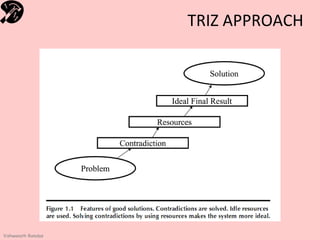
      • Resolves a contradiction [ 2 – dim TOC ]
             – Tradeoffs / Inherent

      • Reaches Ideality
             – All features / No costs * No harmful effects * less complexity

      • Uses idle resources [no waste – Lean]
             – Energy / Materials / Information / objects

      • 2 Views
             – Mcgregor :: Cristopher Freeman :: Engestrom :: De Bono
             – Theory Y :: Demand Pull :: Humanized :: Lateral
             – Theory X :: Science Push :: Rationlized :: Straight


Vishwanath Ramdas
TRIZ APPROACH


Vishwanath Ramdas
OLD AND THE NEW


Vishwanath Ramdas
COMBINING BOTH.


Vishwanath Ramdas
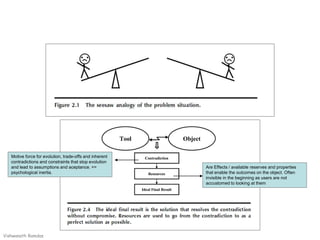
TRIZ in 1 word = Contradiction


                        TRIZ MODEL
Motive force for evolution, trade-offs and inherent
   contradictions and constraints that stop evolution
   and lead to assumptions and aceptance. ==             Are Effects / available reserves and properties
   psychological inertia.                                that enable the outcomes on the object. Often
                                                         invisible in the beginning as users are not
                                                         accustomed to looking at them


Vishwanath Ramdas
Getting to the ideal final result –
                                                 completing the model
      • Features                                             • ARIZ
             –      Whole gamut of components and                –   Method guide for solving TRIZ
                    functionality
                                                             • Standards [76 standards]
      • Patterns                                                 –   List of system transformations
             –      Soft formulae [ not rigid algorithms!]
                                                             • Effects
      • Laws / Innovative Principles                             –   Database of phenomena
                                                                 –   Electro, mechanical, chemical, physical
                                                             • Software
                                                                 –   Automated above!


Vishwanath Ramdas
Some training standards

      • Maintain the good / best practices
             – Some elements like 40 principles that reflects evolution of thinking for
               innovation should be maintained

      • General Concepts >> short procedures
             – Less than 1 page the better [ capability vs usability]

      • Social network – provide overall concepts
             – People will internailze and adapt [ don’t regidify!]
             – Peter Senge and Engestorm.


               “Leave the beaten track occasionally and dive into the woods. You
               will be certain to find something that you have never seen before.”
                           Alexander Graham Bell in the foyer of Bell Labs as observed by Shockley

Vishwanath Ramdas
Trade-Offs [Multi]
Inherent Contradictions [
         single]


          Understanding Contradictions
In the 1950s, Altshuller wrote that
  finding and resolving
  contradictions is essential in
  problem solving

the same contradictions have been discovered in science,
engineering, and business situations that, on the surface,
             appear to be very different from each other
Draft the problem to expose the
                                                       tradeoffs.
      • Problems are sirens OR scylla & Charybdis
             – Homers illyiad
      • Understand the problem – 50% solution!
             – Problem Finding * Problem Solving
             – The tool – Action / Effect – Object
             – Defining what is the end outcome / effect on the object / user
      • A system by its existence creates trade-offs
             – Its continuous iterative method [TOC]
      • Define systems not by deficiencies but by trade-offs
             – Safety reduces X | Safety reduces as speed increases
      • Describe the systems as Actions & Features
             – Typically it is easier to describe features [nouns] than actions [verbs]
      • Trade-offs happen at different system levels
             – Needs systems thinking e.g. Lawnmover – muffler noise
             – Study at muffler system | lawnmover system | Garden system


Vishwanath Ramdas
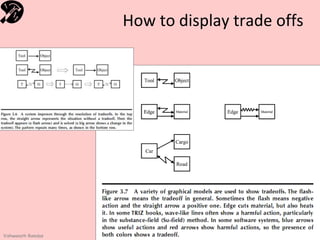
How to display trade offs


Vishwanath Ramdas
Some e.g.s

      • Lawnmower Muffler Noise                                       • Carrot garden thinning to
             – Muffler Level                                            ensure no overlap and
                    • Increase muffler thickness / softness
             – Lawnmower level
                                                                        therefore nutrition supply
                    • Use exhaust differently                            – Time split
             – Garden level                                              – Thinning
                    • Use grass to muffle exhaust noise                       • Right distance between carrots
                          –   Also dries grass to reduce stickiness
                                                                                saplings
                    • Why cut grass at all?                                   • Use mechanization in seeding
                          –   Growth control                             – Seeding
                    • Why have grass at all?                                  • Use bio degradable tapes with
                          –   Artificial grass                                  standard distances
                          –   Grass like lawn effect?


Vishwanath Ramdas
Screens of talented thinking [9
                                                    screens]
      • System @ Present
      • enhance understanding of a
        problem
             – expand the areas in which you can
               look for solutions.

      • Simplify by asking what is
        good or bad in a part [de
        bono forced removal]
             – what happens if left out?
             – Alex Osborn
                    • “What can we eliminate?… Suppose
                      we leave this out.…Why not fewer
                      parts?”


Vishwanath Ramdas
System operator Concept
      • Space & time thinking
      • Systemic thinking
      • Getting over psychological
        intertia
      • Zoom in & out for more
        frames.


Vishwanath Ramdas        Darell Manns description of the system operator model from triz journal.
System operator –between the boxes
                                                    SLP
      • Step in & view from each
        room
      • Small little people – get into
        the problem
      • Become the problem
        [synectics]
      • E.g.s
             – Helicopter blades & dust
             – Airports & People [beyond airport]
             – Future modeling


Vishwanath Ramdas                   Darell Manns description of the system operator model from triz journal.
System operator- additional dimension
      • Multiple layers of system
        operator plots
             – Robert Dilts

      • One direct application
             – Map vs territory
             – Reality vs Perception

      • Management problems esp.
      • E.g.
             – Marks & Spencers products
             – HR problems


Vishwanath Ramdas                      Darell Manns description of the system operator model from triz journal.
System operator- integrations
      • Using System operator with
        other models like
             –      SWOT
             –      Co-optition [M]
             –      Association / Dissociation
             –      VAKOG
                      • Kinesthetics / Olfactory / Gustative /
                        Visual / Auditory /


Vishwanath Ramdas                           Darell Manns description of the system operator model from triz journal.
“Start with the universe, any sub-
 categorization under that level is
 purely arbitrary”


                       Buckminster Fuller
Selecting the right trade-off

      • Iterative Definition of the problem based on state of
        solution
      • Available resources & time
      • Select Effected Components
      • From the problem to the tradeoff
             – Describe pairs of tools and objects and the action that links them. [Chain]
                    • Select one pair. Explain why you picked this tool and object.
             – Describe features and conflicts between them.
                    • Select one tradeoff.
             – Explain why you identified this tradeoff.
             – Describe the tradeoff graphically and in words.


Vishwanath Ramdas
Selecting the tradeoff - summary


Vishwanath Ramdas
crazier the conflict you imagine,
  the better solution you get.
Inherent contradiction – The root
                                              cause?
      • Solution of this solves many   • Much ↔ little : water
                                          – Atomized water spray
      • Focus on one provides
                                          – Extinguishers [www.hi-fog.com]
        better answers
                                       • Long ↔ short : training
      • Presenting & influencing
        with one is better than        • Present ↔ Absent : Object
        cluttered many.


Vishwanath Ramdas
“Most important, we think the
 excellent companies, if they know
 any one thing, know how to
 manage paradox.”


   Peters and Waterman bestseller “In Search of
                 Excellence” : 1982 - Chapter 4
“Drama is conflict; without conflict
 there is no action, without action,
 no character, without character,
 no story, without story, no
 screenplay”

      Syd Field : The Screen- writer’s Workbook
Intensify the inherent
                                      contradiction!
      • Bizarre but true
      • Push the contradiction to the extreme!


Vishwanath Ramdas
How to intensify contradiction


Vishwanath Ramdas
Mapping of invisible reserves


Andersen’s fairytale :little child saw that the emperor had
                                                 no clothes.
  The ancient Mayans used wheels for toys and obviously
knew how to make wheeled vehicles, but they never built
                                    them for any other uses.
Idle resource :: Free or cheap
  resources that are available in the
  system.
• What are the invisible resources?
             – Boundary conditions [ proximal / gray zones] of development

      • Benefits from resources analysis
             – Understand customer needs
             – Foresee the evolution of development

      • What are the resource types and classes?
      • The seven most important resources in detail


Vishwanath Ramdas
Invisible Reserves

      • Areas for proximal
        development
             – Available resource not used
             – Available resources that can be
               harnessed


Vishwanath Ramdas
Resource Analysis - Benefits

      • Getting new ideas directly   • What are the resources
                                        – MECE
      • Solving contradictions
                                        – Space | Area | Consumer
      • Predicting the system        • Character of resource
        evolution                       – Empty Space | Topology | Time &
                                          skills of users


Vishwanath Ramdas
Resource Types & Classes

      • System levels [ref fig]
      • Type of Resource
             – Substances and things | Modified
               substances and things| Voids |
               Interactions | energy | Form |
               Features or properties | Space |
               Time

      • Additional resources
             – Information | Harm – Side FX| skills
               & abilities


Vishwanath Ramdas
Main Resource Types

      • Resources of tool & Object
             – Starting point | How – Interaction
               needs to be understood

      • Resources : Environment
             – Natural Fields & Effects
             – Emptiness & nothing are also
               resources
             – NVA = Wasteful work

      • Resources : Macro level


Vishwanath Ramdas
References

      •      TechOptimizer
             –      The Invention Machine Company, http://www.invention-machine.com.
      • Ideation Workbench, Ideation International Incorporated,
             –      http://www.ide-ationtriz.com.
      • TRIZ Explorer , Insytec
             –      http://www.insytec.com.
      • The TRIZ Journal
             –      http://www.triz-journal.com.
      • CreaTRIZ & CREAX,
             –      http://www.creax.com.
      • Engeström Y., Learning by Expanding Orienta-Konsultit, Helsinki, 1987.
      • Shockley W. The Path to the Conception of the Junction Transistor.
             –      IEEE Transactions on Electron Devices, vol. ED-23, no. 7, July 1976, 59


Vishwanath Ramdas
References

      • Foster, R.N., Innovation: The Attacker’s Advantage, Summit Books, New
        York, 1986.
      • McGregor, D., The Human Side of Enterprise, McGraw-Hill, New York,
        1960.
      • Freeman, C., The Determinants of innovation, Futures, , June 1979, 206.
      • 4 articles by Darrell Mann The TRIZ Journal on 9 screens methods
             –      http://www.triz-journal.com/archives/2001/09/c/index.htm
             –      http://www.triz-journal.com/archives/2001/11/b/index.htm
             –      http://www.triz-journal.com/archives/2001/12/b/index.htm
             –      http://www.triz-journal.com/archives/2001/11/b/index.htm
      • http://www.google.com/patents?id=KBIBAAAAEBAJ&dq=5,875,658
             –      Latches & Pins patent from google search.


Vishwanath Ramdas
References

      • Peters, T.J. and Waterman, R.H., In Search of Excellence
        Harper & Row, New York, 1982, 91.
      • Field, S., The Screen-Writer´s Workbook Dell, New York, 1984,
        31.
      • Altshuller, G.S., And Suddenly the Inventor Appeared
        Technical Innovation
      • Center, Worcester, MA, 1996, 21.
      • Savransky, S.D., Engineering of Creativity, CRC, Boca Raton,
        2000, 235.
      • Altshuller, G.S. and Shapiro R.B., Psychology of inventive
        creativity, Izobretenie, II , 23, 2000

Vishwanath Ramdas

simplified triz notes

  • 1.
    Simplified TRIZ Ellen Domb & Kalevi Rantanen St Lucie Press Vishwanath Ramdas
  • 2.
    Background - points • Complement tool to many other methods – Theory of Constraints (TOC), Six Sigma, Quality Function Deployment, Taguchi method, DFM-A • Biography of Altshuller / TRIZ – Resident of Baku | tormented by Stalin until 1954 | • Basic Principles – Ideality | Contradiction | Resources | Patterns of Evolution|Innovative Principles – Motivation | Orientation | Internalization | Application | Evaluation | Implementation [Learning cycle] • How does this compare with the Kaplan learning model? Vishwanath Ramdas
  • 3.
    Why do goodideas take time to fruition? • Xerox – lithography • Is it sales? – May be no – Richard Foster’s book Innovation • Penicillin – Alex Fleming • National Cash Register continued to • Molok – dust bins advertise electromechanical cash registers in the 1970s • Mcdonalds – Ray kroc • Is it Prejudice? • Horizontal Petro Drilling – We don’t know whats good or Bad? • T – Drill [without T joint] • Appa – jute wire for opening furnace ladles • Flash smelting • Linz donovitz process …. Vishwanath Ramdas
  • 4.
    How to know?– 3 features? • Resolves a contradiction [ 2 – dim TOC ] – Tradeoffs / Inherent • Reaches Ideality – All features / No costs * No harmful effects * less complexity • Uses idle resources [no waste – Lean] – Energy / Materials / Information / objects • 2 Views – Mcgregor :: Cristopher Freeman :: Engestrom :: De Bono – Theory Y :: Demand Pull :: Humanized :: Lateral – Theory X :: Science Push :: Rationlized :: Straight Vishwanath Ramdas
  • 5.
  • 6.
    OLD AND THENEW Vishwanath Ramdas
  • 7.
  • 8.
    TRIZ in 1word = Contradiction TRIZ MODEL
  • 9.
    Motive force forevolution, trade-offs and inherent contradictions and constraints that stop evolution and lead to assumptions and aceptance. == Are Effects / available reserves and properties psychological inertia. that enable the outcomes on the object. Often invisible in the beginning as users are not accustomed to looking at them Vishwanath Ramdas
  • 10.
    Getting to theideal final result – completing the model • Features • ARIZ – Whole gamut of components and – Method guide for solving TRIZ functionality • Standards [76 standards] • Patterns – List of system transformations – Soft formulae [ not rigid algorithms!] • Effects • Laws / Innovative Principles – Database of phenomena – Electro, mechanical, chemical, physical • Software – Automated above! Vishwanath Ramdas
  • 11.
    Some training standards • Maintain the good / best practices – Some elements like 40 principles that reflects evolution of thinking for innovation should be maintained • General Concepts >> short procedures – Less than 1 page the better [ capability vs usability] • Social network – provide overall concepts – People will internailze and adapt [ don’t regidify!] – Peter Senge and Engestorm. “Leave the beaten track occasionally and dive into the woods. You will be certain to find something that you have never seen before.” Alexander Graham Bell in the foyer of Bell Labs as observed by Shockley Vishwanath Ramdas
  • 12.
    Trade-Offs [Multi] Inherent Contradictions[ single] Understanding Contradictions
  • 13.
    In the 1950s,Altshuller wrote that finding and resolving contradictions is essential in problem solving the same contradictions have been discovered in science, engineering, and business situations that, on the surface, appear to be very different from each other
  • 14.
    Draft the problemto expose the tradeoffs. • Problems are sirens OR scylla & Charybdis – Homers illyiad • Understand the problem – 50% solution! – Problem Finding * Problem Solving – The tool – Action / Effect – Object – Defining what is the end outcome / effect on the object / user • A system by its existence creates trade-offs – Its continuous iterative method [TOC] • Define systems not by deficiencies but by trade-offs – Safety reduces X | Safety reduces as speed increases • Describe the systems as Actions & Features – Typically it is easier to describe features [nouns] than actions [verbs] • Trade-offs happen at different system levels – Needs systems thinking e.g. Lawnmover – muffler noise – Study at muffler system | lawnmover system | Garden system Vishwanath Ramdas
  • 15.
    How to displaytrade offs Vishwanath Ramdas
  • 16.
    Some e.g.s • Lawnmower Muffler Noise • Carrot garden thinning to – Muffler Level ensure no overlap and • Increase muffler thickness / softness – Lawnmower level therefore nutrition supply • Use exhaust differently – Time split – Garden level – Thinning • Use grass to muffle exhaust noise • Right distance between carrots – Also dries grass to reduce stickiness saplings • Why cut grass at all? • Use mechanization in seeding – Growth control – Seeding • Why have grass at all? • Use bio degradable tapes with – Artificial grass standard distances – Grass like lawn effect? Vishwanath Ramdas
  • 17.
    Screens of talentedthinking [9 screens] • System @ Present • enhance understanding of a problem – expand the areas in which you can look for solutions. • Simplify by asking what is good or bad in a part [de bono forced removal] – what happens if left out? – Alex Osborn • “What can we eliminate?… Suppose we leave this out.…Why not fewer parts?” Vishwanath Ramdas
  • 18.
    System operator Concept • Space & time thinking • Systemic thinking • Getting over psychological intertia • Zoom in & out for more frames. Vishwanath Ramdas Darell Manns description of the system operator model from triz journal.
  • 19.
    System operator –betweenthe boxes SLP • Step in & view from each room • Small little people – get into the problem • Become the problem [synectics] • E.g.s – Helicopter blades & dust – Airports & People [beyond airport] – Future modeling Vishwanath Ramdas Darell Manns description of the system operator model from triz journal.
  • 20.
    System operator- additionaldimension • Multiple layers of system operator plots – Robert Dilts • One direct application – Map vs territory – Reality vs Perception • Management problems esp. • E.g. – Marks & Spencers products – HR problems Vishwanath Ramdas Darell Manns description of the system operator model from triz journal.
  • 21.
    System operator- integrations • Using System operator with other models like – SWOT – Co-optition [M] – Association / Dissociation – VAKOG • Kinesthetics / Olfactory / Gustative / Visual / Auditory / Vishwanath Ramdas Darell Manns description of the system operator model from triz journal.
  • 22.
    “Start with theuniverse, any sub- categorization under that level is purely arbitrary” Buckminster Fuller
  • 23.
    Selecting the righttrade-off • Iterative Definition of the problem based on state of solution • Available resources & time • Select Effected Components • From the problem to the tradeoff – Describe pairs of tools and objects and the action that links them. [Chain] • Select one pair. Explain why you picked this tool and object. – Describe features and conflicts between them. • Select one tradeoff. – Explain why you identified this tradeoff. – Describe the tradeoff graphically and in words. Vishwanath Ramdas
  • 24.
    Selecting the tradeoff- summary Vishwanath Ramdas
  • 25.
    crazier the conflictyou imagine, the better solution you get.
  • 26.
    Inherent contradiction –The root cause? • Solution of this solves many • Much ↔ little : water – Atomized water spray • Focus on one provides – Extinguishers [www.hi-fog.com] better answers • Long ↔ short : training • Presenting & influencing with one is better than • Present ↔ Absent : Object cluttered many. Vishwanath Ramdas
  • 27.
    “Most important, wethink the excellent companies, if they know any one thing, know how to manage paradox.” Peters and Waterman bestseller “In Search of Excellence” : 1982 - Chapter 4
  • 28.
    “Drama is conflict;without conflict there is no action, without action, no character, without character, no story, without story, no screenplay” Syd Field : The Screen- writer’s Workbook
  • 29.
    Intensify the inherent contradiction! • Bizarre but true • Push the contradiction to the extreme! Vishwanath Ramdas
  • 30.
    How to intensifycontradiction Vishwanath Ramdas
  • 31.
    Mapping of invisiblereserves Andersen’s fairytale :little child saw that the emperor had no clothes. The ancient Mayans used wheels for toys and obviously knew how to make wheeled vehicles, but they never built them for any other uses.
  • 32.
    Idle resource ::Free or cheap resources that are available in the system.
  • 33.
    • What arethe invisible resources? – Boundary conditions [ proximal / gray zones] of development • Benefits from resources analysis – Understand customer needs – Foresee the evolution of development • What are the resource types and classes? • The seven most important resources in detail Vishwanath Ramdas
  • 34.
    Invisible Reserves • Areas for proximal development – Available resource not used – Available resources that can be harnessed Vishwanath Ramdas
  • 35.
    Resource Analysis -Benefits • Getting new ideas directly • What are the resources – MECE • Solving contradictions – Space | Area | Consumer • Predicting the system • Character of resource evolution – Empty Space | Topology | Time & skills of users Vishwanath Ramdas
  • 36.
    Resource Types &Classes • System levels [ref fig] • Type of Resource – Substances and things | Modified substances and things| Voids | Interactions | energy | Form | Features or properties | Space | Time • Additional resources – Information | Harm – Side FX| skills & abilities Vishwanath Ramdas
  • 37.
    Main Resource Types • Resources of tool & Object – Starting point | How – Interaction needs to be understood • Resources : Environment – Natural Fields & Effects – Emptiness & nothing are also resources – NVA = Wasteful work • Resources : Macro level Vishwanath Ramdas
  • 38.
    References • TechOptimizer – The Invention Machine Company, http://www.invention-machine.com. • Ideation Workbench, Ideation International Incorporated, – http://www.ide-ationtriz.com. • TRIZ Explorer , Insytec – http://www.insytec.com. • The TRIZ Journal – http://www.triz-journal.com. • CreaTRIZ & CREAX, – http://www.creax.com. • Engeström Y., Learning by Expanding Orienta-Konsultit, Helsinki, 1987. • Shockley W. The Path to the Conception of the Junction Transistor. – IEEE Transactions on Electron Devices, vol. ED-23, no. 7, July 1976, 59 Vishwanath Ramdas
  • 39.
    References • Foster, R.N., Innovation: The Attacker’s Advantage, Summit Books, New York, 1986. • McGregor, D., The Human Side of Enterprise, McGraw-Hill, New York, 1960. • Freeman, C., The Determinants of innovation, Futures, , June 1979, 206. • 4 articles by Darrell Mann The TRIZ Journal on 9 screens methods – http://www.triz-journal.com/archives/2001/09/c/index.htm – http://www.triz-journal.com/archives/2001/11/b/index.htm – http://www.triz-journal.com/archives/2001/12/b/index.htm – http://www.triz-journal.com/archives/2001/11/b/index.htm • http://www.google.com/patents?id=KBIBAAAAEBAJ&dq=5,875,658 – Latches & Pins patent from google search. Vishwanath Ramdas
  • 40.
    References • Peters, T.J. and Waterman, R.H., In Search of Excellence Harper & Row, New York, 1982, 91. • Field, S., The Screen-Writer´s Workbook Dell, New York, 1984, 31. • Altshuller, G.S., And Suddenly the Inventor Appeared Technical Innovation • Center, Worcester, MA, 1996, 21. • Savransky, S.D., Engineering of Creativity, CRC, Boca Raton, 2000, 235. • Altshuller, G.S. and Shapiro R.B., Psychology of inventive creativity, Izobretenie, II , 23, 2000 Vishwanath Ramdas