Ted Sullivan
Simpler Semantic Search
lucidworks.com
Senior Solutions Architect
Building Search Applications
Search is about Technology & Language

• These are difficult but also different problems
• Solving the “language problem” requires that we understand
how language is used in search
• We understand language at the semantic level - where
“meaning” or intent lives
• Search Engines deal with language at the syntactic level
• Most problems relating to search quality stem from this basic
“disconnect” – the “what” vs “what words” dichotomy
Better
^
Technology – Horizontal Concerns
Search applications share these requirements with other
information retrieval systems

• Performance – returning results in HTT (Human Tolerable Time)
• Scalability – being able to search “billions and billions”of documents
serving thousands or tens of thousands of users at a time.
• Reliability – fault tolerance, fail-over, redundancy
• Maintainability – easy to upgrade, search index can be kept current
in the face of rapidly changing content.
• Usability – User Experience is critical to success. UI and UX Mobile
Technology Is a Game Changer here!!!
Language – Vertical Concerns
These requirements are more specific to search systems.

• Accuracy – returning the “correct” results.
• Precision – few false positives
• Recall – few false negatives
• Relevance – returning the “best” results at the top
Returning the wrong results very fast is not

necessarily a good thing. Returning too many

results can affect performance.
Time flies like an arrow
Fruit flies like a banana
Our mental image for the second sentence depends
on how we “parse” it. It depends on what the subject
noun or noun phrase is.
The subject can be “fruit” or “fruit flies”. This
decision changes the verb which is either “flies”
or “like” respectively.
Fruit flies like a banana
We can do this because we know that both “fruit” and
“fruit flies” represent single concepts – even though
“fruit flies” is two words – i.e. a “noun phrase”.
Fruit flies like a banana
Search algorithms
and semantics
Tokenization plus vector mathematics

(TF/IDF or one of its cousins) – “bag-of-words”
Algorithmic tweaks – enhanced bag-of-words:

1. Some fields are more relevant than others
2. Hitting on more terms in the query is better than
hitting on fewer (token scores are summed)
3. The nearer the query terms are to each other in the
document the better – same order as query is best
4. Getting 0 results provides no feedback – OR is safer
than AND (we already have “fuzzy” & with bullet (2)
Problem: Search engines don’t
understand semantics
Better Search: Detecting Noun Phrases
Can algorithms be used to detect noun phrases?
Yes, but not perfectly and may need too much
CPU at query-time
Another way is to use knowledge bases – a lot of
extra work, but in some cases – we already have
one - the search index itself!
Better Search: Detecting Noun Phrases
The basic technique is called “autophrasing” –
recognizing when more than one word
represents just one thing.
Autophrasing – uses an extra knowledge-base
file “autophrases.txt”
Query Autofiltering – uses the phrases that are
stored as metadata values in the index.
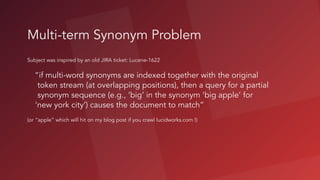
Multi-term Synonym Problem
Subject was inspired by an old JIRA ticket: Lucene-1622

“if multi-word synonyms are indexed together with the original
token stream (at overlapping positions), then a query for a partial
synonym sequence (e.g., ‘big’ in the synonym ‘big apple’ for
‘new york city’) causes the document to match”
(or “apple” which will hit on my blog post if you crawl lucidworks.com !)
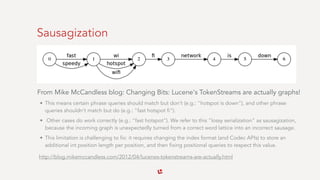
Sausagization
From Mike McCandless blog: Changing Bits: Lucene's TokenStreams are actually graphs!
• This means certain phrase queries should match but don't (e.g.: "hotspot is down"), and other phrase
queries shouldn't match but do (e.g.: "fast hotspot fi").
• Other cases do work correctly (e.g.: "fast hotspot"). We refer to this "lossy serialization" as sausagization,
because the incoming graph is unexpectedly turned from a correct word lattice into an incorrect sausage.
• This limitation is challenging to fix: it requires changing the index format (and Codec APIs) to store an
additional int position length per position, and then fixing positional queries to respect this value.
http://blog.mikemccandless.com/2012/04/lucenes-tokenstreams-are-actually.html
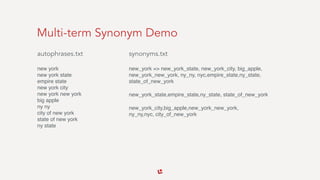
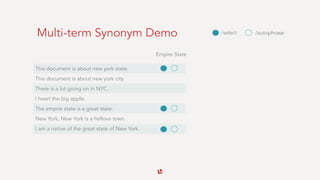
Multi-term Synonym Demo
autophrases.txt
new york

new york state

empire state

new york city

new york new york

big apple

ny ny

city of new york

state of new york

ny state
synonyms.txt
new_york => new_york_state, new_york_city, big_apple,
new_york_new_york, ny_ny, nyc,empire_state,ny_state,
state_of_new_york
new_york_state,empire_state,ny_state, state_of_new_york
new_york_city,big_apple,new_york_new_york,

ny_ny,nyc, city_of_new_york
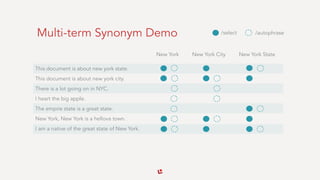
Multi-term Synonym Demo
This document is about new york state.
This document is about new york city.
There is a lot going on in NYC.
I heart the big apple.
The empire state is a great state.
New York, New York is a hellova town.
I am a native of the great state of New York.
New York New York City New York State
/select /autophrase
Multi-term Synonym Demo
This document is about new york state.
This document is about new york city.
There is a lot going on in NYC.
I heart the big apple.
The empire state is a great state.
New York, New York is a hellova town.
I am a native of the great state of New York.
Empire State
/select /autophrase
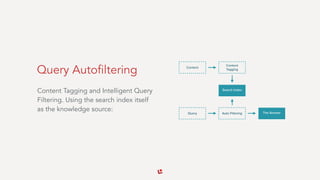
Query Autofiltering
Content Tagging and Intelligent Query
Filtering. Using the search index itself
as the knowledge source:
Search Index
Content
Content

Tagging
Auto FilteringQuery The Answer
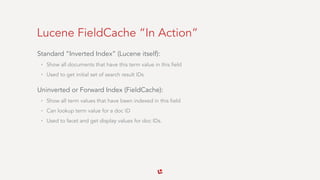
Lucene FieldCache “In Action”
Standard “Inverted Index” (Lucene itself):
• Show all documents that have this term value in this field
• Used to get initial set of search result IDs
Uninverted or Forward Index (FieldCache):
• Show all term values that have been indexed in this field
• Can lookup term value for a doc ID
• Used to facet and get display values for doc IDs.
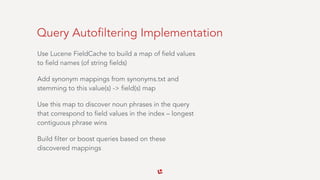
Query Autofiltering Implementation
Use Lucene FieldCache to build a map of field values
to field names (of string fields)
Add synonym mappings from synonyms.txt and
stemming to this value(s) -> field(s) map
Use this map to discover noun phrases in the query
that correspond to field values in the index – longest
contiguous phrase wins
Build filter or boost queries based on these
discovered mappings
QueryAutoFilteringComponent
Solr SearchComponent
github: https://github.com/LucidWorks/query-autofiltering-component
JIRA: SOLR-7539
<requestHandler name="/autofilter" class="solr.SearchHandler">
<lst name="defaults">
<str name="echoParams">explicit</str>
<int name="rows">10</int>
<str name="df">text</str>
</lst>
<arr name="first-components">
<str>queryAutofiltering</str>
</arr>
</requestHandler>
<searchComponent name=“queryAutofiltering" class="org.apache.

solr.handler.component.QueryAutoFilteringComponent" />
Query

Autofiltering Demo
Hypothetical eCommerce App for a
Fictional department store
• Metadata has Noun Phrases!
<doc>
<field name="id">95</field>
<field name="product_type">sweat shirt</field>
<field name="product_category">shirt</field>
<field name="style">V neck</field>
<field name="style">short sleeve</field>
<field name="brand">J Crew</field>
<field name="color">grey</field>
<field name="material">cotton</field>
<field name="consumer_type">womens</field>
</doc>
<doc>
<field name="id">154</field>
<field name="product_type">crew socks</field>
<field name="product_category">socks</field>
<field name="color">white</field>
<field name="brand">Joe Boxer</field>
<field name="consumer_type">mens</field>
</doc>
<doc>
<field name="id">17</field>
<field name="product_type">boxer shorts</field>
<field name="product_category">underwear</field>
<field name="color">white</field>
<field name="brand">Fruit of the Loom</field>
<field name="consumer_type">mens</field>
</doc>
Query Autofiltering – Basic Behavior
q = red socks -> fq=color:red&fq=product_type:socks
or bq=(color:red AND product_type:socks)^20
q = Red Lion socks -> fq=brand:”Red Lion”&fq=product_type:socks
q = scarlet Chaise Lounge -> color:red AND product_type:”Lounge Chair”
q = white dress shirts -> color:white AND product_type:”dress shirt”
Dealing With “Unstructured” Text
This term ITSELF is evidence that we think of language as
unstructured when we know that it actually is not - It HAS to have
structure or we couldn’t communicate very well.
“The Lady Is A Tramp” vs “Lady And The Tramp”
Dealing with unstructured text means better handling of phrases.
Little words – like “if” can have big meaning!
Classification Technologies
Machine Learning
• Automated vs Semi-Automated
Natural Language Processing (NLP)
• Parts Of Speech
Taxonomy / Ontology
• Relationships
• Handles Phrases naturally
• Knows what is what and what is related to what!
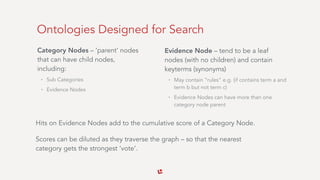
Ontologies Designed for Search
Category Nodes – ‘parent’ nodes
that can have child nodes,
including:
• Sub Categories
• Evidence Nodes
Evidence Node – tend to be a leaf
nodes (with no children) and contain
keyterms (synonyms)
• May contain “rules” e.g. (if contains term a and
term b but not term c)
• Evidence Nodes can have more than one
category node parent
Hits on Evidence Nodes add to the cumulative score of a Category Node.
Scores can be diluted as they traverse the graph – so that the nearest
category gets the strongest ‘vote’.
Fortune 100 Companies
Energy
• Financial Services
• Investment Banks
• Commercial Banks
Health Care
• Health Insurance
• HMO
• Medical Devices
• Pharmaceuticals
Hospitality
Manufacturing
• Aircraft
• Automobiles
• Electrical Equipment
Corporations
• US
• British
• Chinese
• French
• German
• Japanese
• Russian
• +
Fortune 100 Companies
Energy
• Financial Services
• Investment Banks
• Commercial Banks
Health Care
• Health Insurance
• HMO
• Medical Devices
• Pharmaceuticals
Hospitality
Manufacturing
• Aircraft
• Automobiles
• Electrical Equipment
Corporations
• US
• British
• Chinese
• French
• German
• Japanese
• Russian
• +
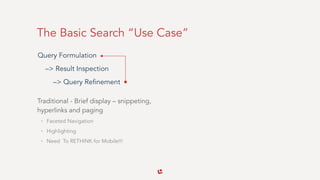
The Basic Search “Use Case”
Traditional - Brief display – snippeting,

hyperlinks and paging
• Faceted Navigation
• Highlighting
• Need To RETHINK for Mobile!!!
Query Formulation 

–> Result Inspection

–> Query Refinement
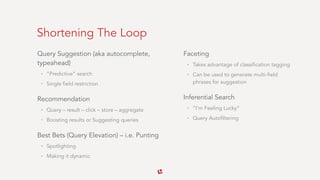
Shortening The Loop
Query Suggestion (aka autocomplete,
typeahead)
• “Predictive” search
• Single field restriction
Recommendation
• Query – result – click – store – aggregate
• Boosting results or Suggesting queries
Best Bets (Query Elevation) – i.e. Punting
• Spotlighting
• Making it dynamic
Faceting
• Takes advantage of classification tagging
• Can be used to generate multi-field
phrases for suggestion
Inferential Search
• “I’m Feeling Lucky”
• Query Autofiltering
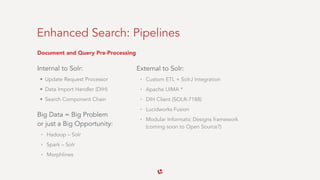
Enhanced Search: Pipelines
Document and Query Pre-Processing
Internal to Solr:
• Update Request Processor
• Data Import Handler (DIH)
• Search Component Chain
Big Data = Big Problem

or just a Big Opportunity:
• Hadoop – Solr
• Spark – Solr
• Morphlines
External to Solr:
• Custom ETL + SolrJ Integration
• Apache UIMA *
• DIH Client (SOLR-7188)
• Lucidworks Fusion
• Modular Informatic Designs framework
(coming soon to Open Source?)
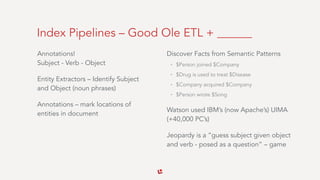
Index Pipelines – Good Ole ETL + ______
Annotations!

Subject - Verb - Object
Entity Extractors – Identify Subject
and Object (noun phrases)
Annotations – mark locations of
entities in document
Discover Facts from Semantic Patterns
• $Person joined $Company
• $Drug is used to treat $Disease
• $Company acquired $Company
• $Person wrote $Song
Watson used IBM’s (now Apache’s) UIMA
(+40,000 PC’s)
Jeopardy is a “guess subject given object
and verb - posed as a question” – game
Who Needs Query Pipelines?
Who, What, Where, When:
• Security Filtering - Entitlements
• Dynamic Boost Block based on Preferences, Search History
• Geo Filtering – IP to geolocation
• Content Spotlighting based on time, place and search history
• Query Introspection – Infer User Intent
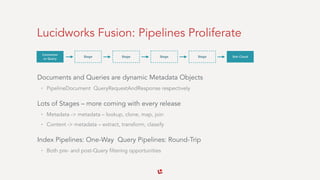
Lucidworks Fusion: Pipelines Proliferate
Documents and Queries are dynamic Metadata Objects
• PipelineDocument QueryRequestAndResponse respectively
Lots of Stages – more coming with every release
• Metadata -> metadata – lookup, clone, map, join
• Content -> metadata – extract, transform, classify
Index Pipelines: One-Way Query Pipelines: Round-Trip
• Both pre- and post-Query filtering opportunities
Connector

or Query
Stage Stage Stage Stage Solr Cloud
Thank you!
lucidworks.com
Ted Sullivan
Senior Solutions Architect

Webinar: Simpler Semantic Search with Solr

  • 2.
    Ted Sullivan Simpler SemanticSearch lucidworks.com Senior Solutions Architect
  • 3.
    Building Search Applications Searchis about Technology & Language
 • These are difficult but also different problems • Solving the “language problem” requires that we understand how language is used in search • We understand language at the semantic level - where “meaning” or intent lives • Search Engines deal with language at the syntactic level • Most problems relating to search quality stem from this basic “disconnect” – the “what” vs “what words” dichotomy Better ^
  • 4.
    Technology – HorizontalConcerns Search applications share these requirements with other information retrieval systems
 • Performance – returning results in HTT (Human Tolerable Time) • Scalability – being able to search “billions and billions”of documents serving thousands or tens of thousands of users at a time. • Reliability – fault tolerance, fail-over, redundancy • Maintainability – easy to upgrade, search index can be kept current in the face of rapidly changing content. • Usability – User Experience is critical to success. UI and UX Mobile Technology Is a Game Changer here!!!
  • 5.
    Language – VerticalConcerns These requirements are more specific to search systems.
 • Accuracy – returning the “correct” results. • Precision – few false positives • Recall – few false negatives • Relevance – returning the “best” results at the top Returning the wrong results very fast is not
 necessarily a good thing. Returning too many
 results can affect performance.
  • 6.
    Time flies likean arrow Fruit flies like a banana Our mental image for the second sentence depends on how we “parse” it. It depends on what the subject noun or noun phrase is.
  • 7.
    The subject canbe “fruit” or “fruit flies”. This decision changes the verb which is either “flies” or “like” respectively. Fruit flies like a banana Fruit flies like a banana
  • 8.
    We can dothis because we know that both “fruit” and “fruit flies” represent single concepts – even though “fruit flies” is two words – i.e. a “noun phrase”. Fruit flies like a banana Fruit flies like a banana
  • 9.
    Search algorithms and semantics Tokenizationplus vector mathematics
 (TF/IDF or one of its cousins) – “bag-of-words” Algorithmic tweaks – enhanced bag-of-words:
 1. Some fields are more relevant than others 2. Hitting on more terms in the query is better than hitting on fewer (token scores are summed) 3. The nearer the query terms are to each other in the document the better – same order as query is best 4. Getting 0 results provides no feedback – OR is safer than AND (we already have “fuzzy” & with bullet (2) Problem: Search engines don’t understand semantics
  • 10.
    Better Search: DetectingNoun Phrases Can algorithms be used to detect noun phrases? Yes, but not perfectly and may need too much CPU at query-time Another way is to use knowledge bases – a lot of extra work, but in some cases – we already have one - the search index itself!
  • 11.
    Better Search: DetectingNoun Phrases The basic technique is called “autophrasing” – recognizing when more than one word represents just one thing. Autophrasing – uses an extra knowledge-base file “autophrases.txt” Query Autofiltering – uses the phrases that are stored as metadata values in the index.
  • 12.
    Multi-term Synonym Problem Subjectwas inspired by an old JIRA ticket: Lucene-1622
 “if multi-word synonyms are indexed together with the original token stream (at overlapping positions), then a query for a partial synonym sequence (e.g., ‘big’ in the synonym ‘big apple’ for ‘new york city’) causes the document to match” (or “apple” which will hit on my blog post if you crawl lucidworks.com !)
  • 13.
    Sausagization From Mike McCandlessblog: Changing Bits: Lucene's TokenStreams are actually graphs! • This means certain phrase queries should match but don't (e.g.: "hotspot is down"), and other phrase queries shouldn't match but do (e.g.: "fast hotspot fi"). • Other cases do work correctly (e.g.: "fast hotspot"). We refer to this "lossy serialization" as sausagization, because the incoming graph is unexpectedly turned from a correct word lattice into an incorrect sausage. • This limitation is challenging to fix: it requires changing the index format (and Codec APIs) to store an additional int position length per position, and then fixing positional queries to respect this value. http://blog.mikemccandless.com/2012/04/lucenes-tokenstreams-are-actually.html
  • 14.
    Multi-term Synonym Demo autophrases.txt newyork
 new york state
 empire state
 new york city
 new york new york
 big apple
 ny ny
 city of new york
 state of new york
 ny state synonyms.txt new_york => new_york_state, new_york_city, big_apple, new_york_new_york, ny_ny, nyc,empire_state,ny_state, state_of_new_york new_york_state,empire_state,ny_state, state_of_new_york new_york_city,big_apple,new_york_new_york,
 ny_ny,nyc, city_of_new_york
  • 15.
    Multi-term Synonym Demo Thisdocument is about new york state. This document is about new york city. There is a lot going on in NYC. I heart the big apple. The empire state is a great state. New York, New York is a hellova town. I am a native of the great state of New York. New York New York City New York State /select /autophrase
  • 16.
    Multi-term Synonym Demo Thisdocument is about new york state. This document is about new york city. There is a lot going on in NYC. I heart the big apple. The empire state is a great state. New York, New York is a hellova town. I am a native of the great state of New York. Empire State /select /autophrase
  • 17.
    Query Autofiltering Content Taggingand Intelligent Query Filtering. Using the search index itself as the knowledge source: Search Index Content Content
 Tagging Auto FilteringQuery The Answer
  • 18.
    Lucene FieldCache “InAction” Standard “Inverted Index” (Lucene itself): • Show all documents that have this term value in this field • Used to get initial set of search result IDs Uninverted or Forward Index (FieldCache): • Show all term values that have been indexed in this field • Can lookup term value for a doc ID • Used to facet and get display values for doc IDs.
  • 19.
    Query Autofiltering Implementation UseLucene FieldCache to build a map of field values to field names (of string fields) Add synonym mappings from synonyms.txt and stemming to this value(s) -> field(s) map Use this map to discover noun phrases in the query that correspond to field values in the index – longest contiguous phrase wins Build filter or boost queries based on these discovered mappings
  • 20.
    QueryAutoFilteringComponent Solr SearchComponent github: https://github.com/LucidWorks/query-autofiltering-component JIRA:SOLR-7539 <requestHandler name="/autofilter" class="solr.SearchHandler"> <lst name="defaults"> <str name="echoParams">explicit</str> <int name="rows">10</int> <str name="df">text</str> </lst> <arr name="first-components"> <str>queryAutofiltering</str> </arr> </requestHandler> <searchComponent name=“queryAutofiltering" class="org.apache.
 solr.handler.component.QueryAutoFilteringComponent" />
  • 21.
    Query
 Autofiltering Demo Hypothetical eCommerceApp for a Fictional department store • Metadata has Noun Phrases! <doc> <field name="id">95</field> <field name="product_type">sweat shirt</field> <field name="product_category">shirt</field> <field name="style">V neck</field> <field name="style">short sleeve</field> <field name="brand">J Crew</field> <field name="color">grey</field> <field name="material">cotton</field> <field name="consumer_type">womens</field> </doc> <doc> <field name="id">154</field> <field name="product_type">crew socks</field> <field name="product_category">socks</field> <field name="color">white</field> <field name="brand">Joe Boxer</field> <field name="consumer_type">mens</field> </doc> <doc> <field name="id">17</field> <field name="product_type">boxer shorts</field> <field name="product_category">underwear</field> <field name="color">white</field> <field name="brand">Fruit of the Loom</field> <field name="consumer_type">mens</field> </doc>
  • 22.
    Query Autofiltering –Basic Behavior q = red socks -> fq=color:red&fq=product_type:socks or bq=(color:red AND product_type:socks)^20 q = Red Lion socks -> fq=brand:”Red Lion”&fq=product_type:socks q = scarlet Chaise Lounge -> color:red AND product_type:”Lounge Chair” q = white dress shirts -> color:white AND product_type:”dress shirt”
  • 23.
    Dealing With “Unstructured”Text This term ITSELF is evidence that we think of language as unstructured when we know that it actually is not - It HAS to have structure or we couldn’t communicate very well. “The Lady Is A Tramp” vs “Lady And The Tramp” Dealing with unstructured text means better handling of phrases. Little words – like “if” can have big meaning!
  • 24.
    Classification Technologies Machine Learning •Automated vs Semi-Automated Natural Language Processing (NLP) • Parts Of Speech Taxonomy / Ontology • Relationships • Handles Phrases naturally • Knows what is what and what is related to what!
  • 25.
    Ontologies Designed forSearch Category Nodes – ‘parent’ nodes that can have child nodes, including: • Sub Categories • Evidence Nodes Evidence Node – tend to be a leaf nodes (with no children) and contain keyterms (synonyms) • May contain “rules” e.g. (if contains term a and term b but not term c) • Evidence Nodes can have more than one category node parent Hits on Evidence Nodes add to the cumulative score of a Category Node. Scores can be diluted as they traverse the graph – so that the nearest category gets the strongest ‘vote’.
  • 26.
    Fortune 100 Companies Energy •Financial Services • Investment Banks • Commercial Banks Health Care • Health Insurance • HMO • Medical Devices • Pharmaceuticals Hospitality Manufacturing • Aircraft • Automobiles • Electrical Equipment Corporations • US • British • Chinese • French • German • Japanese • Russian • +
  • 27.
    Fortune 100 Companies Energy •Financial Services • Investment Banks • Commercial Banks Health Care • Health Insurance • HMO • Medical Devices • Pharmaceuticals Hospitality Manufacturing • Aircraft • Automobiles • Electrical Equipment Corporations • US • British • Chinese • French • German • Japanese • Russian • +
  • 28.
    The Basic Search“Use Case” Traditional - Brief display – snippeting,
 hyperlinks and paging • Faceted Navigation • Highlighting • Need To RETHINK for Mobile!!! Query Formulation 
 –> Result Inspection
 –> Query Refinement
  • 29.
    Shortening The Loop QuerySuggestion (aka autocomplete, typeahead) • “Predictive” search • Single field restriction Recommendation • Query – result – click – store – aggregate • Boosting results or Suggesting queries Best Bets (Query Elevation) – i.e. Punting • Spotlighting • Making it dynamic Faceting • Takes advantage of classification tagging • Can be used to generate multi-field phrases for suggestion Inferential Search • “I’m Feeling Lucky” • Query Autofiltering
  • 30.
    Enhanced Search: Pipelines Documentand Query Pre-Processing Internal to Solr: • Update Request Processor • Data Import Handler (DIH) • Search Component Chain Big Data = Big Problem
 or just a Big Opportunity: • Hadoop – Solr • Spark – Solr • Morphlines External to Solr: • Custom ETL + SolrJ Integration • Apache UIMA * • DIH Client (SOLR-7188) • Lucidworks Fusion • Modular Informatic Designs framework (coming soon to Open Source?)
  • 31.
    Index Pipelines –Good Ole ETL + ______ Annotations!
 Subject - Verb - Object Entity Extractors – Identify Subject and Object (noun phrases) Annotations – mark locations of entities in document Discover Facts from Semantic Patterns • $Person joined $Company • $Drug is used to treat $Disease • $Company acquired $Company • $Person wrote $Song Watson used IBM’s (now Apache’s) UIMA (+40,000 PC’s) Jeopardy is a “guess subject given object and verb - posed as a question” – game
  • 32.
    Who Needs QueryPipelines? Who, What, Where, When: • Security Filtering - Entitlements • Dynamic Boost Block based on Preferences, Search History • Geo Filtering – IP to geolocation • Content Spotlighting based on time, place and search history • Query Introspection – Infer User Intent
  • 33.
    Lucidworks Fusion: PipelinesProliferate Documents and Queries are dynamic Metadata Objects • PipelineDocument QueryRequestAndResponse respectively Lots of Stages – more coming with every release • Metadata -> metadata – lookup, clone, map, join • Content -> metadata – extract, transform, classify Index Pipelines: One-Way Query Pipelines: Round-Trip • Both pre- and post-Query filtering opportunities Connector
 or Query Stage Stage Stage Stage Solr Cloud
  • 34.