1. A positive number has two square roots, one positive,
and one negative, which are opposite to each other?
2. Every prime number greater than 2 is odd?
3. The product of two negative numbers is always positive?
4. All rectangles are squares?
5. Adding odd and even numbers always results in an even
number?
6. A rhombus is always a parallelogram?
7. The sum of the angles in a quadrilateral is always 360
degrees?
8. Any number raised to the power of zero is zero?
9. The square of a negative number is negative?
10. The median of a set of numbers can never be greater than
the mean?
JAMAICA SHYNE SORIANO
KEVIN JOHN PEDRO
PATRISHA SILAVA
.
• To define the traditional
and modified true or
false.
• To determine the
advantages and
disadvantages of TRUE
or FALSE test
• To know the guidelines
in constructing TRUE
or FALSE test
TRUE OF FALSE TYPE OF TEST
Another format of an objective type of test is
the true or false type of test items. In this type of
test, examinees determine whether the statement
presented is true or false. True or false test items
is an example of a “force-choice test” because
there are only two possible choices in this type of
test. The students are required to choose the
answer true or false in recognition to a correct
statement or incorrect statement.
True or false type of test is appropriate in
assessing the behavioral objectives such as
“identify”, “select”, or recognize. “ It also suited to
assess the knowledge and comprehension level in
cognitive domain. This type of test is appropriate
when there are only two plausible alternatives or
distracters.
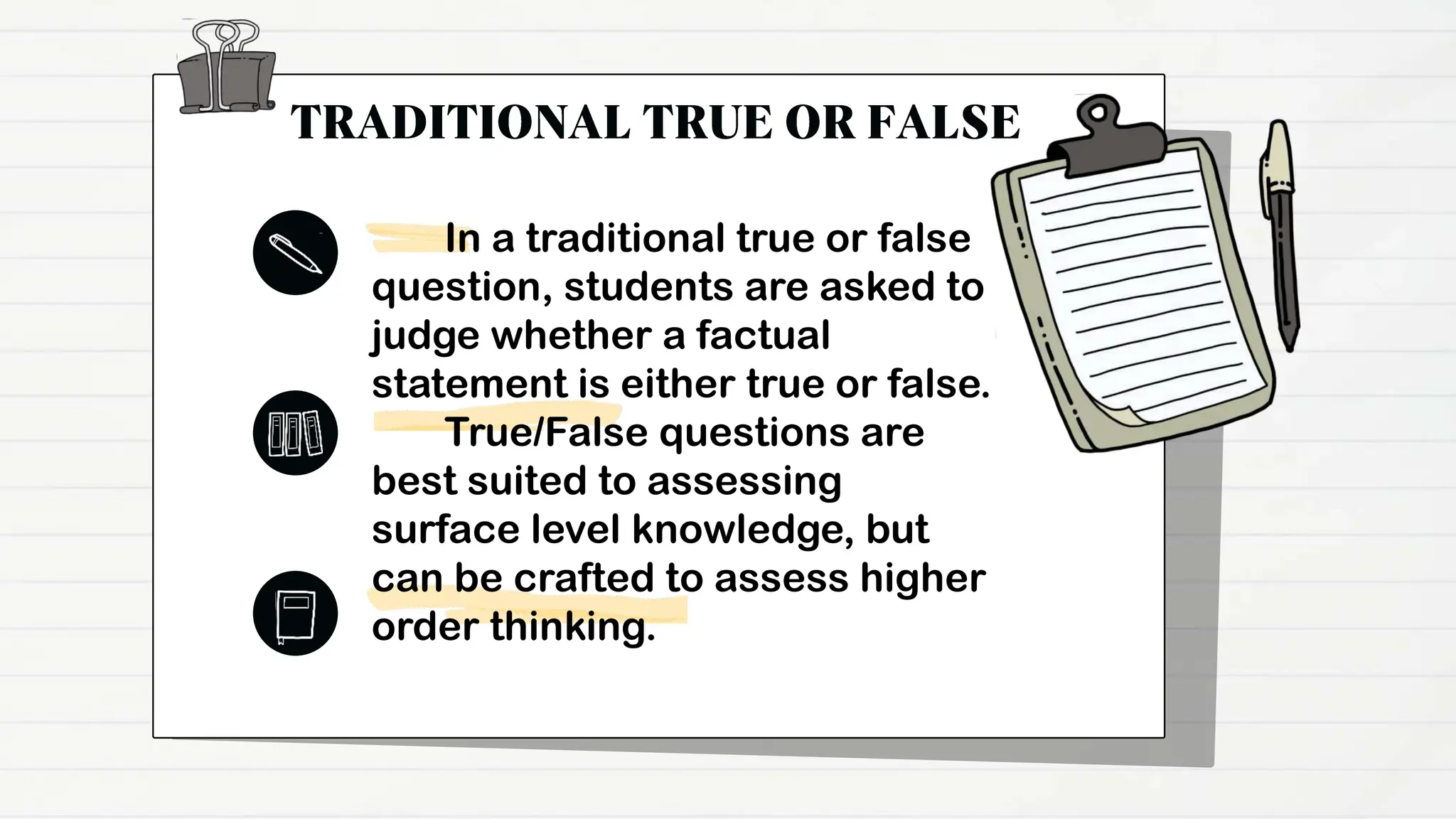
In a traditional true or false
question, students are asked to
judge whether a factual
statement is either true or false.
True/False questions are
best suited to assessing
surface level knowledge, but
can be crafted to assess higher
order thinking.
1. Two lines with positive slopes can be perpendicular.
Answer: False
2. The set of ordered pairs {(6,4),(2,-5),(-2,4),(6,-4)} is a
function.
Answer: False
3. The product of two positive numbers is positive.
Answer: True
A modified true or false
question is a statement that
students must identified as
either true or false. If the
statement is false, however,
students must also provide the
word or phrase that makes the
statement true.
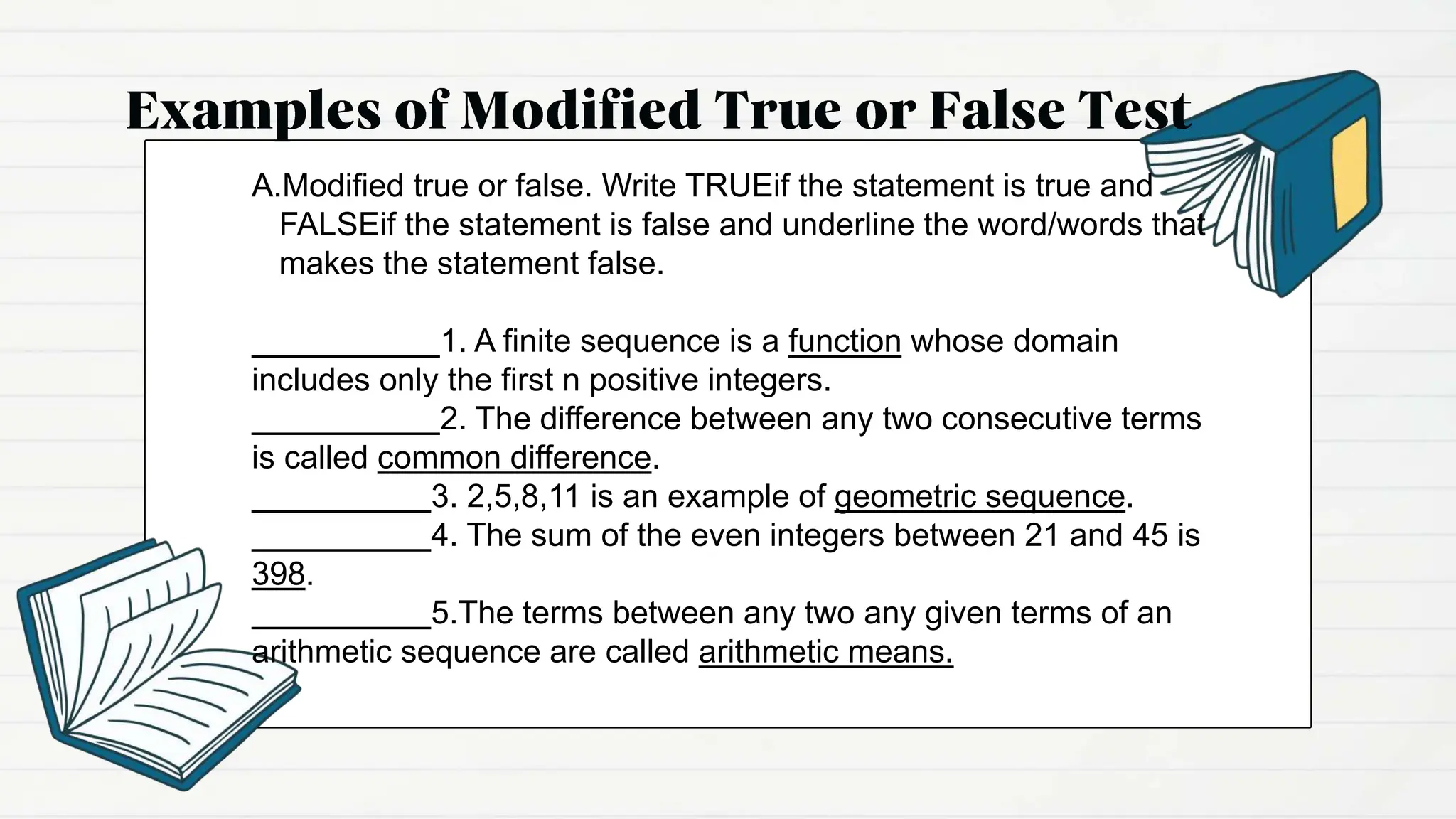
A.Modified true or false. Write TRUEif the statement is true and
FALSEif the statement is false and underline the word/words that
makes the statement false.
1. A finite sequence is a function whose domain
includes only the first n positive integers.
2. The difference between any two consecutive terms
is called common difference.
3. 2,5,8,11 is an example of geometric sequence.
4. The sum of the even integers between 21 and 45 is
398.
5.The terms between any two any given terms of an
arithmetic sequence are called arithmetic means.
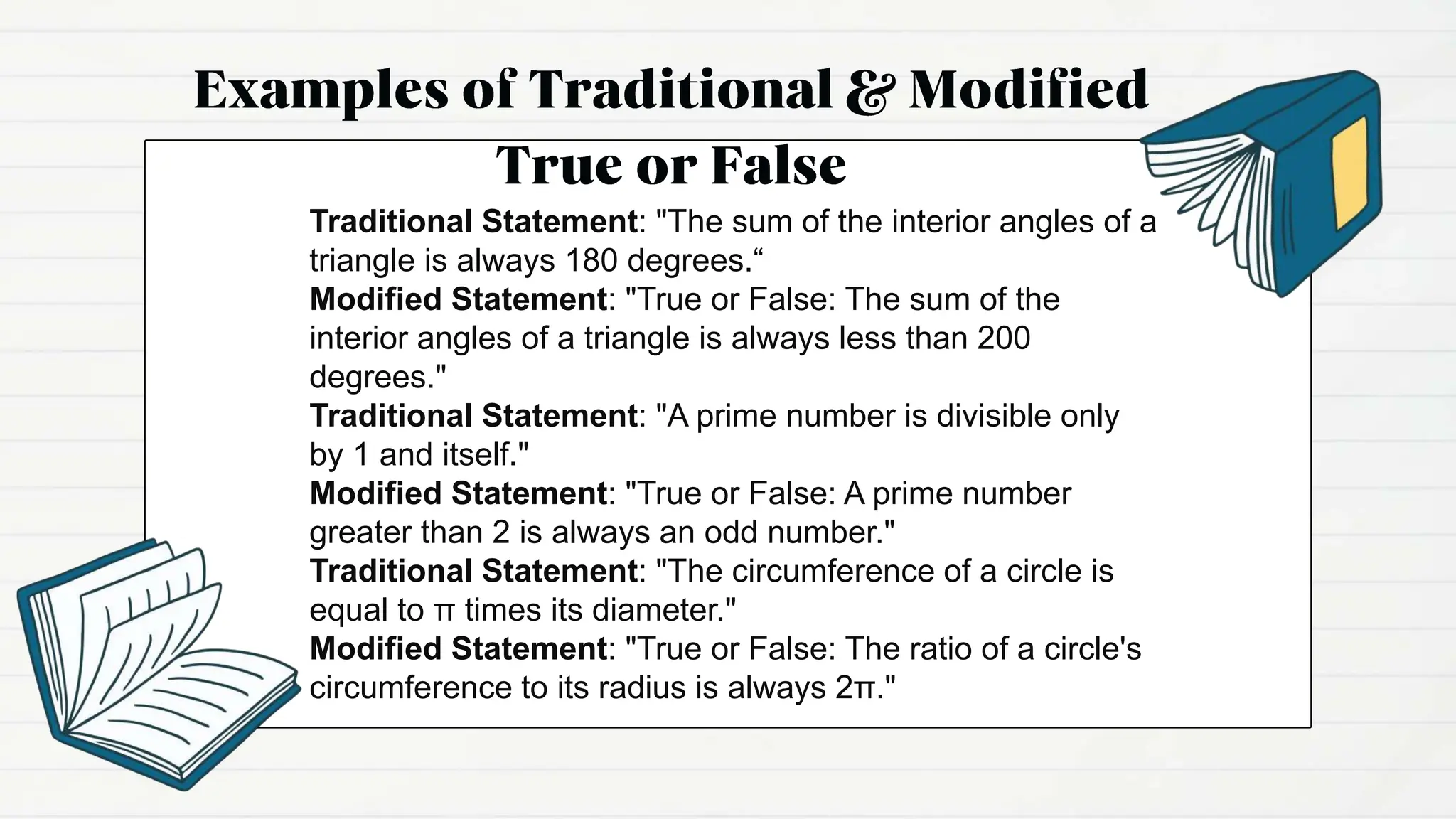
Traditional Statement: "The sum of the interior angles of a
triangle is always 180 degrees.“
Modified Statement: "True or False: The sum of the
interior angles of a triangle is always less than 200
degrees."
Traditional Statement: "A prime number is divisible only
by 1 and itself."
Modified Statement: "True or False: A prime number
greater than 2 is always an odd number."
Traditional Statement: "The circumference of a circle is
equal to π times its diameter."
Modified Statement: "True or False: The ratio of a circle's
circumference to its radius is always 2π."
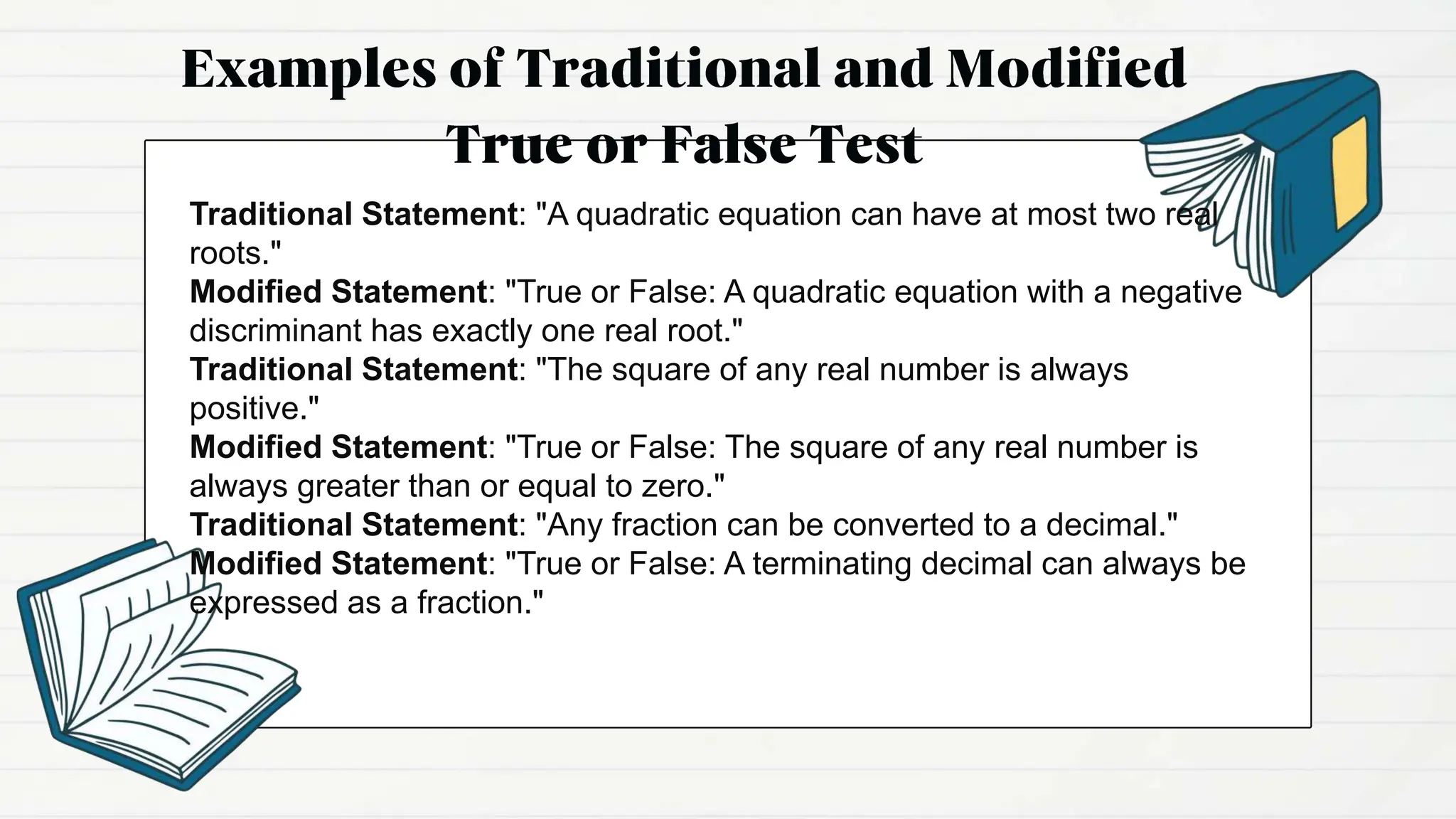
Traditional Statement: "A quadratic equation can have at most two real
roots."
Modified Statement: "True or False: A quadratic equation with a negative
discriminant has exactly one real root."
Traditional Statement: "The square of any real number is always
positive."
Modified Statement: "True or False: The square of any real number is
always greater than or equal to zero."
Traditional Statement: "Any fraction can be converted to a decimal."
Modified Statement: "True or False: A terminating decimal can always be
expressed as a fraction."
2. IT IS EASIER TO PREPARE COMPARED
TO MULTIPLE-CHOICE AND MATCHING
TYPE OF TEST.
ADVANTAGES OF A TRUE OR FALSE TEST
1. IT COVERS A LOT OF CONTENT IN A
SHORT SPAN OF TIME.
3. IT IS EASIER TO SCORE BECAUSE IT CAN
BE SCORED OBJECTIVELY COMPARED TO A
TEST THAT DEPENDS ON THE JUDGEMENT OF
THE RATER(S).
4.IT IS USEFUL WHEN THERE
ARE TWO ALTERNATIVES ONLY.
ADVANTAGES OF A TRUE OR FALSE TEST
5. THE SCORE IS MORE
RELIABLE THAN ESSAY TEST.
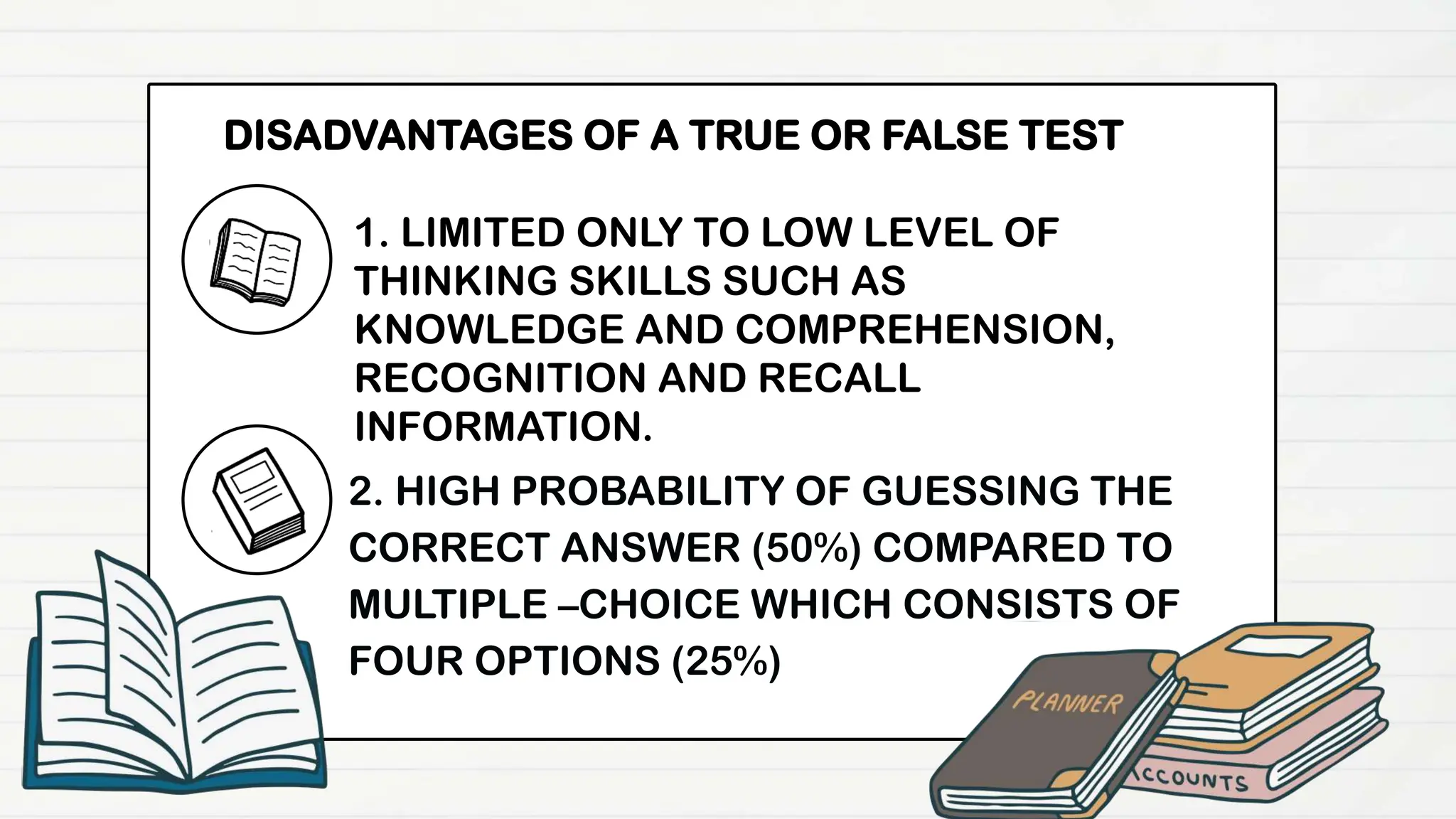
2. HIGH PROBABILITY OF GUESSING THE
CORRECT ANSWER (50%) COMPARED TO
MULTIPLE –CHOICE WHICH CONSISTS OF
FOUR OPTIONS (25%)
DISADVANTAGES OF A TRUE OR FALSE TEST
1. LIMITED ONLY TO LOW LEVEL OF
THINKING SKILLS SUCH AS
KNOWLEDGE AND COMPREHENSION,
RECOGNITION AND RECALL
INFORMATION.
4. AVOID USING OPINION-BASED STATEMENT , IF IT CANNOT BE
AVOIDED THE STATEMENT SHOULD BE ATTRIBUTED TO
SOMEBODY.
1. AVOID WRITING A VERY LONG STATEMENT.
ELIMINATE UNNECESSARY WORD(S) IN THE
SATEMENT (BE CONCISE).
.
2. AVOID TRIVIAL QUESTIONS.
3. IT SHOULD CONTAIN ONLY ONE IDEA IN EACH ITEM
EXCEPT FOR STATEMENT SHOWING RELATIONSHIP
BETWEEN CAUSE AND EFFECT..
8. THE NUMBER OF TRUE ITEMS MUST BE THE SAME WITH THE
NUMBER OF FALSE ITEMS.
9. AVOID STATEMENT DIRECTLY TAKEN FROM THE TEXTBOOK.
5. AVOID USING NEGATIVE OR DOUBLE NEGATIVES. CONSTRUCT THE
STATEMENT POSITIVELY. IF THIS CANNOT BE AVOIDED, BOLD NEGATIVE
WORDS OR UNDERLINED IT TO CALL THE ATTENTION OF EXAMINEES.
.
6. AVOID SPECIFIC DETERMINER SUCH AS “NEVER,” “ALWAYS,” “ALL,” “NONE,”
FOR THEY TEND TO APPEAR IN THE STAEMENTS THAT ARE FALSE.
7. AVOID SPECIFIC DETERMINER SUCH AS “SOME,” “SOMETIMES,” AND “MAY,”
THEY TEND TO APPEAR IN THE STAEMENTS THAT ARE TRUE.
12. DIRECTIONS SHOULD INDICATE WHERE OR HOW THE STUDENTS SHOULD
MARK THEIR ANSWERS.
10. AVOID GRAMMATICAL CLUES THAT LEAD TO A CORRECT ANSWER SUCH
AS THE ARTICLE (A, AN, THE).
.
11. AVOID ARRANGING THE STATEMENTS IN A LOGICAL ORDER SUCH AS
(TTTTTT-FFFFFF , TFTFTF, TTFFTTFF).
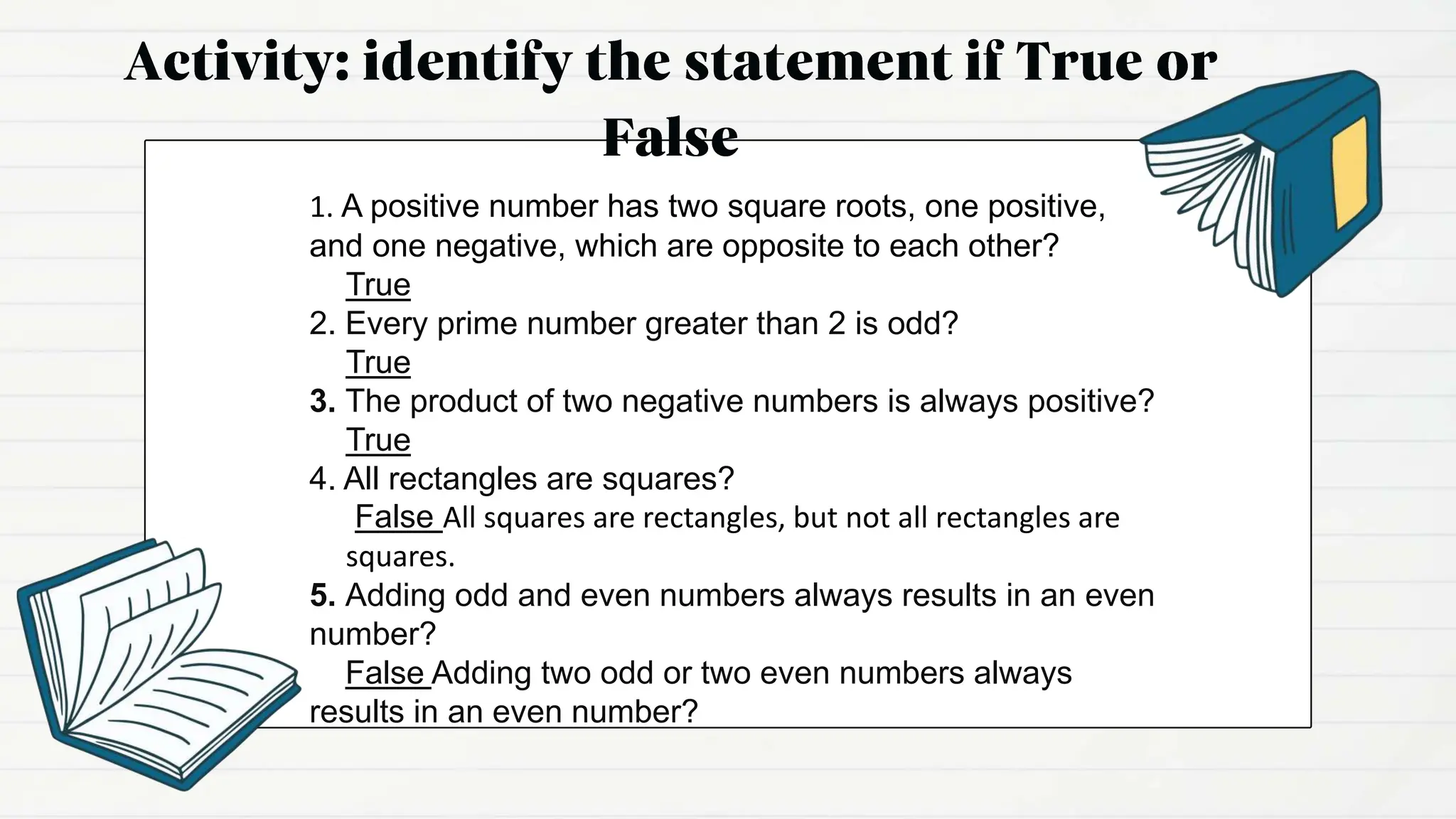
1. A positive number has two square roots, one positive,
and one negative, which are opposite to each other?
True
2. Every prime number greater than 2 is odd?
True
3. The product of two negative numbers is always positive?
True
4. All rectangles are squares?
False All squares are rectangles, but not all rectangles are
squares.
5. Adding odd and even numbers always results in an even
number?
False Adding two odd or two even numbers always
results in an even number?
6. A rhombus is always a parallelogram?
True A parallelogram is a quadrilateral with 2 pairs of parallel
sides. The opposite sides on every rhombus are parallel, so every
rhombus is a parallelogram.
7. The sum of the angles in a quadrilateral is always 360
degrees?
True A quadrilateral is a polygon which has 4 vertices and 4 sides
enclosing 4 angles and the sum of all the angles is 360°.
8. Any number raised to the power of zero is zero?
False Any non-zero number to the zero power equals one. Zero
to any positive exponent equals zero.
9. The square of a negative number is negative?
False squaring a negative number yields the same value as
squaring its positive counterpart.
10. The median of a set of numbers can never be greater than
the mean?
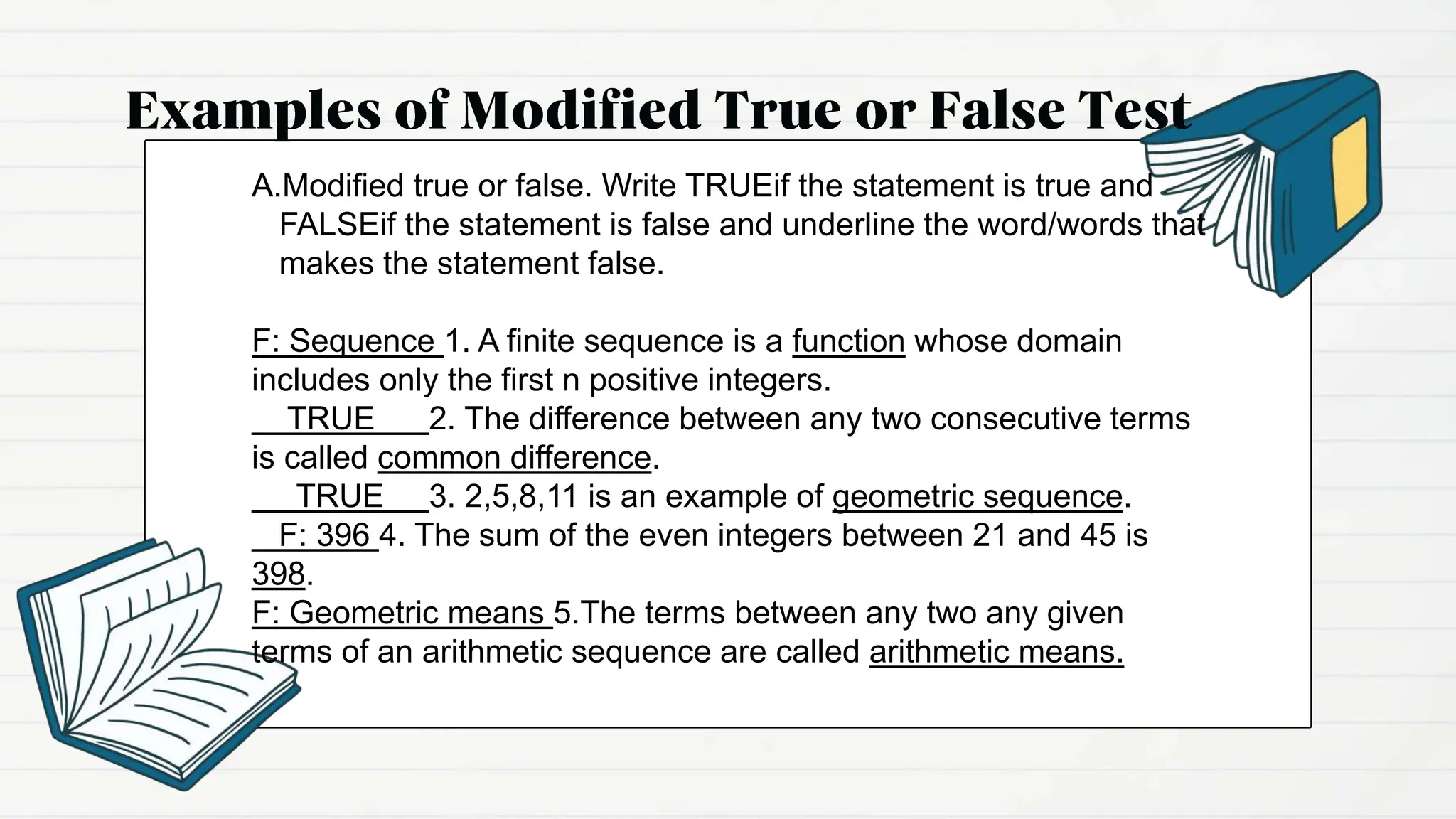
A.Modified true or false. Write TRUEif the statement is true and
FALSEif the statement is false and underline the word/words that
makes the statement false.
F: Sequence 1. A finite sequence is a function whose domain
includes only the first n positive integers.
TRUE 2. The difference between any two consecutive terms
is called common difference.
TRUE 3. 2,5,8,11 is an example of geometric sequence.
F: 396 4. The sum of the even integers between 21 and 45 is
398.
F: Geometric means 5.The terms between any two any given
terms of an arithmetic sequence are called arithmetic means.

Assessment of learning 2 modified TRUE-OR-FALSE.pptx

  • 1.
    1. A positivenumber has two square roots, one positive, and one negative, which are opposite to each other? 2. Every prime number greater than 2 is odd? 3. The product of two negative numbers is always positive? 4. All rectangles are squares? 5. Adding odd and even numbers always results in an even number?
  • 2.
    6. A rhombusis always a parallelogram? 7. The sum of the angles in a quadrilateral is always 360 degrees? 8. Any number raised to the power of zero is zero? 9. The square of a negative number is negative? 10. The median of a set of numbers can never be greater than the mean?
  • 4.
    JAMAICA SHYNE SORIANO KEVINJOHN PEDRO PATRISHA SILAVA .
  • 5.
    • To definethe traditional and modified true or false. • To determine the advantages and disadvantages of TRUE or FALSE test • To know the guidelines in constructing TRUE or FALSE test
  • 6.
    TRUE OF FALSETYPE OF TEST Another format of an objective type of test is the true or false type of test items. In this type of test, examinees determine whether the statement presented is true or false. True or false test items is an example of a “force-choice test” because there are only two possible choices in this type of test. The students are required to choose the answer true or false in recognition to a correct statement or incorrect statement.
  • 7.
    True or falsetype of test is appropriate in assessing the behavioral objectives such as “identify”, “select”, or recognize. “ It also suited to assess the knowledge and comprehension level in cognitive domain. This type of test is appropriate when there are only two plausible alternatives or distracters.
  • 8.
    In a traditionaltrue or false question, students are asked to judge whether a factual statement is either true or false. True/False questions are best suited to assessing surface level knowledge, but can be crafted to assess higher order thinking.
  • 9.
    1. Two lineswith positive slopes can be perpendicular. Answer: False 2. The set of ordered pairs {(6,4),(2,-5),(-2,4),(6,-4)} is a function. Answer: False 3. The product of two positive numbers is positive. Answer: True
  • 10.
    A modified trueor false question is a statement that students must identified as either true or false. If the statement is false, however, students must also provide the word or phrase that makes the statement true.
  • 11.
    A.Modified true orfalse. Write TRUEif the statement is true and FALSEif the statement is false and underline the word/words that makes the statement false. 1. A finite sequence is a function whose domain includes only the first n positive integers. 2. The difference between any two consecutive terms is called common difference. 3. 2,5,8,11 is an example of geometric sequence. 4. The sum of the even integers between 21 and 45 is 398. 5.The terms between any two any given terms of an arithmetic sequence are called arithmetic means.
  • 12.
    Traditional Statement: "Thesum of the interior angles of a triangle is always 180 degrees.“ Modified Statement: "True or False: The sum of the interior angles of a triangle is always less than 200 degrees." Traditional Statement: "A prime number is divisible only by 1 and itself." Modified Statement: "True or False: A prime number greater than 2 is always an odd number." Traditional Statement: "The circumference of a circle is equal to π times its diameter." Modified Statement: "True or False: The ratio of a circle's circumference to its radius is always 2π."
  • 13.
    Traditional Statement: "Aquadratic equation can have at most two real roots." Modified Statement: "True or False: A quadratic equation with a negative discriminant has exactly one real root." Traditional Statement: "The square of any real number is always positive." Modified Statement: "True or False: The square of any real number is always greater than or equal to zero." Traditional Statement: "Any fraction can be converted to a decimal." Modified Statement: "True or False: A terminating decimal can always be expressed as a fraction."
  • 14.
    2. IT ISEASIER TO PREPARE COMPARED TO MULTIPLE-CHOICE AND MATCHING TYPE OF TEST. ADVANTAGES OF A TRUE OR FALSE TEST 1. IT COVERS A LOT OF CONTENT IN A SHORT SPAN OF TIME.
  • 15.
    3. IT ISEASIER TO SCORE BECAUSE IT CAN BE SCORED OBJECTIVELY COMPARED TO A TEST THAT DEPENDS ON THE JUDGEMENT OF THE RATER(S). 4.IT IS USEFUL WHEN THERE ARE TWO ALTERNATIVES ONLY. ADVANTAGES OF A TRUE OR FALSE TEST 5. THE SCORE IS MORE RELIABLE THAN ESSAY TEST.
  • 16.
    2. HIGH PROBABILITYOF GUESSING THE CORRECT ANSWER (50%) COMPARED TO MULTIPLE –CHOICE WHICH CONSISTS OF FOUR OPTIONS (25%) DISADVANTAGES OF A TRUE OR FALSE TEST 1. LIMITED ONLY TO LOW LEVEL OF THINKING SKILLS SUCH AS KNOWLEDGE AND COMPREHENSION, RECOGNITION AND RECALL INFORMATION.
  • 17.
    4. AVOID USINGOPINION-BASED STATEMENT , IF IT CANNOT BE AVOIDED THE STATEMENT SHOULD BE ATTRIBUTED TO SOMEBODY. 1. AVOID WRITING A VERY LONG STATEMENT. ELIMINATE UNNECESSARY WORD(S) IN THE SATEMENT (BE CONCISE). . 2. AVOID TRIVIAL QUESTIONS. 3. IT SHOULD CONTAIN ONLY ONE IDEA IN EACH ITEM EXCEPT FOR STATEMENT SHOWING RELATIONSHIP BETWEEN CAUSE AND EFFECT..
  • 18.
    8. THE NUMBEROF TRUE ITEMS MUST BE THE SAME WITH THE NUMBER OF FALSE ITEMS. 9. AVOID STATEMENT DIRECTLY TAKEN FROM THE TEXTBOOK. 5. AVOID USING NEGATIVE OR DOUBLE NEGATIVES. CONSTRUCT THE STATEMENT POSITIVELY. IF THIS CANNOT BE AVOIDED, BOLD NEGATIVE WORDS OR UNDERLINED IT TO CALL THE ATTENTION OF EXAMINEES. . 6. AVOID SPECIFIC DETERMINER SUCH AS “NEVER,” “ALWAYS,” “ALL,” “NONE,” FOR THEY TEND TO APPEAR IN THE STAEMENTS THAT ARE FALSE. 7. AVOID SPECIFIC DETERMINER SUCH AS “SOME,” “SOMETIMES,” AND “MAY,” THEY TEND TO APPEAR IN THE STAEMENTS THAT ARE TRUE.
  • 19.
    12. DIRECTIONS SHOULDINDICATE WHERE OR HOW THE STUDENTS SHOULD MARK THEIR ANSWERS. 10. AVOID GRAMMATICAL CLUES THAT LEAD TO A CORRECT ANSWER SUCH AS THE ARTICLE (A, AN, THE). . 11. AVOID ARRANGING THE STATEMENTS IN A LOGICAL ORDER SUCH AS (TTTTTT-FFFFFF , TFTFTF, TTFFTTFF).
  • 21.
    1. A positivenumber has two square roots, one positive, and one negative, which are opposite to each other? True 2. Every prime number greater than 2 is odd? True 3. The product of two negative numbers is always positive? True 4. All rectangles are squares? False All squares are rectangles, but not all rectangles are squares. 5. Adding odd and even numbers always results in an even number? False Adding two odd or two even numbers always results in an even number?
  • 22.
    6. A rhombusis always a parallelogram? True A parallelogram is a quadrilateral with 2 pairs of parallel sides. The opposite sides on every rhombus are parallel, so every rhombus is a parallelogram. 7. The sum of the angles in a quadrilateral is always 360 degrees? True A quadrilateral is a polygon which has 4 vertices and 4 sides enclosing 4 angles and the sum of all the angles is 360°. 8. Any number raised to the power of zero is zero? False Any non-zero number to the zero power equals one. Zero to any positive exponent equals zero. 9. The square of a negative number is negative? False squaring a negative number yields the same value as squaring its positive counterpart. 10. The median of a set of numbers can never be greater than the mean?
  • 23.
    A.Modified true orfalse. Write TRUEif the statement is true and FALSEif the statement is false and underline the word/words that makes the statement false. F: Sequence 1. A finite sequence is a function whose domain includes only the first n positive integers. TRUE 2. The difference between any two consecutive terms is called common difference. TRUE 3. 2,5,8,11 is an example of geometric sequence. F: 396 4. The sum of the even integers between 21 and 45 is 398. F: Geometric means 5.The terms between any two any given terms of an arithmetic sequence are called arithmetic means.