Unit 7 Lesson 1
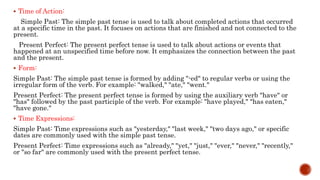
 Time of Action:
Simple Past: The simple past tense is used to talk about completed actions that occurred
at a specific time in the past. It focuses on actions that are finished and not connected to the
present.
Present Perfect: The present perfect tense is used to talk about actions or events that
happened at an unspecified time before now. It emphasizes the connection between the past
and the present.
 Form:
Simple Past: The simple past tense is formed by adding "-ed" to regular verbs or using the
irregular form of the verb. For example: "walked," "ate," "went."
Present Perfect: The present perfect tense is formed by using the auxiliary verb "have" or
"has" followed by the past participle of the verb. For example: "have played," "has eaten,"
"have gone."
 Time Expressions:
Simple Past: Time expressions such as "yesterday," "last week," "two days ago," or specific
dates are commonly used with the simple past tense.
Present Perfect: Time expressions such as "already," "yet," "just," "ever," "never," "recently,"
or "so far" are commonly used with the present perfect tense.
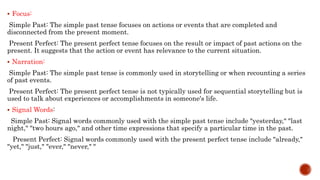
 Focus:
Simple Past: The simple past tense focuses on actions or events that are completed and
disconnected from the present moment.
Present Perfect: The present perfect tense focuses on the result or impact of past actions on the
present. It suggests that the action or event has relevance to the current situation.
 Narration:
Simple Past: The simple past tense is commonly used in storytelling or when recounting a series
of past events.
Present Perfect: The present perfect tense is not typically used for sequential storytelling but is
used to talk about experiences or accomplishments in someone's life.
 Signal Words:
Simple Past: Signal words commonly used with the simple past tense include "yesterday," "last
night," "two hours ago," and other time expressions that specify a particular time in the past.
Present Perfect: Signal words commonly used with the present perfect tense include "already,"
"yet," "just," "ever," "never," "

Simple present vs present perfect May 23rd.pptx

  • 1.
  • 10.
     Time ofAction: Simple Past: The simple past tense is used to talk about completed actions that occurred at a specific time in the past. It focuses on actions that are finished and not connected to the present. Present Perfect: The present perfect tense is used to talk about actions or events that happened at an unspecified time before now. It emphasizes the connection between the past and the present.  Form: Simple Past: The simple past tense is formed by adding "-ed" to regular verbs or using the irregular form of the verb. For example: "walked," "ate," "went." Present Perfect: The present perfect tense is formed by using the auxiliary verb "have" or "has" followed by the past participle of the verb. For example: "have played," "has eaten," "have gone."  Time Expressions: Simple Past: Time expressions such as "yesterday," "last week," "two days ago," or specific dates are commonly used with the simple past tense. Present Perfect: Time expressions such as "already," "yet," "just," "ever," "never," "recently," or "so far" are commonly used with the present perfect tense.
  • 11.
     Focus: Simple Past:The simple past tense focuses on actions or events that are completed and disconnected from the present moment. Present Perfect: The present perfect tense focuses on the result or impact of past actions on the present. It suggests that the action or event has relevance to the current situation.  Narration: Simple Past: The simple past tense is commonly used in storytelling or when recounting a series of past events. Present Perfect: The present perfect tense is not typically used for sequential storytelling but is used to talk about experiences or accomplishments in someone's life.  Signal Words: Simple Past: Signal words commonly used with the simple past tense include "yesterday," "last night," "two hours ago," and other time expressions that specify a particular time in the past. Present Perfect: Signal words commonly used with the present perfect tense include "already," "yet," "just," "ever," "never," "