Reported Speech
Unit 9 Lesson 2
Reported speech.
• Reported speech, also known as indirect speech, is a way of
expressing what someone said without quoting their exact
words. It is commonly used when we want to report or relay
information that was spoken by someone else. In reported
speech, the tense, pronouns, and other elements may change
to reflect the shift from direct speech (quoting the exact words)
to indirect speech.
Example
• Here's an example to illustrate the difference between direct
and reported speech:
Direct speech: Sarah said, "I am going to the movies tonight."
Reported speech: Sarah said that she was going to the movies
that night.
• In the reported speech example, the verb tense ("am") in the
original sentence changes to "was" because the reporting is
happening in the past. Additionally, the pronoun "I" changes to
"she" to reflect the shift in perspective.
Key points.
1.Verb tense changes: When reporting statements or questions, the verb
tense usually shifts back one tense (e.g., present simple becomes past
simple, present continuous becomes past continuous, etc.).
2.Pronoun changes: Pronouns often change based on the subject of the
reported speech. For example, "I" becomes "he" or "she," "we" becomes
"they," etc.
3.Reporting verbs: Verbs such as "say," "tell," "ask," or "explain" are
commonly used to introduce reported speech. These verbs are often
followed by the conjunction "that," although it can be omitted in some
cases.
4.Time and place references: Time and place references usually change to
reflect the moment when the reported speech is being relayed. For
example, "tomorrow" may become "the next day," and "here" may become
"there."
Keep in mind.
• It's important to note that reported speech does not require
quotation marks as direct speech does. Instead, the reported
speech is integrated into the overall narrative or conversation.
• Overall, reported speech allows us to convey what someone
said in our own words while maintaining the meaning and
intention of the original speaker's message.
Tense conversation rules
1.Present Simple ➜ Past Simple: When reporting something that
was said regularly or as a general truth, the Present Simple
tense in direct speech changes to the Past Simple tense in
reported speech.
Direct speech: Mary says, "I work at a bank." Reported speech:
Mary said that she worked at a bank.
2.Present Continuous ➜ Past Continuous: When reporting an
ongoing action or situation in the present, the Present
Continuous tense in direct speech changes to the Past
Continuous tense in reported speech.
Direct speech: John says, "I am studying for my exams."
Reported speech: John said that he was studying for his exams.
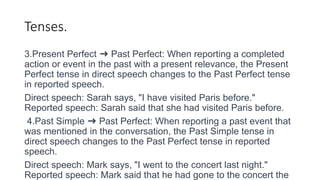
Tenses.
3.Present Perfect ➜ Past Perfect: When reporting a completed
action or event in the past with a present relevance, the Present
Perfect tense in direct speech changes to the Past Perfect tense
in reported speech.
Direct speech: Sarah says, "I have visited Paris before."
Reported speech: Sarah said that she had visited Paris before.
4.Past Simple ➜ Past Perfect: When reporting a past event that
was mentioned in the conversation, the Past Simple tense in
direct speech changes to the Past Perfect tense in reported
speech.
Direct speech: Mark says, "I went to the concert last night."
Reported speech: Mark said that he had gone to the concert the
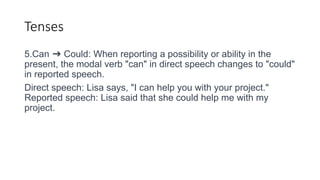
Tenses
5.Can ➜ Could: When reporting a possibility or ability in the
present, the modal verb "can" in direct speech changes to "could"
in reported speech.
Direct speech: Lisa says, "I can help you with your project."
Reported speech: Lisa said that she could help me with my
project.
Reported Speech June 20th.pptx

Reported Speech June 20th.pptx

  • 1.
  • 2.
    Reported speech. • Reportedspeech, also known as indirect speech, is a way of expressing what someone said without quoting their exact words. It is commonly used when we want to report or relay information that was spoken by someone else. In reported speech, the tense, pronouns, and other elements may change to reflect the shift from direct speech (quoting the exact words) to indirect speech.
  • 3.
    Example • Here's anexample to illustrate the difference between direct and reported speech: Direct speech: Sarah said, "I am going to the movies tonight." Reported speech: Sarah said that she was going to the movies that night. • In the reported speech example, the verb tense ("am") in the original sentence changes to "was" because the reporting is happening in the past. Additionally, the pronoun "I" changes to "she" to reflect the shift in perspective.
  • 4.
    Key points. 1.Verb tensechanges: When reporting statements or questions, the verb tense usually shifts back one tense (e.g., present simple becomes past simple, present continuous becomes past continuous, etc.). 2.Pronoun changes: Pronouns often change based on the subject of the reported speech. For example, "I" becomes "he" or "she," "we" becomes "they," etc. 3.Reporting verbs: Verbs such as "say," "tell," "ask," or "explain" are commonly used to introduce reported speech. These verbs are often followed by the conjunction "that," although it can be omitted in some cases. 4.Time and place references: Time and place references usually change to reflect the moment when the reported speech is being relayed. For example, "tomorrow" may become "the next day," and "here" may become "there."
  • 5.
    Keep in mind. •It's important to note that reported speech does not require quotation marks as direct speech does. Instead, the reported speech is integrated into the overall narrative or conversation. • Overall, reported speech allows us to convey what someone said in our own words while maintaining the meaning and intention of the original speaker's message.
  • 6.
    Tense conversation rules 1.PresentSimple ➜ Past Simple: When reporting something that was said regularly or as a general truth, the Present Simple tense in direct speech changes to the Past Simple tense in reported speech. Direct speech: Mary says, "I work at a bank." Reported speech: Mary said that she worked at a bank. 2.Present Continuous ➜ Past Continuous: When reporting an ongoing action or situation in the present, the Present Continuous tense in direct speech changes to the Past Continuous tense in reported speech. Direct speech: John says, "I am studying for my exams." Reported speech: John said that he was studying for his exams.
  • 7.
    Tenses. 3.Present Perfect ➜Past Perfect: When reporting a completed action or event in the past with a present relevance, the Present Perfect tense in direct speech changes to the Past Perfect tense in reported speech. Direct speech: Sarah says, "I have visited Paris before." Reported speech: Sarah said that she had visited Paris before. 4.Past Simple ➜ Past Perfect: When reporting a past event that was mentioned in the conversation, the Past Simple tense in direct speech changes to the Past Perfect tense in reported speech. Direct speech: Mark says, "I went to the concert last night." Reported speech: Mark said that he had gone to the concert the
  • 8.
    Tenses 5.Can ➜ Could:When reporting a possibility or ability in the present, the modal verb "can" in direct speech changes to "could" in reported speech. Direct speech: Lisa says, "I can help you with your project." Reported speech: Lisa said that she could help me with my project.