present simple
is used to express daily routines and habits.
Simple present tense
SIMPLE PRESENT TENSE
 Adverbs of frequency
such as 'usually',
'sometimes',
'rarely', etc.
 are often used with the present simple.
 This tense is often used with the following time
expressions:
always,
usually,
sometimes, etc.
... every day
... on Sundays, Tuesdays, etc.
Positive
Statement
 Subject + Present Tense + object(s) + time Expression
Frank usually takes a bus to work.
Negative
 Subject + do / does + not (don't / doesn't) + verb +
object(s) + time Expression
They don't often go to Chicago.
Question
 (Question Word) + do / does + subject + verb +
object(s) + time Expression
How often do you play golf?
Test your skills
 She ______ get up early on Saturdays.
 not
 doesn't
don't
 My father _____ at a bank.
 works
 work
 do work
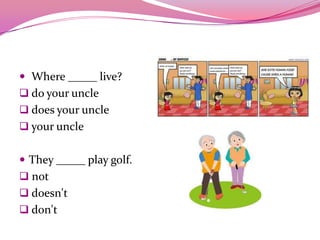
 Where _____ live?
 do your uncle
 does your uncle
 your uncle
 They _____ play golf.
 not
 doesn't
 don't
Present Continuous
 One use of the present continuous tense is for action
that is occurring at the moment of speaking.
 Remember that only action verbs can take the
continuous form.
 This tense is often used with the following time
expressions:
 ... at the moment
... now
... today
... this morning / afternoon / evening
 Positive Sentence
• Subject + I
 auxiliary verb + am
 main verb-ing (Present participle) + playing
 Object cricket
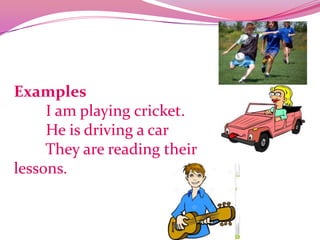
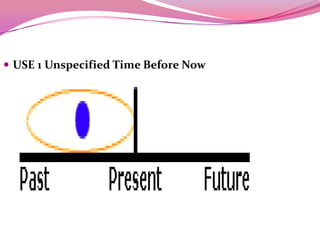
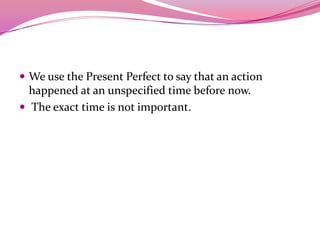
Examples
I am playing cricket.
He is driving a car
They are reading their
lessons.
Present perfect tense
 [has/have + past participle]
 You have seen that movie many times.
 Have you seen that movie many times?
 You have not seen that movie many times.
[
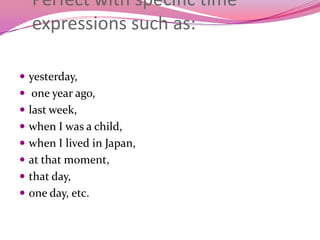
 USE 1 Unspecified Time Before Now
 We use the Present Perfect to say that an action
happened at an unspecified time before now.
 The exact time is not important.
Perfect with specific time
expressions such as:
 yesterday,
 one year ago,
 last week,
 when I was a child,
 when I lived in Japan,
 at that moment,
 that day,
 one day, etc.
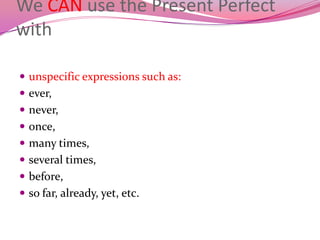
We CAN use the Present Perfect
with
 unspecific expressions such as:
 ever,
 never,
 once,
 many times,
 several times,
 before,
 so far, already, yet, etc.
Examples:
 I have seen that movie twenty times.
 I think I have met him once before.
 There have been many earthquakes in California.
 People have traveled to the Moon.
 People have not traveled to Mars.

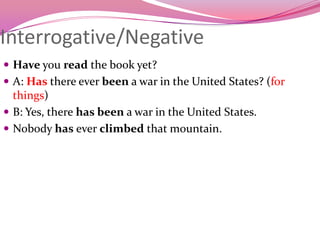
Interrogative/Negative
 Have you read the book yet?
 A: Has there ever been a war in the United States? (for
things)
 B: Yes, there has been a war in the United States.
 Nobody has ever climbed that mountain.
TOPIC 1 Experience
 I have been to France.
THIS SENTENCE MEANS THAT YOU HAVE HAD THE
EXPERIENCE OF BEING IN FRANCE. MAYBE YOU HAVE BEEN
THERE ONCE, OR SEVERAL TIMES.
 He has never traveled by train.
 Joan has studied two foreign languages.
Change Over Time
 You have grown since the last time I saw you.
 The government has become more interested in arts
education.
 Japanese has become one of the most popular courses
at the university since the Asian studies program was
established.
 My English has really improved since I moved to
Australia
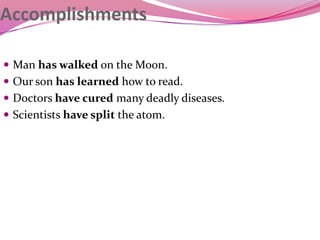
Accomplishments
 Man has walked on the Moon.
 Our son has learned how to read.
 Doctors have cured many deadly diseases.
 Scientists have split the atom.
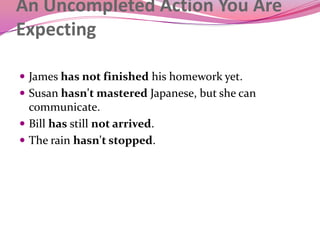
An Uncompleted Action You Are
Expecting
 James has not finished his homework yet.
 Susan hasn't mastered Japanese, but she can
communicate.
 Bill has still not arrived.
 The rain hasn't stopped.
Multiple Actions at Different
Times
 The army has attacked that city five times.
 I have had four quizzes and five tests so far this
semester.
 We have had many major problems while working on
this project.
 She has talked to several specialists about her
problem, but nobody knows why she is sick.
 Time Expressions with Present Perfect
 When we use the Present Perfect it means that
something has happened at some point in our lives
before now. Remember, the exact time the action
happened is not important.
 Sometimes, we want to limit the time we are looking in
for an experience. We can do this with expressions
such as: in the last week, in the last year, this week,
this month, so far, up to now, etc.
 Examples:
 Have you been to Mexico in the last year?
 I have seen that movie six times in the last month.
 They have had three tests in the last week.
 She graduated from university less than three years
ago. She has worked for three different companies so
far.
 My car has broken down three times this week.
Tenses present

Tenses present

  • 1.
    present simple is usedto express daily routines and habits. Simple present tense
  • 2.
    SIMPLE PRESENT TENSE Adverbs of frequency such as 'usually', 'sometimes', 'rarely', etc.  are often used with the present simple.
  • 3.
     This tenseis often used with the following time expressions: always, usually, sometimes, etc. ... every day ... on Sundays, Tuesdays, etc.
  • 4.
    Positive Statement  Subject +Present Tense + object(s) + time Expression Frank usually takes a bus to work.
  • 5.
    Negative  Subject +do / does + not (don't / doesn't) + verb + object(s) + time Expression They don't often go to Chicago.
  • 6.
    Question  (Question Word)+ do / does + subject + verb + object(s) + time Expression How often do you play golf?
  • 7.
    Test your skills She ______ get up early on Saturdays.  not  doesn't don't  My father _____ at a bank.  works  work  do work
  • 8.
     Where _____live?  do your uncle  does your uncle  your uncle  They _____ play golf.  not  doesn't  don't
  • 9.
    Present Continuous  Oneuse of the present continuous tense is for action that is occurring at the moment of speaking.  Remember that only action verbs can take the continuous form.
  • 10.
     This tenseis often used with the following time expressions:  ... at the moment ... now ... today ... this morning / afternoon / evening
  • 11.
     Positive Sentence •Subject + I  auxiliary verb + am  main verb-ing (Present participle) + playing  Object cricket
  • 12.
    Examples I am playingcricket. He is driving a car They are reading their lessons.
  • 13.
    Present perfect tense [has/have + past participle]  You have seen that movie many times.  Have you seen that movie many times?  You have not seen that movie many times. [
  • 14.
     USE 1Unspecified Time Before Now
  • 15.
     We usethe Present Perfect to say that an action happened at an unspecified time before now.  The exact time is not important.
  • 16.
    Perfect with specifictime expressions such as:  yesterday,  one year ago,  last week,  when I was a child,  when I lived in Japan,  at that moment,  that day,  one day, etc.
  • 17.
    We CAN usethe Present Perfect with  unspecific expressions such as:  ever,  never,  once,  many times,  several times,  before,  so far, already, yet, etc.
  • 18.
    Examples:  I haveseen that movie twenty times.  I think I have met him once before.  There have been many earthquakes in California.  People have traveled to the Moon.  People have not traveled to Mars. 
  • 19.
    Interrogative/Negative  Have youread the book yet?  A: Has there ever been a war in the United States? (for things)  B: Yes, there has been a war in the United States.  Nobody has ever climbed that mountain.
  • 20.
    TOPIC 1 Experience I have been to France. THIS SENTENCE MEANS THAT YOU HAVE HAD THE EXPERIENCE OF BEING IN FRANCE. MAYBE YOU HAVE BEEN THERE ONCE, OR SEVERAL TIMES.
  • 21.
     He hasnever traveled by train.  Joan has studied two foreign languages.
  • 22.
    Change Over Time You have grown since the last time I saw you.  The government has become more interested in arts education.  Japanese has become one of the most popular courses at the university since the Asian studies program was established.  My English has really improved since I moved to Australia
  • 23.
    Accomplishments  Man haswalked on the Moon.  Our son has learned how to read.  Doctors have cured many deadly diseases.  Scientists have split the atom.
  • 24.
    An Uncompleted ActionYou Are Expecting  James has not finished his homework yet.  Susan hasn't mastered Japanese, but she can communicate.  Bill has still not arrived.  The rain hasn't stopped.
  • 25.
    Multiple Actions atDifferent Times  The army has attacked that city five times.  I have had four quizzes and five tests so far this semester.  We have had many major problems while working on this project.  She has talked to several specialists about her problem, but nobody knows why she is sick.
  • 26.
     Time Expressionswith Present Perfect  When we use the Present Perfect it means that something has happened at some point in our lives before now. Remember, the exact time the action happened is not important.  Sometimes, we want to limit the time we are looking in for an experience. We can do this with expressions such as: in the last week, in the last year, this week, this month, so far, up to now, etc.
  • 27.
     Examples:  Haveyou been to Mexico in the last year?  I have seen that movie six times in the last month.  They have had three tests in the last week.  She graduated from university less than three years ago. She has worked for three different companies so far.  My car has broken down three times this week.