

Simple
Present Tense
By Syarifah Syifa, M.Pd
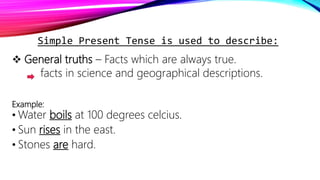
 General truths – Facts which are always true.
facts in science and geographical descriptions.
Example:
• Water boils at 100 degrees celcius.
• Sun rises in the east.
• Stones are hard.
Simple Present Tense is used to describe:
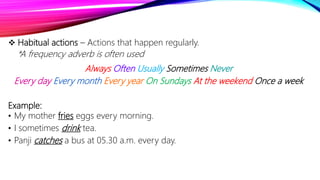
 Habitual actions – Actions that happen regularly.
*A frequency adverb is often used
Always Often Usually Sometimes Never
Every day Every month Every year On Sundays At the weekend Once a week
Example:
• My mother fries eggs every morning.
• I sometimes drink tea.
• Panji catches a bus at 05.30 a.m. every day.
Are you lucky?
Do you sleep late?
Does he sleep late?
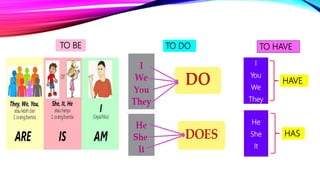
TO BE TO DO
I
You
We
They
He
She
It
HAVE
HAS
TO HAVE
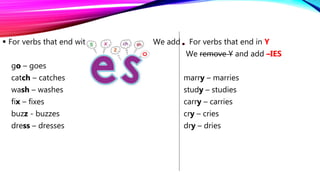
 For verbs that end with We add For verbs that end in Y
We remove Y and add –IES
go – goes
catch – catches marry – marries
wash – washes study – studies
fix – fixes carry – carries
buzz - buzzes cry – cries
dress – dresses dry – dries
QUIZ
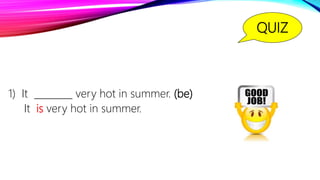
1) It ________ very hot in summer. (be)
It is very hot in summer.
2) Water _________ at 0 degrees. (freeze)
Water freezes at 0 degrees.
QUIZ
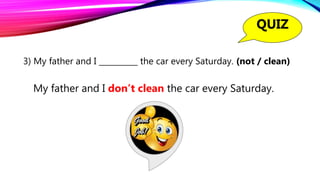
3) My father and I __________ the car every Saturday. (not / clean)
My father and I don’t clean the car every Saturday.
QUIZ
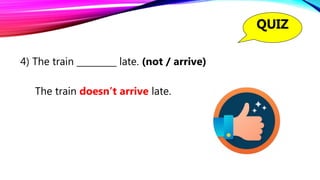
4) The train _________ late. (not / arrive)
The train doesn’t arrive late.
QUIZ
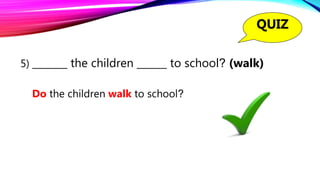
5) _______ the children ______ to school? (walk)
Do the children walk to school?
QUIZ
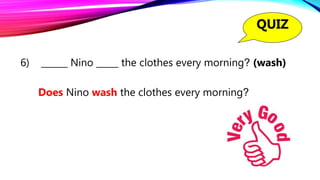
6) ______ Nino _____ the clothes every morning? (wash)
Does Nino wash the clothes every morning?
QUIZ
SIMPLE PRESENT TENSE

SIMPLE PRESENT TENSE

  • 1.
  • 2.
     General truths– Facts which are always true. facts in science and geographical descriptions. Example: • Water boils at 100 degrees celcius. • Sun rises in the east. • Stones are hard. Simple Present Tense is used to describe:
  • 3.
     Habitual actions– Actions that happen regularly. *A frequency adverb is often used Always Often Usually Sometimes Never Every day Every month Every year On Sundays At the weekend Once a week Example: • My mother fries eggs every morning. • I sometimes drink tea. • Panji catches a bus at 05.30 a.m. every day.
  • 4.
    Are you lucky? Doyou sleep late? Does he sleep late?
  • 5.
    TO BE TODO I You We They He She It HAVE HAS TO HAVE
  • 6.
     For verbsthat end with We add For verbs that end in Y We remove Y and add –IES go – goes catch – catches marry – marries wash – washes study – studies fix – fixes carry – carries buzz - buzzes cry – cries dress – dresses dry – dries
  • 7.
    QUIZ 1) It ________very hot in summer. (be) It is very hot in summer.
  • 8.
    2) Water _________at 0 degrees. (freeze) Water freezes at 0 degrees. QUIZ
  • 9.
    3) My fatherand I __________ the car every Saturday. (not / clean) My father and I don’t clean the car every Saturday. QUIZ
  • 10.
    4) The train_________ late. (not / arrive) The train doesn’t arrive late. QUIZ
  • 11.
    5) _______ thechildren ______ to school? (walk) Do the children walk to school? QUIZ
  • 12.
    6) ______ Nino_____ the clothes every morning? (wash) Does Nino wash the clothes every morning? QUIZ